

Download CBSE Class 10 Science Useful Resources
Review targeted academic resources with the Class 10 Science Electricity Exam Notes. Built according to official CBSE standards for the 2026-27 term, these downloadable Class 10 Science study materials support effective daily practice and deeper conceptual understanding for Chapter 11 Electricity.
Access CBSE Study Guides and Summaries
Access the complete useful resource PDF for Class 10 Science below. Regular practice with these targeted academic notes builds familiarity with complex topics and helps secure higher marks in final school evaluations.
Class 10 Science Electricity Exam Notes. Please refer to the examination notes which you can use for preparing and revising for exams. These notes will help you to revise the concepts quickly and get good marks.
Electric Current(Change In Motion)
Definition : The quantity of electric charge flowing through cross section of a given conductor in one second is called current.
Thus, if Q is the charge which flows through a conductor in time t, then the current (I) is given by
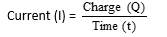
The electric current (or current) is a scalar quantity.
Unit of current
The SI unit of charge (Q) is coulomb (C), and that of time (t) is second (s). So,
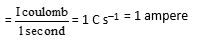
The unit coulomb per second (Cs–1) is called ampere (A)
Direction of Electric Current :
The direction of flow of the positive charge taken as conventional direction of the electric current.
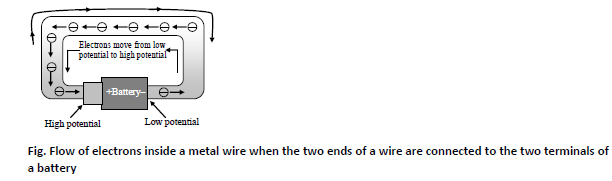
When we consider the flow of electric current in an ordinary conductor, such as a copper wire, the direction of current is taken as opposite to the direction of the flow of electrons.
Flow Of Current In Metal
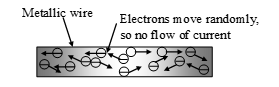
Metals show a very different kind of bonding called metallic bonding. According to this bonding, the outermost electrons are not bound to any particular atom, and move freely inside the metal randomly as shown in fig. So, these electrons are free electrons. These free electrons move freely in all the directions. Different electrons move in different directions and with different speeds. So there is no net movement of the electrons in any particular direction. As a result, there is no net flow of current in any particular direction.


RESISTANCE OF CONDUCTOR
The movement of electron gives rise to the flow of current through metals. The moving electrons collide with each other as well as with the positive ions present in the metallic conductor. These collisions tend to slow down the speed of the electrons and hence oppose the flow of electric current.
The property of a conductor by virtue of which it opposes the flow of electric current through it is called its resistance.
• Resistance is denoted by the letter R.
• The SI unit of resistance is ohm. The ohm is denoted by the Greek letter (W) called omega.
• Resistance is a scalar quantity.
Factors on which resistance of conductor depends
Effect of the length on the resistance of a conductor
The resistance of a conductor is directly proportional to the length. That is Resistance of a conductor. µ Length of the cond.
Effect of the area of cross-section on the resistance of a conductor
The resistance of a conductor is inversely proportional to its area of cross-section. That is, Resistance of a conductor ; R µ ∞ 1 / Area of cross - sec tion (a) of theconductor
* If the area of cross-section of the conductor is doubled, its resistance gets halved.
Effect of temperature on the resistance of a conductor
The resistance of all pure metals increases with a rise in temperature. The resistance of alloys increases very slightly with a rise in temperature. For metal when temperature increases resistance increases and for semiconductors when temperature increases resistance decreases.
Effect of the nature of material on the resistance of a conductor
Some materials have low resistance, whereas some others have much higher resistance. In general, an alloy has higher resistance than pure metals which from the alloy.
* Copper, silver, aluminium etc., have very low resistance.
* Nichrome, constantan etc., have higher resistance. Nichrome is used for making heating elements of heaters, toasters, electric iron etc.
Then R = ...(ii)
Thus, if we take 1 metre long piece of a substance having a cross-sectional area of 1 meter2, then the resistance of that piece of the substance is called its resistivity.
Resistivity of a substance can also be defined as follows :
The resistance offered by a cube of a substance having side of 1 metre, when current flows perpendicular to the opposite faces, is called its resistivity.
♦ Units of resistivity
F
♦ Classification of Material on Basis of Resistivity
♦ Substances showing very low resistivities : The substances which show very low resistivities allow the flow of electric current through them. these type of substances are called conductors. For example, copper, gold, silver, aluminium and electrolytic solutions are conductors.
♦ Substances having moderate resistivity: The substances which have moderate resistivity offer appreciable resistance to the flow of electric current through them. Therefore, such substances are called resistors. For example, alloys such as nichrome, manganin, constantan and carbon are typical resistors.
♦ Substances having very high resistivity: The substances which have very high resistivities do not allow electricity to flow through them. The substances which do not allow electricity to pass through them are called insulators. For example, rubber, plastics, dry wood, etc. are insulators.
♦ COMBINATION OF RESISTANCES
♦ Series Combination
When two or more resistances are joined end-to-end so that the same current flows through each of them,
they are said to be connected in series.
+ –
Battery
I I
R1 R2 R3
Key
When a series combination of resistances is connected to a battery, the same current (I) flows through each of
them.
♦ Law of combination of resistances in series : The law of combination of resistances in series states thatwhen a number of resistances are connected in series, their equivalent resistance is equal to the sum of the individual resistances. Thus, if R1, R2, R3 ..., etc. are combined in series, then the equivalent resistance (R) is given by,s.
Free study material for Science
Free CBSE Study Guides: Class 10 Science Chapter 11 Electricity
Core Study Kit: Class 10 Science Chapter 11 Electricity
Review targeted study resources for Chapter 11 Electricity tailored for Class 10 learners. Utilizing these structured notes and quick-revision tools ensures complete alignment with current CBSE evaluation standards.
NCERT-Aligned Solutions for Chapter 11 Electricity
Each resource draws directly from authorized textbooks to maintain academic accuracy. Evaluating solved examples allows Class 10 students to master the formal presentation and answer-writing standards expected in upcoming school exams.
Next Steps in Your Exam Preparation
For peak performance in upcoming evaluations, integrate official Science sample papers directly into your study schedule. Follow up your revision by attempting online MCQ tests for Chapter 11 Electricity to refine calculation speed and precision.
FAQs
Our advanced study package for Chapter 11 Electricity includes detailed concepts, diagrams, Mind Maps, and explanation of complex topics to ensure Class 10 students learn as per syllabus for 2026 exams.
The Mind Maps provided for Chapter 11 Electricity act as visual anchors which will help faster recall during high-pressure exams.
Yes, teachers use our Class 10 Science resources for lesson planning as they are in simple language and have lot of solved examples.
Yes, You can download the complete, mobile-friendly PDF of the Science Chapter 11 Electricity advanced resources for free.
Yes, our subject matter experts have updated the Chapter 11 Electricity material to align with the rationalized NCERT textbooks and have removed deleted topics and added new competency-based questions.