

Official CBSE Study Materials for Class 10 Science
Explore structured advanced study materials through the CBSE Class 10 Science Our Environment Notes. Tailored for Class 10 learners, utilizing these Science resources ensures thorough preparation and strengthens foundational knowledge before final CBSE evaluations.
Advanced Resources for Science
Access the complete useful resource PDF for Class 10 Science below. Regular practice with these targeted academic notes builds familiarity with complex topics and helps secure higher marks in final school evaluations.
Environment: Our surrounding is called environment.
Living organisms live in different surroundings. Some plants and animals completely live in water and some others live on land. Man also leads life in different surroundings. Some live in cities, some in towns and some in villages. Plants, animals, human beings survive with the interaction between them and the non-living things like air, water and land.
Human beings depend on the resources of nature. These resources include soil, water, coal,electricity, oil, gas, etc. These resources improve the life style of human beings. Environmental science can be defined as the study of organisms in relation to their surrounding. Human activities related to livelihood and welfare generate waste. All wastes are pollutants and they create pollution in one way or another. Air, land and water surroundings are affected due to improper disposal of wastes which create an imbalance in the environment. Pollution: Any undesirable change in the physical, chemical or biological characteristics of air, land and water that affect human life adversely is called pollution. Pollutant: A substance released into the environment due to natural or human activity which affects adversely the environment is called pollutant. e.g. Sulphur-di-oxide, carbon-monoxide,lead, mercury, etc.
CLASSIFICATION OF WASTES
1. Bio–degradable wastes
2. Non–bio-degradable wastes
Substances that are broken down by biological process of biological or microbial action are called bio-degradable waste. e.g. wood, paper and leather. Substances that are not broken down by biological or microbial action are called non-biodegradable wastes. e.g. Plastic substances and mineral wastes.
INTEXT QUESTIONS
Q1. Why are some substances biodegradable and some non-biodegradable?
Ans: Some substances such as metal, glass, plastic, etc. which cannot be decomposed by the living organisms are non-biodegradable wastes. These substances are non-biodegradable because the micro-organisms do not have enzymes that can digest these substances. Therefore, we classify them as non-biodegradable wastes. Other substances such as paper, vegetable wastes, etc. that can be easily broken down by enzymes are biodegradable wastes.
Q2. Give any two ways in which biodegradable substances would affect the environment.
Ans: (i) Biodegradable substances act as a medium to return back the nutrients to the environment.
(ii) Their degradation may release certain gases in the atmosphere thereby polluting the environment.
Q3. Give any two ways in which non-biodegradable substances would affect the environment.
Ans: (i) They make the environment poisonous and unfit for survival.
(ii) They block the transfer of energy and minerals in the ecosystem.
ECO-SYSTEM — WHAT ARE ITS COMPONENTS?
A community of organisms that interact with one another and with the environment is called an ecosystem.
An ecosystem has two types of components, viz. biotic component and abiotic component.
Producers, consumers and decomposers are biotic factors.
ABIOTIC COMPONENT
All the non-living things make the abiotic component of an ecosystem. Air, water and soil are the abiotic components.
♦ Air provides oxygen (for respiration), carbon dioxide (for photosynthesis) and other gases for various needs of the living beings.
♦ Water is essential for all living beings because all the metabolic activities happen in the presence of water.
♦ Soil is the reservoir of various nutrients which are utilised by plants. Through plants, these nutrients reach other living beings.

BIOTIC COMPONENT
All living beings make the biotic component of an ecosystem.
Green plants play the role of producers; because they prepare the food by photosynthesis.
Animals and other living beings play the role of consumers; because they take food (directly or indirectly) from plants.
Bacteria and fungi play the role of decomposers; as they decompose dead remains of plants and animals so that raw materials of organisms canbe channelized back to the environment.
Fig. Flow of energy in an ecosystem
BALANCE IN ECO-SYSTEM
A balanced ecosystem is an ecological community together with its environment and functioning as a complex unit. An ecosystem is maintained by the balance in nature such as the
balance between hawks and mice, if hawk population is larger than the mice population, then it is not balanced. They are balanced between resources like a banana tree and monkeys. If the banana trees stop growing, the monkeys won’t get bananas. An ecosystem maintains the balance between the number of resources and the number of users or the balance between prey and predators.
FOOD CHAIN AND FOOD WEB
The ultimate source of this energy is the sun. Producers like green plants trap solar energy and convert it into the chemical energy of food. When a primary consumer eats the producer, a part of this energy is passed on to it.
The primary consumer is then eaten by a secondary consumer. And the secondary consumer may be eaten by a tertiary consumer, and so on. In this way energy gets transferred from one consumer to the next higher level of consumer. A series of organisms through which food energy flows in an ecosystem is called a food chain. It may also be defined as follows.
“A food chain in an ecosystem is a series of organisms in which each organism feeds on the one below it in the series.”
In a forest ecosystem, grass is eaten by a deer, which in turn is eaten by a tiger. The grass, deer and tiger form a food chain. In this food chain, energy flows from the grass (producer) to the deer (primary consumer) to the tiger (secondary consumer) [see figure (a)].
A food chain in a grassland ecosystem may consist of grasses and other plants, grasshoppers, frogs, snakes and hawks [see figure (b)].
In a freshwater aquatic ecosystem like a pond, the organisms in the food chain include algae, small animals, insects and their larvae, small fish, big fish and a fish-eating bird or animal [see figure (c)].
A food chain always begins with producers. Herbivores (plant-eaters) come next in the chain. They are consumed by carnivores (flesh-eaters). A few food chains can be long and may extend to the fourth, fifth or even sixth order of consumers. Some common food chains are mentioned below:
Plants → Deer → Lion
Plants → Worm→ Bird → Cat
Plants→ Grasshopper→ Frog→ Snake→ Hawk
Algae→ Small→ animal → Small fish → Big fish —> Bird
FOOD WEB
A food web is a graphical depiction of feeding connections among species of an ecological community. Food web consists of food chains of a particular ecosystem. The food web is a
illustration of various methods of feeding that links the ecosystem. The food web also defines the energy flow through species of a community as a result of their feeding relationships. All the food chains are interconnected and overlapping within an ecosystem and they make up a food web. It increases the stability of ecosystem. It provides other source of food and allows the endangered species to grow.
TROPHIC LEVELS OF FOOD CHAINS
The levels of a food chain (food pyramid) is called Trophic levels. The trophic level of an organism is the level it holds in a food pyramid.
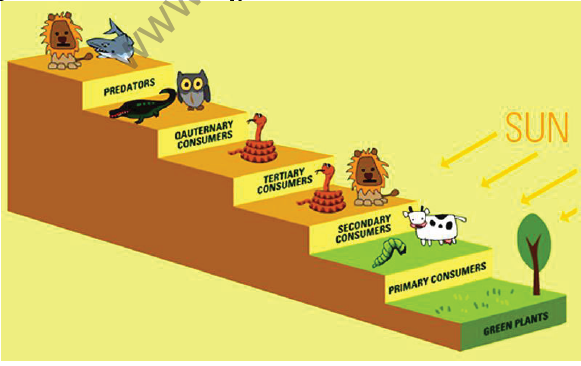
♦ The sun is the source of all the energy in food chains. Green plants, usually the first level of any food chain, absorb some of the Sun’s light energy to make their own food by photosynthesis. Green plants (autotrophs) are therefore known as ‘Producers’ in a food chain.
♦ The second level of the food chains is called the Primary Consumer. These consume the green plants. Animals in this group are usually herbivores. Examples include insects, sheep, caterpillars and even cows.
♦ The third in the chain are Secondary Consumers. These usually eat up the primary consumers and other animal matter. They are commonly called carnivores and examples include lions, snakes and cats.
♦ The fourth level is called Tertiary Consumers. These are animals that eat secondary consumers.
♦ Quaternary Consumers eat tertiary consumers.
♦ At the top of the levels are Predators. They are animals that have little or no natural enemies. They are the ‘bosses’ of their ecosystems. Predators feed on preys. A prey is an animal that predators hunt to kill and feed on. Predators include owls, snakes, wild cats, crocodiles and sharks. Humans can also be called predators.
♦ When any organism dies, detrivores (like vultures, worms and crabs) eat them up. The rest are broken down by decomposers (mostly bacteria and fungi), and the exchange of energy continues. Decomposers start the cycle again.
ENERGY FLOW IS UNIDIRECTIONAL AND REQUIRES CONTINUOUS INPUTS.
Ecosystem energy processes conform to the thermodynamic laws.
♦ Energy cannot be made or destroyed
♦ Energy transformations are not perfect and energy is lost in each transformation in the form of heat.
The flow of energy in the ecosystem is unidirectional. The energy enters the plants (from the sun) through photosynthesis during the making of food. This energy is then passed on from one organism to another in a food chain.
Energy given out by the organisms as heat is lost to the environment, it does not return to be used by the plants again. This makes the flow of energy in ecosystem 'unidirectional'. Thus, the flow of energy in the ecosystem is said to be unidirectional because the energy lost as heat from the living organisms of a food chain cannot be reused by plants in photosynthesis.
During the transfer of energy through successive trophic levels in an ecosystem, there is a loss of energy all along the path. No transfer of energy is 100 per cent. The energy available at each successive trophic level is 10 per cent of the previous level. Thus, there is a progressive decline (gradual reduction) in the amount of energy available as we go from producer level to the higher trophic levels of organisms.
Question. Ecosystem consists of
(A) producers
(B) consumers
(C) decomposers
(D) all of these
Answer : D
Question. What will happen, if all the green plants disappear from the earth ?
(A) all animals will die
(B) only carnivores will die
(C) only herbivores will die
(D) it will have no effect on animals
Answer : A
Question. In an ecosystem
(A) Primary producers are more than that of primary consumers
(B) Secondary consumers are largest, because they are powerful
(C) Primary consumers are out of number
(D) Primary consumers are least dependent upon primary producers
Answer : A
Question. In grassland ecosystem the pyramid of biomass is
(A) Linear
(B) upright
(C) inverted
(D) inverted upright
Answer : B
Question. Primary consumers in detritus food chain are
(A) Herbivores
(B) Bacteria and fungi
(C) Insect larvae, nematodes
(D) Carnivoroes
Answer : B
Question. A food chain starts with
(A) decay
(B) respiration
(C) photosynthesis
(D) nitrogen fixation
Answer : C
Question. Which is not an harmful effect of ozone depletion ?
(A) cataract
(B) skin cancer
(C) Decrease immunity
(D) Respiratory troubles
Answer : D
Question. Which one of the following pyramid is upright always ?
(A) Pyramid of number
(B) Pyramid of energy
(C) Pyramid of biomass
(D) All of the above
Answer : B
Question. The pyramid of number in tree ecosystem-
(A) Inverted
(B) Upright
(C) Both
(D) None
Answer : A
Question. Decomposers of an ecosystem include
(A) Microscopic animals
(B) Bacteria, fungi and microscopic organism
(C) Algae and virus
(D) Bacteria, fungi and cyanobacteria
Answer : B
Question. In terrestrial ecosystem , maximum energy is present in
(A) T3
(B) T2
(C) T1
(D) T4
Answer : C
Question. The life sustaining zone of the earth, where lithosphere, hydrosphere and atmosphere interact is called
(A) ecosystem
(B) stratosphere
(C) biosphere
(D) ozonosphere
Answer : C
Question. Pyramids that is never inverted
(A) energy
(B) mass
(C) number
(D) size
Answer : A
Question. The most rapidly increasing and much harmful waste, today is
(A) Household waste
(B) Paper
(C) municipal sewage
(D) electronic waste
Answer : D
Question. Incineration is the disposal of waste by ;
(A) sedimentation
(B) burning
(C) Scrubers
(D) none of these
Answer : B
Question. Our atmosphere is made of many layers. The layer nearest to the surface of the earth is known as :
(A) Geosphere
(B) Stratosphere
(C) Troposphere
(D) none of above
Answer : C
Question. e-waste is
(A) emergeney waste
(B) energy waste
(C) electronic waste
(D) None of these
Answer : C
Question. Which one of these are non degradable waste ?
(A) Vegetable waste
(B) Fruit peel
(C) Plastics
(D) none of these
Answer : C
Question. Type of effect produce by coolants
(A) Golbal warming
(B) Green house effect
(C) Ozone depletion
(D) All of the above
Answer : A
Question. Which one of the following constitutes a food chain ?
(A) grass, goat and human
(B) grass, fish and goat
(C) goat, cow and elephant
(D) grass, wheat and mango
Answer : A
Question. The human made synthetic chemical used in refrigerator is
(A) LPG
(B) CFC
(C) CH4
(D) PVC
Answer : B
Question. Biological O2 demand measures
(A) industrial pollution
(B) dissolved oxygen needed by microbes
(C) polluting capacity of effluents
(D) air pollution
Answer : B
Question. Example of omnivorous animals is -
(A) Sheep
(B) Deer
(C) Lion
(D) Cockroach
Answer : D
Question. Biogeochemical cycling means cycling of
(A) water
(B) energy in an ecosystem
(C) nutrients in an ecosystem
(D) gases between plants and atmosphere
Answer : C
Question. The accumulation of non-biodegradable substances in a food chain in increasing amount at each higher trophic level is known as :
(A) Accumulation
(B) Eutrophication
(C) Pollution
(D) Biomagnification
Answer : D
Please click the link below to download CBSE Class 10 Science Our Environment Notes.
Free study material for Science
Free CBSE Study Guides: Class 10 Science Chapter 13 Our Environment
Core Study Kit: Class 10 Science Chapter 13 Our Environment
Explore essential learning tools for Class 10 Science Chapter 13 Our Environment. This curated collection features in-depth notes and targeted practice questions built around the active 2026 curriculum to streamline your daily revision.
NCERT-Aligned Solutions for Chapter 13 Our Environment
Each resource draws directly from authorized textbooks to maintain academic accuracy. Evaluating solved examples allows Class 10 students to master the formal presentation and answer-writing standards expected in upcoming school exams.
Next Steps in Your Exam Preparation
For peak performance in upcoming evaluations, integrate official Science sample papers directly into your study schedule. Follow up your revision by attempting online MCQ tests for Chapter 13 Our Environment to refine calculation speed and precision.
FAQs
Our advanced study package for Chapter 13 Our Environment includes detailed concepts, diagrams, Mind Maps, and explanation of complex topics to ensure Class 10 students learn as per syllabus for 2026 exams.
The Mind Maps provided for Chapter 13 Our Environment act as visual anchors which will help faster recall during high-pressure exams.
Yes, teachers use our Class 10 Science resources for lesson planning as they are in simple language and have lot of solved examples.
Yes, You can download the complete, mobile-friendly PDF of the Science Chapter 13 Our Environment advanced resources for free.
Yes, our subject matter experts have updated the Chapter 13 Our Environment material to align with the rationalized NCERT textbooks and have removed deleted topics and added new competency-based questions.