

Class 10 Science Study Guide: Class 10 Science Heredity Exam Notes
Review targeted academic resources with the Class 10 Science Heredity Exam Notes. Built according to official CBSE standards for the 2026-27 term, these downloadable Class 10 Science study materials support effective daily practice and deeper conceptual understanding for Chapter 08 Heredity.
Download Chapter 08 Heredity Study Material PDF
Access the complete useful resource PDF for Class 10 Science below. Regular practice with these targeted academic notes builds familiarity with complex topics and helps secure higher marks in final school evaluations.
Class 10 Science Heredity and Evolution Exam Notes. Please refer to the examination notes which you can use for preparing and revising for exams. These notes will help you to revise the concepts quickly and get good marks.
Introduction
• Variation is the degree of difference found in morphological, physiological & other traits found among individuals belonging to the same family race & species.
• Most of the variation are due to mutations caused by error in DNA replication.
Accumulation Of Variations During Reproduction
• Variation appear during reproduction whether organisms are multiplying asexually or sexually. Each generation provides the next generation with a common basic body design and some subtle changes or variations
• The variations accumulate and pass on to more and more individuals with each generation.
• The diversity is small in case of asexually reproducing organism as it is caused by only errors of DNA copying mechanism.
Signification Of Variations
Preadaptations :
• Some of the neutral variations function as preadaptation to changing environment. For example, heat wave may kill most bacteria except a few which have a pre-adaptation or variation to tolerate high temperature.
Evolution :
• Variations are raw materials for evolutionary processes. Picking up suitable variants by nature or environment forms the basis of evolution.
Struggle for Existence :
• Useful variation provide advantage to the individuals in the struggle for existence and hence survival in nature.
Individuality :
• Variations provide a distinct identity to each and every individual.
Artificial Selection :
• Picking up of certain variations by breeders have resulted in development of a number of breeds and varieties of domesticated plants and animals.
HEREDITY
Heredity (L. hereditas – heirship or inheritance) is the transmission of genetic characters from parents to offspring or one generation to the next
◊ Inherited Traits :
They are those traits which are controlled by getnetic material of the individuals and are obtained from the parents in inheritance.
MENDELISM
Mendel was a monk in Austria.
Mendel performed a number of experiments on the gardan pea plants (Pisum sativum).
◊ Mendel's Law :
• The theoretical explanation of mendel's results are now firmly establisas Mendel's laws of inheritance.
These are as follows :
◊ Mendel's law of Dominance :
• According to this law, if a cross is made between plants with contrasting pair of charactess, the character that appears in the first generation is dominant and the other is recessive.
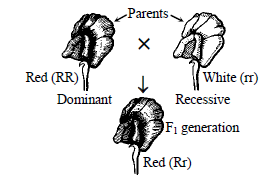
Mendel's monohybrid cross between a homozygous red flowered (RR) and a homozygous white flowered (rr)
plant to show that red colour is dominant over white (recessive)
◊ Mendel's law of segregation (or law of purity of gametes) :
• Both parental allels (i.e. dominant as well as recessive) segregate or separate and are expressed phenotypically in F2 generation, and this is called mendel's Law of segregation.

◊ Mendel's Law of Independent Assortment :
• Which states that most of the characters of parents can appear in any combination in their offsprings

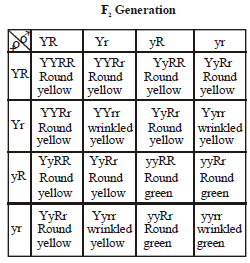
SEX DETERMINATION
It is a process by which the sex of a person is determined. Genetics is involved in the determination of the sex of a person, which is explained as follows :
• A male has one X chromosome and one Y chromosome, i.e., half of the male gamete or sperms will have X chromosome and the other half will have Y chromosome.
• A female has two X chromosomes, i.e., all the female gametes or ova will have only
X chromosomes.
• Sex of a child depends on what happens at fertilisation.
• If a sperm carrying X chromosome fertilises an ovum which carries X chromosome, then the child born will be a girl.
• If a sperm carrying Y chromosome fertilises an ovum which carries X chromosome, then the child born will be a boy.
• Thus, the sperm determines the sex of the child.
• Sex determination is also controlled by the environmental factors in some animals.
• For example, in some reptiles like turtle, high incubation temperature leads to the development of female offsprings, while in case of lizard. high incubation temperature results in male offsprings.

EVOLUTION
Evolution (L.evolvere – to unfold) or organic evolution (Spencer, 1852) is the unfolding of nature wherein newer types of organisms develop from the pre-existing ones through modification.
◊ Acquired Traits :
• Acquired traits are those variations which an individual develops during its life time due to effect of environmental factors, use and disuse of organs and conscious efforts.
Theory of Inheritance of Acquired Characters (Lamarckism). It is the first theory of evolution that was proposed by
French biologist Jean Baptiste de Lamarck. It is based on the following
◊ Internal Vital Force : There is a vital force in organisms which rends to change them, generally making them larger and more complex.
◊ Environment : A change in environment brings about direct changes in plants. It produces new needs in animals.
• New needs (Doctrine of Desires), New need being about new desires that result in changes of older and formation of new organs.
• Use and Disuse of Organs, Repeated use of an organ makes it more complex and efficient. Non-use of an organ brings about its degeneration.
• Inheritance of Acquired Characters. The traits acquired by an individual during its life time are passed on to the next generation. After several generations the accumulation of changes results in the formation of new species.
◊ Inherited traits :
• Inherited traits are those characteristics which are passed from parents to their offspring, generation after generation because they are controlled by genes.
• There is also reshuffling of inherited variations during gemetogenesis and fertilization.
◊ SPECIATION
It is the formation of new species from an existing one due to reproductive isolation of a section of its population.
Development of reproductive isolation is basic to formation of new species. This can occur by the following methods
◊ Physical Barrier :
• A physical barrier like valley, mountain, water body, etc. develop between two populations of a species.
◊ Two Ends of Long Range :
• Subpopulations at the two ends of a long range seldom interbreed.
◊ Mutations :
• A large mutation can make some members reproductively isolated from the rest.
◊ Genetic Drift (Wright Effect) :
• It is random change in gene frequency that occurs in a small population due to fixation of certain alleles and elimination of others.
EVIDENCE OF EVULOTION
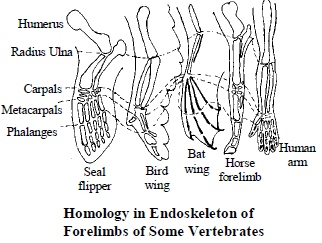
◊ Homologus Organs :
• These organs are similar in structure but disimilar in functions.
•Homologous organs are found in forms showing adaptive radiation from a common ancestor so these give evidence of ‘divergent evolution’.
• Ex. forelimbs of mammals, bat’s wing, a cat’s paw.
•In plants homologous organs may be a thorn or a tendril as they arise in the axillary position. If homology is seen at the molecular level. This is called molecular homology.
◊Analogous Organs :
• These organs are perform similar function but quite different in origin and development.
• Analogous organs are also called homoplastic organs.
• Analogous organs like wings of insects, birds and bats illustrate ‘convergent evolution’.
• Ex. - Wings of birds, wings of insects show the same function but their origin and development is different.
◊Vestigial Organs :
• Vestigial organs are useless organs found in the body. These are present in reduced form.
• Ex. wings of kiwi, limbs of snakes, the nictitating membrane of the eye, body hair and the muscles that move the ears.
• During the period of evolution vestigial organs have become functionless.
◊ Fossil Evidences :
• Fossils are the remains of the organisms that found in the ancient period. We can determine fossil’s age through the period of rock by radioactive material. Histological time scale is a chronological order of evolution history based upon the study of fossils.
• Study of fossils known as palaeontology.
Petrification :
• Hard parts are preserved in this type of fossil.
◊ Archaeopteryx :
• A fossil bird show both reptilian and avian features - It had wing like birds, thecodent dentition and tail like reptiles. Hence, archeopteryx is a connecting link between birds and reptiles.
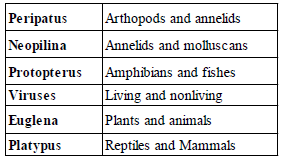
Connecting links :
◊ Embryological Evidences:
The study of embryo from variours organisms reveals similarity in the early stages of embryo development & this theory suggests that these organism have evolved from common ancestors.
Eg. Embryos of fish, turtle, bird, pig & man shows the similarity during embryo development.

Please click on below link to download pdf file for Class 10 Science Heredity and Evolution Exam Notes.
Free study material for Science
Free CBSE Study Guides: Class 10 Science Chapter 08 Heredity
Core Study Kit: Class 10 Science Chapter 08 Heredity
Access comprehensive study material for Chapter 08 Heredity, including revision notes, concept maps, and high-probability questions. These resources are designed in alignment with the latest 2026 CBSE syllabus for Class 10 Science to support effective exam preparation.
NCERT-Aligned Solutions for Chapter 08 Heredity
Designed around the official curriculum, these study guides guarantee standard compliance. Reviewing step-by-step solutions clarifies complex sub-topics within Chapter 08 Heredity and demystifies standard marking schemes for Science evaluations.
Next Steps in Your Exam Preparation
For peak performance in upcoming evaluations, integrate official Science sample papers directly into your study schedule. Follow up your revision by attempting online MCQ tests for Chapter 08 Heredity to refine calculation speed and precision.
FAQs
Our advanced study package for Chapter 08 Heredity includes detailed concepts, diagrams, Mind Maps, and explanation of complex topics to ensure Class 10 students learn as per syllabus for 2026 exams.
The Mind Maps provided for Chapter 08 Heredity act as visual anchors which will help faster recall during high-pressure exams.
Yes, teachers use our Class 10 Science resources for lesson planning as they are in simple language and have lot of solved examples.
Yes, You can download the complete, mobile-friendly PDF of the Science Chapter 08 Heredity advanced resources for free.
Yes, our subject matter experts have updated the Chapter 08 Heredity material to align with the rationalized NCERT textbooks and have removed deleted topics and added new competency-based questions.