

Class 10 Science Study Guide: CBSE Class 10 Science Metals And Non Metals
Access comprehensive study materials and useful resources for Chapter 03 Metals and Nonmetals using the CBSE Class 10 Science Metals And Non Metals. Designed to align with the 2026-27 CBSE academic guidelines, these advanced resources help Class 10 Science students reinforce core concepts beyond standard textbooks.
Download Chapter 03 Metals and Nonmetals Study Material PDF
Navigate directly to the advanced Science study materials using the digital viewer below. Each resource pack includes detailed conceptual summaries and solved practice questions, allowing students to instantly reinforce their learning.
CBSE Class 10 Science-Metals And Non-Metals. Please refer to the examination notes which you can use for preparing and revising for exams. These notes will help you to revise the concepts quickly and get good marks
CHAPTER 3 : METALS AND NON-METALS
MIND MAP
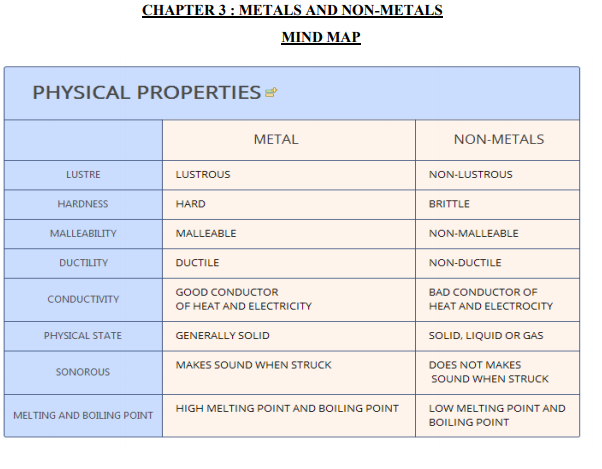
PHYSICAL PROPERTIES
| PROPERTIES | METAL | NON-METALS |
|---|---|---|
| LUSTRE | LUSTROUS | NON-LUSTROUS |
| HARDNESS | HARD | Brittle |
| MALLEABILITY | MALLEABLE | NON-MALLEABLE |
| DUCTILITY | DUCTILE | NON-DUCTILE |
| CONDUCTIVITY | GOOD CONDUCTOR OF HEAT AND ELECTRICITY | BAD CONDUCTOR OF HEAT AND ELECTRICITY |
| PHYSICAL STATE | GENERALLY SOLID | SOLID, LIQUID OR GAS |
| SONOROUS | MAKES SOUND WHEN STRUCK | DOES NOT MAKE SOUND WHEN STRUCK |
| MELTING AND BOILING POINT | HIGH MELTING POINT AND BOILING POINT | LOW MELTING POINT AND BOILING POINT |
Teacher's Note:
a) This mind map summarizes the comparative physical properties of metals and non-metals.
b) Metals generally exhibit high density, high melting points, and good thermal/electrical conductivity.
c) Non-metals show diverse physical states at room temperature and lack characteristic metallic lustre.
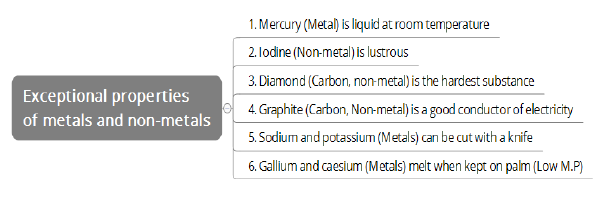
1. Exceptional properties of metals and non-metals [1 Mark]
1. Mercury (Metal) is liquid at room temperature
2. Iodine (Non-metal) is lustrous
3. Diamond (Carbon, non-metal) is the hardest substance
4. Graphite (Carbon, Non-metal) is a good conductor of electricity
5. Sodium and potassium (Metals) can be cut with a knife
6. Gallium and caesium (Metals) melt when kept on palm (Low M.P)
Answer:
1. Metals are generally solids, hard, and have high melting points, but exceptions exist.
2. Non-metals are generally poor conductors and non-lustrous, but exceptions like iodine and graphite exist.
3. These unique properties distinguish certain elements from general trends.
Teacher's Note:
a) Memorize these physical exceptions as they are frequently asked in board exams.
b) Sodium and potassium are stored in kerosene to prevent accidental fires.
Chemical properties of metals and non-metals (mind map)
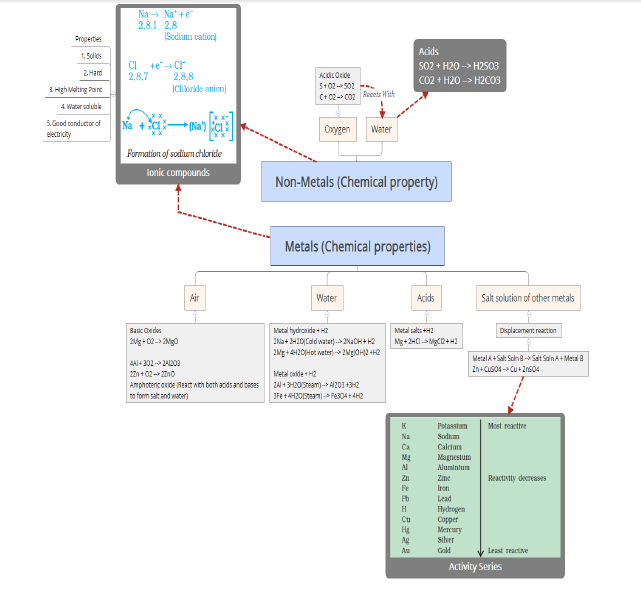
Metals (Chemical properties)
- Air – Basic oxides: 2Mg + O2 → 2MgO; 4Al + 3O2 → 2Al2O3; 2Zn + O2 → 2ZnO. Amphoteric oxide (react with both acids and bases to form salt and water).
- Water – Metal hydroxide + H2: 2Na + 2H2O (cold water) → 2NaOH + H2; 2Mg + 4H2O (hot water) → 2Mg(OH)2 + H2. Metal oxide + H2: 2Al + 3H2O (steam) → Al2O3 + 3H2; 3Fe + 4H2O (steam) → Fe3O4 + 4H2.
- Acids – Metal salts + H2: Mg + 2HCl → MgCl2 + H2.
- Salt solution of other metals – Displacement reaction: Metal A + Salt Soln B → Salt Soln A + Metal B; Zn + CuSO4 → Cu + ZnSO4 (see Activity Series below).
- Metals form Ionic compounds (see below).
Non-Metals (Chemical property)
- Oxygen – Acidic oxide: S + O2 → SO2; C + O2 → CO2.
- Water – the acidic oxide reacts with water to give Acids: SO2 + H2O → H2SO3; CO2 + H2O → H2CO3.
- Non-metals also form Ionic compounds (with metals).
Ionic compounds – Formation of sodium chloride:
Na → Na+ + e− (2,8,1 → 2,8; sodium cation)
Cl + e− → Cl− (2,8,7 → 2,8,8; chloride anion)
Na + Cl → (Na+)(Cl−) (electron dot structure: the electron of Na is transferred to Cl, which then has 8 electrons in its outer shell)
Properties:
1. Solids
2. Hard
3. High Melting Point
4. Water soluble
5. Good conductor of electricity
Activity Series
| Symbol | Metal | |
|---|---|---|
| K | Potassium | Most reactive |
| Na | Sodium | ↓ |
| Ca | Calcium | ↓ |
| Mg | Magnesium | ↓ |
| Al | Aluminium | ↓ |
| Zn | Zinc | Reactivity decreases |
| Fe | Iron | ↓ |
| Pb | Lead | ↓ |
| H | Hydrogen | ↓ |
| Cu | Copper | ↓ |
| Hg | Mercury | ↓ |
| Ag | Silver | ↓ |
| Au | Gold | Least reactive |
EXTRACTION OF METALS
- Ore → Concentration of ore, then by reactivity:
- Metals of high reactivity → Electrolysis of molten ore NaCl → Pure Metal: 2Na + Cl2
- Metals of medium reactivity
- Carbonate ore ZnCO3 → Calcination (less air) → Oxide of metal ZnO
- Sulphide ore ZnS → Roasting (excess air) → Oxide of metal ZnO
- Oxide of metal ZnO → Reduction to metal (ZnO + C) → Purification of metal (Electrolysis)
- Metals of low reactivity → Sulphide ores HgS → Roasting: HgO → Metal Hg → Refining (Electrolysis)
Corrosion
- Silver – with Sulphur → Silver sulphide (Black)
- Copper – with CO2 → Basic copper carbonate (Green layer)
- Iron – with moist air → Hydrated iron oxide (Rust – Brown layer)
- Prevention of corrosion: Galvanisation (layer of zinc on iron)
- Prevention of corrosion: Alloys
- Stainless steel: Fe + Ni + Cr
- Amalgam: Metal + Hg
- Brass: Cu + Zn
- Bronze: Cu + Sn
- Solder: Pb + Sn
1. Write balanced chemical equations for the reaction of metals with water. [3 Marks]
(a) Action of cold water on potassium
(b) Action of hot water on magnesium
(c) Action of steam on iron
Answer:
1. 2K(s) + 2H2O(l) → 2KOH(aq) + H2(g) + Heat
2. Mg(s) + 2H2O(hot) → Mg(OH)2(s) + H2(g)
3. 3Fe(s) + 4H2O(g) → Fe3O4(s) + 4H2(g)
Teacher's Note:
a) Metals react with water to form a metal oxide or metal hydroxide and hydrogen gas.
b) Potassium reacts violently and exothermically with cold water.
c) Magnesium floats on hot water due to hydrogen gas bubbles sticking to its surface.
d) Iron reacts only with steam as it does not react with cold or hot water.
2. What happens when metals react with dilute acids? Give balanced equations for the reaction of zinc with dilute hydrochloric acid and aluminium with dilute sulphuric acid. [3 Marks]
Answer:
1. Metals react with dilute acids to give a salt and hydrogen gas.
2. Zn(s) + 2HCl(dil) → ZnCl2(aq) + H2(g)
3. 2Al(s) + 3H2SO4(dil) → Al2(SO4)3(aq) + 3H2(g)
Teacher's Note:
a) Hydrogen gas is evolved when metals react with dilute acids.
b) Copper, silver and gold do not evolve hydrogen gas with dilute acids because they are less reactive than hydrogen.
c) Nitric acid does not normally give hydrogen gas with metals because it is a strong oxidising agent.
3. State the reactivity series of metals. Explain displacement reactions with a suitable chemical equation and the help of the activity series. [4 Marks]
Answer:
1. The reactivity series is a list of metals arranged in the order of their decreasing activities.
2. Potassium is the most reactive metal and gold is the least reactive metal in the series.
3. More reactive metals can displace less reactive metals from their salt solutions.
4. Zn(s) + CuSO4(aq) → ZnSO4(aq) + Cu(s)
Teacher's Note:
a) The series places hydrogen as a reference element above copper and below lead.
b) Zinc displaces copper from copper sulphate solution because zinc is placed above copper in the activity series.
c) Displacement reactions are also redox reactions involving electron transfer.
d) The blue colour of copper sulphate fades during the displacement by zinc.
1. Write the chemical equation for the reaction of zinc carbonate with air during the process of calcination. [1 Mark]
Answer:
1. ZnCO3 (s) → ZnO (s) + CO2 (g)
Teacher's Note:
a) Calcination involves heating carbonate ores strongly in the absence or limited supply of air to convert them into metal oxides.
b) Zinc carbonate decomposes to form zinc oxide and carbon dioxide gas.
2. State the difference between roasting and calcination based on the supply of air. [2 Marks]
Answer:
1. Roasting involves heating sulphide ores strongly in the presence of excess air.
2. Calcination involves heating carbonate ores strongly in the absence or limited supply of air.
Teacher's Note:
a) Both processes are used to convert concentrated ores into their respective metal oxides.
b) Roasting is applied to sulphide ores, whereas calcination is applied to carbonate ores.
3. List the constituents present in the alloy brass. [1 Mark]
Answer:
1. Copper (Cu) and Zinc (Zn)
Teacher's Note:
a) Brass is an alloy formed by mixing copper and zinc in specific proportions.
b) Alloys generally have lower electrical conductivity and melting point compared to pure metals.
4. Explain the process of galvanisation as a method to prevent corrosion of iron. [3 Marks]
Answer:
1. Galvanisation is a method of protecting steel and iron from rusting by coating them with a thin layer of zinc.
2. The protective zinc layer prevents the iron surface from coming in contact with moisture and oxygen.
3. Even if the zinc coating is scratched or broken, the zinc continues to protect iron preferentially due to its higher reactivity.
Teacher's Note:
a) Zinc acts as a sacrificial anode in protecting iron from corrosion.
b) This is one of the most common industrial methods to prevent rusting of iron pipes and sheets.
c) Ensure you mention both moisture and oxygen as necessary conditions for iron corrosion to occur.
DIAGRAM
[Figure: Electrolytic refining of copper showing an electrolytic tank containing acidified copper sulphate solution, an impure copper anode, a pure copper cathode strip, a power source with key, copper ions Cu2+ in solution, and impurities settling down as anode mud at the bottom.]
Answer:
1. The given diagram illustrates the process of electrolytic refining of impure copper.
2. An impure copper rod is made the anode and connected to the positive terminal of the power supply.
3. A thin strip of pure copper is made the cathode and connected to the negative terminal.
4. Acidified copper sulphate solution is used as the electrolyte.
5. On passing electric current, pure copper from the anode dissolves into the electrolyte and gets deposited on the cathode, while insoluble impurities settle down as anode mud.
Teacher's Note:
a) Electrolytic refining is widely used for purifying copper, zinc, tin, nickel, silver, and gold.
b) Impure metal goes to the anode, pure metal deposits on the cathode.
c) Soluble impurities go into the solution while insoluble impurities form anode mud below the anode.
CROSSWORD
Across
1 Protecting Iron
5 Hardest Substance
9 Forms amphoteric oxide
10 Sulphide Ores
Down
1 Most ductile metal
2 Homogenous mixture of metals
3 A Metal which gets rusted
4 Burns with dazzling white flame
6 Liquid at room temperature
7 Minerals from which metal is extracted
8 Impurity in ore
Crossword grid
Answer:
1. Across:
1. Galvanisation
5. Diamond
9. Zinc
10. Roasting
2. Down:
1. Gold
2. Alloy
3. Iron
4. Magnesium
6. Mercury
7. Ores
8. Gangue
Teacher's Note:
a) Crossword puzzles reinforce key chemical terms and terminology related to metals and non-metals.
b) Pay close attention to word lengths and intersecting letters when solving scientific crosswords.
c) Review properties like ductility, malleability, and states of matter regularly.
QUESTION BANK
VERY SHORT ANSWER TYPE (1 MARK)
1. Differentiate between the oxides of magnesium and sulphur. [1 Mark]
Answer:
1. Magnesium oxide (MgO) is basic in nature and turns red litmus blue.
2. Sulphur dioxide (SO2) is acidic in nature and turns blue litmus red.
Teacher's Note:
a) Metallic oxides are generally basic, while non-metallic oxides are generally acidic.
b) Remember that basic oxides react with acids to form salt and water, whereas acidic oxides react with bases.
2. Name one metal which is a poor conductor of heat [1 Mark]
Answer:
1. Lead (or Mercury) is a poor conductor of heat.
Teacher's Note:
a) Metals are generally good conductors of heat, but lead and mercury show exceptionally low thermal conductivity.
b) Silver and copper are the best conductors of heat among all metals.
SHORT ANSWER TYPE (2 MARK)
1. Give Reasons [2 Marks]
a. Sodium and potassium are stored in kerosene
b. Ionic compounds have higher melting point
Answer:
1. Sodium and potassium are highly reactive metals that catch fire spontaneously if exposed to moisture and oxygen in the air, hence they are kept under kerosene.
2. Ionic compounds have high melting points because of strong inter-ionic forces of attraction between oppositely charged ions, which require a large amount of energy to break.
Teacher's Note:
a) Alkali metals react vigorously with water and oxygen, making kerosene a safe storage medium as it lacks oxygen and moisture.
b) The strong electrostatic forces in crystal lattices are responsible for the physical properties of ionic compounds like high melting and boiling points.
2. Differentiate between metals and non-metals based on [2 Marks]
a. Malleability
b. Electrical conductivity
Answer:
1. Malleability: Metals are malleable, meaning they can be beaten into thin sheets, whereas non-metals are non-malleable and are brittle.
2. Electrical conductivity: Metals are good conductors of electricity, whereas non-metals are generally poor conductors of electricity (except graphite).
Teacher's Note:
a) Malleability arises from the ability of atoms to slide over each other without breaking metallic bonds.
b) Free mobile electrons in metals facilitate electrical conduction, which is absent in most non-metals.
SHORT ANSWER TYPE (3 MARK)
1. Show the formation of magnesium chloride with the help of electron dot structure [3 Marks]
Answer:
1. Magnesium (Mg) has 2 valence electrons (electronic configuration: 2, 8, 2) and tends to lose 2 electrons to achieve stability.
2. Chlorine (Cl) has 7 valence electrons (electronic configuration: 2, 8, 7) and needs 1 electron to complete its octet.
3. One magnesium atom transfers its two valence electrons to two chlorine atoms, forming an ionic bond resulting in Mg2+ and two Cl- ions, yielding MgCl2.
Teacher's Note:
a) Electron dot structures show valence electrons clearly using dots or crosses around the chemical symbols.
b) Always balance the total number of electrons lost by the metal with the total number of electrons gained by non-metal atoms.
2. What happens when [3 Marks]
a. Zinc reacts with copper sulphate solution
b. Aluminium reacts with steam
c. Sodium reacts with water
Give balanced reactions for each.
Answer:
1. Zn (s) + CuSO4 (aq) → ZnSO4 (aq) + Cu (s)
2. 2Al (s) + 3H2O (g) → Al2O3 (s) + 3H2 (g)
3. 2Na (s) + 2H2O (l) → 2NaOH (aq) + H2 (g) + Heat
Teacher's Note:
a) A more reactive metal displaces a less reactive metal from its salt solution.
b) Metals react with water and steam to form metal oxides or hydroxides along with hydrogen gas.
VALUE BASED QUESTION
Anita bought silver jewellery along with her friend Rita. Anita advised Rita to make sure that the jewellery was kept in a sealed box and not exposed to air; but Rita forgot and left it open. After some months when Rita decided to wear it, she found the jewellery all black. Rita was very upset. [3 Marks]
a. Why did the jewellery become black when exposed to air?
b. What is this process called?
c. What were the values shown by Anita?
Answer:
1. Silver reacts with sulphur compounds present in the air, such as hydrogen sulphide, to form a black coating of silver sulphide (Ag2S).
2. This process is called corrosion (specifically tarnishing of silver).
3. Anita showed values of scientific awareness, carefulness, and being a helpful and knowledgeable friend.
Teacher's Note:
a) Silver does not react with oxygen at room temperature, but reacts readily with traces of sulphur gases in the atmosphere.
b) Value-based questions assess both factual scientific knowledge and socio-behavioral understanding.
LONG ANSWER TYPE (5 MARK)
1. With the help of labelled diagram explain how copper metal is purified after extraction [5 Marks]
Answer:
1. Copper is purified using the electrolytic refining method.
2. An impure block of copper is made the anode and a thin strip of pure copper is made the cathode.
3. An acidified copper sulphate solution is used as the electrolyte.
4. When electric current is passed, pure copper from the anode dissolves into the electrolyte and gets deposited on the cathode.
5. Soluble impurities go into the solution while insoluble impurities settle down at the bottom of the anode as anode mud.
Teacher's Note:
a) Electrolytic refining is widely used for purifying copper, zinc, tin, nickel, silver, and gold.
b) Ensure the anode is impure metal and cathode is pure metal in the explanatory diagram.
[Figure: Electrolytic refining of copper showing an electrolytic tank containing acidified copper sulphate solution, impure copper anode connected to positive terminal, pure copper cathode connected to negative terminal, and anode mud settling at the bottom.]
2. Explain [5 Marks]
a. How is zinc obtained from sulphide and carbonate ores? Differentiate between the two giving chemical reactions
b. What are the advantages of alloys? Name the constituents of bronze.
Answer:
1. Sulphide ores are converted into oxides by heating strongly in the presence of excess air, a process called roasting: 2ZnS (s) + 3O2 (g) → 2ZnO (s) + 2SO2 (g).
2. Carbonate ores are converted into oxides by heating strongly in a limited supply of air, a process called calcination: ZnCO3 (s) → ZnO (s) + CO2 (g).
3. The obtained zinc oxide is then reduced to zinc using a reducing agent like carbon: ZnO (s) + C (s) → Zn (s) + CO (g).
4. Advantages of alloys: Alloys are stronger, harder, more resistant to corrosion, and can have altered electrical conductivity and melting points compared to pure metals.
5. Constituents of bronze: Copper (Cu) and Tin (Sn).
Teacher's Note:
a) Roasting is used for sulphide ores, whereas calcination is used for carbonate ores.
b) Alloying is an effective method of improving the mechanical properties of metals for practical industrial uses.
Free study material for Science
CBSE Class 10 Science Study Material: Chapter 03 Metals and Nonmetals
Core Study Kit: Class 10 Science Chapter 03 Metals and Nonmetals
Review targeted study resources for Chapter 03 Metals and Nonmetals tailored for Class 10 learners. Utilizing these structured notes and quick-revision tools ensures complete alignment with current CBSE evaluation standards.
NCERT-Aligned Solutions for Chapter 03 Metals and Nonmetals
Each resource draws directly from authorized textbooks to maintain academic accuracy. Evaluating solved examples allows Class 10 students to master the formal presentation and answer-writing standards expected in upcoming school exams.
Next Steps in Your Exam Preparation
Wrap up your chapter revision by testing your knowledge against standard objective question formats. Explore our full library of free, up-to-date sample papers and online assessments to secure top grades in your CBSE examinations.
FAQs
Our advanced study package for Chapter 03 Metals and Nonmetals includes detailed concepts, diagrams, Mind Maps, and explanation of complex topics to ensure Class 10 students learn as per syllabus for 2026 exams.
The Mind Maps provided for Chapter 03 Metals and Nonmetals act as visual anchors which will help faster recall during high-pressure exams.
Yes, teachers use our Class 10 Science resources for lesson planning as they are in simple language and have lot of solved examples.
Yes, You can download the complete, mobile-friendly PDF of the Science Chapter 03 Metals and Nonmetals advanced resources for free.
Yes, our subject matter experts have updated the Chapter 03 Metals and Nonmetals material to align with the rationalized NCERT textbooks and have removed deleted topics and added new competency-based questions.