

Official CBSE Study Materials for Class 10 Science
Access comprehensive study materials and useful resources for Chapter 11 Electricity using the CBSE Class 10 Science Electricity. Designed to align with the 2026-27 CBSE academic guidelines, these advanced resources help Class 10 Science students reinforce core concepts beyond standard textbooks.
Advanced Resources for Science
Access the complete useful resource PDF for Class 10 Science below. Regular practice with these targeted academic notes builds familiarity with complex topics and helps secure higher marks in final school evaluations.
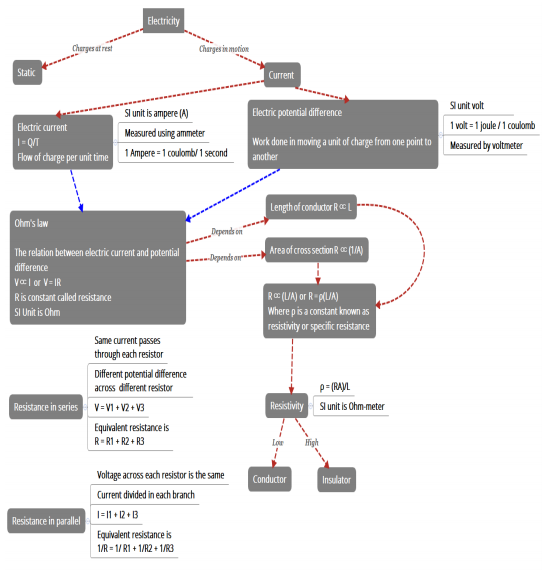
ELECTRICITY MIND MAP
QUESTION BANK
VERY SHORT ANSWER TYPE
1. Calculate the amount of charge flowing in a wire if it draws a current of 2A in 10 minutes.
Ans: 2 x 10 x 60 = 1200 C
2. What happens to resistance of a conductor if area of cross-section is doubled?
Ans: It halves
3. Which device helps to maintain a potential difference across a conductor?
Ans: Cell or battery
SHORT ANSWER TYPE
1. Draw a circuit diagram having the following components
a. Bulb
b. A two cell battery
c. Ammeter
d. A closed key
Ans: Refer diagram
2. Why are heating elements made of alloys rather than metals?
Ans: High resistivity, does not oxidise at high temperatures
3. What do we mean when we say that potential difference between two points is 1volt?
Ans: Definition
SHORT ANSWER TYPE
1. If three resistors of 6Ω, 9Ω and 21Ω are connected in series to a 12V battery, find
a) The total resistance of the circuit.
b) The current flowing through the circuit.
c) The potential difference across the 21 Ω resistor.
Ans. a) 36 Ω b) 0.33A c) 6.93V
2. What are the advantages of connecting electrical devices in parallel with the battery rather than in series?
Ans: (1) The current required by each device is different which is possible only in parallel.
(2)If one device fails others can still work. (3) Total resistance in the circuit is decreased
VALUE BASED QUESTION
Rohan had gone to Sohan‟s house for studying. Sohan was worried about the high electricity bill and was wondering how to reduce it. Rohan suggested using LED bulbs instead of fluorescent bulbs as it consumes less electric energy and switch to solar power. After two months when they met again Sohan was very happy as the number of units consumed and the electric bill had reduced drastically.
1. What is electric power? What is its SI unit? Rate of consumption of electric energy. SI unit is watt
2. What is the commercial unit used to measure electric energy? KWh
3. What values were shown by Rohan? Caring, awareness and conservation of energy
LONG ANSWER TYPE
1. a)What is the function of fuse in an electric circuit?
b) What would be the rating of the fuse for an electric kettle which is operated at 220V and consumes 500 W power?
c) How is the SI unit of electric energy related to its commercial unit?
Ans. b) 2.2A flows through the circuit, fuse should be rated 3A.
c) 1 KWh = 3.6 X 10⁶ J
2. a) State Ohms law. Derive the relation and give graphical representation for it.
b) An electric oven rated at 500W is connected to a 220V line and used for 2 hours daily. Calculate the cost of electric energy per month at the rate of Rs.5 per KWh.
Ans. a) V = IR, linear equation hence straight line passing through origin
b) Energy consumed per day = 1 KWh (P x t) cost for 30 days = 1 X 5 X 30 = Rs.150.00
Question. 10,000 alpha-particles per minute are passing through a straight tube of radius r.
The resulting electric current is approximately
(a) 0.5 × 10⁻¹⁶ A
(b) 2 × 10¹² A
(c) 0.5 × 10¹² A
(d) 2 × 10–12 A
Answer. A
Question. Two metallic wires A and B are connected in series. Wire A has length l and radius r, while wire B has length 2l and radius 2r. If both the wires are of same material then find the ratio of the total resistance of series combination to the resistance of the wire A.
(a) 3/4
(b) 3/2
(c) 6/2
(d) 6/5
Answer. B
Question. The resistivity does not change if
(a) the material is changed
(b) the temperature is changed
(c) the shape of the resistor is changed
(d) both material and temperature are changed.
Answer. C
Question. A cylindrical conductor of length l and uniform area of cross section A has resistance R.
Another conductor of length 2l and resistance R of the same material has area of cross-section
(a) A/2
(b) 3A/2
(c) 2A
(d) 3A
Answer. C
Question. Consider a simple circuit containing a battery and three identical incandescent bulbs A, B and C.Bulb A is wired in parallel with bulb B and this combination is wired in series with bulb C. What would happen to the brightness of the other two bulbs if bulb A were to burn out?
(a) Only bulb B would get brighter.
(b) Both A and B would get brighter.
(c) Bulb B would get brighter and bulb C would get dimmer.
(d) There would be no change in the brightness of either bulb B or bulb C
Answer. C
Question. In a metallic conductor, electric current thought to be due to the movement of
(a) ions
(b) amperes
(c) electrons
(d) protons
Answer. C
Question. 1 volt = ..............
(a) 1 joule/coulomb
(b) 1 coulomb/joule
(c) 1 joule/coulomb2
(d) 1 joule coulomb
Answer. A
Question. If a wire of resistance R is melted and recast to half its length, the new resistance of the wire will be
(a) R/4
(b) R/2
(c) R
(d) 2R
Answer. A
Question. A piece of aluminium of finite length is drawn or stretched such that to reduce its diameter to one fourth its original value, its resistance will become
(a) 256 times
(b) four times
(c) eight times
(d) sixteen times
Answer. A
Question. Choices for the correct combination of elements from column-I and column-II are given as options (a), (b), (c) and (d) out of which one is correct?
Column-I Column-II
(P) Current 1. ohm
(Q) Potential 2. ampere
(R) Resistance 3. ohm m
(S) Resistivity 4. volt
(a) P-2, Q-4, R-1, S-3
(b) P-3, Q-4, R-2, S-1
(c) P-4, Q-3, R-1, S-2
(d) P-2, Q-1, R-4, S-3
Answer. A
Question. A multimeter is used to measure
(a) current only
(b) resistance only
(c) voltage only
(d) current, resistance and voltage.
Answer. D
Question. There are three copper wires of lengths and cross-sectional areas (L, A), (2 L, A/2), (L/2, 2 A). Resistivity is
(a) minimum of wire of cross-sectional area A/2
(b) minimum of wire of cross-sectional area A
(c) minimum of wire of cross-sectional area 2A
(d) same in all the three cases.
Answer. D
Question. In an electrical circuit, three incandescent bulbs A, B and C of rating 40 W, 60 W and 100 W respectively are connected in parallel to an electric source. Which of the following is likely to happen regarding their brightness?
(a) Brightness of all the bulbs will be the same
(b) Brightness of bulb A will be the maximum
(c) Brightness of bulb B will be more than that of A
(d) Brightness of bulb C will be less than that of B
Answer. C
Question. Masses of three wires of copper are in the ratio 1 : 3 : 5 and their lengths are in the ratio of 5 : 3 : 1. The ratio of their electrical resistances are
(a) 1 : 3 : 5
(b) 5 : 3 : 1
(c) 1 : 15 : 125
(d) 125 : 15 : 1
Answer. D
Question. The amount of heat energy produced in 5 minutes by an electric heater rated at 1000 W is
(a) 2 × 10⁵ J
(b) 3 × 10⁵ J
(c) 4 × 10⁵ J
(d) 300 J
Answer. B
CBSE Class 10 Physics Chapter 12 Electricity Case Based MCQs
Case I : Read the passage given below and answer the following questions.
The heating effect of current is obtained by transformation of electrical energy in heat energy. Just as mechanical energy used to overcome friction is converted into heat, in the same way, electrical energy is converted into heat energy when an electric current flows through a resistance wire. The heat produced in a conductor, when a current flows through it is found to depend directly on (a) strength of current (b) resistance of the conductor (c) time for which the current flows.
The mathematical expression is given by
H = I2Rt.
The electrical fuse, electrical heater, electric iron, electric geyser etc. all are based on the heating effect of current.
Question. What are the properties of heating element?
(a) High resistance, high melting point
(b) Low resistance, high melting point
(c) High resistance, low melting point
(d) Low resistance, low melting point.
Answer. A
Question. What are the properties of electric fuse?
(a) Low resistance, low melting point
(b) High resistance, high melting point.
(c) High resistance, low melting point
(d) Low resistance, high melting point
Answer. C
Question. When the current is doubled in a heating device and time is halved, the heat energy produced is
(a) doubled
(b) halved
(c) four times
(d) one fourth times
Answer. A
Question. A fuse wire melts at 5 A. It is is desired that the fuse wire of same material melt at 10 A. The new radius of the wire is
(a) 4 times
(b) 2 times
(c) 1/2 times
(d) 1/4 times
Answer. B
Question. When a current of 0.5 A passes through a conductor for 5 min and the resistance of conductor is 10 W, the amount of heat produced is
(a) 250 J
(b) 5000 J
(c) 750 J
(d) 1000 J
Answer. C
CBSE Class 10 Physics Chapter 12 Electricity Assertion & Reasoning Based MCQs
For question numbers 46-55, a statement of assertion followed by a statement of reason is given. Choose the correct answer out of the following choices.
(a) Both assertion and reason are true, and reason is correct explanation of the assertion.
(b) Both assertion and reason are true, but reason is not the correct explanation of the assertion.
(c) Assertion is true, but reason is false.
(d) Assertion is false, but reason is true.
Question. Assertion : It is advantageous to transmit electric power at high voltage.
Reason : High voltage implies high current.
Answer. C
Question. Assertion : Good conductors of heat are also good conductors of electricity and vice versa.
Reason : Mainly electrons are responsible for conduction.
Answer. A
Question. Assertion : If 10 bulbs are connected in series and one bulb fused, then the remaining 9 bulbs will not work.
Reason : Bulb of higher wattage will give less bright light.
Answer. B
Question. Assertion : The 200 W bulbs glows with more brightness than 100 W bulbs.
Reason : A 100 watt bulb has more resistance than a 200 W bulb.
Answer. A
Question. Assertion : A voltmeter and ammeter can be used together to measure resistance and power.
Reason : Power and resistance can be calculated from voltage and current.
Answer. A
Please click the link below to download CBSE Class 10 Science-Electricity.
Free study material for Science
Free CBSE Study Guides: Class 10 Science Chapter 11 Electricity
Comprehensive Study Resources for Chapter 11 Electricity
Explore essential learning tools for Class 10 Science Chapter 11 Electricity. This curated collection features in-depth notes and targeted practice questions built around the active 2026 curriculum to streamline your daily revision.
Understanding Marking Schemes
Built using official NCERT guidelines for Class 10 Science, these materials provide reliable academic support. Integrating past examination questions and step-by-step solutions helps students understand official CBSE grading criteria.
Complete Revision for Science
Wrap up your chapter revision by testing your knowledge against standard objective question formats. Explore our full library of free, up-to-date sample papers and online assessments to secure top grades in your CBSE examinations.
FAQs
Our advanced study package for Chapter 11 Electricity includes detailed concepts, diagrams, Mind Maps, and explanation of complex topics to ensure Class 10 students learn as per syllabus for 2026 exams.
The Mind Maps provided for Chapter 11 Electricity act as visual anchors which will help faster recall during high-pressure exams.
Yes, teachers use our Class 10 Science resources for lesson planning as they are in simple language and have lot of solved examples.
Yes, You can download the complete, mobile-friendly PDF of the Science Chapter 11 Electricity advanced resources for free.
Yes, our subject matter experts have updated the Chapter 11 Electricity material to align with the rationalized NCERT textbooks and have removed deleted topics and added new competency-based questions.