

Official CBSE Study Materials for Class 10 Science
Explore structured advanced study materials through the CBSE Class 10 Science Carbon And Its Compounds. Tailored for Class 10 learners, utilizing these Science resources ensures thorough preparation and strengthens foundational knowledge before final CBSE evaluations.
Advanced Resources for Science
Navigate directly to the advanced Science study materials using the digital viewer below. Each resource pack includes detailed conceptual summaries and solved practice questions, allowing students to instantly reinforce their learning.
This CBSE Class 10 Science Term 2 revision page covers Chapter 4 Carbon and Its Compounds: the element carbon, its allotropes, catenation and tetravalency, isomerism, functional groups and homologous series, important compounds such as ethanol and ethanoic acid, and the chemical properties of carbon compounds. It also includes the full question bank with very short, short, long, value based, multiple choice and practical questions with answers and Teacher's Notes.
TERM 2: CHAPTER 4 CARBON AND ITS COMPOUNDS - IMPORTANT POINTS
Carbon
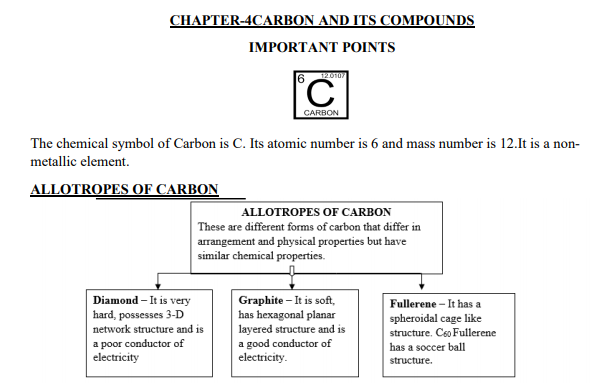
The chemical symbol of carbon is C. Its atomic number is 6 and its mass number is 12. It is a non-metallic element.
ALLOTROPES OF CARBON
Allotropes of carbon are different forms of carbon that differ in arrangement and physical properties but have similar chemical properties.
1. Diamond: very hard, has a 3-D network structure and is a poor conductor of electricity.
2. Graphite: soft, has a hexagonal planar layered structure and is a good conductor of electricity.
3. Fullerene: has a spheroidal cage like structure. C60 Fullerene has a soccer ball structure.
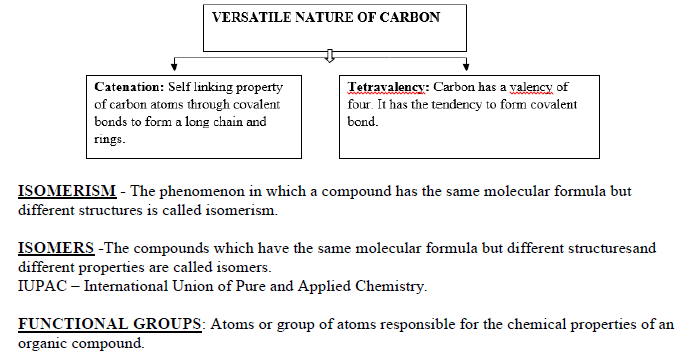
VERSATILE NATURE OF CARBON
1. Catenation: the self linking property of carbon atoms through covalent bonds to form long chains and rings.
2. Tetravalency: carbon has a valency of four. It has the tendency to form covalent bonds.
ISOMERISM AND ISOMERS
Isomerism is the phenomenon in which a compound has the same molecular formula but different structures.
Isomers are compounds which have the same molecular formula but different structures and different properties.
IUPAC stands for International Union of Pure and Applied Chemistry.
FUNCTIONAL GROUPS
A functional group is an atom or a group of atoms responsible for the chemical properties of an organic compound.
In a hydrocarbon chain, one or more hydrogens can be replaced by some other element. In such compounds, the element replacing hydrogen is referred to as a heteroatom.
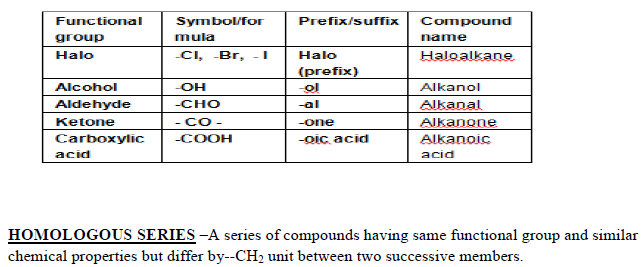
[Figure: Table of functional groups with the columns Functional group, Symbol/formula, Prefix/suffix and Compound name. Halo: -Cl, -Br, -I, prefix Halo, compound name Haloalkane. Alcohol: -OH, suffix -ol, compound name Alkanol. Aldehyde: -CHO, suffix -al, compound name Alkanal. Ketone: -CO-, suffix -one, compound name Alkanone. Carboxylic acid: -COOH, suffix -oic acid, compound name Alkanoic acid.]
ORGANIC COMPOUNDS AND HYDROCARBONS
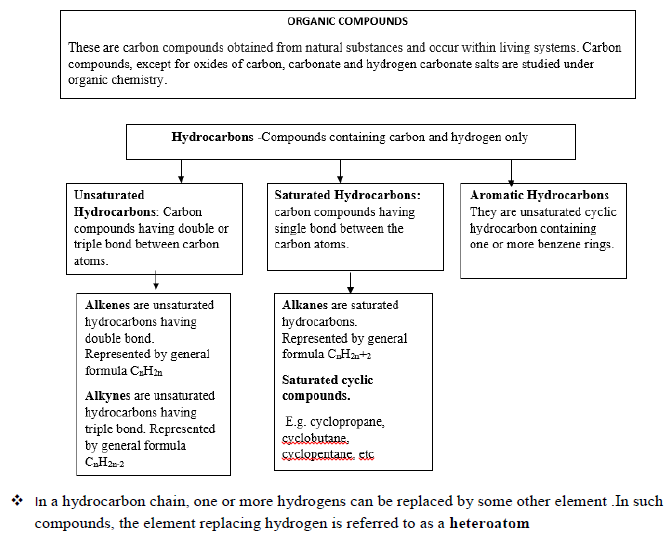
Organic compounds are carbon compounds obtained from natural substances and occur within living systems. Carbon compounds, except for oxides of carbon, carbonates and hydrogen carbonate salts, are studied under organic chemistry.
Hydrocarbons are compounds containing carbon and hydrogen only.
1. Unsaturated hydrocarbons: carbon compounds having a double or triple bond between carbon atoms.
i) Alkenes are unsaturated hydrocarbons having a double bond. They are represented by the general formula CnH2n.
ii) Alkynes are unsaturated hydrocarbons having a triple bond. They are represented by the general formula CnH2n-2.
2. Saturated hydrocarbons: carbon compounds having single bonds between carbon atoms.
i) Alkanes are saturated hydrocarbons, represented by the general formula CnH2n+2.
ii) Saturated cyclic compounds, for example cyclopropane, cyclobutane and cyclopentane.
3. Aromatic hydrocarbons: unsaturated cyclic hydrocarbons containing one or more benzene rings.
HOMOLOGOUS SERIES
A homologous series is a series of compounds having the same functional group and similar chemical properties, but differing by a -CH2 unit between two successive members.
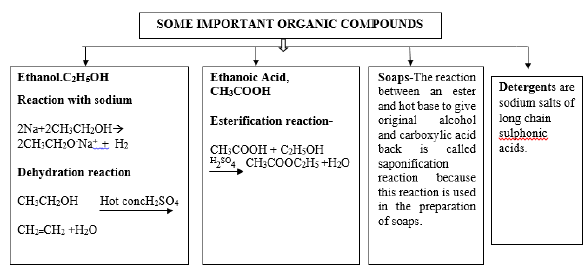
SOME IMPORTANT ORGANIC COMPOUNDS
1. Ethanol (C2H5OH)
i) Reaction with sodium: 2Na + 2CH3CH2OH → 2CH3CH2O-Na+ + H2
ii) Dehydration reaction: CH3CH2OH on heating with conc. H2SO4 gives CH2=CH2 + H2O
2. Ethanoic acid (CH3COOH)
i) Esterification reaction: CH3COOH + C2H5OH → (H2SO4) CH3COOC2H5 + H2O
3. Soaps
Soaps are the sodium or potassium salts of long chain carboxylic acids. The reaction between an ester and hot base to give original alcohol and carboxylic acid back is called saponification reaction, because this reaction is used in the preparation of soaps.
4. Detergents
Detergents are sodium salts of long chain sulphonic acids.
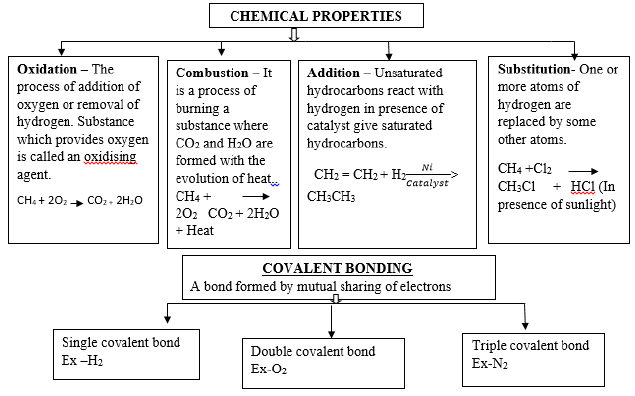
CHEMICAL PROPERTIES OF CARBON COMPOUNDS
1. Oxidation: the process of addition of oxygen or removal of hydrogen. A substance which provides oxygen is called an oxidising agent. Example: CH4 + 2O2 → CO2 + 2H2O
2. Combustion: the process of burning a substance where CO2 and H2O are formed with the evolution of heat. Example: CH4 + 2O2 → CO2 + 2H2O + Heat
3. Addition: unsaturated hydrocarbons react with hydrogen in the presence of a catalyst to give saturated hydrocarbons. Example: CH2=CH2 + H2 → (Ni catalyst) CH3CH3
4. Substitution: one or more atoms of hydrogen are replaced by some other atoms. Example: CH4 + Cl2 → CH3Cl + HCl (in presence of sunlight)
COVALENT BONDING
A covalent bond is a bond formed by mutual sharing of electrons.
1. Single covalent bond: example H2
2. Double covalent bond: example O2
3. Triple covalent bond: example N2
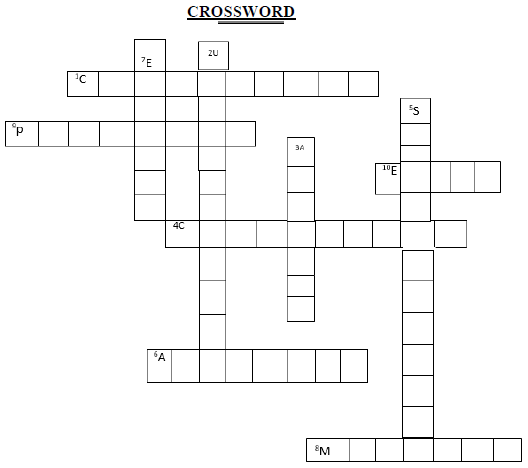
CROSSWORD
[Figure: Crossword grid with numbered cells, 1 to 10, to be solved with the clues below.]
Clues
1. Self linking property of carbon
4. Acid having functional group -COOH
6. Hydrogenation of vegetable oil is ---- reaction
8. Simplest hydrocarbon
9. IUPAC name of next higher homologous of ethanol
10. The substance used in making perfumes and flavoring agents
DOWN
2. Hydrocarbon burns in air with sooty flame.
3. The functional group present in methanol.
5. Chlorination of alkanes is -------- reaction
7. The active ingredient of all alcoholic drinks.
QUESTION BANK
Answer the following questions.
VERY SHORT ANSWER QUESTIONS (1 MARK)
1. Which of the following formulae represents a saturated hydrocarbon? [1 Mark]
CnH2n, CnH2n-2, CnH2n+2, CnH2n+1
Answer: CnH2n+2
1. A saturated hydrocarbon has only single bonds between carbon atoms.
2. Saturated hydrocarbons (alkanes) follow the general formula CnH2n+2.
3. Hence, the correct formula is CnH2n+2.
Teacher's Note:
a) Alkanes are the saturated hydrocarbons, so the formula must give the maximum number of hydrogen atoms.
b) The formula CnH2n belongs to alkenes, which have one double bond.
2. Draw the electron dot structure of Ethene. [1 Mark]
Answer:
Ethene has the molecular formula C2H4. Its electron dot structure is H × C :: C × H, with one hydrogen atom bonded to each carbon atom on the top and one on the bottom. Each carbon shares two electron pairs with the other carbon (a double bond) and one electron pair with each of its two hydrogen atoms.
Teacher's Note:
a) Each carbon atom has four valence electrons and needs four shared electrons to complete its octet.
b) The double bond between the two carbon atoms is shown by four shared electrons.
SHORT ANSWER QUESTIONS (2 MARKS)
1. Why is the conversion of ethanol to ethanoic acid an oxidation reaction? [2 Marks]
Answer:
1. Ethanol (C2H5OH) gains oxygen to form ethanoic acid (CH3COOH), so it is oxidised.
2. The reaction is brought about by an oxidising agent such as alkaline potassium permanganate or acidified potassium dichromate.
Teacher's Note:
a) Any reaction in which oxygen is added to a compound, or hydrogen is removed from it, is an oxidation reaction.
b) Ethanol to ethanoic acid is a classic example used in board questions.
2. What is meant by denatured alcohol? What is the need to denature alcohol? [2 Marks]
Answer:
1. Denatured alcohol is ethanol that has been made unfit for drinking by adding poisonous substances such as methanol, or a dye.
2. It is needed to prevent people from drinking alcohol meant for industrial use, and to avoid paying the high excise duty charged on drinking alcohol.
Teacher's Note:
a) Methanol makes the mixture poisonous and unfit for consumption.
b) Denatured spirit is widely used as a solvent and fuel in laboratories and industry.
c) The excise duty is the tax that makes drinking alcohol costly.
SHORT ANSWER QUESTIONS (3 MARKS)
1. An organic compound A of molecular formula C2H6O on heating with excess of conc. H2SO4 gives compound B of molecular formula C2H4. Compound B on reduction gives compound C of molecular formula C2H6. [3 Marks]
a) Name A, B and C.
Answer:
1. A is ethanol (C2H5OH).
2. B is ethene (C2H4).
3. C is ethane (C2H6).
Teacher's Note:
a) Ethanol is dehydrated by concentrated sulphuric acid to form ethene.
b) Ethene is reduced by hydrogen in the presence of nickel to give ethane.
c) Ethane is the saturated hydrocarbon with two carbon atoms.
b) Write the chemical equation for the conversion of A to B.
Answer: CH3CH2OH → (conc. H2SO4, 443 K) CH2=CH2 + H2O
Teacher's Note:
a) The temperature of 443 K is needed for the dehydration reaction.
b) Water is removed from one molecule of ethanol to form ethene.
c) What is the role of conc. H2SO4 in above equation?
Answer: Concentrated sulphuric acid acts as a dehydrating agent, because it removes the elements of water from ethanol.
Teacher's Note:
a) A dehydrating agent takes away water from a compound.
b) The same acid is used as a catalyst in esterification, which is a different reaction.
VALUE BASED QUESTION
Meera and her mother were travelling in a CNG auto. The auto driver took the auto to the CNG filling station for filling the empty cylinder. Meera asked her mother about the gas used to fill the cylinder. Her mother replied that the gas used was CNG. CNG is used in place of petrol or diesel because it is cheaper, pollution free and eco-friendly.
Answer the following questions
a) What is the long form of CNG?
Answer: The long form of CNG is Compressed Natural Gas.
Teacher's Note:
a) CNG is natural gas compressed at high pressure and stored in cylinders.
b) It is used as a fuel in vehicles.
b) Name the main constituent of CNG.
Answer: The main constituent of CNG is methane (CH4).
Teacher's Note:
a) Methane is the simplest hydrocarbon, with one carbon and four hydrogen atoms.
b) Burning methane produces mostly carbon dioxide and water, which is why CNG is cleaner.
c) What value have you learnt after reading the text?
Answer:
1. We should use clean and eco-friendly fuels to reduce air pollution.
2. Using CNG saves money as it is cheaper than petrol or diesel.
3. Everyone should take care of the environment in daily life.
Teacher's Note:
a) Choosing cleaner fuels is one simple way to protect the environment.
b) Cheaper fuel also helps families save money on daily travel.
LONG ANSWER QUESTIONS (5 MARKS)
1. An organic compound with molecular formula C2H4O2 produces brisk effervescence on addition of sodium carbonate / bicarbonate. [5 Marks]
a) Identify the organic compound.
Answer: The organic compound is ethanoic acid (acetic acid), CH3COOH.
Teacher's Note:
a) Ethanoic acid is the only common acid with this formula.
b) Carboxylic acids react with carbonates and bicarbonates to release carbon dioxide.
b) Name the gas evolved.
Answer: The gas evolved is carbon dioxide.
Teacher's Note:
a) The effervescence is caused by the bubbles of carbon dioxide.
c) How will you test the gas evolved?
Answer:
1. Pass the gas through lime water (calcium hydroxide solution).
2. The lime water turns milky, which confirms that the gas is carbon dioxide.
Teacher's Note:
a) Milkiness is due to the formation of insoluble calcium carbonate.
b) If the gas is passed for a long time, the milkiness disappears because soluble calcium hydrogen carbonate forms.
c) Do not confuse this test with the test for hydrogen, which is the burning splint test.
d) Write the chemical equation for the above reaction.
Answer:
1. With sodium carbonate: 2CH3COOH + Na2CO3 → 2CH3COONa + H2O + CO2
2. With sodium bicarbonate: CH3COOH + NaHCO3 → CH3COONa + H2O + CO2
Teacher's Note:
a) Balance the sodium carbonate equation with two molecules of acid.
b) Sodium acetate and water are the other products in both equations.
e) List two important uses of the above compound.
Answer:
1. It is used as vinegar, a 5 to 8 per cent solution, for preserving food and pickles.
2. It is used in the manufacture of esters, which are used in making perfumes and flavouring agents, and in the manufacture of solvents.
Teacher's Note:
a) Vinegar is a dilute solution of ethanoic acid in water.
b) Ethanoic acid is also used in the manufacture of rubber coagulants and medicines.
c) Esters made from ethanoic acid give fruity smells.
2. a) List two reasons for carbon forming a large number of compounds.
Answer:
1. Carbon shows catenation, which means carbon atoms can link with each other to form long chains and rings.
2. Carbon shows tetravalency, which means each carbon atom can form four covalent bonds with other atoms.
Teacher's Note:
a) Catenation is strongest in carbon among all elements.
b) Tetravalency allows carbon to bond with hydrogen, oxygen, nitrogen and other elements.
c) These two properties together explain the huge number of carbon compounds known.
b) Name the type of bonding found in most of the carbon compounds. Why does carbon form compounds mainly by this kind of bonding?
Answer:
1. The type of bonding is covalent bonding, which is formed by mutual sharing of electrons.
2. Carbon has four valence electrons, so it needs to gain or lose four electrons to get a stable octet. That is difficult, so carbon shares electrons instead.
Teacher's Note:
a) Ionic bonds need a transfer of four electrons, which requires a very large amount of energy.
b) Covalent bonds are formed by sharing, which is much easier for carbon.
c) Give reason.
(i) Carbon compounds generally have low melting and boiling points.
Answer: Carbon compounds are made of molecules held together by weak intermolecular forces, so only a small amount of energy is needed to melt or boil them.
Teacher's Note:
a) The covalent bonds inside a molecule are strong, but the forces between molecules are weak.
b) This is why many carbon compounds exist as liquids or gases at room temperature.
(ii) Carbon compounds do not conduct electricity.
Answer: Carbon compounds do not have free ions or free electrons that can carry electric current, because their atoms are bonded by shared electrons.
Teacher's Note:
a) Graphite is an exception, because it has free electrons in its layered structure.
b) Molecular compounds do not form ions when dissolved, so their solutions also fail to conduct electricity.
MULTIPLE CHOICE QUESTIONS
1. Vinegar is a solution of [1 Mark]
(a) 50% - 60% acetic acid in alcohol
(b) 5% - 8% acetic acid in alcohol
(c) 5% - 8% acetic acid in water
(d) 50% - 60% acetic acid in water
Answer: (c) 5% - 8% acetic acid in water
1. Vinegar is a dilute solution of acetic acid.
2. Acetic acid is dissolved in water, not in alcohol.
3. Hence, the correct option is (c).
Teacher's Note:
a) Glacial acetic acid is the pure form, and it is far more concentrated than vinegar.
b) Vinegar is safe to eat, so it must be a dilute water based solution.
2. On adding NaHCO3 to acetic acid, a gas is evolved which turns lime water milky due to formation of [1 Mark]
(a) Calcium bicarbonate
(b) Calcium hydroxide
(c) Calcium carbonate
(d) Calcium acetate
Answer: (c) Calcium carbonate
1. The gas evolved is carbon dioxide.
2. Carbon dioxide reacts with lime water to form insoluble calcium carbonate.
3. Hence, the correct option is (c).
Teacher's Note:
a) The milkiness is caused by the solid calcium carbonate particles.
b) Calcium hydroxide is the lime water itself, so it is not the product.
3. Dilute acetic acid was added to the four test tubes containing the following chemical. [1 Mark]
i. KOH ii. NaHCO3 iii. K2CO3 iv. NaCl
Brisk effervescence was observed in test tubes
a) i & ii
b) ii & iii
c) i & iv
d) ii & iii
Answer: (b) ii & iii
1. Acetic acid reacts with carbonates and bicarbonates to give carbon dioxide, which causes effervescence.
2. NaHCO3 and K2CO3 are carbonate and bicarbonate salts, so brisk effervescence is seen.
3. Hence, the correct option is (b).
Teacher's Note:
a) KOH only gives a neutralisation reaction, which has no visible gas.
b) NaCl does not react with acetic acid, so no effervescence is seen.
c) Options (b) and (d) are printed with the same text in the paper. The correct pair is ii and iii, which is option (b).
4. Few drops of ethanoic acid was added to solid sodium carbonate. The observation made was that [1 Mark]
a) A pungent smelling gas evolved
b) Brown fumes evolved
c) Brisk effervescence occurred
d) A hissing sound was evolved
Answer: (c) Brisk effervescence occurred
1. Ethanoic acid reacts with sodium carbonate to form sodium ethanoate, water and carbon dioxide.
2. Carbon dioxide escapes as bubbles, which is seen as brisk effervescence.
3. Hence, the correct option is (c).
Teacher's Note:
a) Brown fumes come from nitrogen dioxide, which is not formed in this reaction.
b) A pungent gas would indicate a different acid, not the reaction with a carbonate.
5. 2 ml of acetic acid was added in drops to 5 ml of water. It was noticed that: [1 Mark]
a) A pink and clear solution was formed.
b) Water formed a separate layer on the top of the acid.
c) A clear and homogeneous solution was formed.
d) The acid formed a separate layer on the top of water.
Answer: (c) A clear and homogeneous solution was formed.
1. Acetic acid is miscible with water in all proportions.
2. So the two liquids mix completely and form one uniform layer.
3. Hence, the correct option is (c).
Teacher's Note:
a) Layers form only when two liquids are immiscible, such as oil and water.
b) Acetic acid has a polar -COOH group, which mixes well with water.
PRACTICAL BASED QUESTIONS (2 MARKS)
1. 1 ml glacial acetic acid and 1 ml of ethanol are mixed together in a test tube. Few drops of concentrated sulphuric acid is added in the mixture and are warmed in a water bath for 5 min. [2 Marks]
a) Name the resultant compound formed.
Answer: The resultant compound is ethyl ethanoate (ethyl acetate), CH3COOC2H5.
Teacher's Note:
a) This is an ester, formed from an acid and an alcohol.
b) Concentrated sulphuric acid acts as a catalyst and removes water.
b) Represent the above change by a chemical equation.
Answer: CH3COOH + C2H5OH → (conc. H2SO4) CH3COOC2H5 + H2O
Teacher's Note:
a) The reaction is reversible, so the ester can break back into acid and alcohol.
b) Water is the second product in this equation.
c) What term is given to such a reaction?
Answer: Such a reaction is called an esterification reaction.
Teacher's Note:
a) Esterification is the reaction between an alcohol and a carboxylic acid.
b) The reverse of this reaction is called hydrolysis.
d) What are the special characteristics of the compound formed?
Answer:
1. The compound has a pleasant, fruity smell.
2. It is insoluble in water and forms a separate layer on top of it.
Teacher's Note:
a) Esters are used in making perfumes and flavouring agents.
b) Esters have low boiling points and are volatile.
2. An organic compound with molecular formula C2H4O2 produces brisk effervescence on addition of sodium carbonate / bicarbonate. [2 Marks]
a) Identify the organic compound.
Answer: The organic compound is ethanoic acid (acetic acid), CH3COOH.
Teacher's Note:
a) This is the same compound as in the long answer question on the same formula.
b) The brisk effervescence confirms the presence of the carboxylic acid group.
b) Name the gas evolved.
Answer: The gas evolved is carbon dioxide.
Teacher's Note:
a) Carbon dioxide turns lime water milky.
b) The gas does not burn and does not support combustion.
Free study material for Science
Science Class 10 Exam Resources: Chapter 04 Carbon and Its Compound
Comprehensive Study Resources for Chapter 04 Carbon and Its Compound
Explore essential learning tools for Class 10 Science Chapter 04 Carbon and Its Compound. This curated collection features in-depth notes and targeted practice questions built around the active 2026 curriculum to streamline your daily revision.
Understanding Marking Schemes
Designed around the official curriculum, these study guides guarantee standard compliance. Reviewing step-by-step solutions clarifies complex sub-topics within Chapter 04 Carbon and Its Compound and demystifies standard marking schemes for Science evaluations.
Complete Revision for Science
Maximize your grade potential by utilizing Class 10 Science practice papers in tandem with these structured notes. All printable assignments and interactive mock tests on our platform are updated for the 2026 session and available free of charge.
FAQs
Our advanced study package for Chapter 04 Carbon and Its Compound includes detailed concepts, diagrams, Mind Maps, and explanation of complex topics to ensure Class 10 students learn as per syllabus for 2026 exams.
The Mind Maps provided for Chapter 04 Carbon and Its Compound act as visual anchors which will help faster recall during high-pressure exams.
Yes, teachers use our Class 10 Science resources for lesson planning as they are in simple language and have lot of solved examples.
Yes, You can download the complete, mobile-friendly PDF of the Science Chapter 04 Carbon and Its Compound advanced resources for free.
Yes, our subject matter experts have updated the Chapter 04 Carbon and Its Compound material to align with the rationalized NCERT textbooks and have removed deleted topics and added new competency-based questions.