

Download CBSE Class 10 Science Useful Resources
Explore structured advanced study materials through the CBSE Class 10 Science Control And Coordination. Tailored for Class 10 learners, utilizing these Science resources ensures thorough preparation and strengthens foundational knowledge before final CBSE evaluations.
Access CBSE Study Guides and Summaries
View or download the dedicated CBSE Class 10 Science Control And Coordination resource below. Engaging with these advanced study guides under focused conditions ensures continuous academic progress and mastery of the 2026-27 curriculum for Chapter 06 Control and Coordination.
CONTROL AND COORDINATION
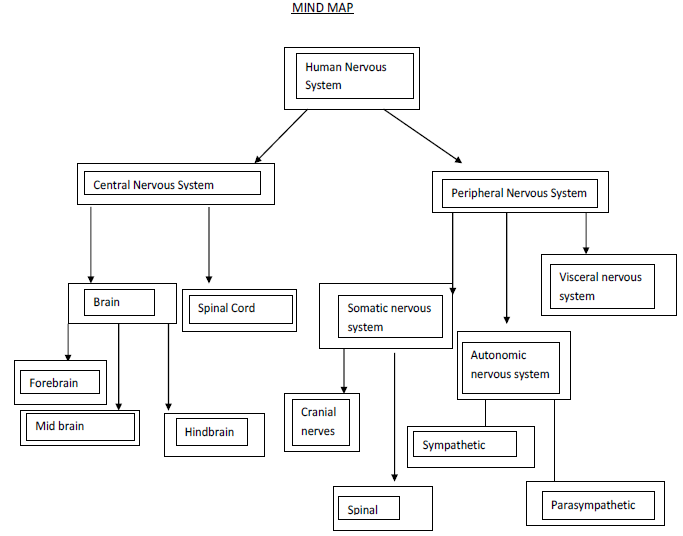
Stimulus:-The change in the environment to which an organism respond and react is called stimulus. Control & co-ordination in animals takes place by :-a) Nervous system) Hormonal system (Endocrine glands)
Parts of Nervous system:-a) Brain b) Spinal cord c) Nerves
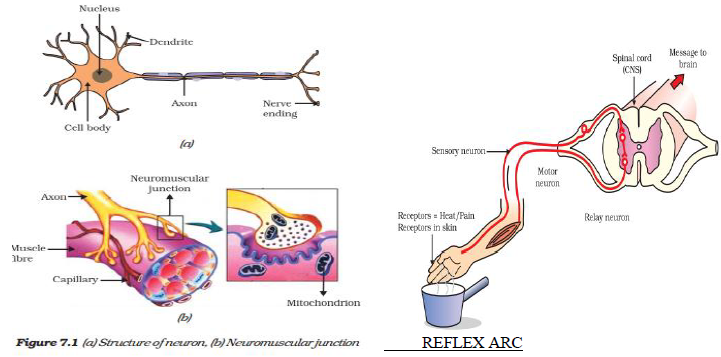
Neuron:-Is the structural and functional unit of Nervous system
Parts of Neuron:-a) Dendrites, b) cell body c) Axon
Synapse:-Junction between two adjacent nerves
Reflex action- spontaneous, involuntary and automatic response to a stimulus to protect us from harmful situations.
E.g. On touching a hot objects unknowingly we instantly withdraw our hand.
Nervous system-(1) Central Nervous System (CNS)
(2) Peripheral Nervous System (PNS)
(i) Autonomic Nervous System (ii) Voluntary Nervous System
Brain (i) Centre of coordination of all activities (ii) Thinking is involved (iii) Complex process
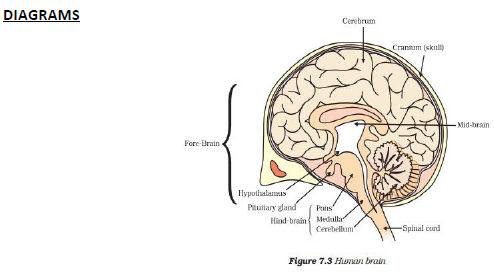
Parts of Brain-
Fore brain Cerebrum - (i) Main thinking and largest part of the brain.
(ii) It has 3 main areasa.
a. Sensory area- to receive impulses from sense organs via Receptors
b. Motor area- control voluntary movements
c. Association areas- Reasoning, learning & intelligence.
Thalamus- It relays sensory information to the cerebrum.
Hypothalamus- It forms the link between Nervous system & Endocrine system
Mid brain- It connects fore brain and hind brain
Hind Brain- connects the fore brain and hind brain
Cerebellum- controls & coordinates muscular movements, maintaining body posture and equilibrium.
Pons- acts as a bridge between brain and spinal cord
Medulla Oblongata- Controls involuntary actions like blood pressure, salivation, vomiting etc.
Spinal cord: - cylindrical or tubular structure is extending downwards from the medulla oblongata.
Protection of the brain & the spinal cord-
(i) Bony outer covering: skull for the brain and vertebral column for the spinal cord.
(ii) Cerebrospinal fluid present in between the three membranes.
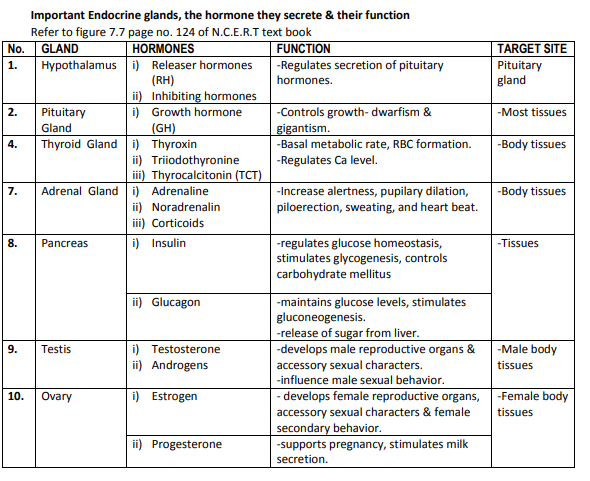
Hormones- (i) are chemical messenger secreted by endocrine glands
(ii) Are secreted in small amounts & may act in nearby places or distant places.
(iii) do not take part in the reaction & are destroyed immediately.
Important Endocrine glands, the hormone they secrete & their function
Coordination in plants- only chemical coordination is present in plants.
Tropic movements- the movements of plants in the direction of stimulus (positive) or away
from it (negative) are called tropic movements. E.g. Phototropism, Geotropism, Chemotropism.
Plant hormones (Phytohormones)

1. Name the hormone which helps in regulating sugar level in our blood? Name the gland which secretes this hormone?
2. State the main function of abscisic acid
3. Write name of three hormones secreted by the pituitary gland
4. Mention one example of chemotropism.
Question. Which of the following is not a plant harmone?
(A) Auxin
(B) Gibberellins
(C) Cytokinin
(D) Adrenaline
Answer : D
Question. Choose the right option from the following.
i. In light, hormone auxin, helps the cells to grow longer in plants.
ii. Plant hormone gibberellins helps in growth of a stem.
iii. Cytokininis inhibits cell division.
iv. Abscisic acid promote growth in plants.
(A) i and iii are correct
(B) ii and iv are correct
(C) i and ii are correct
(D) i and iv are correct
Answer : C
Question. The two hormones secreted by adrenal glands which regulates the concentration of salts in blood and prepares the body to face the emergency are .................and ..................
(A) Insulin and Glucagon
(B) Testosterone and Estrogen
(C) Cortisone and Dopamine
(D) Cortitisone and Adrenaline
Answer : D
Question. The essential hormome for ripening of fruits is :
(A) Auxin
(B) Cytokinin
(C) Ethylene
(D) Gibberellin
Answer : C
Question. Cut leaves remain green for longer time if dipped in :
(A) Auxins
(B) Cytokinins
(C) Ethylene
(D) Gibberellins
Answer : B
Question. Neurons have a unique property that makes them to communicate with other cells via :
(A) Nerve cords
(B) Glial cells
(C) Synapses
(D) Schwann cells
Answer : C
Question. Which one is anti transpirant hormones ?
(A) Auxin
(B) Cytokinin
(C) Abscisic Acid
(D) Gibberellin
Answer : C
Question. Which one of the following is secreted by pituitary gland?
(A) Insulin
(B) Estrogen
(C) Adrenaline
(D) Growth hormone
Answer : D
Question. One of the basic characteristics of living organisms which is well developed in nervous system is :
(A) Movement
(B) Growth
(C) Irritability
(D) Nutrition
Answer : C
Question. If a person cannot walk in a straight line or cannot balance a ride on bicycle, probably which part of his brain is not working properly ?
(A) Cerebrum
(B) Cranium
(C) Cerebellum
(D) Hypothalamus
Answer : C
Question. Lack of melanin synthesis may cause the genetic disorder.
(A) Colour blindness
(B) Haemophilia
(C) Albinism
(D) Hypertrichosis
Answer : C
Question. Hormone which stimulate initiation of flowering process is :
(A) Gibberellin
(B) Ethylene
(C) Vernalin
(D) Florigen
Answer : D
Question. Choose the corret alternate in which the type of tropism exhibited by plants is correctly matched with the stimulus to which they respond
Tropism Stimulus
1) Hydrotropsin i) Earth
2) Geotropism ii) Light
3) Chemotropism iii) Water
4) Phototropism iv) Chemical
(A) 1 – ii, 2 – i, 3 – iv, 4 – iii
(B) 1 – iii, 2 – i, 3 – iv, 4 – ii
(C) 1 – iv, 2 – iii, 3 – i , 4 – ii
(D) 1 – iii, 2 – i , 3 – ii, 4 – iv
Answer : B
Question. Which two of the following are growth promoting hormones in plant ?
(A) Auxin and Cytokinin
(B) Gibberelin and Ethylene
(C) Abscisic acid and Auxin
(D) Cytokinin and Ethylene
Answer : A
Question. Which part of the brain controls co-ordinated movements of our body, such as riding a bicycle ?
(A) Cerebrum
(B) Cerebellum
(C) Medulla
(D) Pons
Answer : B
Question. The functional junction between two neurons is called
(A) synapse
(B) axon
(C) dendrites
(D) none of these
Answer : A
Question. The correct order of the parts of a nerve cell through which a nerve impulse is transmitted is.
(A) Nerve endings-dendrites-axon-cell body
(B) Cell body-axon-dendrites -nerve endings
(C) Dendrites-nerve endings-cell body axon
(D) Dendrites - cell body-axon-nerve endings
Answer : D
Question. Which is the largest endocrine gland in human beings.
(A) Pituitary
(B) Adrenal
(C) Thyroid
(D) Parathyroid
Answer : C
Question. Which of the following ion is needed for nerve conduction?
(A) Ca
(B) Zn
(C) Mg
(D) Na
Answer : D
Question. When we smell a flower, which one of the following first receives the scent?
(A) Dendrite of motor neur on
(B) Dendrite of sensory neuron
(C) Axon of motor neuron
(D) Axon of sensory neuron
Answer : B
Question. Show the pathway of electric impulse :
(A) Dendrite → Cell body → Axon → to its end
(B) Cell body → Dendrite → Axon → to its end
(C) Axon → Cell body → Dendrite → to. its end
(D) Dendrite → Axon → Cell body → to its end
Answer : A
Question. The systematic regulation of various activities means :
(A) Control
(B) Co-ordiantion
(C) Taming
(D) Randomness
Answer : B
Question. Which is the hormone that brings about changes in girls during puberty?
(A) Estrogen
(B) Progesterone
(C) Testosterone
(D) Thyroxine
Answer : A
Question. If the apical parts of the negative geotropic roots of mangrove plant are pasted with wax, which function of these roots will be affected ?
(A) Exchange of O2 and CO2
(B) Water absorption
(C) Fixation of plant
(D) Photosynthesis
Answer : A
Question. In plants abscisic acid controls
(A) growth in shoot
(B) flower formation
(C) cell division
(D) fall of leaf
Answer : D
SHORT ANSWER TYPE QUESTIONS
1. Name the following:
a)Necessary for thyroid glands
b) Necessary to maintain sugar level of the body
2) Draw the diagram of a nerve cell and label the following on it:(a) Nucleus (b) Dendrites
3) How does our body maintain blood sugar level?
SHORT ANSWER QUESTIONS
1. A compound of iodine is compulsorily added to common salt in small quantity.
(a) Why is it important for us to have iodised salt in our diet.
(b) Name the disease caused by its deficiency.
(c) Write the symptoms of the disease.
2. What is reflex action? Describe the steps involved in reflex action.
3) Name the following: Response of plants to light, chemical and water.
VALUE BASED QUESTION
Ritesh is fond of eating pickles. As he hears the name of pickles, watering starts in his mouth. His friends used to make fun of him. When the same process or event was executed to the dog of Ristesh, the result was different. Now answer the following questions:
(i) What is the biological term for the watering of Ritesh in his mouth?
(ii)Why did the dog of Ritesh not water from mouth in the same events?
(iii)What is the value shown by his friends?
LONG ANSWER QUESTIONS
1. Name the plant growth hormone which is synthesized at the shoot tip. Explainbriefly why a plant bends towards light during its growth.
2. Draw the diagram of human brain and label the parts. Write the function of cerebellum and pons 3. What is reflex action? Describe the steps involved in reflex action.
4) Name the following: Response of plants to light, chemical and water.
Please click the link below to download CBSE Class 10 Science-Control And Coordination.
Free study material for Science
Science Class 10 Exam Resources: Chapter 06 Control and Coordination
Comprehensive Study Resources for Chapter 06 Control and Coordination
Review targeted study resources for Chapter 06 Control and Coordination tailored for Class 10 learners. Utilizing these structured notes and quick-revision tools ensures complete alignment with current CBSE evaluation standards.
Understanding Marking Schemes
Each resource draws directly from authorized textbooks to maintain academic accuracy. Evaluating solved examples allows Class 10 students to master the formal presentation and answer-writing standards expected in upcoming school exams.
Complete Revision for Science
For peak performance in upcoming evaluations, integrate official Science sample papers directly into your study schedule. Follow up your revision by attempting online MCQ tests for Chapter 06 Control and Coordination to refine calculation speed and precision.
FAQs
Our advanced study package for Chapter 06 Control and Coordination includes detailed concepts, diagrams, Mind Maps, and explanation of complex topics to ensure Class 10 students learn as per syllabus for 2026 exams.
The Mind Maps provided for Chapter 06 Control and Coordination act as visual anchors which will help faster recall during high-pressure exams.
Yes, teachers use our Class 10 Science resources for lesson planning as they are in simple language and have lot of solved examples.
Yes, You can download the complete, mobile-friendly PDF of the Science Chapter 06 Control and Coordination advanced resources for free.
Yes, our subject matter experts have updated the Chapter 06 Control and Coordination material to align with the rationalized NCERT textbooks and have removed deleted topics and added new competency-based questions.