

Advanced Study Material for Class 10 Science: Elementry Idea of Bonding
Explore structured advanced study materials through the Class 10 Science Elementry Idea of Bonding Exam Notes. Tailored for Class 10 learners, utilizing these Science resources ensures thorough preparation and strengthens foundational knowledge before final CBSE evaluations.
Practice Class 10 Science Resources: Elementry Idea of Bonding
Access the complete useful resource PDF for Class 10 Science below. Regular practice with these targeted academic notes builds familiarity with complex topics and helps secure higher marks in final school evaluations.
Class 10 Science Elementry Idea of Bonding Exam Notes. Please refer to the examination notes which you can use for preparing and revising for exams. These notes will help you to revise the concepts quickly and get good marks.
Introduction
We know that different elements have different atomic numbers and electronic configurations. The properties of atoms depend upon their electronic configurations. Some atoms are more reactive than others. Noble gas (He, Ne, Ar, Kr, Xe and Rn) atoms are not reactive at all; they are inert and stable. Then the question arises why noble gases do not react to form compounds, while other elements do so? This can be answered by comparing the electronic configurations of noble gases with those of other elements. Also, it is important to understand how and why atoms react to form molecules and compounds. Atoms gain electrons in their outermost shells or lose them from their outermost shells, or share electrons with other atoms in such a way that their outermost shells become filled to capacity. They can do this by reacting with other atoms. As long as the outermost shell can accommodate more electrons, i.e., it is not full, an atom tends to combine with other atoms in order to fill its outermost shell. When the outermost shell is filled to capacity, the atom becomes stable.
The atoms of all other elements (elements other than the noble gases) have in their outermost shells less than 8 electrons, i.e., their outermost shells are not filled to capacity. Therefore, the atoms of these elements combine with other atoms to achieve stable configurations like those of the noble gases. It is the tendency on the part of an atom to achieve a stable configuration (like that of the noble gases) which is responsible for its chemical reactivity.
Bonds
We know that an atom tends to attain stability by acquiring the electronic configuration of its nearest noble gas. This can be achieved in anyone of the following manners during chemical combination:
1.By the transfer of electron(s) from one atom to another
2.By the sharing of valence electrons between the two combining atoms
There must be some kind of force which binds the atoms together in a molecule. The attractive force which holds together two atoms, two molecules, two ions or a combination of these is known as a chemical bond.
The two modes of attaining the electronic configuration of the nearest noble gas give rise to two types of bonds-the electrovalent bond and the covalent bond.
The Electrovalent Bond :
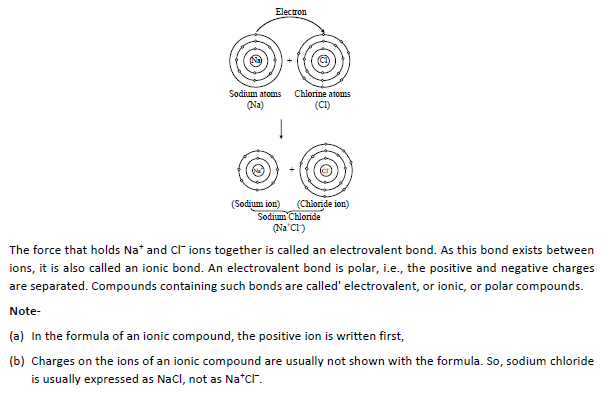
In this type of bond, valence electrons are transferred from one atom to another. One atom donates its excess electrons to another atom so that both the atoms may acquire a stable noble gas configuration. The atom which loses electron becomes positively charged and is called the cation. The atom which takes up the electron lost by the first atom becomes negatively charged and is called the anion. These two oppositely charged ions are now held together by an electrostatic force of attraction. This force of attraction binding the two atoms together is known as an electrovalent or ionic bond.
Thus, the chemical bond formed between two atoms by the transfer of one or more valence electrons from one atom to the other is known as an electrovalent or ionic bond.It is also called a polar bond.


Please click on below link to download pdf file for Class 10 Science Elementry Idea of Bonding Exam Notes.
Free study material for Science
Science Class 10 Exam Resources: Elementry Idea of Bonding
Core Study Kit: Class 10 Science Elementry Idea of Bonding
Access comprehensive study material for Elementry Idea of Bonding, including revision notes, concept maps, and high-probability questions. These resources are designed in alignment with the latest 2026 CBSE syllabus for Class 10 Science to support effective exam preparation.
NCERT-Aligned Solutions for Elementry Idea of Bonding
Each resource draws directly from authorized textbooks to maintain academic accuracy. Evaluating solved examples allows Class 10 students to master the formal presentation and answer-writing standards expected in upcoming school exams.
Next Steps in Your Exam Preparation
For peak performance in upcoming evaluations, integrate official Science sample papers directly into your study schedule. Follow up your revision by attempting online MCQ tests for Elementry Idea of Bonding to refine calculation speed and precision.
FAQs
Our advanced study package for Elementry Idea of Bonding includes detailed concepts, diagrams, Mind Maps, and explanation of complex topics to ensure Class 10 students learn as per syllabus for 2026 exams.
The Mind Maps provided for Elementry Idea of Bonding act as visual anchors which will help faster recall during high-pressure exams.
Yes, teachers use our Class 10 Science resources for lesson planning as they are in simple language and have lot of solved examples.
Yes, You can download the complete, mobile-friendly PDF of the Science Elementry Idea of Bonding advanced resources for free.
Yes, our subject matter experts have updated the Elementry Idea of Bonding material to align with the rationalized NCERT textbooks and have removed deleted topics and added new competency-based questions.