

Official CBSE Study Materials for Class 10 Science
Review targeted academic resources with the CBSE Class 10 Science Electricity Notes. Built according to official CBSE standards for the 2026-27 term, these downloadable Class 10 Science study materials support effective daily practice and deeper conceptual understanding for Chapter 11 Electricity.
Advanced Resources for Science
Access the complete useful resource PDF for Class 10 Science below. Regular practice with these targeted academic notes builds familiarity with complex topics and helps secure higher marks in final school evaluations.
CBSE Class 10 Science Electricity Notes. There are many more useful educational material which the students can download in pdf format and use them for studies. Study material like concept maps, important and sure shot question banks, quick to learn flash cards, flow charts, mind maps, teacher notes, important formulas, past examinations question bank, important concepts taught by teachers. Students can download these useful educational material free and use them to get better marks in examinations. Also refer to other worksheets for the same chapter and other subjects too. Use them for better understanding of the subjects.
ELECTRICITY
Electricity is a general term that encompasses a variety of phenomena resulting from the presence and flow of electric charge. These include many easily recognizable phenomena such as lightning and static electricity, but in addition, less familiar concepts such as the electromagnetic field and electromagnetic induction.
Electric charge
Electric charge is a fundamental conserved property of some subatomic particles, which determines their electromagnetic interaction. Electrically charged matter is influenced by, and produces, electromagnetic fields. The interaction between a moving charge and an electromagnetic field is the source of the electromagnetic force, which is one of the four fundamental forces. Electric charge is conserved, additive and quantised. The S.I. unit of electric charge is ‘C’ coulomb. Any other charged body will have a charge Q
Q = ne
where n is the number of electrons and e is the charge on electron = 1.6 x 10⁻¹⁹ coulombs.
Electric current
Electric current is a flow of electrons in a conductor such as a metal wire. Electric current is expressed by the amount of charge flowing through a particular area in unit time. In other words, it is the rate of flow of electric charges. In circuits using metallic wires, electrons constitute the flow of charges. However, electrons were not known at the time when the phenomenon of electricity was first observed. So, electric current was considered to be the flow of positive charges and the direction of flow of positive charges was taken to be the direction of electric current. Conventionally, in an electric circuit the direction of electric current is taken as opposite to the direction of the flow of electrons, which are negative charges. The magnitude of electric current in a conductor is the amount of electric charge passing through a given point of conductor in 1 second.
I =Q/t
S.I. unit of electric current is ‘A’ (Ampere).
The electric current is expressed by a unit called ampere (A), named after the French scientist, Andre-Marie Ampere (1775–1836).
One Ampere
When 1 coulomb of charge flows through any cross-section of a conductor in 1 second, the electric charge flowing through it is said to be 1 ampere. Smaller unit current is milliampere(mA) and microampere( A)
1 mA = 10–3A
1 μA = 10–6A
An instrument called ammeter measures electric current in a circuit. It is always connected in series in a circuit through which the current is to be measured. The direction of electric current is from positive terminal to negative terminal through the electric circuit.
1. What does an electric circuit mean?
Ans. An electric circuit consists of electric devices, switching devices, source of electricity, etc. that are connected by conducting wires.
2. Define the unit of current.
Ans. The unit of electric current is ampere (A). 1 A is defined as the flow of 1 C of charge through a wire in 1 s.
3. Calculate the number of electrons constituting one coulomb of charge.
Ans. One electron possesses a charge of 1.6 × 10⁻¹⁹ C, i.e., 1.6 × 10⁻¹⁹ C of charge is contained in 1 electron.

Potential difference
Potential difference, VA – VB between two points A and B is the work done per unit charge in taking a charge from B to A.
Potential difference,  re VA is potential at point A, VB is
potential at point B and S.I. unit of potential is volts (V), named after Alessandro Volta (1745–1827), an Italian physicist.
Electric Potential
Electric Potential at a point is defined as the work done per unit charge in bringing a charge from infinity to that point.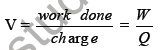
The potential difference is measured by means of an instrument called the voltmeter. The voltmeter is always connected in parallel across the points between which the potential difference is to be measured.
One volt: The potential difference between two points is said to be 1 volt if 1 joule of work is done in moving 1 coulomb of electric charge from one point to the other. Electrons always flow from lower potential to higher potential.
1. Name a device that helps to maintain a potential difference across a conductor.
Ans. A source of electricity such as cell, battery, power supply, etc. helps to maintain a potential difference across a conductor.
2. What is meant by saying that the potential difference between two points is 1 V?
Ans. If 1 J of work is required to move a charge of amount 1 C from one point to another, then it is said that the potential difference between the two points is 1 V.
3. How much energy is given to each coulomb of charge passing through a 6 V battery?
Please click the link below to download CBSE Class 10 Science Electricity Notes.
Free study material for Science
Science Class 10 Exam Resources: Chapter 11 Electricity
Comprehensive Study Resources for Chapter 11 Electricity
Access comprehensive study material for Chapter 11 Electricity, including revision notes, concept maps, and high-probability questions. These resources are designed in alignment with the latest 2026 CBSE syllabus for Class 10 Science to support effective exam preparation.
Understanding Marking Schemes
Each resource draws directly from authorized textbooks to maintain academic accuracy. Evaluating solved examples allows Class 10 students to master the formal presentation and answer-writing standards expected in upcoming school exams.
Complete Revision for Science
Maximize your grade potential by utilizing Class 10 Science practice papers in tandem with these structured notes. All printable assignments and interactive mock tests on our platform are updated for the 2026 session and available free of charge.
FAQs
Our advanced study package for Chapter 11 Electricity includes detailed concepts, diagrams, Mind Maps, and explanation of complex topics to ensure Class 10 students learn as per syllabus for 2026 exams.
The Mind Maps provided for Chapter 11 Electricity act as visual anchors which will help faster recall during high-pressure exams.
Yes, teachers use our Class 10 Science resources for lesson planning as they are in simple language and have lot of solved examples.
Yes, You can download the complete, mobile-friendly PDF of the Science Chapter 11 Electricity advanced resources for free.
Yes, our subject matter experts have updated the Chapter 11 Electricity material to align with the rationalized NCERT textbooks and have removed deleted topics and added new competency-based questions.