

Class 10 Science Study Guide: CBSE Class 10 Science Chemical Reactions And Equations
Access comprehensive study materials and useful resources for Chapter 01 Chemical Reactions and Equations using the CBSE Class 10 Science Chemical Reactions And Equations. Designed to align with the 2026-27 CBSE academic guidelines, these advanced resources help Class 10 Science students reinforce core concepts beyond standard textbooks.
Download Chapter 01 Chemical Reactions and Equations Study Material PDF
View or download the dedicated CBSE Class 10 Science Chemical Reactions And Equations resource below. Engaging with these advanced study guides under focused conditions ensures continuous academic progress and mastery of the 2026-27 curriculum for Chapter 01 Chemical Reactions and Equations.
CBSE Class 10 Science Chemical Reactions And Equations. There are many more useful educational material which the students can download in pdf format and use them for studies. Study material like concept maps, important and sure shot question banks, quick to learn flash cards, flow charts, mind maps, teacher notes, important formulas, past examinations question bank, important concepts taught by teachers. Students can download these useful educational material free and use them to get better marks in examinations. Also refer to other worksheets for the same chapter and other subjects too. Use them for better understanding of the subjects.
TERM I
CHAPTER 1 - CHEMICAL REACTIONS AND EQUATIONS
1. During chemical reactions, chemical composition of substances changes or new substances are formed.
Answer:
1. A chemical change involves the transformation of reactants into new substances with entirely different properties.
2. Bonds between atoms in reactants are broken, and new bonds are formed to create products.
Teacher's Note:
a) Chemical reactions involve breaking and making of chemical bonds.
b) Physical state changes do not necessarily indicate a chemical reaction.
2. Chemical reactions can be written in chemical equation form which should be always balanced.
Answer:
1. A chemical equation represents a chemical reaction using symbols and chemical formulas of reactants and products.
2. It must be balanced to satisfy the Law of Conservation of Mass, ensuring the total number of atoms of each element is equal on both sides.
Teacher's Note:
a) Mass can neither be created nor destroyed in a chemical reaction.
b) Coefficients are adjusted to balance atoms, never change the subscripts in chemical formulas.
3. Types of Chemical Reactions
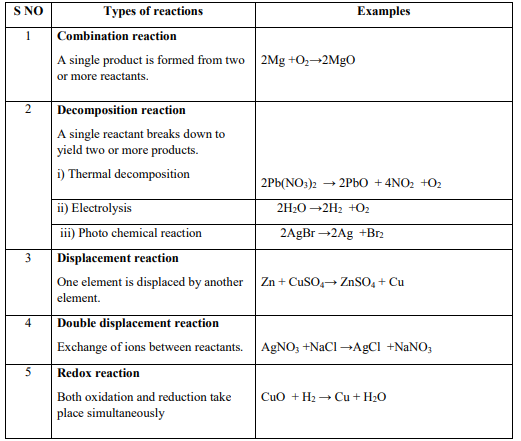
| S NO | Types of reactions | Examples |
|---|---|---|
| 1 | Combination reaction A single product is formed from two or more reactants. | 2Mg + O2 → 2MgO |
| 2 | Decomposition reaction A single reactant breaks down to yield two or more products. i) Thermal decomposition ii) Electrolysis iii) Photo chemical reaction | 2Pb(NO3)2 → 2PbO + 4NO2 + O2 2H2O → 2H2 + O2 2AgBr → 2Ag + Br2 |
| 3 | Displacement reaction One element is displaced by another element. | Zn + CuSO4 → ZnSO4 + Cu |
| 4 | Double displacement reaction Exchange of ions between reactants. | AgNO3 + NaCl → AgCl + NaNO3 |
| 5 | Redox reaction Both oxidation and reduction take place simultaneously. | CuO + H2 → Cu + H2O |
Answer:
1. Reactions are classified based on how reactants interact to form products.
2. Combination and decomposition are opposites, while displacement involves reactivity series.
Teacher's Note:
a) Learn standard equations for each reaction type.
b) Note that silver bromide decomposes in sunlight, which is used in black and white photography.
4. (i) Exothermic reaction: A chemical reaction in which heat energy is evolved.
C + O2 → CO2 (g) + heat
(ii) Endothermic reaction: A chemical reaction in which heat energy is absorbed.
ZnCO3 + Heat → ZnO + CO2
Answer:
1. Exothermic reactions release thermal energy, increasing the surrounding temperature.
2. Endothermic reactions absorb thermal energy from the surroundings, causing cooling or requiring continuous heating.
Teacher's Note:
a) Combustion and respiration are classic examples of exothermic processes.
b) Thermal decomposition reactions are typically endothermic.
5. Redox reaction: Chemical reaction in which both oxidation and reduction take place simultaneously.
Answer:
1. Oxidation involves the gain of oxygen or loss of electrons.
2. Reduction involves the loss of oxygen or gain of electrons.
3. In any redox reaction, the substance getting oxidized acts as a reducing agent, and the substance getting reduced acts as an oxidizing agent.
Teacher's Note:
a) Oxidation and reduction always occur together in a chemical system.
b) Identify oxidizing and reducing agents carefully by tracking oxygen transfer.
Oxidation: Reaction that involves the gain of oxygen or loss of hydrogen. [1 Mark]
Answer:
1. Oxidation is defined as the addition of oxygen to an element or a compound.
2. It can also be defined as the removal of hydrogen from a compound.
3. Example: When carbon is heated with zinc oxide, carbon gains oxygen to form carbon monoxide.
4. Equation: \(\text{ZnO} + \text{C} \rightarrow \text{Zn} + \text{CO}\)
Teacher's Note:
a) Focus on electron transfer or oxygen gain as core concepts.
b) Students often forget that loss of hydrogen is also oxidation.
c) Always quote a balanced chemical equation to support the definition.
Reduction: Reaction that shows the loss of oxygen or gain of hydrogen. [1 Mark]
Answer:
1. Reduction is defined as the removal of oxygen from a compound.
2. It can also be defined as the addition of hydrogen to an element or a compound.
3. Example: In the reaction between zinc oxide and carbon, zinc oxide loses oxygen to form zinc metal.
4. Equation: \(\text{ZnO} + \text{C} \rightarrow \text{Zn} + \text{CO}\)
Teacher's Note:
a) Reduction is the exact opposite process of oxidation.
b) Identify which reactant undergoes reduction by tracking oxygen loss.
c) Both processes occur simultaneously in redox reactions.
6. Effects of oxidation reactions in our daily life: [3 Marks]
a) Corrosion: It is an undesirable change that occurs in metals, when they are attacked by moisture, air, acids and bases.
Corrosion (rusting) of iron: \(\text{Fe}_2\text{O}_3 \cdot x\text{H}_2\text{O}\) (Hydrated iron oxide)
Corrosion of copper: \(\text{CuCO}_3 \cdot \text{Cu(OH)}_2\) (Basic copper carbonate)
Corrosion of silver: \(\text{Ag}_2\text{S}\) (Silver sulphide)
Corrosion of Aluminum: \(\text{Al}_2\text{O}_3\) (Aluminum oxide)
b) Rancidity: Undesirable change that takes place in oil containing food items due to the oxidation of fatty acids.
Preventive methods:
(1) Adding antioxidants to the food materials.
(2) Storing food in air tight container
(3) Flushing out air with nitrogen gas.
(4) Refrigeration

Answer:
1. Corrosion damages bridges, iron railings, ships, and all objects made of metals.
2. Rancidity leads to bad smell and bad taste of food containing fats and oils.
3. Preventive methods help extend the shelf life of food items by preventing oxidation.
Teacher's Note:
a) Distinguish clearly between corrosion of iron and corrosion of copper.
b) Remember that nitrogen flushing prevents chips from getting rancid.
c) Memorize specific chemical formulas for rust and green coating on copper.
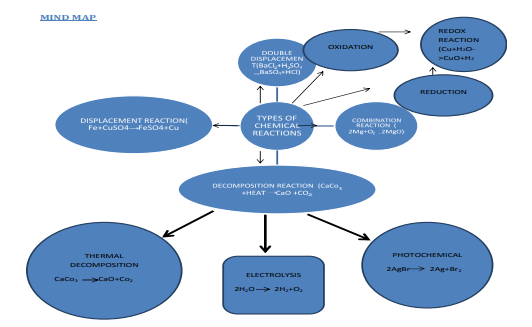
MIND MAP: TYPES OF CHEMICAL REACTIONS [2 Marks]
[Figure: Flowchart showing types of chemical reactions including Combination, Decomposition, Displacement, Double Displacement, and Redox Reactions, with sub-branches for Thermal Decomposition, Electrolysis, and Photochemical reactions.]
Mind map details (types of chemical reactions):
- Centre: TYPES OF CHEMICAL REACTIONS, linked to:
- Displacement reaction: \(\text{Fe} + \text{CuSO}_4 \rightarrow \text{FeSO}_4 + \text{Cu}\)
- Double displacement reaction: \(\text{BaCl}_2 + \text{H}_2\text{SO}_4 \rightarrow \text{BaSO}_4 + \text{HCl}\)
- Combination reaction: \(2\text{Mg} + \text{O}_2 \rightarrow 2\text{MgO}\)
- Redox reaction: \(\text{Cu} + \text{H}_2\text{O} \rightarrow \text{CuO} + \text{H}_2\), linked to OXIDATION and REDUCTION
- Decomposition reaction: \(\text{CaCO}_3 + \text{heat} \rightarrow \text{CaO} + \text{CO}_2\), with three branches:
- Thermal decomposition: \(\text{CaCO}_3 \rightarrow \text{CaO} + \text{CO}_2\)
- Electrolysis: \(2\text{H}_2\text{O} \rightarrow 2\text{H}_2 + \text{O}_2\)
- Photochemical: \(2\text{AgBr} \rightarrow 2\text{Ag} + \text{Br}_2\)
Answer:
1. Chemical reactions are broadly classified into combination, decomposition, displacement, double displacement, and redox reactions.
2. Decomposition reactions are further sub-divided into thermal decomposition, electrolysis, and photochemical decomposition based on the source of energy supplied.
Teacher's Note:
a) Mind maps help in quick revision of interconnected chemical concepts.
b) Ensure all sub-types of decomposition reactions are supported by balanced equations.
CROSSWORD
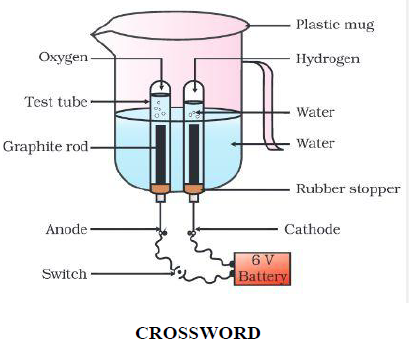
[Figure: Diagram of the electrolysis of water showing a plastic mug, two inverted test tubes filled with water and gases over graphite electrodes, rubber stoppers, an anode, a cathode, a switch, and a 6V battery connected by wires]
Answer:
1. The given figure illustrates the electrolysis of water.
2. Water decomposes into hydrogen and oxygen gases upon passing an electric current.
3. Hydrogen gas collects at the cathode and oxygen gas collects at the anode.
4. The volume of hydrogen collected is twice the volume of oxygen collected.
Teacher's Note:
a) This setup demonstrates a decomposition reaction driven by electrical energy.
b) Ensure students label the cathode and anode correctly based on battery polarity.
c) The 2:1 volume ratio comes from the chemical formula of water, H2O.
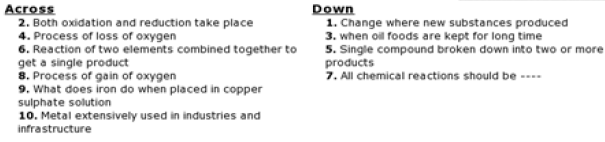
Crossword: Complete the crossword below, put the correct word
Across
2. Both oxidation and reduction take place
4. Process of loss of oxygen
6. Reaction of two elements combined together to get a single product
8. Process of gain of oxygen
9. What does iron do when placed in copper sulphate solution
10. Metal extensively used in industries and infrastructure
Down
1. Change where new substances produced
3. When oil foods are kept for long time
5. Single compound broken down into two or more products
7. All chemical reactions should be ----
Very short answer questions. (1 mark)
1. Identify in the following reaction:
2PbO + C → 2Pb + CO
a) the substance oxidised and
b) the substance reduced. [1 Mark]
Answer:
1. a) Carbon (C) is oxidised to carbon monoxide (CO).
2. b) Lead oxide (PbO) is reduced to lead (Pb).
Teacher's Note:
a) Oxidation is the addition of oxygen or removal of hydrogen.
b) Reduction is the removal of oxygen or addition of hydrogen.
2. A shiny brown coloured element “x” on heating in air becomes black in colour . Name the element “x” and the black coloured compound formed. [1 Mark]
Answer:
1. Element x is Copper (Cu).
2. The black coloured compound formed is copper(II) oxide or cupric oxide (CuO).
Teacher's Note:
a) Heating copper metal in the presence of air causes it to react with oxygen.
b) Note that the official answer key contains a minor typographical error stating Cu2O, but the correct black coating formed upon heating copper is copper(II) oxide (CuO).
Short answer type questions (2 mark)
1. Classify the following reaction as combination, decomposition, displacement and double displacement reaction:- [2 Marks]
a) BaCl2 + H2SO4 → BaSO4 + 2HCl
b) 3CuSO4 + 2Al → Al2(SO4)3 + 3Cu
c) ZnCO3 → ZnO + CO2
d) C + O2 → CO2
Answer:
1. a) Double displacement reaction.
2. b) Displacement reaction.
3. c) Decomposition reaction.
4. d) Combination reaction.
Teacher's Note:
a) A double displacement reaction involves the exchange of ions between reactants.
b) A displacement reaction occurs when a more reactive element displaces a less reactive element.
c) A combination reaction involves two or more reactants forming a single product.
2) What is a precipitation reaction? Give an example. [2 Marks]
Answer:
1. Any reaction in which an insoluble substance (known as a precipitate) is formed is called a precipitation reaction.
2. Example: Na2SO4(aq) + BaCl2(aq) → BaSO4(s) + 2NaCl(aq)
Teacher's Note:
a) Precipitation reactions involve the exchange of ions between reactants in aqueous solution.
b) Barium sulphate forms a white precipitate which is insoluble in water.
Short answer type questions (3 mark)
1. Give an example, each for thermal decomposition and photochemical decomposition reactions. Write balanced equation for the same. [3 Marks]
Answer:
1. Thermal decomposition: Heating of limestone to give calcium oxide and carbon dioxide.
CaCO3 → CaO + CO2
2. Photochemical decomposition: Action of sunlight on silver bromide to give silver and bromine.
2AgBr → 2Ag + Br2
3. Both reactions absorb energy in the form of heat or light to break down a single reactant into simpler products.
Teacher's Note:
a) Decomposition reactions are opposite to combination reactions.
b) Ensure all physical states and balancing coefficients are correctly written in chemical equations.
c) Silver salts are stored in dark coloured bottles to prevent photochemical decomposition.
VALUE BASED QUESTION
Asmita visited her grandmother during summer holidays. Her grandmother prepared chips for her and stored it in airtight containers.
a) What value is shown by her grandmother?
b) Why did Asmita's grandmother store the snack in airtight container? [2 Marks]
Answer:
1. a) Scientific temperament and concern for family health.
2. b) To prevent the food items from rancidity by restricting contact with atmospheric oxygen and moisture.
Teacher's Note:
a) Rancidity is the oxidation of fats and oils in food that causes foul smell and taste.
b) Airtight containers slow down oxidation and increase the shelf life of food items.
Very long answer type questions (5 mark)
1. (i) Write chemical equations for the following and balance them.
a) Zinc carbonate(s) → Zinc oxide + Carbon dioxide
b) Potassium bromide(aq) + Barium iodide(aq) → Potassium iodide + Barium bromide
c) Nitrogen + Hydrogen → Ammonia
(ii) What happens when electricity is passed through acidified water? [5 Marks]
Answer:
1. (i) a) ZnCO3 → ZnO + CO2
2. (i) b) 2KBr + BaI2 → 2KI + BaBr2
3. (i) c) N2 + 3H2 → 2NH3
4. (ii) Decomposition of water takes place resulting in the formation of hydrogen and oxygen gases.
5. (ii) Balanced equation: 2H2O(l) → 2H2(g) + O2(g)
Teacher's Note:
a) Always check for conservation of mass by ensuring each equation is balanced on both sides.
b) Electrolysis of water is an example of an electrolytic decomposition reaction.
c) Acidified water is used because pure water is a poor conductor of electricity.
d) Hydrogen is collected at the cathode and oxygen at the anode in a 2:1 volume ratio.
ZnO + C →Zn + CO
ZnO is reduced to Zn -reduction
C is oxidized to CO ------oxidation
Free study material for Science
CBSE Class 10 Science Study Material: Chapter 01 Chemical Reactions and Equations
Comprehensive Study Resources for Chapter 01 Chemical Reactions and Equations
Review targeted study resources for Chapter 01 Chemical Reactions and Equations tailored for Class 10 learners. Utilizing these structured notes and quick-revision tools ensures complete alignment with current CBSE evaluation standards.
Understanding Marking Schemes
Built using official NCERT guidelines for Class 10 Science, these materials provide reliable academic support. Integrating past examination questions and step-by-step solutions helps students understand official CBSE grading criteria.
Complete Revision for Science
Maximize your grade potential by utilizing Class 10 Science practice papers in tandem with these structured notes. All printable assignments and interactive mock tests on our platform are updated for the 2026 session and available free of charge.
FAQs
Our advanced study package for Chapter 01 Chemical Reactions and Equations includes detailed concepts, diagrams, Mind Maps, and explanation of complex topics to ensure Class 10 students learn as per syllabus for 2026 exams.
The Mind Maps provided for Chapter 01 Chemical Reactions and Equations act as visual anchors which will help faster recall during high-pressure exams.
Yes, teachers use our Class 10 Science resources for lesson planning as they are in simple language and have lot of solved examples.
Yes, You can download the complete, mobile-friendly PDF of the Science Chapter 01 Chemical Reactions and Equations advanced resources for free.
Yes, our subject matter experts have updated the Chapter 01 Chemical Reactions and Equations material to align with the rationalized NCERT textbooks and have removed deleted topics and added new competency-based questions.