

Class 10 Science Study Guide: Class 10 Science Control and Coordination Exam Notes
Review targeted academic resources with the Class 10 Science Control and Coordination Exam Notes. Built according to official CBSE standards for the 2026-27 term, these downloadable Class 10 Science study materials support effective daily practice and deeper conceptual understanding for Chapter 06 Control and Coordination.
Download Chapter 06 Control and Coordination Study Material PDF
Navigate directly to the advanced Science study materials using the digital viewer below. Each resource pack includes detailed conceptual summaries and solved practice questions, allowing students to instantly reinforce their learning.
Class 10 Science Control and Coordination Exam Notes. Please refer to the examination notes which you can use for preparing and revising for exams. These notes will help you to revise the concepts quickly and get good marks.
Control and coordination is the process by which living organisms regulate their activities and respond to stimuli. These Class 10 Science exam notes cover the meaning of control and coordination, the human nervous system, the structure of a neuron, reflex actions, sense organs, the human brain, the endocrine glands and their hormones, and the plant hormones auxins, gibberellins, cytokinins, abscisic acid and ethylene.
CONTROL AND COORDINATION
Control:
Control is the power of restraint and regulation by which a process can be started, slowed down or stopped.
Coordination:
Coordination is the orderly working of different but inter-related parts to perform one or more activities very smoothly.
There are 2 modes of control and coordination, chemical and nervous. Plants do not have a nervous system. They possess only chemical control and coordination.
Animals have both chemical and nervous control and coordination.
NERVOUS SYSTEM OF ANIMALS
It is the system of nervous organs, nerves and neurons that form a network throughout the body for conducting information via electrical impulses so as to coordinate and control activities of different parts as well as provide appropriate response to both internal and external stimuli.

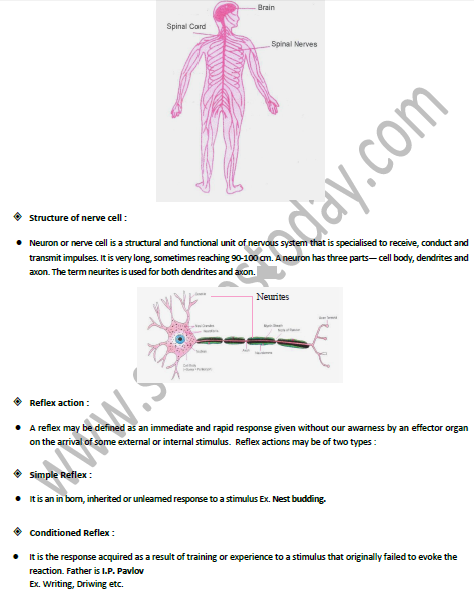

Human Nervous System:
1. Central Nervous System (CNS): Brain and Spinal Cord
2. Peripheral Nervous System (PNS):
(a) Voluntary Nervous System: Cranial Nerves (12 pair) and Spinal Nerves (31 pair)
(b) Involuntary or Autonomic Nervous System: Sympathetic Nervous System and Parasympathetic Nervous System
[Figure: Human body outline showing the nervous system with the labels Brain, Spinal Cord and Spinal Nerves]
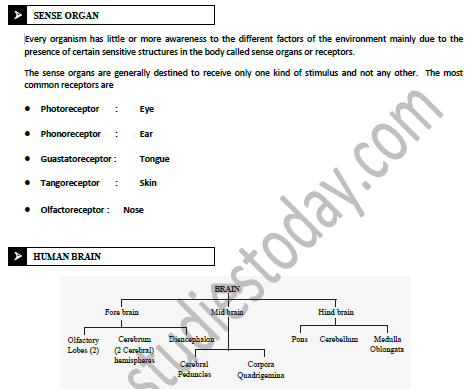
STRUCTURE OF NERVE CELL
Neuron or nerve cell is a structural and functional unit of the nervous system that is specialised to receive, conduct and transmit impulses. It is very long, sometimes reaching 90-100 cm. A neuron has three parts - cell body, dendrites and axon. The term neurites is used for both dendrites and axon.
[Figure: Structure of a neuron with the labels Dendrites, Neurites, Nissl Granules, Neurofibrils, Nucleus, Cell Body (= Soma = Perikaryon), Axon, Neurolemma, Myelin Sheath, Node of Ranvier and Axon Terminal]
REFLEX ACTION
A reflex may be defined as an immediate and rapid response given without our awareness by an effector organ on the arrival of some external or internal stimulus. Reflex actions may be of two types:
Simple Reflex:
It is an inborn, inherited or unlearned response to a stimulus. Ex. Knee jerk.
Conditioned Reflex:
It is the response acquired as a result of training or experience to a stimulus that originally failed to evoke the reaction. Father of the conditioned reflex is I.P. Pavlov.
Ex. Writing, Driving etc.
SENSE ORGAN
Every organism has little or more awareness of the different factors of the environment mainly due to the presence of certain sensitive structures in the body called sense organs or receptors.
The sense organs are generally destined to receive only one kind of stimulus and not any other. The most common receptors are:
Photoreceptor : Eye
Phonoreceptor : Ear
Gustatoreceptor : Tongue
Tangoreceptor : Skin
Olfactoreceptor : Nose
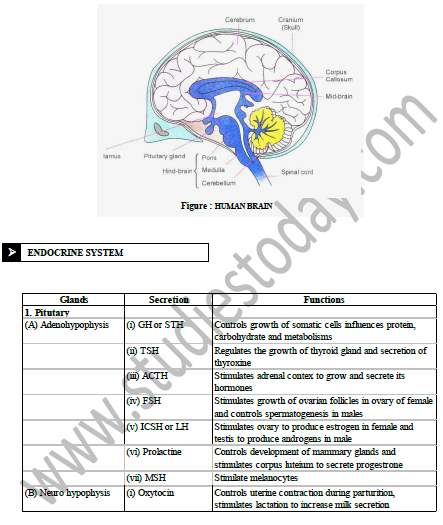
HUMAN BRAIN
The brain has three main parts:
1. Fore brain: Olfactory Lobes (2), Cerebrum (2 cerebral hemispheres) and Diencephalon
2. Mid brain: Cerebral Peduncles and Corpora Quadrigemina
3. Hind brain: Pons, Cerebellum and Medulla Oblongata
[Figure: HUMAN BRAIN - sectional view with the labels Cerebrum, Cranium (Skull), Corpus Callosum, Mid-brain, Thalamus, Pituitary gland, Pons, Hind-brain (Medulla, Cerebellum) and Spinal cord]
ENDOCRINE SYSTEM
| Glands | Secretion | Functions |
|---|---|---|
| 1. Pituitary | ||
| (A) Adenohypophysis | (i) GH or STH | Controls growth of somatic cells; influences protein, carbohydrate and fat metabolism |
| (ii) TSH | Regulates the growth of thyroid gland and secretion of thyroxine | |
| (iii) ACTH | Stimulates adrenal cortex to grow and secrete its hormones | |
| (iv) FSH | Stimulates growth of ovarian follicles in ovary of female and controls spermatogenesis in males | |
| (v) ICSH or LH | Stimulates ovary to produce estrogen in female and testis to produce androgens in male | |
| (vi) Prolactin | Controls development of mammary glands and stimulates corpus luteum to secrete progesterone | |
| (vii) MSH | Stimulates melanocytes | |
| (B) Neurohypophysis | (i) Oxytocin | Controls uterine contraction during parturition, stimulates lactation to increase milk secretion |
| 2. Thyroid | (i) Thyroxine (ii) Thyrocalcitonin | Controls metabolism Deposits calcium over bones |
| 3. Parathyroid | PTH | Maintains blood calcium |
| 4. Adrenal (A) Cortex (B) Medulla | Mineralocorticoid (Aldosterone) Adrenaline | Salt retention Emergency hormone |
| 5. Gonads (A) Testis (Cells of Leydig) | Androgens (Testosterone) | Controls spermatogenesis and development of secondary sexual characters of males |
| (B) Ovaries (a) Graafian follicle (b) Corpus luteum | (i) Estrogen (i) Progesterone | Development of female sexual organs Maintains pregnancy |
| 6. Thymus | Thymosin | Strengthens immune system |
| 7. Pineal | Melatonin | Controls skin colour |
COORDINATION IN PLANTS
Plant Hormones:
Auxins:
Auxins take part in a number of plant processes. Some are as follows:
Auxin promotes apical dominance.
Auxin participates in molecular reactions.
Affects osmotic pressure by increasing solutes.
Affects enzyme action.
Affects nucleic acid activities.
Stimulates respiration.
Promotes root formation.
Helps in inhibition of leaf and fruit abscission.
Gibberellins:
These hormones were first identified in studies of a disease of rice in Japan, the bakanae (foolish seedling) disease caused by Gibberella fujikuroi.
These are the second important growth hormones found in plants. Normally gibberellins cause increased growth, especially in height of stem. So gibberellins are defined as the growth hormones which cause cell elongation.
Cytokinins:
Cytokinins are defined as compounds having a highly specific hydrophilic group or adenine and one nonspecific lipophilic group.
Names of some cytokinins are: Kinetin, dihydrozeatin, methylthiozeatin and ribosylzeatin.
Abscisic Acid (ABA):
Acts as growth inhibitor and induces dormancy of buds towards the approach of winter.
Inhibition of cambium activity - Towards the approach of winter, the activity of cambium is inhibited due to the formation of abscisic acid.
Abscission - Abscisic acid promotes abscission of flowers and fruits.
Senescence - It stimulates senescence of leaves.
Closure of stomata - ABA normally causes closure of stomata (by inhibiting K+ uptake).
Inhibition of germination - Abscisic acid inhibits sprouting of cereal grains.
Resistance - Abscisic acid increases resistance of plant to cold.
Flowering - ABA delays flowering in long day plants.
Tuberization in potato - ABA helps in tuber formation in potato.
Rooting - ABA promotes root initiation in stem cuttings of some plants e.g. Ivy, Poinsettia.
Ethylene (CH2 = CH2):
Functions of ethylene are -
Transverse growth - Stimulates transverse growth so that stem looks swollen.
Inhibition of geotropism - Ethylene nullifies geotropism.
Fruit ripening - Ethylene is a ripening agent. Fruits such as apple, banana, mango, citrus etc. are ripened artificially with ethylene.
Apical dominance - Ethylene inhibits the growth of lateral buds and thus causes apical dominance.
Root initiation - In low concentration, ethylene stimulates root initiation.
Abscission - Ethylene accelerates abscission of leaves, flowers and fruits.
Senescence - Ethylene is associated with the process of senescence (ageing) of leaves and flowers.
Breaking of dormancy - Ethylene breaks dormancy of storage organs.
Uses of Ethylene:
Ripening of Fruits - Ethylene lamps are used for colour development and ripening of certain fleshy fruits (e.g. apple, banana, mango etc.)
• Name of some cytokinins are :-
• Kinetin, dihydrozeation, methylthiozeation and riboxylzeatin.
Free study material for Science
Useful Resources and Notes for Class 10 Science Chapter 06 Control and Coordination
Core Study Kit: Class 10 Science Chapter 06 Control and Coordination
Review targeted study resources for Chapter 06 Control and Coordination tailored for Class 10 learners. Utilizing these structured notes and quick-revision tools ensures complete alignment with current CBSE evaluation standards.
NCERT-Aligned Solutions for Chapter 06 Control and Coordination
Each resource draws directly from authorized textbooks to maintain academic accuracy. Evaluating solved examples allows Class 10 students to master the formal presentation and answer-writing standards expected in upcoming school exams.
Next Steps in Your Exam Preparation
For peak performance in upcoming evaluations, integrate official Science sample papers directly into your study schedule. Follow up your revision by attempting online MCQ tests for Chapter 06 Control and Coordination to refine calculation speed and precision.
FAQs
Our advanced study package for Chapter 06 Control and Coordination includes detailed concepts, diagrams, Mind Maps, and explanation of complex topics to ensure Class 10 students learn as per syllabus for 2026 exams.
The Mind Maps provided for Chapter 06 Control and Coordination act as visual anchors which will help faster recall during high-pressure exams.
Yes, teachers use our Class 10 Science resources for lesson planning as they are in simple language and have lot of solved examples.
Yes, You can download the complete, mobile-friendly PDF of the Science Chapter 06 Control and Coordination advanced resources for free.
Yes, our subject matter experts have updated the Chapter 06 Control and Coordination material to align with the rationalized NCERT textbooks and have removed deleted topics and added new competency-based questions.