

Advanced Study Material for Class 10 Science: Chapter 09 Light Reflection and Refraction
Explore structured advanced study materials through the CBSE Class 10 Science Light Reflection and Refraction. Tailored for Class 10 learners, utilizing these Science resources ensures thorough preparation and strengthens foundational knowledge before final CBSE evaluations.
Practice Class 10 Science Resources: Chapter 09 Light Reflection and Refraction
Access the complete useful resource PDF for Class 10 Science below. Regular practice with these targeted academic notes builds familiarity with complex topics and helps secure higher marks in final school evaluations.
LIGHT REFLECTION AND REFRACTION
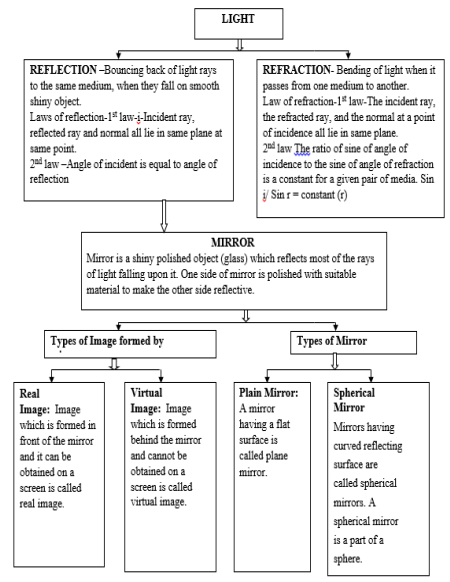

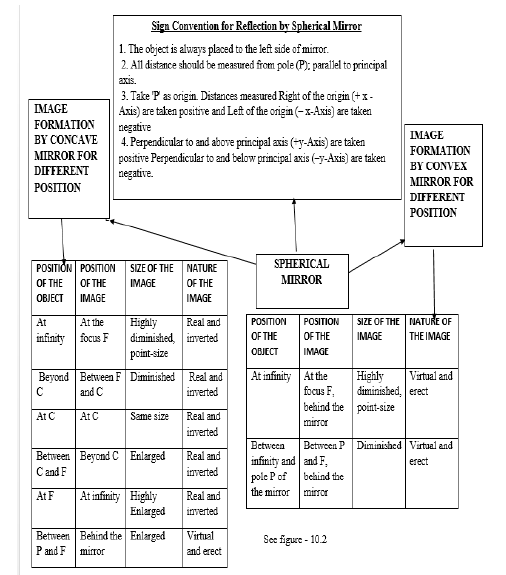
Question. An object is placed 20 cm in front of a plane mirror. The mirror is moved 2 cm towards the object. The distance between the positions of the original and final images seen in the mirror is:
(a) 2 cm
(b) 4 cm
(c) 10 cm
(d) 22 cm
Answer: A
Question. A ray of light that strikes a plane mirror PQ at an angle of incidence of 30o, is reflected from the plane mirror and then strikes a second plane mirror QR placed at right angles to the first mirror. The angle of reflection at the second mirror is:
(a) 30o
(b) 45o
(c) 60o
(d) 90o
Answer: C
Question. An object is placed at 100 mm in front of a concave mirror which produces an upright image (erect image). The radius of curvature of the mirror is:
(a) Less than 100 mm
(b) Between 100 mm and 200 mm
(c) Exactly 200 mm
(d) More than 200 mm
Answer: D
Question. Which position of the object will produce a magnified virtual image, if a concave mirror of focal length 15 cm is being used?
(a) 10 cm
(b) 20 cm
(c) 30 cm
(d) 35 cm
Answer: A
Question. A concave mirror produces a magnification of +4. The object is placed:
(a) At the focus
(b) Between focus and centre of curvature
(c) Between focus and pole
(d) Beyond the centre of curvature
Answer: C
Question. Two big mirrors A and B are fitted side by side on a wall. A man is standing at such a distance from the wall that he can see the erect image of his face in both the mirrors. When the man starts walking towards the mirrors, he finds that the size of his face in mirror A goes on increasing but that in mirror B remains the same:
(a) Mirror A is concave and mirror B is convex
(b) Mirror A is plane and mirror B is concave
(c) Mirror A is concave and mirror B is plane
(d) Mirror A is convex and mirror B is concave
Answer: C
Question. A ray of light is travelling in a direction perpendicular to the boundary of a parallel glass slab. The ray of light:
(a) Is refracted towards the normal
(b) Is refracted away from the normal
(c) Is reflected along the same path
(d) Does not get refracted
Answer: D
Question. A ray of light passes from a medium X to another medium Y. No refraction of light occurs if the ray of light hits the boundary of medium Y at an angle of:
(a) 120o
(b) 90o
(c) 45o
(d) 0o
Answer: B
Question. A lens of focal length 12 cm forms an erect image, three times the size of the object. The distance between the object and image is:
(a) 8 cm
(b) 16 cm
(c) 24 cm
(d) 36 cm
Answer: A
Question. If an object is placed 21 cm from a converging lens, the image formed is slightly smaller than the object. If the object is placed at a distance of 19 cm from the lens, the image formed is slightly larger than the object. The approximate focal length of the lens is:
(a) 20 cm
(b) 18 cm
(c) 10 cm
(d) 5 cm
Answer: C
Question. A student does the experiment on tracing the path of a ray of light passing through a rectangular glass slab for different angles of incidence. He can get a correct measure of the angle of incidence and the angle of emergence by following the labelling indicated in figure:
(a) A
(b) B
(c) C
(d) D
Answer: D
Question. While performing an experiment on determination of focal length of a convex lens, four students obtained the image of the same distant tree on the screen as follows:
Which diagram shows the formation of image correctly?
(a) A
(b) B
(c) C
(d) D
Answer: D
Question. Four students A, B, C and D performed the experiment to determine the focal length of a concave mirror by obtaining the image of a distant tree on a screen. They measured the distances between the screen and the mirror as shown in the diagrams given below:
The correct way to measure accurate focal length of the mirror is:
(a) A
(b) B
(c) C
(d) D
Answer: C
Question. A student traces the path of a ray of light passing through a rectangular slab for three different values of angle of incidence (∠I ) namely 30o, 45o and 60o. He extends the direction of incident ray by a dotted line and measures the perpendicular distance ‘l’ between the extended incident ray and the emergent ray. He will observe that:
(a) ‘l’ keeps on increasing with increase in angle of incidence
(b) ‘l’ keeps on decreasing with increase in angle of incidence
(c) ‘l’ remains the same for all three angles of incidence
(d) ‘l’ is the maximum for ∠i = 45o and is less than this value for ∠i = 30o and ∠i = 60o.
Answer: A
Please click the link below to download pdf file of CBSE Class 10 Science-Light Reflection and Refraction.
Free study material for Science
CBSE Class 10 Science Study Material: Chapter 09 Light Reflection and Refraction
Core Study Kit: Class 10 Science Chapter 09 Light Reflection and Refraction
Access comprehensive study material for Chapter 09 Light Reflection and Refraction, including revision notes, concept maps, and high-probability questions. These resources are designed in alignment with the latest 2026 CBSE syllabus for Class 10 Science to support effective exam preparation.
NCERT-Aligned Solutions for Chapter 09 Light Reflection and Refraction
Designed around the official curriculum, these study guides guarantee standard compliance. Reviewing step-by-step solutions clarifies complex sub-topics within Chapter 09 Light Reflection and Refraction and demystifies standard marking schemes for Science evaluations.
Next Steps in Your Exam Preparation
Maximize your grade potential by utilizing Class 10 Science practice papers in tandem with these structured notes. All printable assignments and interactive mock tests on our platform are updated for the 2026 session and available free of charge.
FAQs
Our advanced study package for Chapter 09 Light Reflection and Refraction includes detailed concepts, diagrams, Mind Maps, and explanation of complex topics to ensure Class 10 students learn as per syllabus for 2026 exams.
The Mind Maps provided for Chapter 09 Light Reflection and Refraction act as visual anchors which will help faster recall during high-pressure exams.
Yes, teachers use our Class 10 Science resources for lesson planning as they are in simple language and have lot of solved examples.
Yes, You can download the complete, mobile-friendly PDF of the Science Chapter 09 Light Reflection and Refraction advanced resources for free.
Yes, our subject matter experts have updated the Chapter 09 Light Reflection and Refraction material to align with the rationalized NCERT textbooks and have removed deleted topics and added new competency-based questions.