

Official CBSE Study Materials for Class 10 Science
Explore structured advanced study materials through the Class 10 Science Compounds of Common Use Exam Notes. Tailored for Class 10 learners, utilizing these Science resources ensures thorough preparation and strengthens foundational knowledge before final CBSE evaluations.
Advanced Resources for Science
View or download the dedicated Class 10 Science Compounds of Common Use Exam Notes resource below. Engaging with these advanced study guides under focused conditions ensures continuous academic progress and mastery of the 2026-27 curriculum for Compounds of Common Use.
Class 10 Science Compounds of Common Use Exam Notes. Please refer to the examination notes which you can use for preparing and revising for exams. These notes will help you to revise the concepts quickly and get good marks.
Introduction
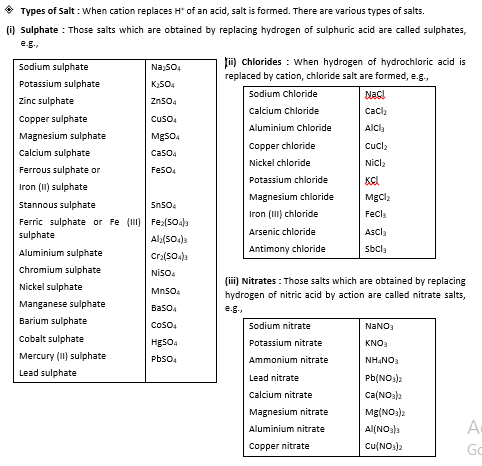
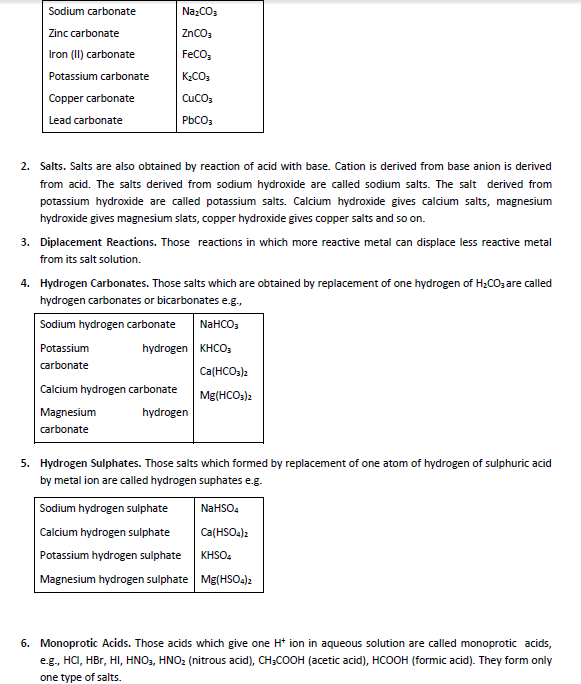
7. Diprotic Acids. Those acids which give two H+ ions in aqueous solution are called diprotic acids, e.g., H2SO4, H2CO3 (carbonic acid), H2SO3 (sulphuric acid), (COOH)2 (oxalic acid). They form two series of salts, one by replacing one hydrogen and another by replacing both the hydrogen atoms.
8. Triprotic Acids. Those acids which give three protons i.e. three H+ ions in aqueous solution are called triprotic acid, e.g., H3PO4 (phosphoric acid). They form three series of salts.
9. Chemical in Common Salt. The main chemical present in common salt is sodium chloride. It is obtained by neutralization reaction of sodium hydroxide with HCl (Hydrochloric acid).
It is obtained on a large scale from sea water. It is found in large deposits called rock salt.
10. Uses of Common Salt.
(i) It is used in daily food.
(ii) It is used as preservative
(iii) It is used for manufacture of Na metal and Cl2 (g) by electrolysis in molten state.
(iv) It is used for manufacture of caustic soda.
(v) It is used for manufacture of baking soda and washing soda by Solvay process.
11. Manufacture of Sodium Hydroxide.
Sodium hydroxide is the most important alkali and is made commercially by electrolysis of saturated brine solution (sodium chloride). Three kinds of cells are used :
Castner-Kellner Cell. In this cell, mercury flows along the bottom of the cell and is made cathode in outer compartments as shown in figure. The anode consists of number of graphite blocks.
Thee electrolysis of brine solution takes place. Since hydrogen has a over voltage (i.e.more energy is required to discharge H+ ion) at mercury cathode, sodium is preferentially discharged at cathode forming amalgam with mercury. Sodium amalgam flows out and is reacted with H2O to give NaOH.
2NaHg + 2H2O –2NaOH + 2Hg + H2
The mercury is recirculated in the cell. H2 and Cl2 are two important by-products.
12. Properties of Sodium Hydroxide.
(i) It is deliquescent solid and absorbs moisture and CO2 finally forming solid hydrated carbonate.
(ii) It can precipitate cations like Zn2+, Al3+, Pb2+, Sn2+ but these precipitates get dissolved in excess of NaOH.
Zn(OH)2 + 2OH– – [Zn(OH)4]2– (Zincate ion)
Al(OH)3 + 3OH– – [Al(OH)6]3– (Aluminate ion)
Sn(OH)2 + 4OH– – [Sn(OH)6]3– (Stannate ion)
Pb(OH)2 + 2OH– – [Pb(OH)4]2– (Plumbate ion)
13. Uses of Sodium Hydroxide.
(i) It is used in soap industry.
(ii) It is used in paper industry
(iii) It is used in textile industry
(iv) It is used for preparation of pure fats and oils.
(v) It is used in preparation of artificial silk (rayon).
(vi) It is used in petroleum industry.
(vii) It is used in absorbing poisonous gases.
(viii) It is used as reagent in laboratory.
14. Washing Soda. Its chemical formula is Na2CO3.10H2O, i.e. sodium carbonate decahydrate, i.e. one mole of Na2CO3 contains 10 moles of water of crystallization.
Anhydrous sodium carbonate is called soda ash.
15. Solvay Process. It is used for manufacture of washing soda. It is also called Ammonia Soda process. Raw materials. Sodium chloride (NaCl), ammonia (NH3) and limestone (CaCO3).
Process.
(i) In this process a cold and concentrated solution of sodium chloride (called brine) is saturated with ammonia.
(ii) The ammonical brine is fed from the top of the carbonating tower packed with perforated plates.
(iii) Carbon dioxide (CO2) is introduced from the base of the tower which reacts with NH3 and H2O to form ammonium bicarbonate (ammonium hydrogen carbonate).
NH3 + H2O + CO2 – (NH4)HCO3 …..(i)
(iv) Ammonia hydrogen carbonate reacts with sodium chloride (NaCl) to form sodium hydrogen carbonate and ammonia chloride.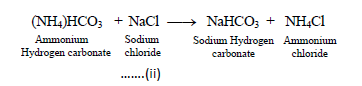
(v) CO2 used in first reaction is produced by heating limestone in lime kiln (furnace).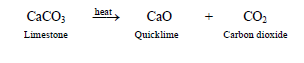
Please click on below link to download pdf file for Class 10 Science Compounds of Common Use Exam Notes
Free study material for Science
Science Class 10 Exam Resources: Compounds of Common Use
Core Study Kit: Class 10 Science Compounds of Common Use
Review targeted study resources for Compounds of Common Use tailored for Class 10 learners. Utilizing these structured notes and quick-revision tools ensures complete alignment with current CBSE evaluation standards.
NCERT-Aligned Solutions for Compounds of Common Use
Each resource draws directly from authorized textbooks to maintain academic accuracy. Evaluating solved examples allows Class 10 students to master the formal presentation and answer-writing standards expected in upcoming school exams.
Next Steps in Your Exam Preparation
Wrap up your chapter revision by testing your knowledge against standard objective question formats. Explore our full library of free, up-to-date sample papers and online assessments to secure top grades in your CBSE examinations.
FAQs
Our advanced study package for Compounds of Common Use includes detailed concepts, diagrams, Mind Maps, and explanation of complex topics to ensure Class 10 students learn as per syllabus for 2026 exams.
The Mind Maps provided for Compounds of Common Use act as visual anchors which will help faster recall during high-pressure exams.
Yes, teachers use our Class 10 Science resources for lesson planning as they are in simple language and have lot of solved examples.
Yes, You can download the complete, mobile-friendly PDF of the Science Compounds of Common Use advanced resources for free.
Yes, our subject matter experts have updated the Compounds of Common Use material to align with the rationalized NCERT textbooks and have removed deleted topics and added new competency-based questions.