

Download CBSE Class 10 Science Useful Resources
Review targeted academic resources with the Class 10 Science Magnetic Effect of Current Exam Notes. Built according to official CBSE standards for the 2026-27 term, these downloadable Class 10 Science study materials support effective daily practice and deeper conceptual understanding for Chapter 12 Magnetic Effects of Electric Current.
Access CBSE Study Guides and Summaries
Access the complete useful resource PDF for Class 10 Science below. Regular practice with these targeted academic notes builds familiarity with complex topics and helps secure higher marks in final school evaluations.
Class 10 Science Magnetic Effect of Current Exam Notes. Please refer to the examination notes which you can use for preparing and revising for exams. These notes will help you to revise the concepts quickly and get good marks.
Magnetism : The property due to which a substance attracts iron pieces towards it, is called magnetism.
The substance having property of magnetism, is called magnet.
Types of Magnets
(A) Permanent (Natural & Artificial magnets)
(B) Temporary (Electromagnets)
(A) Permanent (Natural & Artificial magnets)
Natural magnets
Definition : Pieces of naturally occurring iron ore lode–stone or magnetic or black iron oxide (Fe2O3), are called natural magnets.
Properties : These have following two properties.
(i) Attractive property: They attract small iron pieces towards them.
(ii) Directive property: When suspended freely, their ends would point in geographical north–south direction. For this reason, the suspended piece is called lode stone or leading stone.
Disadvantage : These have following two demerits :
(i) They have irregular shape.
(ii) They are weak.
Artificial Magnets
Description : These magnets are made of hard steel or special alloys. The substances of these magnets have many small ‘atomic’ magnets. Ordinarily they are all oriented in random directions (Fig.). Then the substance is unmagnetised.
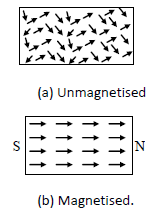
When such a piece is put in North–South direction and hammered, the atomic magnets align themselves in the direction of the earth’s field fig. They retain this alignment and the piece becomes a magnet with North (N) and (S) pole near ends. This magnet with two poles, is called a magnetic dipole.
♦ Advantage : These have following two merits
(a) They may be given desired regular shape. (b) They are strong.
(B) Electromagnet
Electromagnets are based on the magnetic effect of electric current. An electromagnet is usually prepared by placing a soft iron core in a solenoid, or by winding a large number of turns of an insulated wire (generally the insulated copper wire) on a cylindrical soft iron core. An electromagnet shows magnetic properties only as long as the electric current flows through the solenoid. Thus, electromagnets are temporary magnets.
♦ Difference between electromagnet and permanent magnet
Electromagnet :
Nature of magnetism : Temporary. An electromagnet shows magnetism only as long as current flows through it.
Polarity : The polarity of an electromagnet can be changed by reversing the direction of the current.
Strength : The strength of an electromagnet can be increased or decreased by increasing or decreasing the current.
Permanent magnet (or Bar magnet) :
Nature of magnetism : Permanent (or bar) magnets show permanent magnetism.
Polarity : Polarity of a permanent magnet cannot be changed.
Strength : The strength of a permanent magnet cannot be changed.
TWO POLES OF A MAGNET
♦ Poles of a magnet : When ends of a magnet are dipped in iron filings, the filings stick to its ends only and not to its sides. It means that in magnets, centres of attraction are located near ends only. These centres of attraction near the ends of a magnet are called poles.
When this magnet is freely suspended, the two ends point in north–south direction. The pole near the end pointing towards North (north–seeking end) is called North pole. The pole near the end pointing towards South (south–seeking end) is called South pole.
♦ Interaction between poles : The magnetic poles exert forces on each other. Like pole repel each other, i.e., one north pole will repel another north pole or unlike poles attract each other i.e., north pole attract south pole.
MAGNETIC FIELD
Lines of Magnetic field (Magnetic lines of force)
♦ Definition : A magnetic line of force, is a line straight or curved, in the magnetic field of a magnetic pole of magnetic dipole, such that the tangent at any point of this line gives the direction of the magnetic field at that point.
♦ Properties of Magnetic Lines of Force
These have following properties :
♦ They are always nearly normal to the surface of magnet at every point.
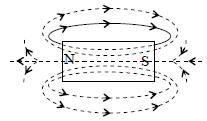
♦ They start from a north (positive) pole and end at a south (negative) pole.
♦ Two lines of force do not intersect each other.
♦ They tend to contract longitudinally (longitudinal contraction).
♦ They tend to expand laterally (lateral repulsion) so as to exert lateral pressure on neighboring lines. (The above two properties are similar to that of a stretched rubber band).
♦ The number of magnetic lines of force passing normally per unit area about a point, gives the intensity of the magnetic field at the point.
EARTH’S MAGNETIC FIELD
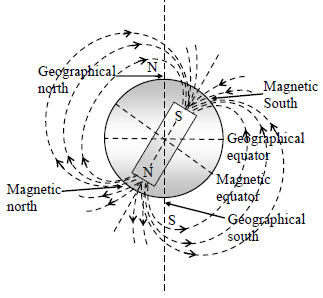
♦ Earth Magnetism : Earth behaves as a huge magnet (or a giant solenoid). The source of this huge magnetism is given as the molten charged metallic fluid giving rise to a current flowing inside the core of the earth. This core has a radius of about 3500 km (earth’s radius is 6400 km).
♦ Some Associated Terms
- South Magnetic Pole (S) : It is near north geographical pole N.
- North Magnetic Pole (N) : It is near south geographical pole S.
ORESTED'S EXPERIMENT
♦ Arrangement : A straight wire AB is connected to a battery V and key K. The wire is held horizontally over a magnetic needle.
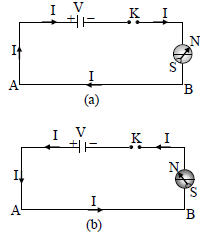
♦ Working : When key is closed, current flows in the wire in the direction as shown. The needle deflects one side. When key is taken out and current in wire becomes zero, needle returns back to its initial position (S – N). This shows that a magnetic field is associated with an electric current.
When direction of current in wire is reversed, direction of deflection of needle is also reversed. If direction of current be kept same and wire be put under the needle, direction of deflection of needle again becomes reversed.
Please click on below link to download pdf file for Class 10 Science Magnetic Effect of Current Exam Notes.
Free study material for Science
Free CBSE Study Guides: Class 10 Science Chapter 12 Magnetic Effects of Electric Current
Quick Revision Material for Chapter 12 Magnetic Effects of Electric Current
Access comprehensive study material for Chapter 12 Magnetic Effects of Electric Current, including revision notes, concept maps, and high-probability questions. These resources are designed in alignment with the latest 2026 CBSE syllabus for Class 10 Science to support effective exam preparation.
Expert Notes and Solved Exam Questions
Built using official NCERT guidelines for Class 10 Science, these materials provide reliable academic support. Integrating past examination questions and step-by-step solutions helps students understand official CBSE grading criteria.
Additional Study Resources for Class 10
Maximize your grade potential by utilizing Class 10 Science practice papers in tandem with these structured notes. All printable assignments and interactive mock tests on our platform are updated for the 2026 session and available free of charge.
FAQs
Our advanced study package for Chapter 12 Magnetic Effects of Electric Current includes detailed concepts, diagrams, Mind Maps, and explanation of complex topics to ensure Class 10 students learn as per syllabus for 2026 exams.
The Mind Maps provided for Chapter 12 Magnetic Effects of Electric Current act as visual anchors which will help faster recall during high-pressure exams.
Yes, teachers use our Class 10 Science resources for lesson planning as they are in simple language and have lot of solved examples.
Yes, You can download the complete, mobile-friendly PDF of the Science Chapter 12 Magnetic Effects of Electric Current advanced resources for free.
Yes, our subject matter experts have updated the Chapter 12 Magnetic Effects of Electric Current material to align with the rationalized NCERT textbooks and have removed deleted topics and added new competency-based questions.