

Class 10 Science Study Guide: CBSE Class 10 Science Magnetic effect of current Notes
Review targeted academic resources with the CBSE Class 10 Science Magnetic effect of current Notes. Built according to official CBSE standards for the 2026-27 term, these downloadable Class 10 Science study materials support effective daily practice and deeper conceptual understanding for Chapter 12 Magnetic Effects of Electric Current.
Download Chapter 12 Magnetic Effects of Electric Current Study Material PDF
Navigate directly to the advanced Science study materials using the digital viewer below. Each resource pack includes detailed conceptual summaries and solved practice questions, allowing students to instantly reinforce their learning.
CBSE Class 10 Science Magnetic effect of current Notes. There are many more useful educational material which the students can download in pdf format and use them for studies. Study material like concept maps, important and sure shot question banks, quick to learn flash cards, flow charts, mind maps, teacher notes, important formulas, past examinations question bank, important concepts taught by teachers. Students can download these useful educational material free and use them to get better marks in examinations. Also refer to other worksheets for the same chapter and other subjects too. Use them for better understanding of the subjects.
CHAPTER – 13
MAGNETIC EFFECT OF CURRENT
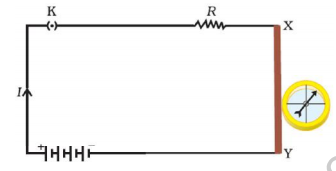
The term magnetic effect of electric current means that an electric current flowing in a wire produces a magnetic field around it. A current flowing in a wire always gives rise to a magnetic field around it. The magnetic effect of current is also called electromagnetism which means electricity produces magnetism. In figure, the deflection of compass needle by the current carrying wire in the below experiment show that an electric current produces a magnetic field around it.
MAGNET
A magnet is an object, which attracts pieces of iron, steel, nickel and cobalt. It has two poles at ends – South and North Pole.
1. Like magnetic poles repel each other.
2. Unlike magnetic poles attract each other.
MAGNETIC FIELD
The space surrounding a magnet in which the force of attraction and repulsion is exerted is called a magnetic field.
MAGNETIC FIELD LINES
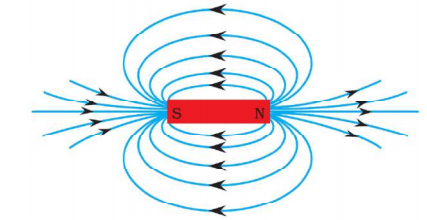
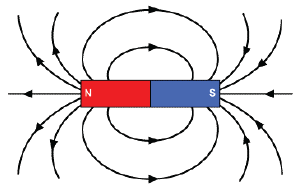
The magnetic field lines are the lines drawn in a magnetic field along which a north magnetic pole would move. These are also known as magnetic lines of forces.
PROPERTIES OF MAGNETIC FIELD LINES
1. A magnetic field lines originate from north pole and end at its south pole.
2. A magnetic field line is a closed and continuous curve.
3. The magnetic field lines are closer near the poles of a magnet where the magnetic field is strong and farther apart where the magnetic field is weak.
4. The magnetic field lines never intersect each other.
5. A uniform magnetic field is represented by parallel and equidistant field lines.
INTEXT QUESTIONS PAGE NO. 224
1. Why does a compass needle get deflected when brought near a bar magnet?
Ans. A compass gets deflected due to the forces acting on its poles due to the magnetic field of the bar magnet.
MAGNETIC FIELD DUE TO A CURRENT THROUGH A STRAIGHT
CONDUCTOR
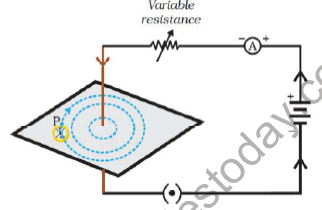
The magnetic field lines around a straight conductor carrying current are concentric circles whose centres lies on the wire.
The magnitude of magnetic field produced by a straight current carrying wire at a point-
• directly proportional to current passing in the wire.
• inversely proportional to the distance of that point from the wire.
RIGHT-HAND THUMB RULE
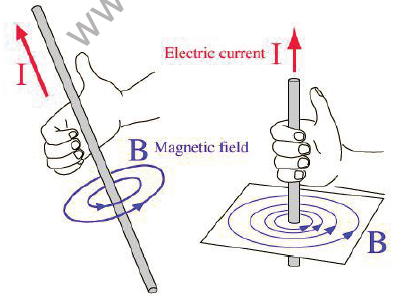
When a current-carrying straight conductor is holding in right hand such that the thumb points towards the direction of current. Then fingers will wrap around the conductor in the direction of the field lines of the magnetic field, as shown in below figure. This is known as the right-hand thumb rule Thumb-points in the direction of current then direction of fingers encircle the wire give the direction of magnetic field around the wire.
INTEXT QUESTIONS PAGE NO. 228
1. Draw magnetic field lines around a bar magnet.
2. List the properties of magnetic lines of force.
Ans. Refer in page no. 1
3. Why don’t two magnetic lines of force intersect each other?
Ans. If two magnetic lines of force intersect then there would be two directions of magnetic field at that point, which is absurd. That is why they never intersect.
MAGNETIC FIELD DUE TO A CURRENT THROUGH A CIRCULAR LOOP
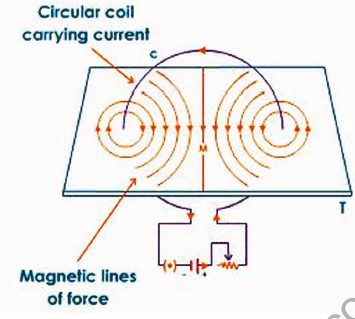
The magnetic field lines are circular near the current carrying loop. As we move away, the concentric circles becomes bigger and bigger. At the centre, the lines are straight.
At the centre, all the magnetic field lines are in the same direction due to which the strength of magnetic field increase.
The magnetic of magnetic field produced by a current carrying circular loop at its centre is
• directly proportional to the current passing
• inversely proportional to the radius of the circular loop
The strength of magnetic field produced by a circular coil carrying current is directly proportional to both number of turns(n) and current(I) but inversely proportional to its
radius(r).
MAGNETIC FIELD DUE TO A CURRENT IN A SOLENOID
The insulated copper wire wound on a cylindrical tube such that its length is greater than its diameter is called a solenoid. The solenoid is from greek word for channel.
• The solenoid is a long coil containing a large number of close turns of insulated copper wire.
• The magnetic field produced by a current carrying solenoid is similar to the magnetic field produced by a bar magnet.
• The current in each turn of a current carrying solenoid flows in the same direction due to which the magnetic field produced by each turn of the solenoid ads up, giving a strong magnetic field inside the solenoid.
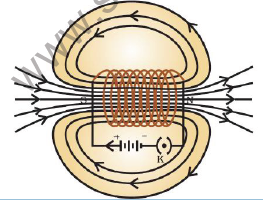
The strong magnetic field produced inside a current-carrying solenoid can be used to magnetise a piece of magnetic material like soft iron, when placed inside the solenoid.
The magnet thus formed is called an electromagnet.
So, a solenoid is used for making electromagnets. The strength of magnetic field produced by a carrying current solenoid depends on
• number of turns(n)
• strength of current(I)
• nature of core material used in solenoid – use of soft iron as core in a solenoid produces the strongest magnetism.
Please click the link below to download CBSE Class 10 Science Magnetic effect of current Notes.
Free study material for Science
Useful Resources and Notes for Class 10 Science Chapter 12 Magnetic Effects of Electric Current
Quick Revision Material for Chapter 12 Magnetic Effects of Electric Current
Explore essential learning tools for Class 10 Science Chapter 12 Magnetic Effects of Electric Current. This curated collection features in-depth notes and targeted practice questions built around the active 2026 curriculum to streamline your daily revision.
Expert Notes and Solved Exam Questions
Designed around the official curriculum, these study guides guarantee standard compliance. Reviewing step-by-step solutions clarifies complex sub-topics within Chapter 12 Magnetic Effects of Electric Current and demystifies standard marking schemes for Science evaluations.
Additional Study Resources for Class 10
For peak performance in upcoming evaluations, integrate official Science sample papers directly into your study schedule. Follow up your revision by attempting online MCQ tests for Chapter 12 Magnetic Effects of Electric Current to refine calculation speed and precision.
FAQs
Our advanced study package for Chapter 12 Magnetic Effects of Electric Current includes detailed concepts, diagrams, Mind Maps, and explanation of complex topics to ensure Class 10 students learn as per syllabus for 2026 exams.
The Mind Maps provided for Chapter 12 Magnetic Effects of Electric Current act as visual anchors which will help faster recall during high-pressure exams.
Yes, teachers use our Class 10 Science resources for lesson planning as they are in simple language and have lot of solved examples.
Yes, You can download the complete, mobile-friendly PDF of the Science Chapter 12 Magnetic Effects of Electric Current advanced resources for free.
Yes, our subject matter experts have updated the Chapter 12 Magnetic Effects of Electric Current material to align with the rationalized NCERT textbooks and have removed deleted topics and added new competency-based questions.