

Official Class 12 Chemistry Worksheets: Unit 7 Alcohols, Phenols and Ethers
Access comprehensive chapter-wise worksheets for Unit 7 Alcohols, Phenols and Ethers using the CBSE Class 12 Chemistry Alcohols Phenol And Ethers Worksheet Set 01. Designed to align with the 2026-27 academic syllabus for Class 12 Chemistry, these printable practice sets help students reinforce key concepts and improve their overall exam readiness.
Solved Practice Worksheets for Chemistry
Navigate directly to the solved Chemistry worksheets using the digital viewer below. Each practice set includes detailed step-by-step solutions, allowing students to instantly cross-check their work and identify areas requiring further revision.
Q1. Give IUPAC names and structures of:-
(a) Isobutyl alcohol (b) Sec – butyl alcohol
(c) tert-butyl alcohol (d) n-amyl alcohol
(e) o-cresol (f) Catechol
(g) glycerol (h) picric acid
(i) vinyl alcohol (j) benzyl ale
(k) Aspirin (l) cyclobexyl methanol
Q2. Give reasons for the following:-
(i) Commercially carboxylic acids are not reduced to alcohols directly instead alcohols are obtained by converting them to ester followed by their reduction.
(ii) Alcohols and phenols are Bronsted acids.
(iii) Alcohols are weaker acids than water.
(iv) In esterification reaction between carboxylic and alcohol, water is removed as soon as it’s formed.
(v) Esterification reaction between acid chloride and alcohol is carried out in presence of pyridine.
(vi) 3, 3-Dimethyl butan-2-ol on acid catalyzed dehydration yields an unexpected 2,3-dimethyl but 2-ene as major product.
(vii) n-hexanol is not soluble in water
(viii) Unlike most phenols, 2, 4-dinitrophenol & 2, 4, 6–trinitraphenol is soluble in aqueous sodium bicarbonate solution.
(ix) Phenol has a smaller dipole moment (1.54, 0) than methanol (1.71 D)
(x) For the prepn of alkyl halides from alcohols, through chloride is preferred over other reagents.
(xi) Phenols do not give protonation reactions easily.
MCQ Questions for NCERT CBSE Class 12 Chemistry Alcohols Phenole And Ethers
Question. 
(a) Benzaldehyde
(b) Benzoic acid
(c) Benzene
(d) Toluene
Answer: B
Question. 
(a) Etard reaction
(b) Gattermann Koch reaction
(c) Williamson synthesis
(d) Esterification
Answer: C
Question. The heating of phenyl methyl ether with HI produces
(a) Iodobenzene
(b) Phenol
(c) Benzene
(d) Ethyl chloride
Answer: B
Question. How many alcohols with molecular formula C4H10O are chiral in nature?
(a) 1
(b) 2
(c) 3
(d) 4
Answer: A
Question. What is the correct order of reactivity of alcohols in the following reaction?
R—OH + HCl znCl2 → R—Cl + H2O
(a) 1° > 2° > 3°
(b) 1° < 2° > 3°
(c) 3° > 2° > 1°
(d) 3° > 1° > 2°
Answer: C
Question. CH3CH2OH can be converted into CH3CHO by ________________.
(a) catalytic hydrogenation
(b) treatment with LiAlH4
(c) treatment with pyridinium chlorochromate
(d) treatment with KMnO4
Answer: C
Question. Among the following sets of reactants which one produces anisole?
(a) CH3CHO; RMgX
(b) C6H5OH; NaOH, CH3I
(c) C6H5OH, neutral FeCl3
(d) C6H5—CH3; CH3COCl; AlCl3
Answer: B
Question. Which of the following gives positive iodoform test?
(a) C6H5CH2CH2OH
(b) CH3CH(CH3)CH2OH
(c) PhCHOHCH3
(d) CH3CH2CH(OH) CH2CH3
Answer: C
Question. Monochlorination of toluene in sunlight followed by hydrolysis with aq. NaOH yields.
(a) o-Cresol
(b) m-Cresol
(c) 2, 4-Dihydroxytoluene
(d) Benzyl alcohol
Answer: A
Question. Which of the following are used to convert RCHO into RCH2OH?
(a) H2/Pd
(b) LiAlH4
(c) NaBH4
(d) Reaction with RMgX followed by hydrolysis
Answer: A , B , C
Question. Arrange the following in decreasing order of acidic character: 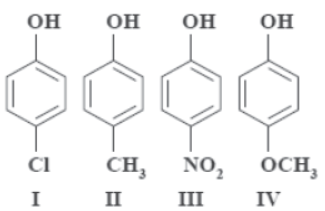
(a) IV > III > I > II
(b) II > IV > I > III
(c) I > II > III > IV
(d) III > I > II > IV
Answer: D
Question. Arrange the following compounds in increasing order of boiling point. Propan-1-ol, butan-1-ol, butan-2-ol, pentan-1-ol
(a) Propan-1-ol, butan-2-ol, butan-1-ol, pentan-1-ol
(b) Propan-1-ol, butan-1-ol, butan-2-ol, pentan-1-ol
(c) Pentan-1-ol, butan-2-ol, butan-1-ol, propan-1-ol
(d) Pentan-1-ol, butan-1-ol, butan-2-ol, propan-1-ol
Answer: A
Question. Write the IUPAC name of the given compound: 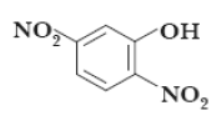
(a) 2,3- dinitrophenol
(b) 2,5- dinitrophenol
(c) 2,4- dinitrophenol
(d) 2,5- nitrophenol
Answer: B
Question. Which of the following compound would not react with Lucas reagent at room temperature?
(a) CH2 = CH—CH2OH
(b) C6H5CH2OH
(c) CH3CH2CH2OH
(d) (CH3)3 COH
Answer: D
Question. Which of the following compounds will react with sodium hydroxide solution in water?
(a) C6H5OH
(b) C6H5CH2OH
(c) (CH3)3 COH
(d) C2H5OH
Answer: A
Question. IUPAC name of the compound is _______________ .
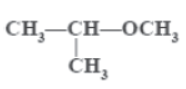
(a) 1-methoxy-1-methylethane
(b) 2-methoxy-2-methylethane
(c) 2-methoxypropane
(d) isopropylmethyl ether
Answer: C
Assertion Reason Based Question :
In the following question a statement of assertion followed by a statement of reason is given. Choose the correct answer out of the following choices.
(a) Assertion and reason both are correct and reason is correct explanation of assertion.
(b) Assertion and reason both are wrong statements.
(c) Assertion is correct statement but reason is wrong statement.
(d) Assertion is wrong statement but reason is correct statement.
(e) Both assertion and reason are correct statements but reason is not correct explanation of assertion.
Question. Assertion: Like bromination of benzene, bromination of phenol is also carried out in the presence of Lewis acid.
Reason: Lewis acid polarises the bromine molecule.
Answer: D
(a) Assertion and reason both are correct and reason is correct explanation of assertion.
(b) Assertion and reason both are wrong statements.
(c) Assertion is correct statement but reason is wrong statement.
(d) Assertion is wrong statement but reason is correct statement.
(e) Both assertion and reason are correct statements but reason is not correct explanation of assertion.
Question. Assertion: Bond angle in ethers is slightly less than the tetrahedral angle.
Reason: There is a repulsion between the two bulky (—R) groups.
Answer: D
Question. When salicylic acid is heated with Zn dust , what will be the main product ?
a) Benzene
b) phenol
c) Toluene
d) Benzoic acid
Answer. D
Question. To prepare butan-2-ol using CH3MgI, what other chemical would you choose ?
a) Propanal
b) Ethanal
c) Ethanol
d) Propan-2-ol
Answer. A
Question. Which of the following cannot be made by using Williamson’s synthesis ?
a) Methoxy benzene
b) tert-butyl ethyl ether
c) allyl methyl ether
d) Ditert-butyl ether
Answer. D
Question. Heating of phenyl methyl ether with HI produces
a) Iodobenzene
b) phenol
c) benzene
c) ethyl chloride
Answer. B
ASSERTION REASON TYPE QUESTIONS
For questions given below two statements are given- one labelled Assertion (A) and the other labelled as Reason (R). Select the correct answer from the codes (A) , (B) , ( C) and (D) as given below :
(A) Bothe assertion and reason are correct statements , and reason is the correct explanation of the assertion.
(B) Both assertion and reason are correct statements , but reason is not the correct explanation of the assertion
(C) Assertion is correct , but reason is wrong statement
(D) Assertion is wrong , but reason is correct statement
Question. Assertion (A) : The carbon-oxygen bond length in phenol is slightly less than that in methanol.
Reason (R) : The carbon –oxygen bond in phenol has partial double bond character due to + R effect
Answer. A
Question. Assertion (A) : Aldehydes are reduced to primary alcohols by using LiAlH4
Reason (R) : LiAlH4 is a strong reducing agent
Answer. A
Question. Assertion (A) : The acid strength of primary alcohol is more than secondary alcohol
Reason (R) : + I effect decreases the acid character
Answer. A
Question. Assertion (A) : o- nitrophenol has lower boiling point than p-nitrophenol
Reason (R) : o-nitrophenol possess intramolecular hydrogen bonding while p-nitrophenolhas intermolecular hydrogen bonding
Answer. A
Question. Assertion (A) : t-Butyl methyl ether on treatment with HI at 373K gives a mixture of methyliodide and tert-butyl alcohol
Reason (R) : The reaction occurs by SN1 mechanism
Answer. D
SHORT ANSWER TYPE QUESTIONS
Question. Arrange the following compounds in increasing order of their acid strength: Propan-1-ol, 2, 4, 6-trinitrophenol, 3-nitrophenol, 3, 5-dinitrophenol, phenol, 4-methylphenol.
Answer. Propan-1-ol, 4-methylphenol, phenol, 3-nitrophenol, 3, 5-dinitrophenol, 2, 4, 6-trinitrophenol.
Question. How primary, secondary and tertiary alcohols are distinguished by Lucas reagent test? Alcohols react with hydrogen halides to form alkyl halides.
Answer. The difference in reactivity of three classes of alcohols with HCl distinguishes them from one another (Lucas test). Alcohols are soluble in Lucas reagent (conc. HCl and ZnCl2) while their halides are immiscible and produce turbidity in solution. In case of tertiary alcohols, turbidity is produced immediately as they form the halides easily. Primary alcohols do not produce turbidity at room temperature.
Question. Ortho nitrophenol has lower boiling point than p-nitrophenol. Why?
Answer. Ortho-nitrophenol has lower boiling point due to formation of intramolecular H-bonding whereas p-nitrophenol forms intermolecular H-bonding.
Question. The C-O bond is much shorter in phenol than in ethanol. Give reason.
Answer. Carbon of C-O bond of phenol is Sp2 hybridised, so it acquires a partial double bond character but in ethanol it is Sp3 hybridised and a single bond. Double bond is shorter than a single bond.
Question. Give reasons for the following :
(i) Phenol is more acidic than methanol.
(ii) The C—O—H bond angle in alcohols is slightly less than the tetrahedral angle (190°28′).
(iii) (CH3)3C—O—CH3 on reaction with HI gives (CH3)3C—I and CH3—OH as the main products and not (CH3)3C—OH and CH3—I.
Answer. (i) Phenol is more acidic than methanol because in phenol, phenoxide ion formed is more stabilized by resonance than phenol. There is no resonance in methanol.
(ii) The C—O—H bond angle in alcohols is slightly less than tetrahedral angle due to repulsion between the lone pairs of electrons of oxygen.
(iii) (CH3)3C+ is 3° carbo-cation which is more stable than CH3+ for SN1 reaction.
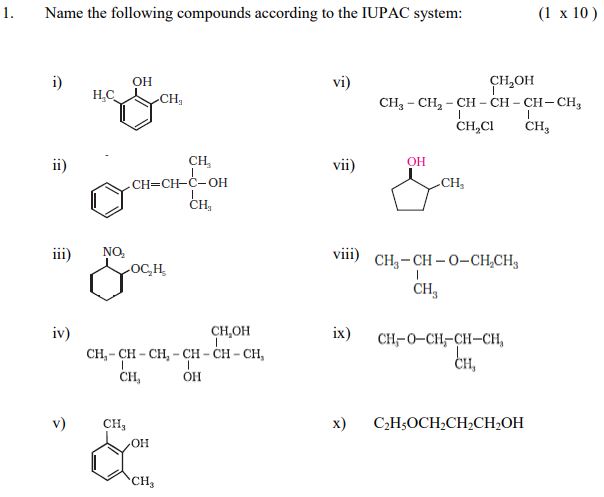
2 Account for the following:
i) C – O – H bond angle in alcohol is less than tetrahedral angle.
ii) C – O bond length in phenol is shorter than that in methanol.
iii) C – O – C bond angle in ether is greater than the tetrahedral angle.
iv) The boiling points of alcohols and phenols are higher than corresponding alkanes of same molecular mass.
v) Among the isomeric alcohols the boiling point follows the order 30< 20< 10.
vi) Lower alcohols are soluble in water
vii) Ethanol is less acidic than methanol.
viii) The acidic character of the alcohols follows the order 10> 20> 30
ix) The reaction of alcohol with acid is carried out in presence of small amount of concentrated H2SO4.
x) Reaction of alcohol with acid chloride is carried out in presence of a base pyridine.
3. Effect the following conversions:
i) Chloro benzene to phenol vi) Propene to 1-Propanol
ii) Benzene sulphonic acid to phenol vii) Propene to 2-propanol
iii) Ethanol to isopropyl alcohol viii) Phenol to anisole
iv) Phenol to picric acid ix) Phenol to aspirin
v) Phenol to p-hydroxy acetophenone x) Aniline to phenol
4. Arrange the following on the increasing property given in bracket:
a) Pentan-1-ol, butan-1-ol, butan-2-ol, ethanol, propan-1-ol, methanol (Boiling Point)
b) Pentan-1-ol, n-butane, pentanal, Ethoxyethane (Boiling point)
c) Propan-1-ol, 2, 4, 6 – trinitro phenol, 3,5 – dinitro phenol, 4-methylphenol (Acidity)
d) Ter. Butyl alcohol, isobutyl alcohol, n-butyl alcohol (Acidity)
e) 4-nitro phenol, phenol, 2,4,6-trinitro phenol (Acid strength )
5. Write short note on the following:
i) Hydroboration
iv) Kolbe’s reaction
ii) Reimer – Tiemann Reaction.
v) Williamson’s synthesis
iii) Friedel-Craft’s reaction
THREE MARK QUESTION
1. Write the mechanism of the following: Acid catalyzed dehydration of ethanol to diethyl ether.
VALUE BASED QUESTION
1. Leanne, a student of class XII is working in her chemistry laboratory. She is checking the action of acid chlorides and acid anhydrides on phenols. She found that as a result of one reaction aspirin is formed as product. She kept aspirin for medical use.
a) Write the reaction for the formation of aspirin.
b) What do you mean by acetylation reaction?
c) Why is pyridine added in the reaction of alcohols with acid chloride
d) Why Leanne is storing aspirin for medical use? Is her this act correct? Give reason.
Free study material for Chemistry
Download Class 12 Chemistry Unit 7 Alcohols, Phenols and Ethers Practice Worksheets
Practice Exercises for Class 12 Chemistry Unit 7 Alcohols, Phenols and Ethers
Access structured practice worksheets for Unit 7 Alcohols, Phenols and Ethers aligned with the 2026 CBSE curriculum. These downloadable exercises for Class 12 Chemistry help students build accuracy and reinforce core concepts for upcoming school tests.
Step-by-Step Solutions and Practice Guidelines
Designed around the official curriculum for Class 12 Chemistry, these practice sheets guarantee standard compliance. Reviewing step-by-step solutions after completion sharpens your accuracy and clarifies complex sub-topics within Unit 7 Alcohols, Phenols and Ethers.
Enhance Speed with Online Practice
Follow up your worksheet practice by attempting the interactive online MCQ tests for Unit 7 Alcohols, Phenols and Ethers to evaluate your execution speed. All printable assignments and revision sheets on our platform are updated for the 2026 session and available free of charge.
FAQs
You can download the latest chapter-wise printable worksheets for Class 12 Chemistry Unit 7 Alcohols, Phenols and Ethers for free from StudiesToday.com. These have been made as per the latest CBSE curriculum for this academic year.
Yes, Class 12 Chemistry worksheets for Unit 7 Alcohols, Phenols and Ethers focus on activity-based learning and also competency-style questions. This helps students to apply theoretical knowledge to practical scenarios.
Yes, we have provided solved worksheets for Class 12 Chemistry Unit 7 Alcohols, Phenols and Ethers to help students verify their answers instantly.
Yes, our Class 12 Chemistry test sheets are mobile-friendly PDFs and can be printed by teachers for classroom.
For Unit 7 Alcohols, Phenols and Ethers, regular practice with our worksheets will improve question-handling speed and help students understand all technical terms and diagrams.