

Official Class 12 Chemistry Worksheets: Chemical Test To Distinguish Between Pair Of Compounds
Review targeted academic worksheets with the CBSE Class 12 Chemistry Chemical Test To Distinguish Between Pair Of Compounds Worksheet. Built according to official educational standards for the 2026-27 term, these downloadable Class 12 Chemistry resources support effective daily practice and detailed self-evaluation for Chemical Test To Distinguish Between Pair Of Compounds.
Solved Practice Worksheets for Chemistry
Access the complete worksheet PDF for Class 12 Chemistry below. Regular practice with these targeted academic tasks builds familiarity with standard question patterns and helps secure higher marks in final school examinations.
CBSE Class 12 Chemistry Chemical Test To Distinguish Between Pair Of Compounds. CBSE issues sample papers every year for students for class 12 board exams. Students should solve the CBSE issued sample papers to understand the pattern of the question paper which will come in class 12 board exams this year. The sample papers have been provided with marking scheme. It’s always recommended to practice as many CBSE sample papers as possible before the board examinations. Sample papers should be always practiced in examination condition at home or school and the student should show the answers to teachers for checking or compare with the answers provided. Students can download the sample papers in pdf format free and score better marks in examinations. Refer to other links too for latest sample papers.
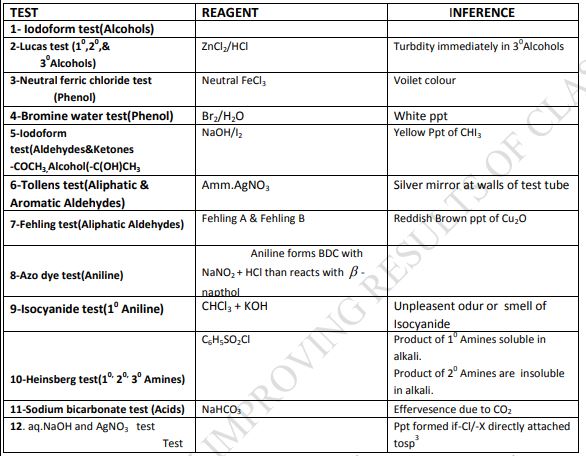
CHEMICAL TEST TO DISTINGUISH BETWEEN PAIR OF COMPOUNDS
LEVEL A
| TEST | REAGENT | INFERENCE |
|---|---|---|
| 1- Iodoform test (Alcohols) | \( \text{NaOH} / \text{I}_2 \) | Yellow precipitate of \( \text{CHI}_3 \) |
| 2- Lucas test (\( 1^\circ, 2^\circ, \& 3^\circ \) Alcohols) | \( \text{ZnCl}_2 / \text{HCl} \) | Turbidity appears immediately in tertiary (\( 3^\circ \)) alcohols |
| 3- Neutral ferric chloride test (Phenol) | Neutral \( \text{FeCl}_3 \) | Violet coloration |
| 4- Bromine water test (Phenol) | \( \text{Br}_2 / \text{H}_2\text{O} \) | White precipitate |
| 5- Iodoform test (Aldehydes & Ketones with \( \text{-COCH}_3 \) or Alcohols with \( \text{-CH(OH)CH}_3 \)) | \( \text{NaOH} / \text{I}_2 \) | Yellow precipitate of \( \text{CHI}_3 \) |
| 6- Tollens' test (Aliphatic & Aromatic Aldehydes) | Ammoniacal \( \text{AgNO}_3 \) | Shining silver mirror on the walls of the test tube |
| 7- Fehling's test (Aliphatic Aldehydes) | Fehling A & Fehling B | Reddish-brown precipitate of \( \text{Cu}_2\text{O} \) |
| 8- Azo dye test (Aniline) | Aniline forms BDC with \( \text{NaNO}_2 + \text{HCl} \), then reacts with \( \beta \)-naphthol | Brilliant orange-red dye |
| 9- Isocyanide test (\( 1^\circ \) Amines) | \( \text{CHCl}_3 + \text{KOH} \) | Extremely unpleasant odor of carbylamine |
| 10- Hinsberg's test (\( 1^\circ, 2^\circ, \& 3^\circ \) Amines) | \( \text{C}_6\text{H}_5\text{SO}_2\text{Cl} \) | Product of \( 1^\circ \) amine is soluble in alkali; product of \( 2^\circ \) amine is insoluble in alkali. |
| 11- Sodium bicarbonate test (Acids) | \( \text{NaHCO}_3 \) | Effervescence due to evolution of \( \text{CO}_2 \) gas |
| 12- aq. NaOH and AgNO3 test (for Halides) | \( \text{aq. NaOH} \) followed by \( \text{AgNO}_3 \) | Precipitate forms if \( \text{-Cl} \) or \( \text{-X} \) is attached directly to \( sp^3 \) carbon |
LEVEL B: DISTINGUISH BY A SINGLE CHEMICAL TEST (WITH CHEMICAL EQUATION)
Question 1. Methylamine and dimethylamine
Answer: These compounds are distinguished using the Carbylamine Test. Methylamine (a primary amine) reacts with chloroform and alcoholic \( \text{KOH} \) on warming to produce an offensive-smelling compound, methyl isocyanide. Dimethylamine (a secondary amine) does not give this reaction. \[ \text{CH}_3\text{NH}_2 + \text{CHCl}_3 + 3\text{KOH(alc.)} \xrightarrow{\Delta} \text{CH}_3\text{NC} + 3\text{KCl} + 3\text{H}_2\text{O} \]
In simple words: Only the primary amine (methylamine) produces a highly unpleasant, foul smell when heated with chloroform and base.
Exam Tip: Always state the chemical equation and explicitly name the foul-smelling product (isocyanide) to secure full marks.
Question 2. Secondary and tertiary amines
Answer: These classes can be differentiated using the Hinsberg Test. Secondary amines react with benzenesulphonyl chloride (\( \text{C}_6\text{H}_5\text{SO}_2\text{Cl} \)) to produce N,N-dialkylbenzenesulphonamide, which is insoluble in alkali. Tertiary amines do not react with Hinsberg's reagent at all. \[ \text{R}_2\text{NH} + \text{C}_6\text{H}_5\text{SO}_2\text{Cl} \rightarrow \text{C}_6\text{H}_5\text{SO}_2\text{NR}_2 + \text{HCl} \]
In simple words: Hinsberg's reagent forms a solid residue with secondary amines that does not dissolve in basic solutions, whereas tertiary amines remain unreacted.
Exam Tip: Explain the solubility of the product in alkali: primary amine products are soluble due to an acidic proton, while secondary amine products lack this proton and remain insoluble.
Question 3. Ethylamine and aniline
Answer: These amines are distinguished using the Azo Dye Test. Aniline (an aromatic primary amine) reacts with nitrous acid (\( \text{NaNO}_2 + \text{HCl} \)) at \( 273 - 278\text{ K} \) to form benzene diazonium chloride, which when coupled with alkaline \( \beta \)-naphthol yields an orange-red dye. Ethylamine (an aliphatic primary amine) does not produce a dye; it reacts with nitrous acid to release nitrogen gas bubbles. \[ \text{C}_6\text{H}_5\text{NH}_2 + \text{HNO}_2 + \text{HCl} \xrightarrow{273-278\text{ K}} \text{C}_6\text{H}_5\text{N}_2^+\text{Cl}^- \xrightarrow{\beta\text{-naphthol}} \text{Orange dye} \]
In simple words: Only aniline can form a bright orange-red dye with nitrous acid and naphthol, while ethylamine simply bubbles with nitrogen gas.
Exam Tip: Specify the low temperature range of \( 0 - 5^\circ\text{C} \) (\( 273 - 278\text{ K} \)) because the diazonium salt is unstable at higher temperatures.
Question 4. Aniline and benzylamine
Answer: These are distinguished using the Azo Dye Test. Aniline forms a stable diazonium salt at low temperatures that couples with alkaline \( \beta \)-naphthol to produce an orange-red azo dye. Benzylamine behaves as an aliphatic amine, producing an unstable diazonium intermediate that decomposes to release nitrogen gas without forming a dye. \[ \text{C}_6\text{H}_5\text{NH}_2 + \text{NaNO}_2 + 2\text{HCl} \xrightarrow{273-278\text{ K}} \text{C}_6\text{H}_5\text{N}_2^+\text{Cl}^- \xrightarrow{\beta\text{-naphthol}} \text{Orange-red dye} \]
In simple words: Aniline forms a bright orange dye when mixed with cold nitrous acid and naphthol, whereas benzylamine only releases gas bubbles.
Exam Tip: Benzylamine behaves as an aliphatic amine because its amine group is not directly attached to the aromatic ring.
Question 5. Aniline and N-methylaniline
Answer: These amines are distinguished using the Carbylamine Test. Aniline (a primary aromatic amine) reacts with chloroform and alcoholic \( \text{KOH} \) upon heating to produce phenyl isocyanide, which has an offensive odor. N-methylaniline (a secondary amine) does not give this test. \[ \text{C}_6\text{H}_5\text{NH}_2 + \text{CHCl}_3 + 3\text{KOH} \xrightarrow{\Delta} \text{C}_6\text{H}_5\text{NC} + 3\text{KCl} + 3\text{H}_2\text{O} \]
In simple words: Heating the primary amine (aniline) with chloroform produces a foul-smelling product, which does not happen with N-methylaniline.
Exam Tip: Phenyl isocyanide is the highly toxic and foul-smelling compound formed during this reaction.
Question 6. Propanal and Propanone
Answer: These compounds are distinguished using Tollens' Test. Propanal (an aldehyde) reduces Tollens' reagent to form a shining silver mirror on the walls of the test tube, while propanone (a ketone) does not react. \[ \text{CH}_3\text{CH}_2\text{CHO} + 2[\text{Ag(NH}_3)_2]^+ + 3\text{OH}^- \rightarrow \text{CH}_3\text{CH}_2\text{COO}^- + 2\text{Ag}\downarrow + 4\text{NH}_3 + 2\text{H}_2\text{O} \]
In simple words: Only the aldehyde (propanal) reacts with Tollens' reagent to coat the inside of the test tube with a thin layer of silver.
Exam Tip: Be sure to write the balanced ionic equation showing the reduction of silver ions to metallic silver (\( \text{Ag} \)).
Question 7. Acetophenone and Benzophenone
Answer: These ketones are distinguished using the Iodoform Test. Acetophenone contains a methyl ketone group (\( \text{-COCH}_3 \)) and reacts with sodium hypoiodite (\( \text{I}_2 + \text{NaOH} \)) to produce a yellow precipitate of iodoform. Benzophenone does not contain a methyl ketone group and does not react. \[ \text{C}_6\text{H}_5\text{COCH}_3 + 3\text{I}_2 + 4\text{NaOH} \rightarrow \text{C}_6\text{H}_5\text{COONa} + \text{CHI}_3\downarrow + 3\text{NaI} + 3\text{H}_2\text{O} \]
In simple words: Acetophenone reacts with iodine and sodium hydroxide to form bright yellow crystals, whereas benzophenone shows no reaction.
Exam Tip: Only compounds with the \( \text{CH}_3\text{CO-} \) or \( \text{CH}_3\text{CH(OH)-} \) structure yield a positive iodoform reaction.
Question 8. Phenol and Benzoic acid
Answer: These compounds are distinguished using the Sodium Bicarbonate Test. Benzoic acid reacts with aqueous sodium bicarbonate (\( \text{NaHCO}_3 \)) to release carbon dioxide gas with brisk effervescence. Phenol is less acidic and does not react. \[ \text{C}_6\text{H}_5\text{COOH} + \text{NaHCO}_3 \rightarrow \text{C}_6\text{H}_5\text{COONa} + \text{CO}_2\uparrow + \text{H}_2\text{O} \]
In simple words: Benzoic acid releases carbon dioxide bubbles when mixed with baking soda solution, while phenol does not.
Exam Tip: This test is very reliable because only carboxylic acids are strong enough to decompose carbonates and bicarbonates.
Question 9. Benzoic acid and Ethyl benzoate
Answer: These are distinguished using the Sodium Bicarbonate Test. Benzoic acid reacts with \( \text{NaHCO}_3 \) to yield brisk effervescence of carbon dioxide gas, while the ester ethyl benzoate shows no reaction. \[ \text{C}_6\text{H}_5\text{COOH} + \text{NaHCO}_3 \rightarrow \text{C}_6\text{H}_5\text{COONa} + \text{CO}_2\uparrow + \text{H}_2\text{O} \]
In simple words: Mixing benzoic acid with sodium bicarbonate releases bubbles, but the ester ethyl benzoate is unreactive.
Exam Tip: Effervescence is due to the release of carbon dioxide gas, which can be verified by passing it through lime water to turn it milky.
Question 10. Pentan-2-one and Pentan-3-one
Answer: These isomers are distinguished using the Iodoform Test. Pentan-2-one has a methyl ketone group (\( \text{-COCH}_3 \)) and reacts with \( \text{I}_2 + \text{NaOH} \) to form a yellow precipitate of iodoform. Pentan-3-one does not react. \[ \text{CH}_3\text{COCH}_2\text{CH}_2\text{CH}_3 + 3\text{I}_2 + 4\text{NaOH} \rightarrow \text{CH}_3\text{CH}_2\text{CH}_2\text{COONa} + \text{CHI}_3\downarrow + 3\text{NaI} + 3\text{H}_2\text{O} \]
In simple words: Pentan-2-one has a terminal methyl group adjacent to the carbonyl carbon, enabling it to form yellow iodoform crystals.
Exam Tip: This is a very common exam question for distinguishing between positional isomers of ketones.
Question 11. Benzaldehyde and Acetophenone
Answer: These are distinguished using Tollens' Test (or the Iodoform Test). Benzaldehyde reduces Tollens' reagent to give a silver mirror. Acetophenone (a ketone) does not react. \[ \text{C}_6\text{H}_5\text{CHO} + 2[\text{Ag(NH}_3)_2]^+ + 3\text{OH}^- \rightarrow \text{C}_6\text{H}_5\text{COO}^- + 2\text{Ag}\downarrow + 4\text{NH}_3 + 2\text{H}_2\text{O} \]
In simple words: Benzaldehyde produces a shining silver layer when tested with Tollens' reagent, whereas the ketone acetophenone does not.
Exam Tip: Alternatively, you can use the iodoform test: acetophenone gives a yellow precipitate while benzaldehyde does not.
Question 12. Ethanal and Propanal
Answer: These aldehydes are distinguished using the Iodoform Test. Ethanal (\( \text{CH}_3\text{CHO} \)) contains a methyl carbonyl group and reacts with \( \text{I}_2 + \text{NaOH} \) to form a yellow precipitate of iodoform. Propanal (\( \text{CH}_3\text{CH}_2\text{CHO} \)) does not give this test. \[ \text{CH}_3\text{CHO} + 3\text{I}_2 + 4\text{NaOH} \rightarrow \text{HCOONa} + \text{CHI}_3\downarrow + 3\text{NaI} + 3\text{H}_2\text{O} \]
In simple words: Ethanal is the only aldehyde with a terminal methyl group that can produce yellow iodoform crystals.
Exam Tip: Ethanal is the only aldehyde in organic chemistry that yields a positive iodoform test.
Question 13. Acetone and Acetaldehyde
Answer: These are distinguished using Fehling's Test. Acetaldehyde reduces Fehling's solution to form a reddish-brown precipitate of cuprous oxide (\( \text{Cu}_2\text{O} \)), while acetone does not react. \[ \text{CH}_3\text{CHO} + 2\text{Cu}^{2+} + 5\text{OH}^- \rightarrow \text{CH}_3\text{COO}^- + \text{Cu}_2\text{O}\downarrow + 3\text{H}_2\text{O} \]
In simple words: Acetaldehyde turns blue Fehling's solution into a reddish-brown brick precipitate, while acetone does not.
Exam Tip: Acetaldehyde is an aldehyde, which is easily oxidized, whereas ketones like acetone resist mild oxidation.
Question 14. Acetaldehyde and Benzaldehyde
Answer: These aldehydes are distinguished using Fehling's Test. Acetaldehyde (an aliphatic aldehyde) reduces Fehling's solution to give a reddish-brown precipitate of cuprous oxide. Benzaldehyde (an aromatic aldehyde) does not reduce Fehling's solution. \[ \text{CH}_3\text{CHO} + 2\text{Cu}^{2+} + 5\text{OH}^- \rightarrow \text{CH}_3\text{COO}^- + \text{Cu}_2\text{O}\downarrow + 3\text{H}_2\text{O} \]
In simple words: Fehling's test works for aliphatic aldehydes but fails with aromatic ones like benzaldehyde.
Exam Tip: This is an excellent way to distinguish between aliphatic and aromatic aldehydes, as both will give a positive Tollens' test.
Question 15. Ethanoic acid and Ethnoyl chloride
Answer: These are distinguished using the Silver Nitrate Test. Ethanoyl chloride hydrolyzes rapidly in water to produce chloride ions, which react with aqueous \( \text{AgNO}_3 \) to form a white precipitate of silver chloride. Ethanoic acid does not form a precipitate. \[ \text{CH}_3\text{COCl} + \text{H}_2\text{O} \rightarrow \text{CH}_3\text{COOH} + \text{HCl} \xrightarrow{\text{AgNO}_3} \text{AgCl}\downarrow \text{ (white ppt)} \]
In simple words: Ethanoyl chloride yields free chloride ions that react with silver nitrate to form a white cloud, which ethanoic acid cannot do.
Exam Tip: Be sure to acidify the solution with dilute nitric acid before adding silver nitrate to prevent interference.
Question 16. Methanol and Ethanol
Answer: These alcohols are distinguished using the Iodoform Test. Ethanol contains the methylcarbinol group (\( \text{CH}_3\text{CH(OH)-} \)) and reacts with \( \text{I}_2 + \text{NaOH} \) upon heating to produce a yellow precipitate of iodoform. Methanol does not react. \[ \text{CH}_3\text{CH}_2\text{OH} + 4\text{I}_2 + 6\text{NaOH} \xrightarrow{\Delta} \text{CHI}_3\downarrow + \text{HCOONa} + 5\text{NaI} + 5\text{H}_2\text{O} \]
In simple words: Ethanol produces yellow iodoform crystals, while methanol remains clear and unreacted.
Exam Tip: This test is highly valued for distinguishing primary alcohols from each other, as ethanol is the only primary alcohol that responds positively.
Question 17. Propanol and Propan-2-ol
Answer: These isomers are distinguished using the Iodoform Test. Propan-2-ol contains the \( \text{CH}_3\text{CH(OH)-} \) group and reacts with \( \text{I}_2 + \text{NaOH} \) to form a yellow precipitate of iodoform. Propanol (propan-1-ol) does not give this test. \[ \text{CH}_3\text{CH(OH)CH}_3 + 4\text{I}_2 + 6\text{NaOH} \rightarrow \text{CHI}_3\downarrow + \text{CH}_3\text{COONa} + 5\text{NaI} + 5\text{H}_2\text{O} \]
In simple words: Only the secondary alcohol (propan-2-ol) has the correct methyl-bearing structure to yield a yellow iodoform precipitate.
Exam Tip: You can also use the Lucas test: propan-2-ol produces turbidity within 5 minutes, while propan-1-ol requires heating.
Question 18. 2-Methyl Propan-2-ol and Propanol
Answer: These are distinguished using the Lucas Test. 2-Methylpropan-2-ol (a tertiary alcohol) reacts immediately with Lucas reagent (\( \text{ZnCl}_2 / \text{HCl} \)) to produce a cloudy turbidity due to insoluble alkyl chloride formation. Propanol (a primary alcohol) does not produce turbidity at room temperature. \[ (\text{CH}_3)_3\text{COH} + \text{HCl} \xrightarrow{\text{anhyd. ZnCl}_2} (\text{CH}_3)_3\text{CCl}\downarrow \text{ (immediate turbidity)} + \text{H}_2\text{O} \]
In simple words: The tertiary alcohol becomes cloudy instantly when mixed with the Lucas reagent, whereas the primary alcohol remains clear.
Exam Tip: Specify that this test is conducted at room temperature, as primary alcohols will also produce turbidity if heated.
Question 19. Phenol and Cyclohexanol
Answer: These are distinguished using the Ferric Chloride Test. Phenol reacts with neutral ferric chloride (\( \text{FeCl}_3 \)) to produce a characteristic violet coloration, while cyclohexanol does not react. \[ 6\text{C}_6\text{H}_5\text{OH} + \text{FeCl}_3 \rightarrow [\text{Fe(OC}_6\text{H}_5)_6]^{3-} \text{ (violet complex)} + 3\text{H}^+ + 3\text{Cl}^- \]
In simple words: Only phenol forms a beautiful, deep violet chemical complex when neutral iron chloride is added.
Exam Tip: Phenols easily form colored coordination complexes with iron, which sets them apart from aliphatic alcohols.
Question 20. 10,20,&30 Alchols
Answer: These three classes of alcohols are distinguished using the Lucas Test. When treated with Lucas reagent (\( \text{anhyd. ZnCl}_2 / \text{conc. HCl} \)) at room temperature:
- Tertiary (\( 3^\circ \)) alcohols give immediate turbidity.
- Secondary (\( 2^\circ \)) alcohols give turbidity within 5 minutes.
- Primary (\( 1^\circ \)) alcohols do not show any turbidity at room temperature. \[ \text{R-OH} + \text{HCl} \xrightarrow{\text{anhyd. ZnCl}_2} \text{R-Cl}\downarrow + \text{H}_2\text{O} \]
In simple words: The speed at which the solution turns cloudy determines the degree of the alcohol: instant cloudiness indicates tertiary, a 5-minute wait indicates secondary, and no change indicates primary.
Exam Tip: Write down all three observation timelines clearly to ensure you receive full credit.
Question 21. 10,20,& 30 Amines
Answer: These amines are distinguished using the Hinsberg Test by reacting them with benzenesulphonyl chloride (\( \text{C}_6\text{H}_5\text{SO}_2\text{Cl} \)):
- Primary (\( 1^\circ \)) amines yield a sulfonamide precipitate that is soluble in aqueous KOH.
- Secondary (\( 2^\circ \)) amines yield a sulfonamide precipitate that is insoluble in aqueous KOH.
- Tertiary (\( 3^\circ \)) amines do not react with Hinsberg's reagent. \[ \text{R-NH}_2 + \text{C}_6\text{H}_5\text{SO}_2\text{Cl} \rightarrow \text{C}_6\text{H}_5\text{SO}_2\text{NHR} \xrightarrow{\text{KOH}} \text{Soluble salt} \]
In simple words: Primary amines form a product that dissolves in base, secondary amines form a product that remains a solid in base, and tertiary amines show no reaction.
Exam Tip: The solubility of the primary amine product is due to the highly acidic sulfonamide hydrogen atom that can be removed by KOH.
Question 22. Formic acid and Acetic acid
Answer: These are distinguished using Tollens' Test. Formic acid (methanoic acid) contains an aldehyde-like hydrogen atom attached to its carbonyl carbon, allowing it to reduce Tollens' reagent to form a shining silver mirror. Acetic acid does not react. \[ \text{HCOOH} + 2[\text{Ag(NH}_3)_2]^+ + 2\text{OH}^- \rightarrow \text{CO}_2\uparrow + 2\text{Ag}\downarrow + 4\text{NH}_3 + 2\text{H}_2\text{O} \]
In simple words: Formic acid behaves like an aldehyde and reduces silver ions to form a silver mirror, while acetic acid is unreactive.
Exam Tip: Formic acid is unique among simple carboxylic acids because its structure allows it to act as both an acid and an aldehyde.
WORK SHEET: MATCH THE FOLLOWING
Question 1. Match the following :-
| Sl no | Column A | Sl No | Column B |
|---|---|---|---|
| 1 | Neutral Ferric Chloride solution | a | Test for carboxylic acid |
| 2 | Iodoform test | b | Test for p- , s- t- alcohol |
| 3 | Azodye test ( NaNO2 +HCl) and beta-napthol | c | Test for p- , s- t- amines |
| 4 | aq.NaOH and AgNO3 test | d | Test for any aldehyde |
| 5 | Hinsberg’s reagent ( benzene sulphonyl chloride and KOH) | e | Test for phenol |
| 6 | Tollen’s Reagent (ammoniacal AgNO3 solution) | f | Test for chloride |
| 7 | Lucas Test ( anh. ZnCl2 + conc.HCl ) | g | Test for alphatic and aromatic 10-amine |
| 8 | NaHCO3 solution | h | Test for aromatic 10-amine |
| 9 | Isocyanide Test Or Carbylamine Test | i | Test for ethanol. Ethanal , |
| 10 | Fehling’s solution (alkaline sol. Of CuSO4 + Sod.Pot.Tartarate | j | Acetophenone |
Answer:
The correct matched pairs are presented below:
| Column A (Reagent / Test) | Column B (Application) |
|---|---|
| 1. Neutral Ferric Chloride solution | e. Test for phenol |
| 2. Iodoform test | i. Test for ethanol, ethanal, acetophenone, etc. |
| 3. Azodye test (\( \text{NaNO}_2 + \text{HCl} \)) and \( \beta \)-naphthol | h. Test for aromatic \( 1^\circ \)-amine |
| 4. aq. NaOH and \( \text{AgNO}_3 \) test | f. Test for chloride (halides on \( sp^3 \) carbon) |
| 5. Hinsberg's reagent (benzene sulphonyl chloride and KOH) | c. Test for \( 1^\circ, 2^\circ, \& 3^\circ \) amines |
| 6. Tollens' Reagent (ammoniacal \( \text{AgNO}_3 \) solution) | d. Test for any aldehyde |
| 7. Lucas Test (anh. \( \text{ZnCl}_2 + \text{conc. HCl} \)) | b. Test for \( 1^\circ, 2^\circ, \& 3^\circ \) alcohols |
| 8. \( \text{NaHCO}_3 \) solution | a. Test for carboxylic acid |
| 9. Isocyanide Test Or Carbylamine Test | g. Test for aliphatic and aromatic \( 1^\circ \)-amine |
| 10. Fehling's solution | j. (Used for distinguishing aliphatic aldehydes from ketones like Acetophenone) |
In simple words: This table links common laboratory tests and chemical reagents with the specific functional groups they are used to detect.
Exam Tip: Be sure to match the specific structural requirements (like \( 1^\circ, 2^\circ, \& 3^\circ \)) when identifying tests for alcohols, amines, and halides.
WHICH ONE WILL GIVE POSITIVE TEST FOR THE REAGENT
Question 1. NaOH + I2 ( Propanal and Ethanal) .
Answer: Ethanal will give a positive iodoform test because it contains the \( \text{CH}_3\text{CO-} \) group. Propanal does not.
In simple words: Ethanal forms yellow crystals with iodine and base, while propanal shows no change.
Exam Tip: Ethanal is the only aldehyde in organic chemistry that gives a positive iodoform test.
Question 2. Neutral FeCl3 solution( Phenol , Acetic Acid )
Answer: Phenol gives a characteristic violet coloration complex. Acetic acid reacts with neutral \( \text{FeCl}_3 \) to form a deep red coloration (ferric acetate complex) which produces a brown-red precipitate on boiling.
In simple words: Phenol turns the iron solution violet, while acetic acid turns it wine-red.
Exam Tip: Be sure to write the distinct colors observed: violet for phenol, and red/brown for acetic acid.
Question 3. Ammoniacal AgNO3 solution ( Propanone and Propanal)
Answer: Propanal (an aldehyde) will give a positive Tollens' test, producing a silver mirror. Propanone (a ketone) does not react.
In simple words: The aldehyde propanal reduces silver ions to coat the tube with silver, while propanone does not.
Exam Tip: Tollens' reagent is a mild oxidizing agent that easily oxidizes aldehydes but fails to oxidize ketones.
Question 4. NaHCO3 solution ( Benzoic acid and Phenol )
Answer: Benzoic acid reacts with \( \text{NaHCO}_3 \) to produce brisk effervescence of \( \text{CO}_2 \) gas. Phenol does not react because it is a weaker acid.
In simple words: Benzoic acid releases carbon dioxide bubbles when mixed with baking soda, but phenol does not.
Exam Tip: This test is essential to prove that carboxylic acids are stronger acids than phenols.
Question 5. CHCl3 and alcoholic KOH ( Ethanamine and N-ethyl Ethanamine)
Answer: Ethanamine (a primary amine) will give a positive carbylamine test, producing an offensive-smelling isocyanide compound. N-ethyl ethanamine (a secondary amine) does not react.
In simple words: Only the primary amine (ethanamine) produces a foul smell when heated with chloroform and base.
Exam Tip: Remember that secondary and tertiary amines do not respond to the carbylamine test.
Question 6. Benzene sulphonyl chloride .( 20 amine and 30 amine)
Answer: 2° amine reacts with benzene sulphonyl chloride to form a precipitate that is insoluble in alkali. 3° amine does not react with the reagent.
In simple words: Only the secondary amine reacts to form a solid compound that does not dissolve in basic solution.
Exam Tip: Since the sulfonamide product from a secondary amine has no remaining acidic hydrogen on nitrogen, it cannot dissolve in alkali.
Question 7. ( NaNO2 +HCl) and beta-Napthol ( CH3NH2 and Aniline )
Answer: Aniline (primary aromatic amine) gives a positive azo dye test, yielding a brilliant orange-red dye. \( \text{CH}_3\text{NH}_2 \) (aliphatic primary amine) decomposes to release nitrogen gas without forming a dye.
In simple words: Aniline forms a stable diazonium intermediate that couples with naphthol to make an orange dye.
Exam Tip: The formation of a stable, conjugated azo-dye requires a primary aromatic amine.
Question 8. anh. ZnCl2 + conc.HCl (Isopropyl alcohol , Propanone)
Answer: Isopropyl alcohol (a secondary alcohol) reacts with Lucas reagent to produce cloudiness/turbidity within 5 minutes. Propanone (a ketone) does not react.
In simple words: Isopropyl alcohol turns the solution cloudy after a few minutes, while propanone does not react.
Exam Tip: Lucas test specifically targets the replacement of hydroxyl groups in alcohols with chlorine atoms.
Question 9. aq.NaOH and AgNO3 test ( Chlorobenzene ,Cyclohexylchloride)
Answer: Cyclohexyl chloride (an alkyl halide with halogen on \( sp^3 \) carbon) yields a white precipitate of \( \text{AgCl} \). Chlorobenzene (aryl halide) does not react due to resonance stabilization of the carbon-halogen bond.
In simple words: Cyclohexyl chloride easily drops its chlorine to form white silver chloride, while chlorobenzene is unreactive.
Exam Tip: Chlorobenzene resists hydrolysis because its carbon-chlorine bond possesses partial double-bond character.
Question 10. alkaline sol. Of CuSO4 + sod.pot.tartarate ( Acetone and Acetaldehyde)
Answer: Acetaldehyde (an aliphatic aldehyde) will give a positive Fehling's test, forming a reddish-brown precipitate of \( \text{Cu}_2\text{O} \). Acetone does not react.
In simple words: Acetaldehyde reduces Fehling's solution to form a red-brown solid, while acetone does not.
Exam Tip: Fehling's test is specific to aliphatic aldehydes; aromatic aldehydes like benzaldehyde do not respond.
Question 11. Hinsberg's reagent (Methylamine and dimethylamine)
Answer: Both react, but Methylamine (primary amine) forms a sulfonamide precipitate that is soluble in KOH, whereas dimethylamine (secondary amine) forms one that is insoluble in KOH.
In simple words: This test separates them because only the primary amine product dissolves completely in basic solutions.
Exam Tip: Be sure to highlight the difference in alkali solubility, as both amines react with the sulfonyl chloride starting material.
Question 12. Tollen's Test ( Formic acid and Acetic acid )
Answer: Formic acid reduces Tollens' reagent to give a shining silver mirror, whereas acetic acid does not react.
In simple words: Formic acid contains a formyl hydrogen atom that allows it to reduce silver, producing a silver mirror.
Exam Tip: Formic acid is the only simple carboxylic acid that can reduce Tollens' reagent.
Question 13. aq.NaOH and AgNO3 test (Benzyl chloride and Chlorobenzene)
Answer: Benzyl chloride reacts with aqueous \( \text{NaOH} \) to release chloride ions, which react with silver nitrate to form a white precipitate of \( \text{AgCl} \). Chlorobenzene is unreactive.
In simple words: Benzyl chloride has its chlorine attached to an \( sp^3 \) carbon, allowing it to easily form silver chloride precipitate.
Exam Tip: Aromatic chlorine atoms directly attached to the benzene ring are highly inert, whereas benzylic chlorine atoms are very reactive.
Question 14. Acidic hydrolysis of ester + Iodoform test. ( Methyl Acetate and Ethyl Acetate)
Answer: Ethyl acetate gives a positive test because its hydrolysis produces ethanol, which responds positively to the iodoform test. Methyl acetate yields methanol, which does not react.
In simple words: Hydrolysis of ethyl acetate releases ethanol, which then forms yellow iodoform crystals when heated with iodine and base.
Exam Tip: Write down both steps: the hydrolysis of the ester followed by the iodoform reaction of the resulting alcohol.
Question 15. Na-metal test ( Ethanol and Ethoxyethane )
Answer: Ethanol reacts with sodium metal to release hydrogen gas bubbles, while the ether ethoxyethane is unreactive.
In simple words: Ethanol has an active acidic hydrogen atom that reacts with sodium to release hydrogen gas.
Exam Tip: The sodium metal test is a classic way to distinguish active hydrogen compounds like alcohols and carboxylic acids from inert compounds like ethers.
MCQ SECTION
Question 1. Which of the following compound will give positive iodoform test.
a. 3-methylpropan-2-ol
b. 1-phenylpropan-1-ol
c. 1-methylcyclopentanal
d. 3-phenylpropan-2-ol
(i) a & c
(ii) a & d
(iii) b & c
(iv) b and d
Answer: (ii) a & d
In simple words: Both 3-methylpropan-2-ol and 3-phenylpropan-2-ol contain the essential \( \text{CH}_3\text{-CH(OH)-} \) group required to form a yellow iodoform precipitate.
Exam Tip: Identify the presence of a methyl group attached to the carbon bearing the hydroxyl group to quickly find compounds that give a positive iodoform test.
Question 2. Propan-1-ol and propan-2-ol can be distinguished by_____________
(a) Lucas test
(b) Ferric chloride test
(c) Tollen’s reagent test
(d) Na metal test
Answer: (a) Lucas test
In simple words: Propan-2-ol (secondary alcohol) reacts with Lucas reagent to produce turbidity within 5 minutes, while propan-1-ol (primary alcohol) remains clear.
Exam Tip: These isomeric alcohols can also be distinguished using the iodoform test, as only propan-2-ol reacts positively.
Question 3. Lucas test is associated with___________ .
(a) Alcohol
(b) phenol
(c) Aldehyde
(d) Carboxylic acid
Answer: (a) Alcohol
In simple words: The Lucas test is used to identify and distinguish between primary, secondary, and tertiary alcohols.
Exam Tip: Remember that Lucas reagent is a mixture of anhydrous zinc chloride (\( \text{ZnCl}_2 \)) and concentrated hydrochloric acid (\( \text{HCl} \)).
Question 4. ___________ alcohol react immediately with anhydrous ZnCl2 + HCl and give insoluble Chloride.
(a) Methanol
(b) Butanol
(c) Isopropylalcohol
(d) 2-methylpropan-2-ol
Answer: (d) 2-methylpropan-2-ol
In simple words: 2-Methylpropan-2-ol is a tertiary alcohol, which forms a highly stable carbocation and reacts instantly with Lucas reagent to give turbidity.
Exam Tip: The reaction rate with Lucas reagent follows the order of carbocation stability: \( 3^\circ > 2^\circ > 1^\circ \).
Question 5. C2H5OH and C6H5OH can be distinguished by
(a) Br2+ H2O
(b) I2+NaOH
(c) FeCl3
(d) both B and C
Answer: (d) both B and C
In simple words: Ethanol gives a positive iodoform test (with \( \text{I}_2 + \text{NaOH} \)), and phenol gives a violet color with ferric chloride. Both tests successfully separate them.
Exam Tip: Alternatively, phenol will also form a white precipitate with bromine water, while ethanol remains unreacted.
Question 6. C2H5CHO and (CH3)2CO be distinguished by testing with
(a) Phenyl Hydrazide
(b) Hydroxylamine
(c) Fehlings solution
(d) Sodium Bisulphide
Answer: (c) Fehlings solution
In simple words: Propanal (an aldehyde) reduces Fehling's solution to give a reddish-brown precipitate, while propanone (a ketone) does not react.
Exam Tip: Aliphatic aldehydes are easily oxidized by mild reagents like Fehling's solution, whereas ketones are resistant.
Question 7. Silver mirror test can be used to distinguished between
(a) Ketone and Acid
(b) Phenol and Acid
(c) Aldehyde And Acid
(d) Alcohol and phenol
Answer: (c) Aldehyde And Acid
In simple words: Tollens' silver mirror test is specific to aldehydes, allowing them to be distinguished from carboxylic acids.
Exam Tip: Formic acid is an exception as it is the only carboxylic acid that can reduce Tollens' reagent.
Question 8. The pair of compounds in which both the compounds give positive with tollen’s reagent
(a) Glucose and Sucrose
(b) Fructose and Sucrose
(c) Acetophenone and Hexanal
(d) Glucose and Fructose
Answer: (d) Glucose and Fructose
In simple words: Both glucose and fructose are reducing sugars; they reduce Tollens' reagent to give a positive silver mirror test.
Exam Tip: Fructose is a ketose but gives a positive Tollens' test because it isomerizes to glucose and mannose under basic reaction conditions.
Question 9. Acetone and Acetaldeyhde are differentiated by
(a) NaOH+I2
(b) [Ag(NH3)2]+
(c) HNO3
(d) I2
Answer: (b) [Ag(NH3)2]+
In simple words: Acetaldehyde (an aldehyde) reduces Tollens' reagent to form a silver mirror, while acetone (a ketone) does not react.
Exam Tip: Both compounds contain a methyl carbonyl group and will give a positive iodoform test, so Tollens' reagent is the ideal differentiator.
Question 10. Which of the following pairs can be distinguished by sodium hypoiodite
(a) CH3CHO and CH3COCH3
(b) CH3CH2CHO and CH3COCH3
(c) CH3CH2OH and CH3CH2CHOHCH3
(d) CH3OH and CH3CH2 CHO
Answer: (b) CH3CH2CHO and CH3COCH3
In simple words: Sodium hypoiodite is used in the iodoform test. Only propanone (\( \text{CH}_3\text{COCH}_3 \)) gives a positive test, while propanal (\( \text{CH}_3\text{CH}_2\text{CHO} \)) does not.
Exam Tip: Choose pairs where only one compound possesses the reactive \( \text{CH}_3\text{CO-} \) or \( \text{CH}_3\text{CH(OH)-} \) group.
Question 11. CH3CHO and C2H5CH2CHO can be distinguished by
(a) Bendict test
(b) Iodoform test
(c) Tollen’s test
(d) Fehlings solution test
Answer: (b) Iodoform test
In simple words: Ethanal (\( \text{CH}_3\text{CHO} \)) contains a methyl carbonyl group and gives a positive iodoform test, while butanal (\( \text{C}_2\text{H}_5\text{CH}_2\text{CHO} \)) does not react.
Exam Tip: Both are aliphatic aldehydes and will react with Tollens' and Fehling's solutions, making the iodoform test the only distinguishing test.
Question 12. Dye test can be used to distinguished between
(a) Ethylamine and Acetamide
(b) Ethylamine and Aniline
(c) Urea and Acetamide
(d) Methylamine and Ethylamine
Answer: (b) Ethylamine and Aniline
In simple words: Only aniline (an aromatic primary amine) undergoes diazotization and coupling with \( \beta \)-naphthol to produce a brilliant orange azo-dye.
Exam Tip: The azo-dye test is specifically used to distinguish aromatic primary amines from aliphatic primary amines.
Question 13. Hinsbergs reagent is :
(a) Benzenesulphonyl chloride
(b) Benzenesulphonic acid
(c) Phenyl iocyanide
(d) Benzenesulphamide
Answer: (a) Benzenesulphonyl chloride
In simple words: Benzenesulphonyl chloride (\( \text{C}_6\text{H}_5\text{SO}_2\text{Cl} \)) is the chemical reagent used in the Hinsberg test to classify amines.
Exam Tip: Be sure of the name and formula, as it is a highly common chemical reagent in CBSE board exams.
Question 14. Iodoform can be prepared from, all except.
(a) Ethyl methyl ketone
(b) Isopropyl alcohol
(c) 3-methylbutan-2-one
(d) Isobutyl alcohol
Answer: (d) Isobutyl alcohol
In simple words: Isobutyl alcohol (\( (\text{CH}_3)_2\text{CH-CH}_2\text{OH} \)) does not contain the methylcarbinol group, so it cannot form iodoform.
Exam Tip: Draw the structures of all options to verify the presence of the \( \text{CH}_3\text{-CH(OH)-} \) or \( \text{CH}_3\text{-CO-} \) structure.
STATE TRUE OR FALSE
Question 1. Formic acid reduces Tollens’ reagent
Answer: True
In simple words: Formic acid has a hydrogen atom attached to its carbonyl carbon, allowing it to reduce Tollens' reagent like an aldehyde.
Exam Tip: Remember this unique property of formic acid, as it is frequently tested in organic chemistry distinction questions.
Question 2. Carboxylic acids do not give characteristic reactions of carbonyl Group
Answer: True
In simple words: The carbonyl group in carboxylic acids is involved in resonance with the hydroxyl group, making it less electrophilic and unreactive.
Exam Tip: Resonance stabilization significantly reduces the electrophilicity of the carbonyl carbon in acids and esters.
Question 3. Acetic acid does not give sodium bisulphite addition product
Answer: True
In simple words: Carboxylic acids do not undergo nucleophilic addition reactions typical of simple aldehydes and ketones.
Exam Tip: Only highly reactive carbonyl groups in aldehydes and methyl ketones can form stable bisulphite addition products.
Question 4. Benzaldehyde does not give Fehling’s test.
Answer: True
In simple words: Fehling's solution is a weak oxidizing agent that cannot oxidize aromatic aldehydes like benzaldehyde.
Exam Tip: Benzaldehyde can be oxidized by the stronger Tollens' reagent but remains completely unreactive toward Fehling's solution.
Question 5. Can iodoform be prepared from ethanol ?
Answer: True
In simple words: Yes, ethanol contains the \( \text{CH}_3\text{CH(OH)-} \) group and reacts with iodine and sodium hydroxide to produce iodoform.
Exam Tip: Ethanol is oxidized to acetaldehyde during the reaction, which subsequently undergoes the iodoform reaction.
Free study material for Chemistry
CBSE Class 12 Chemistry Worksheets for Chemical Test To Distinguish Between Pair Of Compounds
Mastering Chemical Test To Distinguish Between Pair Of Compounds with Printable Worksheets
Explore reliable practice questions for Chemical Test To Distinguish Between Pair Of Compounds tailored for Class 12 Chemistry learners. Use these structured worksheets to evaluate exam preparedness and strengthen problem-solving skills throughout the 2026 academic session.
Verified Solutions and NCERT Alignment
Each worksheet draws directly from authorized standard textbooks to maintain academic accuracy. Evaluating your finished exercises against expert-verified solutions helps master the formal presentation standards expected in school evaluations.
Additional Study Resources for Class 12 Chemistry
Wrap up your chapter revision by testing your knowledge against standard objective question formats. Explore our full library of free, up-to-date printable assignments to maximize your academic results in upcoming CBSE evaluations.
FAQs
You can download the latest chapter-wise printable worksheets for Class 12 Chemistry Chemical Test To Distinguish Between Pair Of Compounds for free from StudiesToday.com. These have been made as per the latest CBSE curriculum for this academic year.
Yes, Class 12 Chemistry worksheets for Chemical Test To Distinguish Between Pair Of Compounds focus on activity-based learning and also competency-style questions. This helps students to apply theoretical knowledge to practical scenarios.
Yes, we have provided solved worksheets for Class 12 Chemistry Chemical Test To Distinguish Between Pair Of Compounds to help students verify their answers instantly.
Yes, our Class 12 Chemistry test sheets are mobile-friendly PDFs and can be printed by teachers for classroom.
For Chemical Test To Distinguish Between Pair Of Compounds, regular practice with our worksheets will improve question-handling speed and help students understand all technical terms and diagrams.