

Chapter-wise Worksheets for Class 12 Chemistry: Analysis Of Food
Review targeted academic worksheets with the CBSE Class 12 Chemistry Analysis Of Food Worksheet. Built according to official educational standards for the 2026-27 term, these downloadable Class 12 Chemistry resources support effective daily practice and detailed self-evaluation for Analysis Of Food.
Practice Class 12 Chemistry Worksheets: Analysis Of Food
Access the complete worksheet PDF for Class 12 Chemistry below. Regular practice with these targeted academic tasks builds familiarity with standard question patterns and helps secure higher marks in final school examinations.
CBSE Class 12 Chemistry Analysis of Food. CBSE issues sample papers every year for students for class 12 board exams. Students should solve the CBSE issued sample papers to understand the pattern of the question paper which will come in class 12 board exams this year. The sample papers have been provided with marking scheme. It’s always recommended to practice as many CBSE sample papers as possible before the board examinations. Sample papers should be always practiced in examination condition at home or school and the student should show the answers to teachers for checking or compare with the answers provided. Students can download the sample papers in pdf format free and score better marks in examinations. Refer to other links too for latest sample papers.
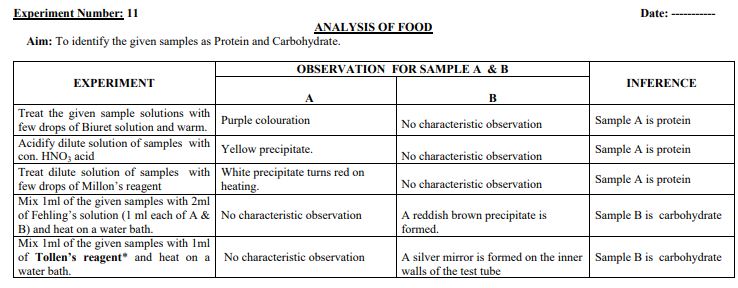
Question. Outline the systematic chemical tests, observations, and inferences required to identify two unknown food samples as either protein or carbohydrate.
Answer:
To systematically identify protein and carbohydrate components in food samples, a series of qualitative tests are performed as outlined in the experiment table below:
| EXPERIMENT | OBSERVATION A | OBSERVATION B | INFERENCE |
|---|---|---|---|
| Treat the given sample solutions with a few drops of Biuret solution and warm. | Purple coloration | No characteristic observation | Sample A is protein |
| Acidify a dilute solution of the samples with concentrated \( \text{HNO}_3 \) acid. | Yellow precipitate | No characteristic observation | Sample A is protein |
| Treat a dilute solution of the samples with a few drops of Millon's reagent and heat. | White precipitate that turns red on heating | No characteristic observation | Sample A is protein |
| Mix 1 mL of the given samples with 2 mL of Fehling's solution (1 mL each of Fehling A & B) and heat on a water bath. | No characteristic observation | A reddish-brown precipitate is formed | Sample B is carbohydrate |
| Mix 1 mL of the given samples with 1 mL of Tollens' reagent* and heat on a water bath. | No characteristic observation | A silver mirror is formed on the inner walls of the test tube | Sample B is carbohydrate |
* Preparation of Tollens' Reagent: Clean a test tube thoroughly with a small volume of sodium hydroxide (\( \text{NaOH} \)) solution, then add about \( 1\text{ mL} \) of silver nitrate (\( \text{AgNO}_3 \)) solution. A dark precipitate will form; add ammonium hydroxide (\( \text{NH}_4\text{OH} \)) solution dropwise with care until the precipitate is just barely dissolved.
Result: Based on the experimental observations, the given sample A is identified as Protein and sample B is identified as Carbohydrate.
In simple words: Proteins are identified by a purple color in the Biuret test or a yellow precipitate with nitric acid. Carbohydrates are confirmed when they reduce Fehling's solution to form a red-brown solid or produce a shiny silver layer with Tollens' reagent.
Exam Tip: Always make sure to use a water bath when heating mixtures for Fehling's and Tollens' tests, as direct heating over a flame can cause uneven reaction rates or cracking of the glass tube.
Question. Detail the laboratory chemical tests, observations, and corresponding chemical inferences used to detect aldehydes, carboxylic acids, primary amines, and phenols in an organic sample.
Answer:
The identification of different organic functional groups is carried out systematically by performing functional-group-specific chemical reactions as detailed below:
| EXPERIMENT | OBSERVATION | INFERENCE |
|---|---|---|
| TESTS FOR ALDEHYDES (-CHO GROUP) [Using acetaldehyde] | ||
| 1. Mix 1 mL of the organic sample with 2 mL of Fehling's solution (A + B) and heat on a water bath. | A reddish-brown precipitate is formed. | Presence of \( \text{-CHO} \) group. |
| 2. Mix 1 mL of the organic sample with 1 mL of Tollens' reagent and heat on a water bath. | A silver mirror is formed on the inner walls of the test tube. | Presence of \( \text{-CHO} \) group is confirmed. |
| TESTS FOR CARBOXYLIC ACID (-COOH) GROUP [Using acetic acid] | ||
| 1. Add a small volume of a saturated solution of sodium bicarbonate (\( \text{NaHCO}_3 \)) to the given sample. | Brisk effervescence of a colorless, odorless gas which turns clear limewater milky. | Presence of carboxylic acid group. |
| 2. Mix 1 mL of the sample with 1 mL of ethanol and 1 drop of concentrated \( \text{H}_2\text{SO}_4 \). Heat the mixture in a boiling water bath for about 5 minutes, then pour into a beaker containing 25 mL of tap water and note the aroma. | A pleasant, sweet, and fruity odor of an ester is evolved. | Presence of carboxylic acid is confirmed. |
| TESTS FOR AMINO (-NH2) GROUP [Using aniline] | ||
| 1. Shake 2 drops of the given compound with 2 mL of dilute \( \text{HCl} \). | The organic compound dissolves completely. | Presence of \( \text{-NH}_2 \) group. |
| 2. Take 1 mL each of the organic sample, concentrated \( \text{HCl} \), aqueous \( \text{NaNO}_2 \), and alkaline \( \beta \)-naphthol solution in separate test tubes and cool below \( 5^\circ\text{C} \) in an ice bath. Mix in order: \( \text{HCl} + \text{NaNO}_2 \), then add the aniline, and finally add alkaline \( \beta \)-naphthol, stirring in the ice bath for 5 minutes. | A vibrant red-orange colored dye precipitate is obtained. | Presence of \( \text{-NH}_2 \) group is confirmed. |
| TESTS FOR PHENOLIC (-OH) GROUP [Using Phenol] | ||
| 1. Treat the organic samples with a neutral ferric chloride solution and add 10 mL of water. | Violet coloration. | Presence of Phenol. |
| 2. Phthalic Test: Place 2-3 flakes of phthalic anhydride and 1 mL of the sample in a test tube. Add 2-3 drops of concentrated \( \text{H}_2\text{SO}_4 \), heat on a boiling water bath for 2-3 minutes, then pour the mixture into dilute \( \text{NaOH} \) solution. | A pink coloration develops. | Presence of Phenol. |
In simple words: Organic compounds are identified by distinct behaviors: aldehydes form silver mirrors; carboxylic acids fizz with baking soda and smell fruity with alcohol; amines dissolve in acid and form red-orange dyes; phenols turn violet with iron chloride.
Exam Tip: For the azo-dye test, keeping the reactants strictly below \( 5^\circ\text{C} \) is critical. If the temperature rises, the diazonium salt intermediate decomposes, preventing the formation of the colored dye.
Free study material for Chemistry
Free CBSE Practice Worksheets: Class 12 Chemistry Analysis Of Food
Daily Practice Questions for Class 12 Chemistry
Explore reliable practice questions for Analysis Of Food tailored for Class 12 Chemistry learners. Use these structured worksheets to evaluate exam preparedness and strengthen problem-solving skills throughout the 2026 academic session.
Detailed Answers for Class 12 Chemistry Analysis Of Food
Designed around the official curriculum for Class 12 Chemistry, these practice sheets guarantee standard compliance. Reviewing step-by-step solutions after completion sharpens your accuracy and clarifies complex sub-topics within Analysis Of Food.
Complete Your Chapter Revision
Consistent engagement with these exercises builds familiarity with recurring exam themes. If specific areas within Analysis Of Food cause trouble, utilize our dedicated NCERT solutions for Class 12 Chemistry to clear up doubts immediately.
FAQs
You can download the latest chapter-wise printable worksheets for Class 12 Chemistry Analysis Of Food for free from StudiesToday.com. These have been made as per the latest CBSE curriculum for this academic year.
Yes, Class 12 Chemistry worksheets for Analysis Of Food focus on activity-based learning and also competency-style questions. This helps students to apply theoretical knowledge to practical scenarios.
Yes, we have provided solved worksheets for Class 12 Chemistry Analysis Of Food to help students verify their answers instantly.
Yes, our Class 12 Chemistry test sheets are mobile-friendly PDFs and can be printed by teachers for classroom.
For Analysis Of Food, regular practice with our worksheets will improve question-handling speed and help students understand all technical terms and diagrams.