

Download Class 12 Chemistry Practice Worksheets
Explore structured practice materials through the CBSE Class 12 Chemistry All Chapters Concept Cards Worksheet. Tailored for Class 12 learners, utilizing these Chemistry worksheets ensures thorough preparation and strengthens problem-solving accuracy before final school evaluations.
Access All Chapters Concept Cards Practice Papers and Solutions
Navigate directly to the solved Chemistry worksheets using the digital viewer below. Each practice set includes detailed step-by-step solutions, allowing students to instantly cross-check their work and identify areas requiring further revision.
CBSE Class 12 Chemistry All Chapters Concept Cards. CBSE issues sample papers every year for students for class 12 board exams. Students should solve the CBSE issued sample papers to understand the pattern of the question paper which will come in class 12 board exams this year. The sample papers have been provided with marking scheme. It’s always recommended to practice as many CBSE sample papers as possible before the board examinations. Sample papers should be always practiced in examination condition at home or school and the student should show the answers to teachers for checking or compare with the answers provided. Students can download the sample papers in pdf format free and score better marks in examinations. Refer to other links too for latest sample papers.
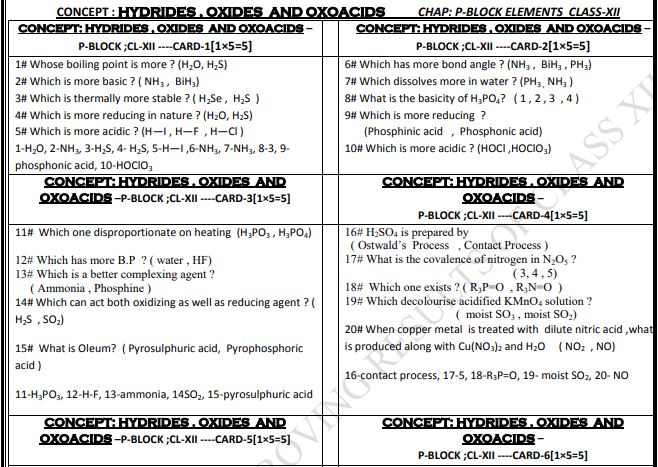
Concept: Hydrides, Oxides and Oxoacids
Question 1. Whose boiling point is more? (\( \text{H}_2\text{O} \), \( \text{H}_2\text{S} \))
Answer: \( \text{H}_2\text{O} \)
In simple words: Water has a higher boiling point than hydrogen sulfide because its molecules are held together by strong hydrogen bonds.
Exam Tip: Always highlight oxygen's high electronegativity, which allows \( \text{H}_2\text{O} \) to form extensive intermolecular hydrogen bonding, unlike \( \text{H}_2\text{S} \).
Question 2. Which is more basic? (\( \text{NH}_3 \), \( \text{BiH}_3 \))
Answer: \( \text{NH}_3 \)
In simple words: Ammonia is much more basic because nitrogen is smaller, concentrating its electron pair in a tight space where it is easily shared.
Exam Tip: Basicity decreases down the group from \( \text{NH}_3 \) to \( \text{BiH}_3 \) due to the increase in size of the central atom and the resulting dispersal of the lone pair's charge density.
Question 3. Which is thermally more stable? (\( \text{H}_2\text{Se} \box \), \( \text{H}_2\text{S} \))
Answer: \( \text{H}_2\text{S} \)
In simple words: Hydrogen sulfide is more stable when heated because sulfur is smaller than selenium, allowing it to form a shorter and stronger bond with hydrogen.
Exam Tip: Bond dissociation enthalpy of the E-H bond decreases down the group as the size of the central atom increases, lowering thermal stability.
Question 4. Which is more reducing in nature? (\( \text{H}_2\text{O} \), \( \text{H}_2\text{S} \))
Answer: \( \text{H}_2\text{S} \)
In simple words: Hydrogen sulfide is a stronger reducing agent because it is less stable than water and easily releases its hydrogen atoms.
Exam Tip: Water is non-reducing because of its exceptionally high O-H bond strength, whereas group 16 hydrides exhibit increasing reducing character down the column.
Question 5. Which is more acidic? (\( \text{H-I} \), \( \text{H-F} \), \( \text{H-Cl} \))
Answer: \( \text{H-I} \)
In simple words: Hydroiodic acid is the strongest acid because the bond between hydrogen and iodine is the longest and weakest, letting the hydrogen ion break free easily.
Exam Tip: Acidic strength of halogen acids increases down the group (\( \text{HF} < \text{HCl} < \text{HBr} < \text{HI} \)) as bond dissociation enthalpy decreases.
Question 6. Which has more bond angle? (\( \text{NH}_3 \), \( \text{BiH}_3 \), \( \text{PH}_3 \))
Answer: \( \text{NH}_3 \)
In simple words: Ammonia has the largest bond angle because nitrogen's high electronegativity pulls the bonding electron pairs closer, forcing them to repel each other and open up the angle.
Exam Tip: As the size of the central atom increases down the group, its electronegativity decreases, bonding pairs move further away, and repulsion between them weakens, lowering the bond angle.
Question 7. Which dissolves more in water? (\( \text{PH}_3 \), \( \text{NH}_3 \))
Answer: \( \text{NH}_3 \)
In simple words: Ammonia dissolves very well in water because its molecules can form strong hydrogen bonds with water molecules.
Exam Tip: Phosphine is only slightly soluble in water because phosphorus is not electronegative enough to establish hydrogen bonds with solvent molecules.
Question 8. What is the basicity of \( \text{H}_3\text{PO}_4 \)? (1, 2, 3, 4)
Answer: 3
In simple words: Orthophosphoric acid is tribasic because it contains three ionizable P-OH groups that can release hydrogen ions.
Exam Tip: Always look at the structure of phosphorus oxoacids; only the hydrogens attached to oxygen (P-OH bonds) are ionizable and contribute to basicity.
Question 9. Which is more reducing? (Phosphinic acid, Phosphonic acid)
Answer: Phosphinic acid
In simple words: Phosphinic acid (\( \text{H}_3\text{PO}_2 \)) is a stronger reducing agent because it contains two directly-bonded P-H groups, whereas phosphonic acid (\( \text{H}_3\text{PO}_3 \)) has only one.
Exam Tip: The reducing character of phosphorus oxoacids is directly determined by the number of active P-H bonds present in the structure.
Question 10. Which is more acidic? (\( \text{HOCl} \), \( \text{HOClO}_3 \))
Answer: \( \text{HOClO}_3 \)
In simple words: Perchloric acid is much stronger because its chlorine atom has more oxygen atoms pulling on its electrons, stabilizing the conjugate base through resonance.
Exam Tip: For oxoacids of the same halogen, acidic strength increases with an increase in the oxidation state of the central halogen atom.
Question 11. Which one disproportionate on heating (\( \text{H}_3\text{PO}_3 \), \( \text{H}_3\text{PO}_4 \))
Answer: \( \text{H}_3\text{PO}_3 \)
In simple words: Phosphonic acid decomposes when heated to form phosphoric acid and toxic phosphine gas, undergoing self-oxidation and reduction.
Exam Tip: Write down the balanced disproportionation reaction: \( 4\text{H}_3\text{PO}_3 \xrightarrow{\Delta} 3\text{H}_3\text{PO}_4 + \text{PH}_3 \).
Question 12. Which has more B.P ? (water, HF)
Answer: water
In simple words: Water has a higher boiling point than hydrogen fluoride because each water molecule can form up to four hydrogen bonds, creating a more cohesive liquid network.
Exam Tip: Although fluorine is more electronegative, \( \text{HF} \) forms only two hydrogen bonds per molecule on average, leading to a lower boiling point than water.
Question 13. Which is a better complexing agent? (Ammonia, Phosphine)
Answer: Ammonia
In simple words: Ammonia is a better complexing ligand because nitrogen's smaller size allows it to coordinate more closely with metal ions.
Exam Tip: Smaller size and higher charge density of the donor atom increase its ability to donate lone pairs, enhancing its ligating power.
Question 14. Which can act both oxidizing as well as reducing agent? (\( \text{H}_2\text{S} \), \( \text{SO}_2 \))
Answer: \( \text{SO}_2 \)
In simple words: In sulfur dioxide, sulfur is in an intermediate \( +4 \) oxidation state, meaning it can lose electrons to reach \( +6 \) or gain electrons to go down to zero or \( -2 \).
Exam Tip: Compounds in their highest oxidation states act only as oxidizing agents, and those in their lowest act only as reducing agents.
Question 15. What is Oleum? (Pyrosulphuric acid, Pyrophosphoric acid)
Answer: Pyrosulphuric acid
In simple words: Oleum is another name for pyrosulphuric acid (\( \text{H}_2\text{S}_2\text{O}_7 \)), which is formed by dissolving sulfur trioxide gas in concentrated sulfuric acid.
Exam Tip: Always remember the chemical formula of oleum is \( \text{H}_2\text{S}_2\text{O}_7 \), which is produced in the Contact Process.
Question 16. \( \text{H}_2\text{SO}_4 \) is prepared by (Ostwald’s Process, Contact Process)
Answer: Contact Process
In simple words: Sulfuric acid is manufactured on an industrial scale using the Contact Process, which involves oxidizing sulfur dioxide to sulfur trioxide.
Exam Tip: Ostwald's process is used for nitric acid (\( \text{HNO}_3 \)), and the Contact process is used for sulfuric acid (\( \text{H}_2\text{SO}_4 \)).
Question 17. What is the covalence of nitrogen in \( \text{N}_2\text{O}_5 \)? (3, 4, 5)
Answer: 4
In simple words: Although nitrogen has five valence electrons, it cannot expand its octet beyond four bonds because it lacks d-orbitals, restricting its maximum covalency to four.
Exam Tip: In \( \text{N}_2\text{O}_5 \), each nitrogen is bonded to three oxygen atoms, sharing four pairs of bonding electrons in total.
Question 18. Which one exists? (\( \text{R}_3\text{P=O} \), \( \text{R}_3\text{N=O} \))
Answer: \( \text{R}_3\text{P=O} \)
In simple words: Phosphorus can form a double bond with oxygen by using its empty d-orbitals for backbonding, but nitrogen cannot do this because it lacks d-orbitals.
Exam Tip: Transition and heavier p-block elements can form \( d_\pi\text{-}p_\pi \) double bonds, whereas second-period elements like nitrogen are restricted to \( p_\pi\text{-}p_\pi \) bonding.
Question 19. Which decolourise acidified KMnO4 solution? (moist SO3, moist SO2)
Answer: moist SO2
In simple words: Moist sulfur dioxide acts as a strong reducing agent and reduces the purple permanganate ions to colorless manganese ions.
Exam Tip: Write down the reaction: \( 2\text{MnO}_4^- + 5\text{SO}_2 + 2\text{H}_2\text{O} \rightarrow 2\text{Mn}^{2+} + 5\text{SO}_4^{2-} + 4\text{H}^+ \).
Question 20. When copper metal is treated with dilute nitric acid, what is produced along with Cu(NO3)2 and H2O? (NO2, NO)
Answer: NO
In simple words: Dilute nitric acid acts as a mild oxidizing agent, reacting with copper to release nitric oxide gas.
Exam Tip: Remember: Copper with dilute \( \text{HNO}_3 \) gives \( \text{NO} \), while copper with concentrated \( \text{HNO}_3 \) gives \( \text{NO}_2 \).
Question 21. The spontaneous combustion of which gas is technically used in Holme’s Signals? (H2S or PH3)
Answer: \( \text{PH}_3 \)
In simple words: Phosphine gas ignites spontaneously in contact with air, creating a bright smoke signal used to guide ships at sea.
Exam Tip: Holme's signals contain calcium phosphide and calcium carbide which react with water to release flammable phosphine and acetylene gases.
Question 22. Name the common acid used in pickling of stainless steel, oxidizer in rocket fuels and in explosives. (H2SO4 or HNO3)
Answer: \( \text{HNO}_3 \)
In simple words: Nitric acid is used for cleaning steel, as an oxygen provider in rocket propellants, and in making explosives like TNT.
Exam Tip: Nitric acid is widely used in the defense and space industries because of its strong oxidizing properties.
Question 23. Which gas is poisonous and has rotten fish smell? (hydrogen sulphide, phosphine)
Answer: phosphine
In simple words: Phosphine is a highly toxic gas that is characterized by its foul, rotten-fish-like odor.
Exam Tip: Do not confuse the odors: \( \text{H}_2\text{S} \) smells like rotten eggs, while \( \text{PH}_3 \) smells like rotten fish.
Question 24. Which one of the oxides will not have two different N-O bond length? (N2O5, N2O3, N2O4)
Answer: \( \text{N}_2\text{O}_4 \)
In simple words: Dinitrogen tetroxide has a completely symmetrical planar structure, which means all its outer nitrogen-oxygen bonds are equal in length due to resonance.
Exam Tip: Symmetrical oxides like \( \text{N}_2\text{O}_4 \) display equivalent terminal N-O bond distances due to resonance stabilization.
Question 25. Which acid is more acidic? (CrO, CrO3, Cr2O3)
Answer: \( \text{CrO}_3 \)
In simple words: Chromium trioxide is the most acidic because chromium is in its highest oxidation state (+6), which strongly attracts electron density.
Exam Tip: For transition metal oxides, the acidic character increases as the oxidation state of the metal increases.
Question 26. The catalyst used in Contact Process are-------- (Pt/ Rh-gauge at 500K and 9 bar, V2O5)
Answer: \( \text{V}_2\text{O}_5 \default \)
In simple words: Vanadium pentoxide is used as the key catalyst to convert sulfur dioxide to sulfur trioxide in the Contact Process.
Exam Tip: Although platinum can also be used, vanadium pentoxide is preferred industrially because it is cheaper and less susceptible to catalytic poisoning.
Question 27. Which is the anhydride of HNO3? (N2O3, N2O5, NO2)
Answer: \( \text{N}_2\text{O}_5 \)
In simple words: Dinitrogen pentoxide is the anhydride of nitric acid because dehydrating two molecules of nitric acid yields \( \text{N}_2\text{O}_5 \).
Exam Tip: You can find the anhydride of an acid by subtracting water from its formula: \( 2\text{HNO}_3 - \text{H}_2\text{O} \rightarrow \text{N}_2\text{O}_5 \).
Question 28. Which one is colourless gas, neutral, reactive, paramagnetic and dimerise? (NO2, NO, N2O4)
Answer: NO
In simple words: Nitric oxide is a neutral, colorless, reactive gas that has one unpaired electron (paramagnetic) and easily pairs up into a dimer in its liquid and solid states.
Exam Tip: Nitric oxide contains an odd number of electrons, making it paramagnetic in the gaseous state.
Question 29. Which one does not have P-O-P linkage? (pyrophosphoric acid, polymetaphosphoric acid, Hypophosphoric acid)
Answer: Hypophosphoric acid
In simple words: Hypophosphoric acid (\( \text{H}_4\text{P}_2\text{O}_6 \)) contains a direct P-P single bond rather than an oxygen-bridged P-O-P link.
Exam Tip: Draw the structure of \( \text{H}_4\text{P}_2\text{O}_6 \) to show the \( \text{O}_2\text{P(OH)}_2\text{-P(OH)}_2\text{O}_2 \) configuration without any bridging oxygen.
Question 30. Which acid is stronger? (Perchloric acid, H2SO4)
Answer: Perchloric acid
In simple words: Perchloric acid is stronger than sulfuric acid because the high oxidation state (+7) of its chlorine atom stabilizes the conjugate base through effective charge dispersal.
Exam Tip: Perchloric acid is widely considered the strongest mineral acid under standard conditions.
Question 31. Spontaneous combustion of which one is technically used in Holme’s Signals? (Ca3P2, CaC2, PH3)
Answer: \( \text{PH}_3 \)
In simple words: Phosphine gas, generated by the reaction of calcium phosphide with seawater, catches fire on its own when it contacts air, making it useful for marine distress signals.
Exam Tip: Spontaneous combustion occurs due to traces of highly flammable \( \text{P}_2\text{H}_4 \) (diphosphine) impurities formed along with \( \text{PH}_3 \).
Question 32. The acid contain -----------------bond have strong reducing properties. (P-OH, P-H)
Answer: P-H
In simple words: The presence of directly-bonded P-H groups is what gives phosphorus oxoacids their strong reducing power.
Exam Tip: Hydrogens in P-OH bonds are acidic, while those in P-H bonds act as active hydride donors for reduction reactions.
Question 33. Which one is not responsible for ozone layer depletion? (NO2, NO, CFC)
Answer: \( \text{NO}_2 \)
In simple words: Unlike nitric oxide (\( \text{NO} \)) and chlorofluorocarbons, nitrogen dioxide does not directly catalyze the breakdown of ozone.
Exam Tip: Free radical catalysts like \( \text{Cl}^\bullet \) and \( \text{NO}^\bullet \) are the primary agents of stratospheric ozone depletion.
Question 34. Which statement is incorrect about White Phosphorous: P4 has (a) six P-P single bonds (b) Four P-P single bonds (c) four lone pairs of electrons (d) PPP angle of 600
Answer: (b) Four P-P single bonds
In simple words: White phosphorus actually contains six P-P single bonds forming its tetrahedral shape, not four.
Exam Tip: The tetrahedral \( \text{P}_4 \) molecule has 4 vertices, 6 edges (bonds), and suffers from severe angle strain due to its 60-degree bond angles.
Question 35. The number of P-O-P bonds in cyclotri metaphosphoric acid is (a) zero (b) 2 (c) 3 (d) 4
Answer: (c) 3
In simple words: Cyclotrimetaphosphoric acid has a six-membered ring of alternating phosphorus and oxygen atoms, which contains exactly three P-O-P links.
Exam Tip: Draw the cyclic structures of metaphosphoric acids to verify the alternating pattern of phosphorus and oxygen atoms.
Question 36. The gases produced in the thermal decomposition reaction of Pb(NO3)2 and NH4NO3 are respectively: (a) N2O, NO (b) N2O, NO2 (c) NO, NO2 (d) NO2, N2O
Answer: (d) NO2, N2O
In simple words: Heating lead nitrate releases reddish-brown nitrogen dioxide gas, while heating ammonium nitrate yields nitrous oxide gas.
Exam Tip: Write both decomposition reactions: \( 2\text{Pb(NO}_3)_2 \rightarrow 2\text{PbO} + 4\text{NO}_2 + \text{O}_2 \) and \( \text{NH}_4\text{NO}_3 \rightarrow \text{N}_2\text{O} + 2\text{H}_2\text{O} \).
Question 37. The ONO bond angle is maximum in (a) NO3- (b) NO2- (c) NO2 (d) NO2+
Answer: (d) NO2+
In simple words: The nitronium ion (\( \text{NO}_2^+ \)) is linear with \( sp \) hybridization, which gives it a maximum bond angle of 180 degrees.
Exam Tip: Predict bond angles using steric numbers and hybridization: \( \text{NO}_2^+ \) (linear, 180°), \( \text{NO}_2 \) (bent, ~134°), \( \text{NO}_2^- \) (bent, ~115°).
Question 38. Which of the following has least bond angle (a) H2O (b) H2S (c) H2Se (d) H2Te
Answer: (d) H2Te
In simple words: Hydrogen telluride has the smallest bond angle because tellurium is large and has low electronegativity, which weakens repulsion between bonding pairs.
Exam Tip: In hydrides of groups 15 and 16, the bond angle decreases down the group towards approximately 90 degrees due to the decreasing use of hybrid s-orbitals.
Question 39. Which statement is wrong for NO (a) It is anhydride of nitrous acid (b) It’s dipole moment is 0.22 D (c) It forms dimer (d) It is paramagnetic
Answer: (a) It is anhydride of nitrous acid
In simple words: The anhydride of nitrous acid is dinitrogen trioxide (\( \text{N}_2\text{O}_3 \)), not nitric oxide.
Exam Tip: Nitrous acid (\( \text{HNO}_2 \)) dehydration proceeds as: \( 2\text{HNO}_2 - \text{H}_2\text{O} \rightarrow \text{N}_2\text{O}_3 \).
Question 40. Which of the following hydrogen halide is most volatile? (a) HF (b) HCl (c) HBr (d) HI
Answer: (b) HCl
In simple words: Hydrochloric acid is the most volatile because it has the lowest boiling point, lacking the strong hydrogen bonding of HF and the larger van der Waals forces of HBr and HI.
Exam Tip: The boiling point order of hydrogen halides is \( \text{HCl} < \text{HBr} < \text{HI} < \text{HF} \), making \( \text{HCl} \) the most volatile.
Question 41. Arrange in increasing order of basic strength -- NH3 , BiH3 , PH3 , AsH3 , SbH3
Answer: \( \text{BiH}_3 < \text{SbH}_3 < \text{AsH}_3 < \text{PH}_3 < \text{NH}_3 \)
In simple words: Basicity decreases as the central atom gets larger, because the lone pair becomes more spread out and harder to donate.
Exam Tip: Nitrogen's small size concentrates its lone pair density, making \( \text{NH}_3 \) a far stronger Lewis base than the hydrides below it.
Question 42. Arrange In increasing order of acidic strength -- HBr ,HCl ,HF , HI .
Answer: \( \text{HF} < \text{HCl} < \text{HBr} < \text{HI} \)
In simple words: Hydroiodic acid is the strongest acid because the long, weak bond between hydrogen and the large iodine atom easily breaks to release hydrogen ions.
Exam Tip: Down Group 17, the H-X bond length increases and bond dissociation energy decreases, which increases acidic strength.
Question 43. The optimum conditions for the production of ammonia are
Answer: A high pressure of approximately \( 200\text{ atm} \), a temperature of about \( 700\text{ K} \), and the use of iron oxide as a catalyst with small amounts of \( \text{K}_2\text{O} \) and \( \text{Al}_2\text{O}_3 \) as promoters.
In simple words: To make ammonia efficiently using Haber's process, we use high pressure, moderate heat, and an iron catalyst with promoters.
Exam Tip: Cite Le Chatelier's principle to explain why high pressure favors the synthesis of ammonia (which proceeds with a decrease in volume).
Question 45. The chemical compound responsible for Brown –Ring in nitrate test is
Answer: \( [\text{Fe}(\text{H}_2\text{O})_5(\text{NO})]^{2+} \)
In simple words: The brown ring is caused by the formation of a coordination complex between iron and nitric oxide, named pentaaquanitrosyliron(II) sulfate.
Exam Tip: Be sure to write the formula \( [\text{Fe}(\text{H}_2\text{O})_5(\text{NO})]^{2+} \) with its \( 2+ \) coordination charge correct.
Question 46. The conditions to maximize the yield of sulphuric acid by Contact Process are ---------
Answer: A pressure of about \( 2\text{ bar} \), a temperature of \( 720\text{ K} \), and the use of vanadium pentoxide (\( \text{V}_2\text{O}_5 \)) as a catalyst to convert sulfur dioxide to sulfur trioxide.
In simple words: To get the most sulfuric acid, we maintain a moderate pressure of 2 bar, a temperature of 720 K, and use a vanadium pentoxide catalyst.
Exam Tip: Explain that since the key reaction \( 2\text{SO}_2 + \text{O}_2 \rightarrow 2\text{SO}_3 \) is exothermic, lower temperatures favor the yield but slow the rate, necessitating a catalyst.
Question 47. The two areas in which H2SO4 plays an important role are 1.---------- 2.---------------
Answer: 1. Fertilizer manufacturing (such as ammonium sulfate and superphosphate) and 2. Lead storage batteries.
In simple words: Sulfuric acid is critical for making fertilizers and as the electrolyte liquid in car batteries.
Exam Tip: Mentioning its usage in fertilizer production is highly valued by examiners due to its large industrial scale.
Question 48. Out of HOF and HOCl , relatively stable oxo-acid is -----------------------------
Answer: HOCl
In simple words: Hypochlorous acid is much more stable because fluorine is too small and electronegative to support stable, isolated oxoacids like HOF under standard conditions.
Exam Tip: Fluorine does not form stable oxoacids and the only one it forms, HOF, decomposes rapidly at room temperature.
Question 49. HClO4 is more acidic than HOCl because ------
Answer: The conjugate base of perchloric acid, the perchlorate ion (\( \text{ClO}_4^- \)), is highly stabilized by resonance charge dispersal across its four electronegative oxygen atoms.
In simple words: Losing a hydrogen ion leaves a highly stable perchlorate ion, making perchloric acid release its proton very easily compared to hypochlorous acid.
Exam Tip: Higher resonance stabilization of the conjugate base directly increases the strength of the parent acid.
Question 50. Give one chemical equation to show the dehydrating action of conc. H2SO4 .-------------------
Answer:
\[ \text{C}_{12}\text{H}_{22}\text{O}_{11} \xrightarrow{\text{conc. H}_2\text{SO}_4} 12\text{C} + 11\text{H}_2\text{O} \]
In simple words: Concentrated sulfuric acid strips water elements from cane sugar, leaving behind a black mass of pure carbon.
Exam Tip: This reaction is commonly referred to as the "charring of sugar," showcasing sulfuric acid's strong affinity for water.
Question. Match the following : I [1×5=5]
| COLUMN-I | COLUMN-II |
|---|---|
| 1. \( \text{NO}_2 \) | A. Oxidizing agent |
| 2. Conc. \( \text{H}_2\text{SO}_4 \) | B. Acid having reducing properties |
| 3. \( \text{H}_3\text{PO}_2 \) | C. Odd electron molecule |
| 4. \( \text{HNO}_3 \) | D. Decolourise acidified \( \text{KMnO}_4 \) solution |
| 5. \( \text{SO}_2 \) | E. Having dehydrating action |
Answer:
The correct matched pairs are:
| COLUMN-I | Matched COLUMN-II |
|---|---|
| 1. \( \text{NO}_2 \) | C. Odd electron molecule |
| 2. Conc. \( \text{H}_2\text{SO}_4 \) | E. Having dehydrating action |
| 3. \( \text{H}_3\text{PO}_2 \) | B. Acid having reducing properties |
| 4. \( \text{HNO}_3 \) | A. Oxidizing agent |
| 5. \( \text{SO}_2 \) | D. Decolourise acidified \( \text{KMnO}_4 \) solution |
In simple words: This table matches key inorganic nitrogen, sulfur, and phosphorus compounds to their primary chemical properties and behaviors.
Exam Tip: Be sure to remember that sulfur dioxide acts as a reducing agent in solution and decolorizes permanganate, which is a common diagnostic test.
Question. Match the following : II : [1×5=5]
| COLUMN-I | COLUMN-II |
|---|---|
| 1. Oleum | A. Disproportionate when heated |
| 2. Phosphine | B. Pyrosulphuric acid |
| 3. Hydrogen sulphide | C. Rotten fish smell |
| 4. Phosphonic acid | D. Ozone depleting compound |
| 5. Nitric Oxide | E. Rotten egg smell |
Answer:
The correct matched pairs are:
| COLUMN-I | Matched COLUMN-II |
|---|---|
| 1. Oleum | B. Pyrosulphuric acid |
| 2. Phosphine | C. Rotten fish smell |
| 3. Hydrogen sulphide | E. Rotten egg smell |
| 4. Phosphonic acid | A. Disproportionate when heated |
| 5. Nitric Oxide | D. Ozone depleting compound |
In simple words: This table aligns the common names or chemical formulas with their unique properties, odors, or reactions.
Exam Tip: Learn the distinct odors: phosphine smells like rotten fish, and hydrogen sulfide smells like rotten eggs.
Question. Answer the following by Choosing from the parenthesis :- ( Fluorine ,Chlorine , Ammonia , Sulphuric acid , nitrous acid ) 1. Oxo acids obtained through Contact Process 2. Oxoacids which disproportionate 3. Hydrides of Gr-15 which give deep blue colour with Cu++ 4. Halogen that is prepared through Oxidation of HX by Deacon’s Process 5. Halogen form only one oxoacids .
Answer:
1. Sulphuric acid
2. nitrous acid
3. Ammonia
4. Chlorine
5. Fluorine
In simple words: These matches show key reagents and elements of groups 15, 16, and 17 based on their characteristic processes, reactions, and properties.
Exam Tip: Remember that fluorine only forms one oxoacid, HOF, due to its small size and high electronegativity.
Question. Just Name it [1×5=5] 1. Hydrides of Gr-15 used in Holme’s Signal 2. A powerful oxidizing compound which is produced when Conc. H2SO4 is electrolyzed ? 3. Oxoacids obtained through Ostwald’s Process ? 4. Name the oxoacids , which is a constituent of Aquaregia 5. Strongest reducing hydrides of Gr-15 .
Answer:
1. Phosphine (\( \text{PH}_3 \))
2. Peroxodisulphate ion (\( \text{H}_2\text{S}_2\text{O}_8 \))
3. Nitric acid (\( \text{HNO}_3 \))
4. Nitric acid (\( \text{HNO}_3 \)) and Hydrochloric acid (\( \text{HCl} \))
5. Bismuthine (\( \text{BiH}_3 \))
In simple words: These identify key compounds based on their chemical synthesis, reactivity, or industrial names.
Exam Tip: Ensure you write both chemical formulas and names to present complete answers in the exam.
Question. Give reason / Account for the following : 1# In aqueous solution , HI is stronger acid than HCl . 2# Hydrogen fluoride has a much higher boiling point than hydrogen Chloride . 3# NH3 is a stronger base than PH3 . 4# In the structure of HNO3 molecule , The N—O bond (121pm) is shorter than N—OH bond(140pm) 5# H3PO2 and H3PO3 act as good reducing agents while H3PO4 does not ?
Answer:
1. In aqueous solution, \( \text{HI} \) is a stronger acid than \( \text{HCl} \) because of its significantly lower bond dissociation enthalpy, which is a consequence of the large size difference between hydrogen and iodine.
2. Hydrogen fluoride has a much higher boiling point than hydrogen chloride because fluorine is highly electronegative, allowing \( \text{HF} \) molecules to participate in extensive intermolecular hydrogen bonding.
3. \( \text{NH}_3 \) is a stronger Lewis base than \( \text{PH}_3 \) because the smaller nitrogen atom concentrates its lone pair of electrons into a smaller volume, giving it a much higher charge density than phosphorus.
4. In \( \text{HNO}_3 \), the terminal N-O bonds exhibit partial double bond character due to resonance, making them shorter (121 pm) than the single N-OH bond (140 pm).
5. \( \text{H}_3\text{PO}_2 \) (containing two P-H bonds) and \( \text{H}_3\text{PO}_3 \) (containing one P-H bond) act as reducing agents because P-H bonds readily donate hydride ions. \( \text{H}_3\text{PO}_4 \) contains only P-OH and P=O bonds with no P-H bonds, so it lacks reducing properties.
In simple words: The H-I bond is weaker and breaks more easily than H-Cl. HF has hydrogen bonds that keep it from boiling easily. Nitrogen's small size concentrates its lone pair, making it a better base. Resonance shortens the terminal N-O bonds in nitric acid. Only the acids with direct P-H bonds have reducing power.
Exam Tip: Always relate reducing properties of phosphorus oxoacids specifically to the count of directly bonded P-H protons.
Question. Give reason / Account for the following : 6# Iron dissolves in HCl to form FeCl2 and not FeCl3 . 7# H2O is a liquid while , inspite of higher molecular mass , H2S is gas . 8# HBr and HI can’t be prepared by treating metal bromides or iodides with conc. H2SO4 . 9#Draw the structure of SO2 molecule Comment on the nature of two S–O bonds formed in SO2 molecule. Are the two S–O bonds in this molecule equal ? 10# Why BiH3 the strongest reducing agent among all the hydrides of group -15 elements ?
Answer:
6. Iron reacts with \( \text{HCl} \) to yield \( \text{FeCl}_2 \) and hydrogen gas. The liberated \( \text{H}_2 \) gas acts as a reducing agent and prevents the oxidation of \( \text{Fe}^{2+} \) to \( \text{Fe}^{3+} \).
7. Oxygen is highly electronegative and forms strong intermolecular hydrogen bonds in \( \text{H}_2\text{O} \), holding it in the liquid state, whereas sulfur cannot form these bonds in \( \text{H}_2\text{S} \).
8. \( \text{HBr} \) and \( \text{HI} \) cannot be prepared by treating metal halides with concentrated \( \text{H}_2\text{SO}_4 \) because sulfuric acid is a strong oxidizing agent and oxidizes the generated \( \text{HX} \) into \( \text{X}_2 \) gas.
9. \( \text{SO}_2 \) has a bent structure. The two sulfur-oxygen bonds are equal in length (143 pm) because of resonance, which gives each bond a partial double bond character.
10. \( \text{BiH}_3 \) is the strongest reducing agent because bismuth has the largest atomic size, resulting in the longest and weakest Bi-H bond with the lowest bond dissociation enthalpy.
In simple words: Hydrogen gas prevents the iron from oxidizing to FeCl3. Water forms strong hydrogen bonds that keep it liquid. Sulfuric acid oxidizes the halide gases to elemental halogens. Resonance spreads the bond character equally over both sulfur-oxygen bonds. Bismuthine has the weakest bond with hydrogen, making it easiest to break.
Exam Tip: To show the equal nature of bonds in \( \text{SO}_2 \), sketch the two equivalent resonance hybrid structures.
Question. 11# In solution of H2SO4 in water , the second dissociation constant Ka2 , is less than the first dissociation constant Ka1
Answer: The first dissociation constant (\( K_{a1} \)) is much larger because it is far easier to remove a positively charged proton from a neutral \( \text{H}_2\text{SO}_4 \) molecule than to remove a proton from a negatively charged \( \text{HSO}_4^- \) hydrogen sulfate anion, which experiences stronger electrostatic attraction.
In simple words: It is much harder to pull a positive proton away from an already negative ion than from a neutral molecule.
Exam Tip: For polyprotic acids, the successive dissociation constants always follow the order \( K_{a1} >> K_{a2} \).
Question. 13# In which one of the following structures, NO2+ and NO2ˉ , the bond angle has higher value ?
Answer: \( \text{NO}_2^+ \)
In simple words: The nitronium ion has a linear shape with a bond angle of 180 degrees, while the nitrite ion is bent with a bond angle of around 115 degrees.
Exam Tip: \( \text{NO}_2^+ \) is \( sp \) hybridized (linear, 180°), whereas \( \text{NO}_2^- \) is \( sp^2 \) hybridized with a lone pair causing angular bending.
Question. 15# Why the bond angle of PH3 molecule is lesser than that in NH3 molecule ?
Answer: Nitrogen is smaller and more electronegative than phosphorus, pulling the bonded electron pairs closer to itself. This concentrates the negative charge and causes stronger repulsion between the bond pairs, spreading the N-H bonds wider.
In simple words: In ammonia, the electrons are pulled closer to the central atom, pushing the bonds further apart and increasing the angle.
Exam Tip: In \( \text{PH}_3 \), the bonding pairs are further from the central atom, reducing bond-pair bond-pair repulsions and lowering the angle close to 90 degrees.
Question. 16# Dscribe the favourable conditions for the manufacture of (i) ammonia by Habber’s Process (ii) Sulphuric acid by Contact Process (2)
Answer:
(i) **Haber's Process:** A high pressure of 200 atm, a temperature of 700 K, and iron oxide catalyst with \( \text{K}_2\text{O} \) and \( \text{Al}_2\text{O}_3 \) promoters.
(ii) **Contact Process:** A pressure of 2 bar, a temperature of 720 K, and vanadium pentoxide (\( \text{V}_2\text{O}_5 \)) catalyst.
In simple words: High pressure and moderate heat are utilized along with catalysts to optimize the yield of both ammonia and sulfuric acid.
Exam Tip: Mentioning Le Chatelier's principle to justify the choice of pressure is highly appreciated by examiners.
Question. 17# Which is stronger acid in aqueous solution ( HCl , HI)
Answer: \( \text{HI} \)
In simple words: Hydroiodic acid is stronger because the H-I bond is much longer and weaker than the H-Cl bond, letting the hydrogen ion break free easily.
Exam Tip: Acid strength of halogen acids increases down the group as bond dissociation enthalpy decreases.
Question. 18# Arrange HClO3 , HClO2 , HClO ,HClO4 in order of increasing acid strength . Give reason for your answer (2m)
Answer: \( \text{HClO} < \text{HClO}_2 < \text{HClO}_3 < \text{HClO}_4 \)
Reason: Acid strength increases as the oxidation state of the central chlorine atom increases (from +1 to +7). A higher number of electronegative oxygen atoms stabilizes the conjugate base anion through resonance and effective charge dispersal.
In simple words: Perchloric acid is the strongest because it has the most oxygen atoms, which stabilize the ion left behind after hydrogen is released.
Exam Tip: Mention both the increasing oxidation state of Cl and the resonance stabilization of the resulting conjugate anions.
Question. 19# Although the H-bonding in hydrogen fluoride is much stronger than that in water , yet water has a much higher boiling point than hydrogen fluoride . Why ?
Answer: A water molecule can form up to four hydrogen bonds in a three-dimensional network because it has two hydrogen atoms and two lone pairs. A hydrogen fluoride molecule, having only one hydrogen atom, can form only two hydrogen bonds on average, creating a weaker molecular network.
In simple words: Water forms a denser, stronger three-dimensional web of hydrogen bonds than HF can manage.
Exam Tip: Explain that the extent of hydrogen bonding (number of bonds per molecule) is what determines the higher boiling point of water.
Question. 20# Why do chlorine water on standing loses its yellow colour?
Answer: Upon standing, chlorine water undergoes a chemical reaction to form a colorless mixture of hydrochloric acid (\( \text{HCl} \)) and hypochlorous acid (\( \text{HClO} \)). The unstable \( \text{HClO} \) further decomposes to release oxygen gas and \( \text{HCl} \).
In simple words: Chlorine gas reacts with water over time, turning into colorless hydrochloric and hypochlorous acids.
Exam Tip: Write down the reactions: \( \text{Cl}_2 + \text{H}_2\text{O} \rightarrow \text{HCl} + \text{HClO} \) and \( 2\text{HClO} \rightarrow 2\text{HCl} + \text{O}_2 \).
Question. [CARD-19] Arrange the Following in increasing order against the properties mentioned :- 1# Bond Dissociation Enthalpy:- (a) Br—Br , I—I , Cl—Cl , F—F (b) H—I , H—F, H—Br, H—Cl (c) O—H, H—Te, H—Se, H—S (d) N—N, P—P, As—As 2# Base Strength:- BiH3 , NH3 , AsH3 , SbH3 , PH3
Answer:
1# (a) \( \text{I}_2 < \text{F}_2 < \text{Br}_2 < \text{Cl}_2 \) (Fluorine is lower than expected due to lone-pair repulsion)
(b) \( \text{H-I} < \text{H-Br} < \text{H-Cl} < \text{H-F} \)
(c) \( \text{H-Te} < \text{H-Se} < \text{H-S} < \text{O-H} \box \)
(d) \( \text{As-As} < \text{N-N} < \text{P-P} \)
2# \( \text{BiH}_3 < \text{SbH}_3 < \text{AsH}_3 < \text{PH}_3 < \text{NH}_3 \)
In simple words: These sequences show how bond energies and basic strengths change down the group based on atomic size and lone-pair repulsions.
Exam Tip: Always note the anomalous position of \( \text{F}_2 \) in bond dissociation enthalpy, which is a favorite board exam topic.
Question. [CARD-20] Arrange the Following in increasing order against the properties mentioned :- 1# Acid strength:- (a) H—I , H—F , H—Br , H—Cl (b) HF, CH4 , H2O , NH3 (c) H2O, H2Te , H2Se , H2S 2# Thermal Stability:- (a) H2O , H2Te , H2Se , H2S (b) PH3 , BiH3 , AsH3 , SbH3 , NH3
Answer:
1# (a) \( \text{HF} < \text{HCl} < \text{HBr} < \text{HI} \)
(b) \( \text{CH}_4 < \text{NH}_3 < \text{H}_2\text{O} < \text{HF} \)
(c) \( \text{H}_2\text{O} < \text{H}_2\text{S} < \text{H}_2\text{Se} < \text{H}_2\text{Te} \)
2# (a) \( \text{H}_2\text{Te} < \text{H}_2\text{Se} < \text{H}_2\text{S} < \text{H}_2\text{O} \)
(b) \( \text{BiH}_3 < \text{SbH}_3 < \text{AsH}_3 < \text{PH}_3 < \text{NH}_3 \)
In simple words: Acidic strength increases as the bonds with hydrogen grow longer and weaker down the group. Conversely, thermal stability decreases down the group for the same reason.
Exam Tip: Remember that hydride thermal stability is directly proportional to bond dissociation enthalpy.
Question. [CARD-21] Arrange the Following in increasing order against the properties mentioned :- 1# Bond Angle:- (a) H2Se , H2O, H2S ,H2Te (b) PH3 , BiH3 , AsH3 , SbH3 , NH3 2# Boiling Point :- (a) H2S , H2O , H2Te , H2Se (b) PH3 , BiH3 , AsH3 , SbH3 , NH3 3# Volatility:- H2O , H2Te , H2Se, H2S
Answer:
1# (a) \( \text{H}_2\text{Te} < \text{H}_2\text{Se} < \text{H}_2\text{S} < \text{H}_2\text{O} \)
(b) \( \text{BiH}_3 < \text{SbH}_3 < \text{AsH}_3 < \text{PH}_3 < \text{NH}_3 \)
2# (a) \( \text{H}_2\text{S} < \text{H}_2\text{Se} < \text{H}_2\text{Te} < \text{H}_2\text{O} \) (Water is highest due to hydrogen bonding)
(b) \( \text{PH}_3 < \text{AsH}_3 < \text{NH}_3 < \text{SbH}_3 < \text{BiH}_3 \)
3# (a) \( \text{H}_2\text{O} < \text{H}_2\text{Te} < \text{H}_2\text{Se} < \text{H}_2\text{S} \) (Volatility is inversely proportional to boiling point)
In simple words: Water has anomalous boiling point, volatility, and bond angle because of hydrogen bonding and the small size of the oxygen atom.
Exam Tip: Clearly state that \( \text{NH}_3 \) and \( \text{H}_2\text{O} \) break the normal group boiling point trends because of extensive hydrogen bonding.
Question. [CARD-22] Arrange the Following in increasing order against the properties mentioned :- 1# Covalent Character :- (a) Cr2O3 , CrO, CrO3 (b) P2O5,Sb2O5, As2O5 (c) BeCl2, MgCl2 ,CaCl2, BaCl2 2# Acid Strength:- (a) HOClO2 , HOClO , HOCl ,HOClO3 (b) HOCl , HOI ,HOBr
Answer:
1# (a) \( \text{CrO} < \text{Cr}_2\text{O}_3 < \text{CrO}_3 \) (According to Fajan's rule, higher oxidation states increase polarization and covalent character)
(b) \( \text{Sb}_2\text{O}_5 < \text{As}_2\text{O}_5 < \text{P}_2\text{O}_5 \)
(c) \( \text{BaCl}_2 < \text{CaCl}_2 < \text{MgCl}_2 < \text{BeCl}_2 \)
2# (a) \( \text{HOCl} < \text{HOClO} < \text{HOClO}_2 < \text{HOClO}_3 \) (Acid strength increases with oxidation state)
(b) \( \text{HOI} < \text{HOBr} < \text{HOCl} \) (Acid strength increases as central atom electronegativity increases)
In simple words: Higher charges on metals increase covalent character. Oxoacid strength increases with more oxygen atoms and with more electronegative central halogens.
Exam Tip: Use Fajan's rules to explain covalent character trends: smaller cations with higher charges polarize anions more effectively.
Question. [CARD-23] Arrange the Following in increasing order against the properties mentioned :- 1# Reducing properties: (a) H2O, H2Te , H2Se , H2S (b) H3PO4 , H3PO2 , H3PO3 2# Acidic Character -- (a) N2O, N2O5, N2O3 ,NO , N2O4 (b) ClO2 , Cl2O7 ,Cl2O , Cl2O6 (c) HNO2 & HNO3
Answer:
1# (a) \( \text{H}_2\text{O} < \text{H}_2\text{S} < \text{H}_2\text{Se} < \text{H}_2\text{Te} \)
(b) \( \text{H}_3\text{PO}_4 < \text{H}_3\text{PO}_3 < \text{H}_3\text{PO}_2 \)
2# (a) \( \text{N}_2\text{O} < \text{NO} < \text{N}_2\text{O}_3 < \text{N}_2\text{O}_4 < \text{N}_2\text{O}_5 \) (Acidic character increases with oxidation state)
(b) \( \text{Cl}_2\text{O} < \text{ClO}_2 < \text{Cl}_2\text{O}_6 < \text{Cl}_2\text{O}_7 \)
(c) \( \text{HNO}_2 < \text{HNO}_3 \)
In simple words: Reducing power of oxoacids increases with more P-H bonds. Acidic character of non-metal oxides increases as the oxidation state of the non-metal increases.
Exam Tip: Higher oxidation states of non-metals pull more electron density, making their oxides more acidic.
Question. [CARD-24] Arrange the Following in increasing order against the properties mentioned :- 1# Acidic Character -- (a) H2SO3 &H2SO4 (b)GeO2 ,ClO2 ,As2O3 ,Ga2O3 (c) P2O5 ,SO3 , N2O5 , CO2 , SiO2 (d) Al2O3 ,CaO, Cl2O7 ,SO3 (e) BF3 ,BBr3 , BCl3
Answer:
1# (a) \( \text{H}_2\text{SO}_3 < \text{H}_2\text{SO}_4 \)
(b) \( \text{Ga}_2\text{O}_3 < \text{GeO}_2 < \text{As}_2\text{O}_3 < \text{ClO}_2 \)
(c) \( \text{SiO}_2 < \text{CO}_2 < \text{P}_2\text{O}_5 < \text{N}_2\text{O}_5 < \text{SO}_3 \)
(d) \( \text{CaO} < \text{Al}_2\text{O}_3 < \text{SO}_3 < \text{Cl}_2\text{O}_7 \)
(e) \( \text{BF}_3 < \text{BCl}_3 < \text{BBr}_3 \) (Backbonding in \( \text{BF}_3 \) reduces boron's electron deficiency, making it less acidic)
In simple words: Oxides become more acidic from left to right across a period. Boron trifluoride is the weakest Lewis acid among the halides due to internal back-donation of electrons.
Exam Tip: Explain the anomalous trend of boron trihalides (\( \text{BF}_3 < \text{BCl}_3 < \text{BBr}_3 \)) specifically through \( 2p\text{-}2p \) \( \pi \)-backbonding.
Question. [CARD-25] 1# (A) reacts with H2SO4 to form purple coloured solution (B) which reacts with KI to form colourless compound (C). The colour of (B) disappears with acidic solution of FeSO4. With concentrated H2SO4 (B) forms (D) which can decompose to give a black compound (E) and O2. Identify (A) to (E) and write equations for the reactions involved.
Answer:
- **A:** Potassium permanganate (\( \text{KMnO}_4 \))
- **B:** Permanganic acid (\( \text{HMnO}_4 \) in solution)
- **C:** Manganese sulfate (\( \text{MnSO}_4 \) or \( \text{Mn}^{2+} \) ions)
- **D:** Manganese heptoxide (\( \text{Mn}_2\text{O}_7 \))
- **E:** Manganese dioxide (\( \text{MnO}_2 \))
Reactions:
1. Acidification: \[ 2\text{KMnO}_4 + \text{H}_2\text{SO}_4 \rightarrow 2\text{HMnO}_4 + \text{K}_2\text{SO}_4 \] 2. Reaction with KI: \[ 2\text{MnO}_4^- + 10\text{I}^- + 16\text{H}^+ \rightarrow 2\text{Mn}^{2+} + 5\text{I}_2 + 8\text{H}_2\text{O} \] 3. Reaction with FeSO4: \[ \text{MnO}_4^- + 5\text{Fe}^{2+} + 8\text{H}^+ \rightarrow \text{Mn}^{2+} + 5\text{Fe}^{3+} + 4\text{H}_2\text{O} \] 4. Dehydration with concentrated sulfuric acid: \[ 2\text{KMnO}_4 + \text{H}_2\text{SO}_4\text{(conc.)} \rightarrow \text{Mn}_2\text{O}_7 + \text{K}_2\text{SO}_4 + \text{H}_2\text{O} \] 5. Decomposition of \( \text{Mn}_2\text{O}_7 \): \[ 2\text{Mn}_2\text{O}_7 \rightarrow 4\text{MnO}_2 + 3\text{O}_2 \]
In simple words: Potassium permanganate solution is purple and acts as a strong oxidizer, turning into colorless manganese ions when reduced. It dehydrates with concentrated acid to form explosive green oil manganese heptoxide, which decomposes into black manganese dioxide.
Exam Tip: Be very careful when writing the formula of manganese heptoxide (\( \text{Mn}_2\text{O}_7 \)) as it is a highly explosive compound.
Question. [CARD-26] 2# When conc. sulphuric acid was added to an unknown salt present in a test tube, a brown gas (A) was evolved. This gas intensified when copper turnings were also added into this tube. On cooling, the gas ‘A’ changed into a colourless gas ‘B’. (a) Identify the gases A and B. (b) Write the equations for the reactions involved. (3M)
Answer:
(a) **Gases Identification:**
- **Gas A:** Nitrogen dioxide (\( \text{NO}_2 \), brown paramagnetic gas)
- **Gas B:** Dinitrogen tetroxide (\( \text{N}_2\text{O}_4 \), colorless diamagnetic gas formed by dimerization)
(b) **Chemical Equations:**
1. Reaction of nitrate salt (e.g., \( \text{NaNO}_3 \)) with concentrated \( \text{H}_2\text{SO}_4 \): \[ \text{NaNO}_3 + \text{H}_2\text{SO}_4 \rightarrow \text{NaHSO}_4 + \text{HNO}_3 \] \[ 4\text{HNO}_3 \rightarrow 4\text{NO}_2 + \text{O}_2 + 2\text{H}_2\text{O} \] 2. Intensification upon adding copper turnings: \[ \text{Cu} + 4\text{HNO}_3\text{(conc.)} \rightarrow \text{Cu(NO}_3)_2 + 2\text{NO}_2 + 2\text{H}_2\text{O} \] 3. Cooling dimerization: \[ 2\text{NO}_2\text{ (Brown)} \xrightarrow{\text{Cooling}} \text{N}_2\text{O}_4\text{ (Colorless)} \]
In simple words: Concentrated sulfuric acid releases nitric acid from nitrate salts, which decomposes to form brown nitrogen dioxide gas. Adding copper turnings speeds up this reaction, producing more brown gas. Cooling the gas causes it to pair up (dimerize) into colorless dinitrogen tetroxide.
Exam Tip: This brown ring test and copper turning intensification is the standard qualitative analytical test for nitrates in chemistry labs.
Question. [CARD-27] 3# A colourless inorganic salt (A) decomposes completely at about 250 C to give only two products, (B) and (C), leaving no residue. The oxide (C) is a liquid at room temperature and neutral to moist litmus paper while the gas (B) is a neutral oxide. White phosphorus burns in excess of (B) to produce a strong white dehydrating agent. Write balanced equations for the reactions involved in the above process. Gradual addition of KI to Bi(NO3)3 solution initially produces a dark brown precipitate which dissolves in excess of KI to give a clear yellow solution. Write chemical equations for the above.
Answer:
- **A:** Ammonium nitrate (\( \text{NH}_4\text{NO}_3 \))
- **B:** Nitrous oxide (\( \text{N}_2\text{O} \), neutral gas)
- **C:** Water (\( \text{H}_2\text{O} \), neutral liquid)
Reactions:
1. Thermal decomposition of \( \text{NH}_4\text{NO}_3 \): \[ \text{NH}_4\text{NO}_3 \xrightarrow{250^\circ\text{C}} \text{N}_2\text{O} + 2\text{H}_2\text{O} \] 2. Burning of phosphorus in \( \text{N}_2\text{O} \) to produce phosphorus pentoxide: \[ \text{P}_4 + 10\text{N}_2\text{O} \rightarrow \text{P}_4\text{O}_{10} + 10\text{N}_2 \] 3. Reaction of bismuth nitrate with potassium iodide: \[ \text{Bi(NO}_3)_3 + 3\text{KI} \rightarrow \text{BiI}_3\downarrow\text{ (Dark brown precipitate)} + 3\text{KNO}_3 \] 4. Dissolution in excess \( \text{KI} \): \[ \text{BiI}_3 + \text{KI} \rightarrow \text{K}[\text{BiI}_4]\text{ (Clear yellow solution)} \]
In simple words: Ammonium nitrate decomposes completely into neutral water and laughing gas. Phosphorus burns in laughing gas to make phosphorus pentoxide, a strong drying agent. Bismuth nitrate reacts with potassium iodide to make a brown solid that dissolves in excess iodide to form a clear yellow solution.
Exam Tip: Be sure to write the formula of the complex ion formed in excess \( \text{KI} \) as \( [\text{BiI}_4]^- \) which gives the yellow solution.
Free study material for Chemistry
Free CBSE Practice Worksheets: Class 12 Chemistry All Chapters Concept Cards
Mastering All Chapters Concept Cards with Printable Worksheets
Access structured practice worksheets for All Chapters Concept Cards aligned with the 2026 CBSE curriculum. These downloadable exercises for Class 12 Chemistry help students build accuracy and reinforce core concepts for upcoming school tests.
Verified Solutions and NCERT Alignment
Built using official NCERT guidelines for Class 12 Chemistry, these practice sheets provide reliable academic support. Cross-reference your completed work with our detailed solutions to learn standard answer-writing formats for CBSE exams.
Additional Study Resources for Class 12 Chemistry
Follow up your worksheet practice by attempting the interactive online MCQ tests for All Chapters Concept Cards to evaluate your execution speed. All printable assignments and revision sheets on our platform are updated for the 2026 session and available free of charge.
FAQs
You can download the latest chapter-wise printable worksheets for Class 12 Chemistry All Chapters Concept Cards for free from StudiesToday.com. These have been made as per the latest CBSE curriculum for this academic year.
Yes, Class 12 Chemistry worksheets for All Chapters Concept Cards focus on activity-based learning and also competency-style questions. This helps students to apply theoretical knowledge to practical scenarios.
Yes, we have provided solved worksheets for Class 12 Chemistry All Chapters Concept Cards to help students verify their answers instantly.
Yes, our Class 12 Chemistry test sheets are mobile-friendly PDFs and can be printed by teachers for classroom.
For All Chapters Concept Cards, regular practice with our worksheets will improve question-handling speed and help students understand all technical terms and diagrams.