

Official Class 12 Chemistry Worksheets: Unit 2 Electrochemistry
Review targeted academic worksheets with the CBSE Class 12 Chemistry Electrochemistry Worksheet Set 02. Built according to official educational standards for the 2026-27 term, these downloadable Class 12 Chemistry resources support effective daily practice and detailed self-evaluation for Unit 2 Electrochemistry.
Solved Practice Worksheets for Chemistry
Navigate directly to the solved Chemistry worksheets using the digital viewer below. Each practice set includes detailed step-by-step solutions, allowing students to instantly cross-check their work and identify areas requiring further revision.
Important Questions for NCERT Class 12 Chemistry Electrochemistry
Question. Given that the standard reduction potentials for M+/M and N+/N electrodes at 298 K are 0.52 V and 0.25 V respectively. Which of the following is correct in respect of the following electrochemical cell ? M/M+ | | N+/N
(a) The overall cell reaction is a spontaneous reaction.
(b) The standard EMF of the cell is – 0.27 V.
(c) The standard EMF of the cell is 0.77 V.
(d) The standard EMF of the cell is – 0.77 V.
Question. The specific conductance of a 0.1 N KCl solution at 23°C is 0.012 ohm–1 cm–1. The resistance of cell containing the solution at the same temperature was found to be 55 ohm. The cell constant will be
(a) 0.918 cm–1
(b) 0.66 cm–1
(c) 1.142 cm–1
(d) 1.12 cm–1
Question. On heating one end of a piece of a metal, the other end becomes hot because of
(a) energised electrons moving to the other end
(b) minor perturbation in the energy of atoms
(c) resistance of the metal
(d) mobility of atoms in the metal.
Question. On electrolysis of dil. sulphuric acid using platinum (Pt) electrode, the product obtained at anode will be
(a) hydrogen gas
(b) oxygen gas
(c) H2S gas
(d) SO2 gas.
Question. The standard electrode potential (E°) values of Al3+/Al, Ag+/Ag, K+/K and Cr3+/Cr are –1.66 V, 0.80 V, –2.93 V and –0.74 V, respectively. The correct decreasing order of reducing power of the metal is
(a) Ag > Cr > Al > K
(b) K > Al > Cr > Ag
(c) K > Al > Ag > Cr
(d) Al > K > Ag > Cr
Question. A button cell used in watches function as following :
Zn(s) + Ag2O(s) + H2O(l) ⇌ 2Ag(s) + Zn2+(aq) + 2OH–(aq)
If half cell potentials are
Zn2+(aq) + 2e– → Zn(s); E° = – 0.76 V
Ag2O(s) + H2O(l) + 2e– → 2Ag(s) + 2OH–(aq); E° = 0.34 V
The cell potential will be
(a) 0.84 V
(b) 1.34 V
(c) 1.10 V
(d) 0.42 V
Question. Standard reduction potentials of the half reactions are given below :
F2(g) + 2e– → 2F–(aq) ; E° = + 2.85 V
Cl2(g) + 2e– → 2Cl–(aq) ; E° = + 1.36 V
Br2(l) + 2e– → 2Br–(aq) ; E° = + 1.06 V
I2(s) + 2e– → 2I–(aq) ; E° = + 0.53 V
The strongest oxidising and reducing agents respectively are
(a) F2 and I–
(b) Br2 and Cl–
(c) Cl2 and Br–
(d) Cl2 and I2
Question. Standard electrode potentials of three metals X, Y and Z are –1.2 V, + 0.5 V and – 3.0 V respectively.
The reducing power of these metals will be
(a) Y > Z > X
(b) Y > X > Z
(c) Z > X > Y
(d) X > Y > Z
Question. Standard electrode potential for Sn4+/Sn2+ couple is +0.15 V and that for the Cr3+/Cr couple is –0.74 V. These two couples in their standard state are connected to make a cell. The cell potential will be
(a) + 1.19 V
(b) + 0.89 V
(c) + 0.18 V
(d) + 1.83 V
Question. A solution contains Fe2+, Fe3+ and I– ions. This solution was treated with iodine at 35°C. E° for Fe3+/Fe2+ is + 0.77 V and E° for I2/2I– = 0.536 V. The favourable redox reaction is
(a) I2 will be reduced to I–
(b) there will be no redox reaction
(c) I– will be oxidised to I2
(d) Fe2+ will be oxidised to Fe3+.
Question. Consider the following relations for emf of an electrochemical cell
(i) EMF of cell = (Oxidation potential of anode) –(Reduction potential of cathode)
(ii) EMF of cell = (Oxidation potential of anode) + (Reduction potential of cathode)
(iii) EMF of cell = (Reductional potential of anode)+ (Reduction potential of cathode)
(iv) EMF of cell = (Oxidation potential of anode) – (Oxidation potential of cathode)
Which of the above relations are correct?
(a) (iii) and (i)
(b) (i) and (ii)
(c) (iii) and (iv)
(d) (ii) and (iv)
Question. On the basis of the following E° values, the strongest oxidizing agent is
[Fe(CN)6]4– → [Fe(CN)6]3– + e– ; E° = –0.35 V
Fe2+ → Fe3+ + e– ; E° = –0.77 V
(a) Fe3+
(b) [Fe(CN)6]3–
(c) [Fe(CN)6]4–
(d) Fe2+
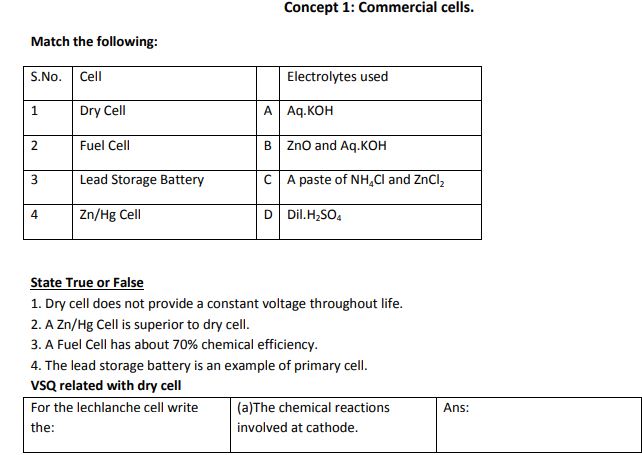
Commercial cells
Question. Match the following:
| S.No. | Cell | Electrolytes used |
|---|---|---|
| 1 | Dry Cell | A. Aq.KOH |
| 2 | Fuel Cell | B. ZnO and Aq.KOH |
| 3 | Lead Storage Battery | C. A paste of \( \text{NH}_4\text{Cl} \) and \( \text{ZnCl}_2 \) |
| 4 | Zn/Hg Cell | D. Dil. \( \text{H}_2\text{SO}_4 \) |
Answer:
The correct matched pairs are:
| S.No. | Cell | Electrolytes used |
|---|---|---|
| 1 | Dry Cell | C. A paste of \( \text{NH}_4\text{Cl} \) and \( \text{ZnCl}_2 \) |
| 2 | Fuel Cell | A. Aq.KOH |
| 3 | Lead Storage Battery | D. Dil. \( \text{H}_2\text{SO}_4 \) |
| 4 | Zn/Hg Cell | B. ZnO and Aq.KOH |
In simple words: This table matches different types of chemical batteries and cells with the specific conducting liquids or pastes they contain.
Exam Tip: Memorize the active electrode materials and electrolytes for all major commercial batteries, as this is a frequent topic in short-answer board exam questions.
Question. State True or False: Dry cell does not provide a constant voltage throughout life.
Answer: True. The dry cell does not maintain a steady potential because the overall cell reaction involves ions whose concentrations change during discharge, causing a gradual decline in voltage.
In simple words: True. A dry cell's power weakens slowly as it runs out of its active chemical compounds.
Exam Tip: State clearly in your explanations that the accumulation of ionic reaction products around the electrodes changes the internal cell potential over time.
Question. State True or False: A Zn/Hg Cell is superior to dry cell.
Answer: True. A zinc-mercury cell is superior to a dry cell because it delivers a highly stable operating potential of approximately \( 1.35\text{ V} \) throughout its entire useful life.
In simple words: True. A mercury cell is better because it gives a steady, unvarying voltage until the battery completely runs out.
Exam Tip: Note that mercury cells maintain a constant potential because the overall reaction does not involve any ions in solution whose concentration can change.
Question. State True or False: A Fuel Cell has about 70% chemical efficiency.
Answer: True. Fuel cells convert chemical energy directly into electrical energy with an outstanding efficiency of about 70%, which is significantly higher than conventional thermal power plants.
In simple words: True. Fuel cells are highly efficient, converting about 70% of the fuel's chemical energy directly into usable electrical power.
Exam Tip: Compare the efficiency of fuel cells (~70%) with conventional steam turbines (~40%) to gain extra points in descriptive questions.
Question. State True or False: The lead storage battery is an example of primary cell.
Answer: False. The lead storage battery is a secondary cell because the electrochemical cell reactions can be fully reversed by passing an external electric current, allowing it to be recharged.
In simple words: False. A lead storage battery is a secondary cell because it is rechargeable, unlike one-time-use primary cells.
Exam Tip: Always categorize batteries based on rechargeability: non-rechargeable are primary cells, while rechargeable are secondary cells.
VSQ Related with Dry Cell
Question. For the Leclanche cell, write the chemical reactions involved at cathode.
Answer: At the cathode, manganese dioxide is reduced in the presence of ammonium ions to manganese oxyhydroxide: \[ \text{MnO}_2 + \text{NH}_4^+ + \text{e}^- \rightarrow \text{Mn(OH)O} + \text{NH}_3 \]
In simple words: At the cathode, manganese dioxide gains an electron and hydrogen from ammonium to produce manganese oxyhydroxide and release ammonia gas.
Exam Tip: Pay special attention to the formulas: manganese is reduced to \( \text{Mn(OH)O} \), which can also be represented as \( \text{MnO(OH)} \).
Question. For the Leclanche cell, write the change in oxidation state of Mn.
Answer: During the cathode reduction reaction, the oxidation state of manganese decreases from \( +4 \) in \( \text{MnO}_2 \) to \( +3 \) in \( \text{Mn(OH)O} \).
In simple words: The oxidation state of manganese decreases from +4 to +3 during the cell's discharge.
Exam Tip: Show the calculation of the oxidation state for both compounds to prove your answer clearly.
Question. For the Leclanche cell, write the complex entity formed between Zn2+(aq) and NH3(g).
Answer: The zinc ions generated at the anode react with the ammonia gas released at the cathode to form a stable coordination complex: \[ [\text{Zn}(\text{NH}_3)_4]^{2+} \]
In simple words: Zinc ions bind with the released ammonia gas to form a complex ion, preventing pressure buildup from gas inside the cell.
Exam Tip: Write the coordination complex with its correct formula and a \( 2+ \) superscript charge to secure full marks.
Concept 2: Units of conductivity, molar conductivity etc.
Question. Match the following:
| S.No. | Property | Unit |
|---|---|---|
| 1 | Conductivity | \( \text{S}^{-1}\text{cm} \) |
| 2 | Conductance | \( \text{S cm}^2\text{mol}^{-1} \) |
| 3 | Molar Conductivity | \( \text{cm}^{-1} \) |
| 4 | Cell Constant | \( \text{Scm}^{-1} \) |
| 5 | Resistivity | \( \text{S} \) |
Answer:
The correct matched properties and units are:
| Property | Matched Unit |
|---|---|
| Conductivity | \( \text{Scm}^{-1} \) |
| Conductance | \( \text{S} \) |
| Molar Conductivity | \( \text{S cm}^2\text{mol}^{-1} \) |
| Cell Constant | \( \text{cm}^{-1} \) |
| Resistivity | \( \text{S}^{-1}\text{cm} \) |
In simple words: This table matches different physical terms in electrochemistry to their standard units. Conductance is measured in Siemens, while cell constant depends on length.
Exam Tip: Be comfortable with both SI units (such as \( \text{S m}^{-1} \)) and common units (such as \( \text{S cm}^{-1} \)) for conductivity calculations.
Concept 3: Products of electrolysis
Question. Predict the products of electrolysis for an aqueous solution of AgNO3 using Ag electrodes.
Answer: When \( \text{AgNO}_3 \) is electrolyzed using active silver electrodes:
- **At Cathode:** Silver ions have a higher reduction potential than water, so silver metal is deposited: \[ \text{Ag}^+(\text{aq}) + \text{e}^- \rightarrow \text{Ag}(\text{s}) \] - **At Anode:** Since the silver anode is active, it oxidizes preferentially over water or nitrate ions: \[ \text{Ag}(\text{s}) \rightarrow \text{Ag}^+(\text{aq}) + \text{e}^- \]
In simple words: Silver dissolves from the anode and gets deposited as pure metal on the cathode.
Exam Tip: When active electrodes are used, the anode material itself dissolves instead of water undergoing oxidation.
Question. Predict the products of electrolysis for an aqueous solution of CuSO4 using Cu electrodes.
Answer: When \( \text{CuSO}_4 \) is electrolyzed using active copper electrodes:
- **At Cathode:** Copper ions have a higher reduction potential than water and are reduced to deposit copper metal: \[ \text{Cu}^{2+}(\text{aq}) + 2\text{e}^- \rightarrow \text{Cu}(\text{s}) \] - **At Anode:** The active copper anode oxidized preferentially, dissolving copper into the solution: \[ \text{Cu}(\text{s}) \rightarrow \text{Cu}^{2+}(\text{aq}) + 2\text{e}^- \]
In simple words: Copper metal dissolves from the positive electrode and deposits onto the negative electrode in its pure form.
Exam Tip: This active-electrode mechanism is the fundamental principle used in the industrial electrolytic refining of copper.
Question. Predict the products of electrolysis for an aqueous solution of AgNO3 using Pt electrodes.
Answer: When \( \text{AgNO}_3 \) is electrolyzed using inert platinum electrodes:
- **At Cathode:** Silver ions are reduced in preference to water, depositing silver metal: \[ \text{Ag}^+(\text{aq}) + \text{e}^- \rightarrow \text{Ag}(\text{s}) \] - **At Anode:** Since platinum is inert, water is oxidized in preference to nitrate ions, releasing oxygen gas: \[ 2\text{H}_2\text{O}(\text{l}) \rightarrow \text{O}_2(\text{g}) + 4\text{H}^+(\text{aq}) + 4\text{e}^- \]
In simple words: Pure silver is deposited on the negative cathode, and bubbles of oxygen gas are released at the positive anode.
Exam Tip: Nitrate ions (\( \text{NO}_3^- \)) have a much higher oxidation potential than water, so oxygen gas is always liberated at an inert anode in nitrate solutions.
Question. Predict the products of electrolysis for an aqueous solution of NaCl using Pt electrodes.
Answer: When aqueous \( \text{NaCl} \) (brine) is electrolyzed using inert platinum electrodes:
- **At Cathode:** Water has a higher reduction potential than sodium ions, so water is reduced to liberate hydrogen gas: \[ 2\text{H}_2\text{O}(\text{l}) + 2\text{e}^- \rightarrow \text{H}_2(\text{g}) + 2\text{OH}^-(\text{aq}) \] - **At Anode:** Chloride ions are oxidized to chlorine gas in preference to water due to the overvoltage of oxygen: \[ 2\text{Cl}^-(\text{aq}) \rightarrow \text{Cl}_2(\text{g}) + 2\text{e}^- \] The remaining ions (\( \text{Na}^+ \) and \( \text{OH}^- \)) leave a solution of sodium hydroxide (\( \text{NaOH} \)).
In simple words: Hydrogen gas bubbles out at the negative electrode, chlorine gas bubbles out at the positive electrode, and the solution turns basic as sodium hydroxide is formed.
Exam Tip: Clearly explain that chloride ions oxidize preferentially over water due to the kinetic barrier of oxygen evolution, commonly known as overpotential.
Free study material for Chemistry
Free CBSE Practice Worksheets: Class 12 Chemistry Unit 2 Electrochemistry
Mastering Unit 2 Electrochemistry with Printable Worksheets
Review targeted practice exercises for Class 12 Chemistry Unit 2 Electrochemistry. Curated to match official CBSE guidelines, these printable problem sets support daily revision and improve overall test readiness.
Verified Solutions and NCERT Alignment
Each worksheet draws directly from authorized standard textbooks to maintain academic accuracy. Evaluating your finished exercises against expert-verified solutions helps master the formal presentation standards expected in school evaluations.
Additional Study Resources for Class 12 Chemistry
Wrap up your chapter revision by testing your knowledge against standard objective question formats. Explore our full library of free, up-to-date printable assignments to maximize your academic results in upcoming CBSE evaluations.
FAQs
You can download the latest chapter-wise printable worksheets for Class 12 Chemistry Unit 2 Electrochemistry for free from StudiesToday.com. These have been made as per the latest CBSE curriculum for this academic year.
Yes, Class 12 Chemistry worksheets for Unit 2 Electrochemistry focus on activity-based learning and also competency-style questions. This helps students to apply theoretical knowledge to practical scenarios.
Yes, we have provided solved worksheets for Class 12 Chemistry Unit 2 Electrochemistry to help students verify their answers instantly.
Yes, our Class 12 Chemistry test sheets are mobile-friendly PDFs and can be printed by teachers for classroom.
For Unit 2 Electrochemistry, regular practice with our worksheets will improve question-handling speed and help students understand all technical terms and diagrams.