

Class 12 Chemistry Practice Sheet: CBSE Class 12 Chemistry P Block Elements Worksheet Set 01
Access comprehensive chapter-wise worksheets for Unit 7 The p-Block Elements using the CBSE Class 12 Chemistry P Block Elements Worksheet Set 01. Designed to align with the 2026-27 academic syllabus for Class 12 Chemistry, these printable practice sets help students reinforce key concepts and improve their overall exam readiness.
Download Unit 7 The p-Block Elements Worksheet PDF with Answers
Navigate directly to the solved Chemistry worksheets using the digital viewer below. Each practice set includes detailed step-by-step solutions, allowing students to instantly cross-check their work and identify areas requiring further revision.
The p-Block Elements

P - BLOCK ELEMENTS
1.Q.Why does NO2 dimerise?
2.Q.Give chemical reactions involved in brown ring test to confirm nitrates.
3. Q.Give the structure of nitric acid.
4. Q.Give equations in each step of oswald's process
5.Q.Give flow chart for preparation of ammonia by Haber's process.
6.Q.Explain preparation of nitrogen.
7.Q. Why do chromium and aluminium not react with the most oxidizing agent?
8.Q. Name the oxides of nitrogen and give oxidation number of each oxide.
9.Q. Give conditions which favors formation of ammonia as it is a reversible reaction.
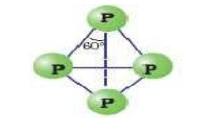
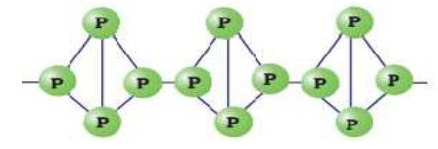
10.Q. Draw the structures of white phosphorus and red phosphorus. Which one of these two types of phosphorus is more reactive and why?
11.Q.Whichoxoacids of phosphorus are reducing in nature?
12.Q.Why is phosphorus acid diprotic and phosphoric acid triproticinpite 3 hydrogens in both?
13.Q.Give the structure of oxy acids of phosphorus and list the anions formed.
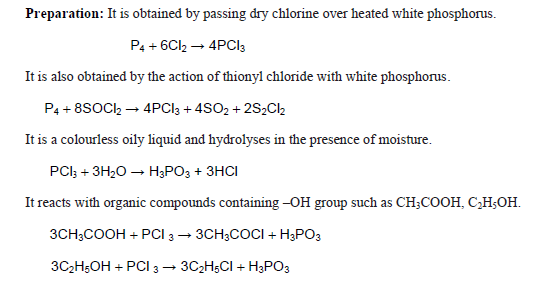
14.Q.Why does PCl3 fume in moisture?
15 Q.Show that PH3 is basic in nature.
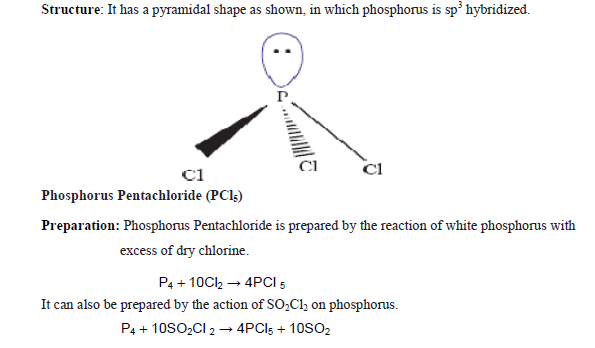
16 Q.Give reason that NCl5 is not formed but PCl5 is formed.
.17.Show that hydrogen peroxide behaves both as an oxidizing and reducing agent.
18.Q.What is oleum? Draw its structure.
19.Q.What happens when sulphur is passed through conc. H2SO4 solution and SO2 is passed through an aqueous solution of Fe(III) salt?
20. Q.Whyare halogens coloured?
I. Account for the following
1. Ammonia has higher boiling point than Phosphine.
2. Bi(V) is a strong oxidizing agent than Sb (V)
3. + 3 oxidation state becomes more and more stable from As to Bi in the group
4. The stability of +3 state increases down the group in group 15 of the periodic table.
5. The +5 oxidation state becomes less stable down the group 15 of the periodic table
6. Phosphorus shows greater tendency for catenation than Nitrogen.
7. Phosphorous ,P4 is much more reactive than Nitrogen N2
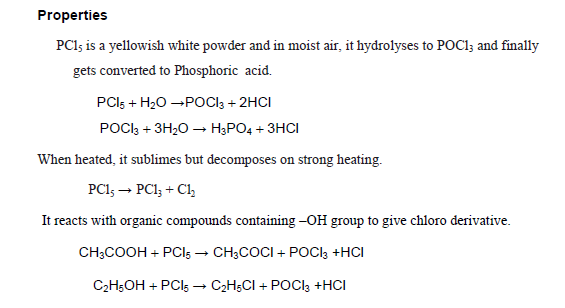
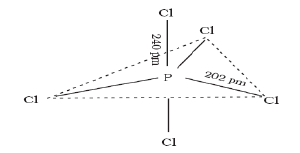
8. All the bonds in the molecules of PCl5 are not equal.
9. NH3 is stronger base than PH3.
10. PH3 is weaker base than NH3
11. PH3 forms bubbles when passed slowly in water but NH3 dissolves.
12. Nitrogen does not form pentahalides.
13. Tendency to form pentahalides decreases down the group in group 15 of the periodic table
14. In solid state PCl5 exists as Ionic compound.
15. PCl4 + is likely to exist but PCl4- is likely not to exist.
16. NH3 act as ligand.( Lewis base)
17. Ammonia(NH3) has greater affinity for protons than phosphine PH3
18. In the structure of HNO3 ,the N-O bond (121pm) is shorter than N-OH bond(140pm)
19. The N – O bond in NO2- is shorter than the N – O bond in NO3-
20. NCl3 is an endothermic compound while NF3 is an exothermic one
21. Red phosphorous is less reactive than white Phosphorous
22. CN¯ ion is known but CP¯ ion is not known.
23. H3PO2 and H3PO3 act as as good reducing agents while H3PO4 does not.
24. NO2 is coloured but N2O4 is colourless.
25. NO2 dimerises to form N2O4
26. Nitric oxide becomes brown when released in air.
27. Nitric oxide is paramagnetic in gaseous state but the solid obtained on cooling it is diamagnetic
28. Bond angle in PH4 + is higher than that in PH3
29. Pentahalides of group 15 are more Covalent than trihalides
30. The first ionization energy of nitrogen is greater than oxygen.
31. H3PO3 is diprotic acid.
32. Nitrogen exists as diatomic molecule and phosphorus as P4.
33. NH3 is basic while BiH3 is only feebly basic
34. PF5 is known while NF5 is not known.
35. Sulphur vapours exhibits paramagnetism.
36. In solution of sulphuric acid in water the Ka2 << Ka1.
37. Sulphur shows greater tendency for catenation than selenium
38. Sulphur has greater tendency for catenation than oxygen.
39. H2O is a liquid while H2S is a gas
40. H2S is less acidic than H2Te.
41. The negative value of electron gain enthalpy of oxygen atom is less than that of sulphur
42. SF6 is much less reactive than SF4
43. All the bonds in the molecules of SF4 are not equal
44. SF6 is kinetically an inert substance.
45. H2S is more acidic than H2O.
45. H2S is more acidic than H2O
46. OF6 is not known.
47. SF4 is easily hydrolysed,SF6 is not easily hydrolysed
48. OF2 should be called oxygen fluoride and not fluorine oxide
49. Dioxygen is a gas but Sulphur is a solid
50. Oxygen molecule has formula O2 while Sulphur S8
51. Oxygen generally exhibit oxidation state of –2 only whereas other members of the family exhibit +2, +4, +6 oxidation states also.
52. H2S acts as only reducing agent but SO2 acts as a reducing as well as an oxidizing agent.
53. Inspite of similar electronegativity, oxygen forms hydrogen bonding while chlorine does not.
54. The increasing order of acidic strength of HX varies in the order H2O < H2S < H2Se < H2Te.
55. SCl6 is not known but SF6 is known.
56. Ozone (O3) act as a powerful oxidising agent.
57. Ozone is thermodynamically less stable than oxygen.
58. Fluorine does not exhibit any positive oxidation state.
59. F2 is most reactive of all the four common halogens
60. F2 is a stronger oxidising agent than Cl2
61. O2 & F2 both stabilize higher oxidation states of metals but O2 exceeds F2 in doing so.
62. When HCl reacts with finely powdered iron, it forms ferrous chloride and not ferric chloride.
63. HF has higher boiling point than HCl.
64. ICl is more reactive than Cl2.
65. Bond dissociation energy of F2 is less than Cl2
66. HI in aqueous solution is strong acid than HF.
67. The negative value of electron gain enthalpy of fluorine is less than that of Chlorine.
68. Fluorine never acts as the central atom in the polyatomic interhalogen compounds
69. ClF3 molecule has a T-shaped structure and not a trigonal planar one.
70. Fluorine forms the largest number of interhalogen compounds among halogens.
71. Halogens are coloured
72. F shows oxidation state of –1 only whereas other halogens exhibit +1, +3, +5, +7 Ox. states also.
73. ClF3 exists but FCl3 does not.
74. Halogens are strong oxidizing agent
75. Most of the reactions of fluorine are exothermic
76. Fluorine forms only one oxoacid, HOF.
77. The acidic strength of oxoacids of halogens varies in the order HOF>HOCl>HOBr>HOI.
78. The acidic strength of oxoacids of halogens varies in the order: HClO4> HClO3> HClO2> HClO
79. Chlorine is a powerful bleaching agent
80. Metal fluorides are more ionic than its chlorides.
81. Perchloric acid is stonger than sulphuric acid
82. The acidic strength decreases in the order HCl > H2S > PH3
83. Helium is used in diving apparatus
84. XeF2 has a linear structure & not a bent angular structure
85. Of the noble gases only Xenon is known to form real chemical compounds
86. No Chemical compound of helium is known.
87. Xe does not forms compounds such as XeF3 and XeF5
88. Helium is used for inflating aeroplane tyres.
89. Noble gases are mostly chemically inert.
90. Structures of Xenon Flourides cannot be explained on the basis of valence bond approach
Important Questions for NCERT Class 12 Chemistry The p Block Elements
Question. Identify the incorrect statement related to PCl5 from the following :
(a) PCl5 molecule is non-reactive.
(b) Three equatorial P – Cl bonds make an angle of 120° with each other.
(c) Two axial P – Cl bonds make an angle of 180° with each other.
(d) Axial P – Cl bonds are longer than equatorial P – Cl bonds.
Question. PCl3 reacts with water to form
(a) PH3
(b) H3PO3, HCl
(c) POCl3
(d) H3PO4
Question. Which of the following oxoacids of phosphorus has strongest reducing property?
(a) H4P2O7
(b) H3PO3
(c) H3PO2
(d) H3PO4
Question. Which is the correct statement for the given acids?
(a) Phosphinic acid is a monoprotic acid while phosphonic acid is a diprotic acid.
(b) Phosphinic acid is a diprotic acid while phosphonic acid is a monoprotic acid.
(c) Both are diprotic acids.
(d) Both are triprotic acids.
Question. Strong reducing behaviour of H3PO2 is due to
(a) high electron gain enthalpy of phosphorus
(b) high oxidation state of phosphorus
(c) presence of two —OH groups and one P—H bond
(d) presence of one —OH group and two P—H bonds.
Question. Which of the following statements is not valid for oxoacids of phosphorus?
(a) Orthophosphoric acid is used in the manufacture of triple superphosphate.
(b) Hypophosphorous acid is a diprotic acid.
(c) All oxoacids contain tetrahedral four coordinated phosphorus.
(d) All oxoacids contain atleast one P O unit and one P—OH group.
Question. Oxidation states of P in H4P2O5, H4P2O6, H4P2O7 are respectively
(a) +3, +5, +4
(b) +5, +3, +4
(c) +5, +4, +3
(d) +3, +4, +5
Question. How many bridging oxygen atoms are present in P4O10?
(a) 6
(b) 4
(c) 2
(d) 5
Question. H3PO2 is the molecular formula of an acid of phosphorus. Its name and basicity respectively are
(a) phosphorous acid and two
(b) hypophosphorous acid and two
(c) hypophosphorous acid and one
(d) hypophosphoric acid and two.
Question. Which one of the following substance is used in the laboratory for fast drying of neutral gases?
(a) Phosphorus pentoxide
(b) Active charcoal
(c) Anhydrous calcium chloride
(d) Na3PO4
Question. P2O5 is heated with water to give
(a) hypophosphorous acid
(b) phosphorous acid
(c) hypophosphoric acid
(d) orthophosphoric acid.
Question. Basicity of orthophosphoric acid is
(a) 2
(b) 3
(c) 4
(d) 5
Question. When orthophosphoric acid is heated to 600°C, the product formed is
(a) PH3
(b) P2O5
(c) H3PO3
(d) HPO3
Question. Which is the correct thermal stability order for H2E (E = O, S, Se, Te and Po) ?
(a) H2Se < H2Te < H2Po < H2O < H2S
(b) H2S < H2O < H2Se < H2Te <H2Po
(c) H2O < H2S < H2Se <H2Te < H2Po
(d) H2Po < H2Te < H2Se < H2S < H2O
Question. Acidity of diprotic acids in aqueous solutions increases in the order
(a) H2S < H2Se < H2Te
(b)H2Se <H2S < H2Te
(c) H2Te < H2S < H2Se
(d) H2Se <H2Te < H2S
Question. Which of the following bonds has the highest energy?
(a) S–S
(b) O–O
(c) Se–Se
(d) Te–Te
Question. Which of the following does not give oxygen on heating?
(a) K2Cr2O7
(b) (NH4)2Cr2O7
(c) KClO3
(d) Zn(ClO3)2
ONE MARK QUESTIONS
1.Why does NO2 dimerise?
2.Fluorine does not exhibit any positive oxidation state. Why?
3.What happens when H3PO3 is heated?
4.Name a compound in which chlorine displays ‘+7’ oxidation number.
5.On heating Cu turnings with conc. HNO3, a brown coloured gas is evolved which on cooling dimerises. Identify the gas.
TWO MARKQUESTIONS
1. Explain why
a) Noble gases form compounds with oxygen and fluorine only.
b) Unlike phosphorous, nitrogen has no tendency for catenation.
2.Complete the following reactions:
a) Zn + HNO3(conc.) →
b) Cl2 + NaOH (hot, Con) →
3.Give equations for the manufacture of a) Ammonia from nitrogen b) Nitric acid from ammonia
THREE MARKQUESTIONS
1.Arrange the following in order of the property mentioned.
a) HF, HCl, HBr, HI (increasing acid strength)
b) NH3, PH3, AsH3, SbH3 (increasing basic strength)
c) HOCl, HOClO, HOClO3 (increasing oxidizing power)
2.What are interhalogen compounds? How are they prepared? Why are they more reactive than molecular halogens?
3.Explain why
a) H2S is gas while water is liquid at room temperature.
b) Helium is used in diving apparatus.
c) Iron dissolves in HCl to form FeCl2 and not FeCl3.
FIVE MARKQUESTIONS
1. a) Account for the following :
i) Bond angle in NH4+ is greater than that in NH3.
ii) Reducing character decreases from SO2 to TeO2.
iii) HClO4 is a stronger acid than HClO.
(b) Draw the structures of the following :
i) H2S2O8
ii) XeOF4
2. a) Complete the following chemical equation:
i) S8 + HNO3(conc.) →
ii) P4+ NaOH + H2O →
b) Explain the following observations:
i) Sulphur in vapour state exhibits paramagnetic behavior.
ii) The stability of +3 state increases down the group in group 15 of the periodic table.
iii) XeF2 has a linear shape and not a bent structure.
VALUE BASED QUESTION
1. Mark attended a seminar on the conservation of ozone layer. He came to know that freons are the compounds which are upsetting the ozone balance. So he decided to minimize the use of air conditioner.
a) What the function of ozone layer?
b) What is the value shown in the above paragraph?
c) Why does O3 act as a powerful oxidizing reagent?
d) Besides freons, which other compounds are responsible for depletion of ozone layer?
Important Questions for NCERT Class 12 Chemistry The p Block Elements
Question. The ion or group detected by K2[HgI4] is :
(a) NO (b) Cl–
(c) NH2–
(d) NH4+
Answer D
Question. Which gas cannot be collected over water ?
(a) O2
(b) PH3
(c) N2
(d) SO2
Answer D
Question. The correct order of increasing oxidising power is :
(a) Cl2 < Br2 < F2 < I2
(b) F2 < Br2 < Cl2 < I2
(c) F2 > Br2 > Cl2 > I2
(d) I2 > Br2 > Cl2 > F2
Answer D
Question. H2S does not produce metallic sulphide with :
(a) CuCl2
(b) COCl2
(c) CdCl2
(d) ZnCl2
Answer B
Question. The correct order of acid strength of oxyacids is:
(a) HClO > HClO2 > HClO3 > HClO4
(b) HClO 2 > HClO 3 > HClO > HClO4
(c) HClO4 > HClO3 > HClO2 > HClO
(d) HClO3 > HClO4 > HClO > HClO2
Answer C
Question. Chlorine acts as a bleaching agent only in presence of:
(a) Sunlight
(b) Moisture
(c) Dry air
(d) Pure oxygen
Answer B
Question. The laughing gas is:
(a) NO
(b) N2O
(c) N2O4
(d) N2O5
Answer B
Question. The correct decreasing order of basic strength is:
(a) AsH3 > SbH3 > PH3 > NH3
(b) SbH3 > AsH3 > PH3 > NH3
(c) NH3 > PH3 > AsH3 > SbH3
(d) PH3 > AsH3 > SbH3 > NH3
Answer C
Question. Iodide of Millon's base is :
(a) HIO3
(b) K2HgI4
(c) NH2HgO.HgI
(d) Hg(NH2 )I
Answer C
Question. Which of the following is not the characteristic of interhalogen compounds?
(a) they are covalent
(b) more reactive than halogens
(c) have low B.P. and high volatile
(d) quite unstable but not explosive
Answer C
Question. Hypo on treatment with iodine produces :
(a) H2S
(b) Na2SO4
(c) Na2SO3
(d) Na2S4O6
Answer D
Question. The tribasic acid is :
(a) H3PO4
(b) H3PO3
(c) H3PO2
(d) HPO3
Answer A
Question. The strongest oxidising agent is :
(a) F2
(b) Cl2
(c) I2
(d) Br2
Answer A
Question. The correct order of solubility in water for He,Ne, Ar, Kr, Xe is
(a) He > Ne > Ar > Kr > Xe
(b) Xe > Kr > Ar > Ne > He
(c) Ne > Ar > Kr > He > Xe
(d) Ar > Ne > He > Kr > Xe
Answer B
Question. Which of the following compound is a tribasic acid?
(a) H3PO2
(b) H3PO4
(c) H3PO3
(d) H4P2O7
Answer B
P - Block Elements (Section 1)
Question. Why does \( \text{NO}_2 \) dimerise?
Answer: \( \text{NO}_2 \) contains odd number of valence electrons. It behaves as an odd electron molecule and therefore undergoes dimerisation to form stable \( \text{N}_2\text{O}_4 \) molecule with even number of electrons.
Question. Give chemical reactions involved in brown ring test to confirm nitrates.
Answer: The brown ring tests depend on the ability of ferrous ion to reduce nitrates to nitric oxide, which reacts with ferrous ion to form a brown colored complex.
\( \text{NO}_3^- + 3\text{Fe}^{2+} + 4\text{H}^+ \rightarrow \text{NO} + 3\text{Fe}^{3+} + 2\text{H}_2\text{O} \)
\( [\text{Fe}(\text{H}_2\text{O})_6]^{2+} + \text{NO} \rightarrow [\text{Fe}(\text{H}_2\text{O})_5(\text{NO})]^{2+} + \text{H}_2\text{O} \)
Question. Give the structure of nitric acid.
Answer: Nitric acid is a planar molecule with the structure showing resonance between its oxygen atoms. The bond angle of \( \text{H-O-N} \) is approximately \( 105^\circ \) and the \( \text{O-N-O} \) bond angle is approximately \( 120^\circ \).
Question. Give equations in each step of oswald's process.
Answer: Nitric acid is produced industrially by the Ostwald Process, which involves three steps:
Step 1: Catalytic oxidation of ammonia
\( 4\text{NH}_3 + 5\text{O}_2 \rightarrow 4\text{NO} + 6\text{H}_2\text{O} \)
Step 2: Oxidation of nitric oxide
\( 2\text{NO} + \text{O}_2 \rightarrow 2\text{NO}_2 \)
Step 3: Reaction with water and oxygen to form nitric acid:
\( 4\text{NO}_2 + 2\text{H}_2\text{O} + \text{O}_2 \rightarrow 4\text{HNO}_3 \)
Question. Give flow chart for preparation of ammonia by Haber's process.
Answer: \( \text{nitrogen} + \text{hydrogen} \rightleftharpoons \text{ammonia } (+\text{ heat}) \)
The process operates continuously and the recycling of the unreacted nitrogen and hydrogen, gives overall conversion of about 98%.
Question. Explain preparation of nitrogen.
Answer: Air is liquefied, and the oxygen which is about 20.9% gets boiled off at \( -183^\circ\text{C} \), leaving liquid nitrogen behind, which boils at \( -196^\circ\text{C} \). This process is known as Fractional distillation. Nitrogen can also be made by heating \( \text{NaN}_3 \) to 300 degrees C. Annual worldwide production is around 44,000,000 tons.
Question. Why do chromium and aluminium not react with the most oxidizing agent?
Answer: These elements form a passive layer of oxide on the surface and prevent the metal to react with nitric acid.
Question. Name the oxides of nitrogen and give oxidation number of each oxide.
Answer: The common oxides of nitrogen include examples of nitrogen with every oxidation number from +1 to +5:
N as +1: \( \text{N}_2\text{O} \)
N as +2: \( \text{NO} \)
N as +3: \( \text{N}_2\text{O}_3 \)
N as +4: \( \text{NO}_2 \)
N as +5: \( \text{N}_2\text{O}_5 \)
Question. Give conditions which favors formation of ammonia as it is a reversible reaction.
Answer: The reaction is reversible. Only about 15-20 % of the reactants are converted into products. The forward reaction is exothermic. Amount of product or yield from a reversible reaction depends on temperature, pressure and catalyst:
- Decreasing the temperature favors exothermic reactions.
- Increasing the pressure favors smaller volume.
- Using a catalyst gives the equilibrium conditions more quickly.
Question. Draw the structures of white phosphorus and red phosphorus. Which one of these two types of phosphorus is more reactive and why?
Answer: White phosphorus is less stable and therefore, more reactive than the red phosphorus under normal conditions because of angular strain in the \( \text{P}_4 \) molecule where the angles are \( 60^\circ \) only.
Question. Whichoxoacids of phosphorus are reducing in nature?
Answer: All acid which have P-H bond are reducing in nature. Examples: Phosphorous acid (\( \text{H}_3\text{PO}_3 \)) and Hypophosphorous acid (\( \text{H}_3\text{PO}_2 \)).
Question. Why is phosphorus acid diprotic and phosphoric acid triproticinpite 3 hydrogens in both?
Answer: Phosphoric acid, \( \text{H}_3\text{PO}_4 \), has 3 ionisable hydrogens. In phosphorous acid, there are 2 ionisable hydrogens as the third one is directly bonded to phosphorus.
Question. Give the structure of oxy acids of phosphorus and list the anions formed.
Answer:
- Phosphoric acid (\( \text{H}_3\text{PO}_4 \)) forms Phosphate, \( \text{PO}_4^{3-} \)
- Phosphorous acid (\( \text{H}_3\text{PO}_3 \)) forms Phosphite, \( \text{HPO}_3^{2-} \)
- Hypophosphorous acid (\( \text{H}_3\text{PO}_2 \)) forms Hypophosphite, \( \text{H}_2\text{PO}_2^- \)
- Diphosphoric acid / pyrophosphoric acid (\( \text{H}_4\text{P}_2\text{O}_7 \)) forms Diphosphate, \( \text{P}_2\text{O}_7^{4-} \)
Question. Why does \( \text{PCl}_3 \) fume in moisture?
Answer: It hydrolyses in moisture giving fumes of HCl:
\( \text{PCl}_3 + 3\text{H}_2\text{O} \rightarrow \text{H}_3\text{PO}_3 + 3\text{HCl} \)
Question. Show that \( \text{PH}_3 \) is basic in nature.
Answer: \( \text{PH}_3 \) has a lone pair of electron and readily reacts with acids like HI and forms salt:
\( \text{PH}_3 + \text{HI} \rightarrow \text{PH}_4\text{I} \)
Question. Give reason that \( \text{NCl}_5 \) is not formed but \( \text{PCl}_5 \) is formed.
Answer: Nitrogen does not have usable d orbitals and cannot expand its octet. Phosphorus can expand its valence shell to hold more than eight electrons, but nitrogen cannot.
Question. Show that hydrogen peroxide behaves both as an oxidizing and reducing agent.
Answer: It produces oxygen and acts as an oxidizing agent in both acid and basic medium:
\( \text{Mn}^{2+} + \text{H}_2\text{O}_2 \rightarrow \text{Mn}^{4+} + 2\text{OH}^- \)
As a reducing agent:
\( \text{HOCl} + \text{H}_2\text{O}_2 \rightarrow \text{H}_2\text{O} + \text{Cl}^- + \text{O}_2 \)
Question. What is oleum? Draw its structure.
Answer: Oleum is a oxoacid of sulphur and is pyrosulphuric acid (\( \text{H}_2\text{S}_2\text{O}_7 \)). Its structure consists of two \( \text{SO}_3\text{OH} \) groups linked through an oxygen atom bridge.
Question. What happens when sulphur is passed through conc. \( \text{H}_2\text{SO}_4 \) solution and \( \text{SO}_2 \) is passed through an aqueous solution of Fe(III) salt?
Answer: When sulphur is passed through conc \( \text{H}_2\text{SO}_4 \) solution it forms \( \text{SO}_2 \):
\( \text{S} + 2\text{H}_2\text{SO}_4 \text{ (conc.)} \rightarrow 3\text{SO}_2 + 2\text{H}_2\text{O} \)
When \( \text{SO}_2 \) is passed through an aqueous solution of Fe(III) salt, it converts Fe(III) ions to Fe(II):
\( 2\text{Fe}^{3+} + \text{SO}_2 + 2\text{H}_2\text{O} \rightarrow 2\text{Fe}^{2+} + \text{SO}_4^{2-} + 4\text{H}^+ \)
Question. Why are halogens coloured?
Answer: Absorption of radiations in visible region by halogen atoms, results in the excitation of outer electrons to higher energy level. By absorbing radiation of different wavelength, they display different colours. For example, \( \text{F}_2 \) has yellow, \( \text{Cl}_2 \) has greenish yellow colour, \( \text{Br}_2 \) has red colour and \( \text{I}_2 \) has violet colour.
P - Block Elements (1-Mark Questions)
Question. Which of \( \text{NH}_3 \) and \( \text{H}_3\text{O}^+ \) has higher bond angle and why?
Answer: \( \text{H}_3\text{O}^+ \) because the central atom has higher electronegativity, thus it pulls bond pairs of electrons towards itself and bp-bp repulsion increases.
Question. Which of \( \text{PH}_4\text{I} \) and \( \text{PH}_4\text{Cl} \) is more stable and why?
Answer: \( \text{PH}_4\text{I} \) is more stable because \( \text{PH}_4^+ \) is a bigger cation and \( \text{I}^- \) is a bigger anion, so it offers effective crystal packing and has larger lattice enthalpy.
Question. What is the basicity of \( \text{H}_3\text{PO}_3 \) and \( \text{H}_3\text{PO}_4 \)?
Answer: 2 and 3
Question. \( \text{NH}_3 \) is easily liquefiable than \( \text{PH}_3 \)?
Answer: Due to intermolecular H-bonding in \( \text{NH}_3 \).
Question. Which of \( \text{NH}_3 \) and \( \text{PH}_3 \) is stronger Lewis base and why?
Answer: \( \text{NH}_3 \) because of its smaller size it has greater charge density on nitrogen.
Question. Why does \( \text{NO}_2 \) dimerise?
Answer: In \( \text{NO}_2 \), there is an odd electron.
Question. \( \text{N}_2\text{O}_4 \) is colourless but \( \text{NO}_2 \) is brown in colour?
Answer: In \( \text{N}_2\text{O}_4 \) there is no unpaired electron.
Question. Write the products of hydrolysis of \( \text{ClF}_3 \).
Answer: \( \text{ClF}_3 + 2\text{H}_2\text{O} \rightarrow 3\text{HF} + \text{HClO}_2 \)
Question. Why is \( \text{S}_2 \) paramagnetic?
Answer: Due to presence of unpaired electrons on anti-bonding orbitals.
Question. Why does not \( \text{SO}_3 \) disproportionate?
Answer: Sulphur is in highest oxidation state (+6).
Question. Why \( \text{Cl}_2 \) bleaches permanently but \( \text{SO}_2 \) temporarily?
Answer: \( \text{Cl}_2 \) bleaches by oxidation but \( \text{SO}_2 \) bleaches by reduction.
Question. Why is He used in observation balloons?
Answer: He is very light and non-combustible.
Question. Why is \( \text{SF}_6 \) resistant to hydrolysis?
Answer: \( \text{SF}_6 \) is sterically protected by six F atoms.
Question. What is the geometry and shape of \( \text{ClF}_5 \)?
Answer: Geometry - Octahedral and shape - square pyramidal.
Question. Why is \( \text{ICl} \) more reactive than \( \text{I}_2 \)?
Answer: \( \text{ICl} \) has low bond dissociation enthalpy because the bond is polar and weaker than the nonpolar \( \text{I-I} \) bond.
Question. Arrange following in increasing order of their reactivity. \( \text{IF} \), \( \text{F}_2 \) and \( \text{I}_2 \)
Answer: \( \text{I}_2 < \text{F}_2 < \text{IF} \)
Question. \( \text{Xe} \) is more reactive than He. Why?
Answer: Less Ionisation Enthalpy (I.E.) of Xe compared to He.
Question. Does the hydrolysis of \( \text{XeF}_6 \) lead to a redox reaction? Why?
Answer: No, because the oxidation state of Xe does not change.
Question. \( \text{H}_2\text{S} \) is less soluble in water than \( \text{H}_2\text{Se} \). Why?
Answer: \( \text{H}_2\text{Se} \) has stronger van der Waals forces with water due to the larger size of Se.
Question. Trimethylamine is more basic than tri silylamine. Why?
Answer: Due to presence of vacant d-orbitals in Si, the pair of electrons lying on N in trisilylamine disperses via \( d\pi-p\pi \) back bonding.
P - Block Elements (2-Mark Questions)
Question. Give reason for the following -
(A) Phosphorus is reactive but Nitrogen is much stable.
(B) Nitrogen is linear but Phosphorus is tetrahedral.
Answer:
(A) \( \text{N}_2 \) has much higher bond enthalpy due to the triple bond \( \text{N}\equiv\text{N} \).
(B) In \( \text{N}_2 \), N is sp-hybridized but in \( \text{P}_4 \), P is \( sp^3 \)-hybridized.
Question. Explain why?
(A) Nitrogen has stronger tendency of multiple bonding than that of Phosphorus.
(B) \( \text{NCl}_5 \) does not exist but \( \text{PCl}_5 \) exists.
Answer:
(A) N has three unpaired electrons in p-orbital, has high effective nuclear charge and small atomic size to undergo greater \( p\pi-p\pi \) overlapping of the orbitals.
(B) N does not have d-orbitals in its valence shell, while P can utilize vacant d-orbitals to expand its octet.
Question. Explain the chemistry of ring test of nitrate ion.
Answer:
\( 3\text{Fe}^{2+} + \text{NO}_3^- + 4\text{H}^+ \rightarrow 3\text{Fe}^{3+} + \text{NO} + 2\text{H}_2\text{O} \)
\( [\text{Fe}(\text{H}_2\text{O})_6]^{2+} + \text{NO} \rightarrow [\text{Fe}(\text{H}_2\text{O})_5(\text{NO})]^{2+} + \text{H}_2\text{O} \) (brown ring)
Question. Draw the structures of following using VSEPR Model: \( \text{XeO}_2\text{F}_2 \) and \( \text{XeO}_3 \)
Answer: \( \text{XeO}_2\text{F}_2 \) has a see-saw structure with trigonal bipyramidal geometry containing one lone pair. \( \text{XeO}_3 \) has a pyramidal structure with tetrahedral geometry containing one lone pair.
Question. Complete the following reactions:
(A) \( \text{Ca}_3\text{P}_2 + \text{H}_2\text{O} \rightarrow \)
(B) \( \text{Cu} + \text{Conc. HNO}_3 \rightarrow \)
Answer:
(A) \( \text{Ca}_3\text{P}_2 + 6\text{H}_2\text{O} \rightarrow 3\text{Ca(OH)}_2 + 2\text{PH}_3 \)
(B) \( \text{Cu} + 4\text{HNO}_3 \rightarrow \text{Cu(NO}_3)_2 + 2\text{NO}_2 + 2\text{H}_2\text{O} \)
Question. Give reason for the following:
(a) \( \text{NO}_2 \) has net dipole moment but \( \text{N}_2\text{O}_4 \) does not have?
(b) Phosphorus has greater catenation tendency than Nitrogen?
Answer:
(a) In \( \text{NO}_2 \), there is an odd electron on nitrogen causing asymmetrical planar structure, whereas \( \text{N}_2\text{O}_4 \) is a symmetrical planar molecule with no net dipole moment.
(b) P-P single bond is stronger than N-N single bond due to less interelectronic repulsion.
Question. Explain following:
(1) Interhalogens are covalent, diamagnetic.
(2) \( \text{I}_2 \) is soluble in aqueous KI.
Answer:
(1) Because they have high electronegativity and paired electrons in their molecular orbitals.
(2) It forms the soluble complex \( \text{KI}_3 \).
Question. Arrange following according to the property shown against each:
(a) \( \text{HClO} \), \( \text{HClO}_3 \), \( \text{HClO}_4 \), \( \text{HClO}_2 \) ------ Increasing order of acidity
(b) \( \text{PH}_3 \), \( \text{NH}_3 \), \( \text{SbH}_3 \), \( \text{AsH}_3 \), \( \text{BiH}_3 \) ------- Decreasing order of basicity
Answer:
(a) \( \text{HClO} < \text{HClO}_2 < \text{HClO}_3 < \text{HClO}_4 \)
(b) \( \text{NH}_3 > \text{PH}_3 > \text{AsH}_3 > \text{SbH}_3 > \text{BiH}_3 \)
Question. Arrange following according to the property shown against each:
(a) \( \text{I}_2 \), \( \text{F}_2 \), \( \text{Cl}_2 \), \( \text{Br}_2 \) ---------- Increasing order ease of liquefaction
(b) \( \text{ClO} \pm \text{Cl}_2\text{O}_3 \), \( \text{Cl}_2\text{O}_5 \), \( \text{Cl}_2\text{O}_7 \) ------------ Increasing acidity strength
Answer:
(a) \( \text{F}_2 < \text{Cl}_2 < \text{Br}_2 < \text{I}_2 \)
(b) \( \text{ClO} < \text{Cl}_2\text{O}_3 < \text{Cl}_2\text{O}_5 < \text{Cl}_2\text{O}_7 \)
Question. Complete the following reactions:
(1) \( \text{P}_4 + \text{NaOH} + \text{H}_2\text{O} \rightarrow \)
(2) \( \text{NaCl} + \text{MnO}_2 + \text{H}_2\text{SO}_4 \rightarrow \)
Answer:
(1) \( \text{P}_4 + 3\text{NaOH} + 3\text{H}_2\text{O} \rightarrow \text{PH}_3 + 3\text{NaH}_2\text{PO}_2 \)
(2) \( 4\text{NaCl} + \text{MnO}_2 + 4\text{H}_2\text{SO}_4 \rightarrow \text{MnCl}_2 + 4\text{NaHSO}_4 + \text{Cl}_2 + 2\text{H}_2\text{O} \)
P - Block Elements (3-Mark Questions)
Question. Give reason for the following -
i) \( \text{NO}_2 \) is acidic oxide but NO is neutral?
ii) \( \text{NH}_3 \) has greater tendency of complex formation than \( \text{PH}_3 \)?
iii) \( \text{PH}_3 \) dissolves in HI. Why?
Answer:
i) More oxygen content in \( \text{NO}_2 \) than NO.
ii) \( \text{NH}_3 \) is a stronger Lewis base due to higher electron density on smaller nitrogen atom.
iii) \( \text{PH}_3 \) is a base and HI is acid, so they react to give \( \text{PH}_4\text{I} \).
Question. Explain for the following -
a) \( \text{H}_3\text{PO}_3 \) shows disproportionation reactions?
b) \( \text{PCl}_5 \) in solid state exists as an ionic compound?
c) \( \text{BiCl}_5 \) is a strong oxidizing agent?
Answer:
a) The oxidation state of P in \( \text{H}_3\text{PO}_3 \) is +3, so it can undergo both oxidation (to +5) and reduction (to -3).
b) It exists as \( [\text{PCl}_4]^+[\text{PCl}_6]^- \).
c) Bi is in +5 oxidation state but its stable oxidation state is +3 due to inert pair effect.
Question. Explain the structure of the following compounds using VSEPR theory:
a) \( \text{PCl}_6^- \)
b) \( \text{SF}_4 \)
c) \( \text{ICl}_2^- \)
Answer:
a) \( \text{PCl}_6^- \) has an octahedral structure.
b) \( \text{SF}_4 \) has a trigonal bipyramidal geometry (see-saw shape with one lone pair).
c) \( \text{ICl}_2^- \) has a linear structure with trigonal bipyramidal geometry containing 3 lone pairs in equatorial positions.
Question. Give the comparative account of the chemistry of carbon and silicon with regard to their:
[i] property of catenation
[ii] stability of hydrides and oxides
Answer:
[i] Carbon has greater catenation tendency than Silicon due to high C-C bond energy.
[ii] The oxides and hydrides of Carbon are more stable than those of Silicon.
Question. Account for the following:
[i] Ammonia has higher boiling point than phosphine.
[ii] Trimethyl ammine is pyramidal and trisilyl ammine is planar.
[iii] Ammonia is stronger base than phosphine.
Answer:
[i] Due to intermolecular H-bonding in ammonia.
[ii] In trisilylamine, presence of vacant d-orbitals in Si allows \( d\pi-p\pi \) back bonding, dispersing the lone pair on N and making it planar.
[iii] The lone pair lying on N in \( \text{NH}_3 \) can be easily donated due to greater charge density on nitrogen.
Question. Describe the following about halogen family:
[i] Oxidising power
[ii] Relative acidic strength of their hydrides
[iii] Relative reducing strength of their hydrides.
Answer:
[i] \( \text{F}_2 > \text{Cl}_2 > \text{Br}_2 > \text{I}_2 \)
[ii] \( \text{HI} > \text{HBr} > \text{HCl} > \text{HF} \)
[iii] \( \text{HI} > \text{HBr} > \text{HCl} > \text{HF} \)
Question. Give reason for the following observations.
[i] Noble gases are mostly chemically inert
[ii] Nitrogen does not form pentahalide
[iii] Bismuth is a strong oxidising agent in pentavalent state
Answer:
[i] They have very high ionization enthalpy and a completely filled octet.
[ii] Absence of d-orbitals in nitrogen's valence shell.
[iii] Due to the inert pair effect, the +3 oxidation state is much more stable than +5.
Question. Arrange following according to the property shown against each:
a) \( \text{NO}_2 \), \( \text{P}_2\text{O}_3 \), \( \text{N}_2\text{O}_5 \), \( \text{P}_2\text{O}_5 \), \( \text{As}_2\text{O}_3 \), \( \text{Bi}_2\text{O}_3 \) --- Increasing acidity strength
b) \( \text{PH}_3 \), \( \text{NH}_3 \), \( \text{SbH}_3 \), \( \text{AsH}_3 \), \( \text{BiH}_3 \) ----- Decreasing order of thermal stability
c) Xe, He, Ne, Kr, Ar, ---------- Increasing order ease of liquefaction
Answer:
a) \( \text{Bi}_2\text{O}_3 < \text{As}_2\text{O}_3 < \text{P}_2\text{O}_3 < \text{NO}_2 < \text{P}_2\text{O}_5 < \text{N}_2\text{O}_5 \)
b) \( \text{NH}_3 > \text{PH}_3 > \text{AsH}_3 > \text{SbH}_3 > \text{BiH}_3 \)
c) He < Ne < Ar < Kr < Xe
Question. Complete following reactions:
1) \( \text{NH}_3 + \text{AgCl} \rightarrow \)
2) \( \text{XeF}_2 + \text{H}_2\text{O} \rightarrow \)
3) \( \text{NaNO}_2 + \text{NH}_4\text{Cl} \rightarrow \)
Answer:
1) \( 2\text{NH}_3 + \text{AgCl} \rightarrow [\text{Ag}(\text{NH}_3)_2]\text{Cl} \)
2) \( 2\text{XeF}_2 + 2\text{H}_2\text{O} \rightarrow 2\text{Xe} + 4\text{HF} + \text{O}_2 \)
3) \( \text{NaNO}_2 + \text{NH}_4\text{Cl} \rightarrow \text{NaCl} + \text{N}_2 + 2\text{H}_2\text{O} \)
Question. How does ozone reacts with following:
i) NO
ii) PbS
iii) Aq. KI
Answer:
i) \( \text{NO} + \text{O}_3 \rightarrow \text{NO}_2 + \text{O}_2 \)
ii) \( \text{PbS} + 4\text{O}_3 \rightarrow \text{PbSO}_4 + 4\text{O}_2 \)
iii) \( 2\text{KI} + \text{O}_3 + \text{H}_2\text{O} \rightarrow 2\text{KOH} + \text{I}_2 + \text{O}_2 \)
P - Block Elements (5-Mark Questions)
Question. A white coloured salt (A) on treatment with conc. \( \text{H}_2\text{SO}_4 \) gives a pungent smelling gas (B) which turns moist blue litmus to red. The gas (B) oxidizes in presence of \( \text{MnO}_2 \) to yield a greenish yellow gas (C). The gas (C) is used in disinfecting drinking water and decolourising the wood pulp in paper industries. Identify A, B and C and write necessary equations.
Answer:
(A) = NaCl, (B) = HCl, (C) = \( \text{Cl}_2 \)
Equations:
\( 4\text{NaCl (A)} + 4\text{H}_2\text{SO}_4 \rightarrow 4\text{NaHSO}_4 + 4\text{HCl (B)} \)
\( 4\text{HCl} + \text{MnO}_2 \rightarrow \text{MnCl}_2 + 2\text{H}_2\text{O} + \text{Cl}_2\text{ (C)} \)
Question. Give reason for the following observations.
a) HF is weakest acid and HI is strongest.
b) Fluorides of Xe undergo hydrolysis readily
c) Oxygen is diatomic but S is octatomic?
d) Reaction of NaBr and \( \text{H}_2\text{SO}_4 \) does not form HBr but it forms \( \text{Br}_2 \) gas.
e) HF is liquid but HCl is a gas.
Answer:
a) Bond dissociation enthalpy of HF is much more than HI due to the smaller size of fluorine.
b) Due to the presence of vacant d-orbitals in Xe.
c) Oxygen forms strong \( p\pi-p\pi \) multiple bonds (\( \text{O}=\text{O} \)), whereas sulfur forms single bonds (\( \text{S-S} \)) due to less effective overlap of its larger orbitals, resulting in an octatomic ring structure (\( \text{S}_8 \)).
d) Because \( \text{H}_2\text{SO}_4 \) is a strong oxidizing agent and oxidizes HBr to \( \text{Br}_2 \).
e) Presence of intermolecular H-bonding in HF.
Question. Arrange following according to the property shown against each:
a) \( \text{HClO} \), \( \text{HClO}_3 \), \( \text{HClO}_4 \), \( \text{HClO}_2 \) ------ Increasing order of acidity
b) HClO, HBrO, HIO, HFO -------- Increasing order of acidity
c) \( \text{F}_2 \), \( \text{O}_2 \), \( \text{Cl}_2 \), \( \text{Br}_2 \) ------- ------------ Increasing order of oxidizing tendency
d) \( \text{PH}_3 \), \( \text{NH}_3 \), \( \text{SbH}_3 \), \( \text{AsH}_3 \), \( \text{BiH}_3 \) -------- Decreasing order of bond angle
e) \( \text{I}_2 \), \( \text{F}_2 \), \( \text{Cl}_2 \), \( \text{Br}_2 \) ---------- Increasing order of b.p.
Answer:
a) \( \text{HClO} < \text{HClO}_2 < \text{HClO}_3 < \text{HClO}_4 \)
b) HFO < HClO < HBrO < HIO
c) \( \text{Cl}_2 < \text{Br}_2 < \text{O}_2 < \text{F}_2 \)
d) \( \text{NH}_3 > \text{PH}_3 > \text{AsH}_3 > \text{SbH}_3 > \text{BiH}_3 \)
e) \( \text{F}_2 < \text{Cl}_2 < \text{Br}_2 < \text{I}_2 \)
Question. A element (X) on heating with Conc. NaOH yields a poisonous gas(Y) and spontaneously catches fire. The gas (Y) reacts with \( \text{Aq.HgCl}_2 \) to form precipitate (Z). Identify X, Y and Z and write necessary equations.
Answer:
X = \( \text{P}_4 \) (White phosphorus), Y = \( \text{PH}_3 \), Z = \( \text{Hg}_3\text{P}_2 \)
Equations:
\( \text{P}_4 + 3\text{NaOH} + 3\text{H}_2\text{O} \rightarrow \text{PH}_3 + 3\text{NaH}_2\text{PO}_2 \)
\( 2\text{PH}_3 + 3\text{HgCl}_2 \rightarrow \text{Hg}_3\text{P}_2 + 6\text{HCl} \)
Question. Draw the structure of the following compounds using VSEPR theory. \( \text{XeF}_6 \), \( \text{XeOF}_4 \), \( \text{XeO}_3 \), \( \text{PCl}_3 \), White Phosphorus (\( \text{P}_4 \))
Answer:
- \( \text{XeF}_6 \): Distorted octahedral geometry.
- \( \text{XeOF}_4 \): Square pyramidal geometry.
- \( \text{XeO}_3 \): Pyramidal geometry.
- \( \text{PCl}_3 \): Pyramidal geometry.
- White Phosphorus (\( \text{P}_4 \)): Tetrahedral structure with bond angle \( 60^\circ \).
Free study material for Chemistry
CBSE Class 12 Chemistry Worksheets for Unit 7 The p-Block Elements
Practice Exercises for Class 12 Chemistry Unit 7 The p-Block Elements
Explore reliable practice questions for Unit 7 The p-Block Elements tailored for Class 12 Chemistry learners. Use these structured worksheets to evaluate exam preparedness and strengthen problem-solving skills throughout the 2026 academic session.
Step-by-Step Solutions and Practice Guidelines
Designed around the official curriculum for Class 12 Chemistry, these practice sheets guarantee standard compliance. Reviewing step-by-step solutions after completion sharpens your accuracy and clarifies complex sub-topics within Unit 7 The p-Block Elements.
Enhance Speed with Online Practice
Follow up your worksheet practice by attempting the interactive online MCQ tests for Unit 7 The p-Block Elements to evaluate your execution speed. All printable assignments and revision sheets on our platform are updated for the 2026 session and available free of charge.
FAQs
You can download the latest chapter-wise printable worksheets for Class 12 Chemistry Unit 7 The p-Block Elements for free from StudiesToday.com. These have been made as per the latest CBSE curriculum for this academic year.
Yes, Class 12 Chemistry worksheets for Unit 7 The p-Block Elements focus on activity-based learning and also competency-style questions. This helps students to apply theoretical knowledge to practical scenarios.
Yes, we have provided solved worksheets for Class 12 Chemistry Unit 7 The p-Block Elements to help students verify their answers instantly.
Yes, our Class 12 Chemistry test sheets are mobile-friendly PDFs and can be printed by teachers for classroom.
For Unit 7 The p-Block Elements, regular practice with our worksheets will improve question-handling speed and help students understand all technical terms and diagrams.