

Download Class 12 Chemistry Practice Worksheets
Explore structured practice materials through the CBSE Class 12 Chemistry Principles And Processes Of Isolation Of Elements Worksheet. Tailored for Class 12 learners, utilizing these Chemistry worksheets ensures thorough preparation and strengthens problem-solving accuracy before final school evaluations.
Access Unit 6 General Principles and Processes of Isolation of Elements Practice Papers and Solutions
View or download the dedicated CBSE Class 12 Chemistry Principles And Processes Of Isolation Of Elements Worksheet resource below. Engaging with these practice papers under focused study conditions ensures continuous academic progress and mastery of the 2026-27 curriculum for Unit 6 General Principles and Processes of Isolation of Elements.
Question. Calcination is used in metallurgy for removal of
(a) moisture
(b) water and CO2
(c) CO2 and H2S
(d) H2O and H2S
Answer : B
Question. Which of the following pairs of metals is purified by van Arkel method ?
(a) Ga and In
(b) Zr and Ti
(c) Ag and Au
(d) Ni and Fe
Answer : B
Question. Calcination is the process in which
(a) ore is heated above its melting point to expel H2O or CO2 or SO2
(b) ore is heated below its melting point to expel volatile impurities
(c) ore is heated above its melting point to remove S, As and Sb as SO2 ,As2O3 and Sb2O3 respectively
(d) ore is heated below its melting point to expel H2O or CO2
Answer : D
Question. The reduction of metal oxides is sometimes done by aluminium in the
(a) Bayer reaction
(b) Zilch reaction
(c) Goldschmidt reaction
(d) Silberschmidt reaction
Answer : C
Question. In froth flotation process many chemicals (frother , collector, activator, and depressant) are used. Which of the following is a frother:
(a) CuSO4
(b) NaCN + alkali
(c) Pine oil
(d) Potassium xanthate.
Answer : C
Question. Thomas slag is
(a) calcium silicate
(b) calcium phosphate
(c) tricalcium phosphate and calcium silicate
(d) calcium ammonium phosphate
Answer : C
Question. Which of the following is chalcopyrite?
(a) CuFeS2
(b) FeS2
(c) KMgCl3.6H2O
(d) Al2O3.2H2O
Answer : A
Question. Cassiterite is concentrated by
(a) levigation
(b) electromagnetic separation
(c) floatation
(d) liquefaction
Answer : B
Question. A sulphide ore is generally roasted to the oxide before reduction, because
(a) the enthalpy of formation of CO2 is more than that of CS2
(b) a metal sulphide is generally more stable than the metal oxide
(c) no reducing agent is found suitable for reducing a sulphide ore
(d) a sulphide ore cannot be reduced at all
Answer : A
Question. Hydro-metallurgical process of extraction of metals is based on
(a) complex formation
(b) hydrolysis
(c) dehydration
(d) dehydrogenation
Answer : A
Question. The process of converting hydrated alumina into anhydrous alumina is called
(a) roasting
(b) smelting
(c) dressing
(d) calcination
Answer : D
Question. One of the ores of lead is known as lead pyromorphite. What is approximate composition?
(a) Pb3O4.PbC)2
(b) PbSO4.Pb(OH)2
(c) 3Pb3(PO4)2.PbCl2
(d) PbCO3.Pb(OH)2
Answer : C
Question. Which of the following process is generally used for the extraction of tin and lead from their chief ores ?
(a) carbon reduction and self-reduction
(b) self reduction and carbon-reduction
(c) electrolysis and self-reduction
(d) self-reduction and electrolysis
Answer : A
Question. The method of zone refining of metals is based on the principle of
(a) greater solubility of the impurities in the molten state than in the solid
(b) greater mobility of the pure metal than that of the impurite
(c) higher melting point of the impurities than that of the pure metal
(d) greater noble character of the solid metal than that of the impurities
Answer : A
Question. Nickel is purified by thermal decomposition of its
(a) hydride
(b) chloride
(c) azide
(d) carbonyl
Answer : D
Question. Composition of azurite mineral is
(a) CuCO3CuO
(b) Cu(HCO3)2. Cu(OH)2
(c) 2CuCO3.Cu(OH)2
(d) CuCO3. 2Cu(OH)2
Answer : C
Question. In order to refine “blister copper” it is melted in a furnace and is stirred with green logs of wood. The purpose is
(a) to expel the dissolved gases in blister copper.
(b) to bring the impurities to surface and oxidize them.
(c) to increase the carbon content of copper.
(d) to reduce the metallic oxide impurities with hydrocarbon gases liberated from the wood.
Answer : D
Question. Consider the following statements –
(A) In the Aluminothermite process, aluminium acts as reducing agent.
(B) The process of extraction of gold involves the formation of [Au(CN)2]– and [Zn(CN)4]2–.
(C) In the extractive metallurgy of zinc, partial fusion of ZnO with coke is called sintering and reduction of ore to the molten metal is called smelting.
(D) Extractive metallurgy of silver from its ore argentine involves complex formation and displacement by more electropositive metal.
Choose the correct options –
(a) A and B
(b) B and C
(c) A, B and C
(d) A, B, C and D
Answer : D
Question. Carbon cannot be used in the reduction of Al2O3 because
(a) the enthalpy of formation of CO2 is more than that of Al2O3
(b) pure carbon is not easily available
(c) the enthalpy of formation of Al2O3 is very high
(d) it is an expensive proposition
Answer : C
Question. Muffle furnace is used in the metallurgy of
(a) Zn
(b) Sn
(c) Pb
(d) Cu
Answer : A
1. Name chief ore of Iron and Aluminium.
2. At what temperature CO is better reducing agent than carbon?
3. What is meant by gangue?
4. Name the impurities associated with bauxite.
5. What is the basis of zone refining?
6. What is the basis of vapour phase refining?
7. Name the refining method used for high degree of purity of metal.
8. How is copper extracted from low grade copper ore?
9. What is the role of collectors in froth floatation process?
10. Name two metals that occur in nature as oxides.
11. Out of C and CO which is better reducing agent for ZnO?
12. What is the role of cryolite in electrometallurgy of aluminum?
13. Why is Bauxite not heated to remove the impurities of water associated with it?
14. Copper can be extracted by hydrometallurgy but not Zn. Why?
15. What is the role of CaF2 in electrometallurgy of aluminum?
16. Why is CaCO3 added to blast furnace during reduction of Haematite?
1-Mark Questions
Question. Name chief ore of Iron and Aluminium.
Answer: Haematite (\( \text{Fe}_2\text{O}_3 \)) and Bauxite (\( \text{Al}_2\text{O}_3\cdot2\text{H}_2\text{O} \))
Question. At what temperature CO is better reducing agent than carbon?
Answer: 673K and Above temperature.
Question. What is meant by gangue?
Answer: Unwanted impurities associated with the ores.
Question. Name the impurities associated with bauxite.
Answer: \( \text{SiO}_2 \), \( \text{TiO}_2 \) and \( \text{Fe}_2\text{O}_3 \)
Question. What is the basis of zone refining?
Answer: Impurities are more soluble in melt than the metal.
Question. What is the basis of vapour phase refining?
Answer: Metal should form volatile compound and it should be easily decomposable.
Question. Name the refining method used for high degree of purity of metal.
Answer: Zone refining.
Question. How is copper extracted from low grade copper ore?
Answer: Hydrometallurgy
\( \text{Cu}^{2+} + \text{H}_2 \rightarrow 2\text{H}^+ + \text{Cu} \)
Question. What is the role of collectors in froth floatation process?
Answer: Collects lighter sulphide ore in it.
Question. Name two metals that occur in nature as oxides.
Answer: Iron and Aluminium.
Question. Out of C and CO which is better reducing agent for ZnO?
Answer: C
Question. What is the role of cryolite in electrometallurgy of aluminum?
Answer: Reduces the melting point of Alumina.
Question. Why is Bauxite not heated to remove the impurities of water associated with it?
Answer: Because aluminium has low melting point and water is chemically associated, so heating causes loss of metal.
Question. Copper can be extracted by hydrometallurgy but not Zn. Why?
Answer: The \( E^0 \) of Zn is lower than that of Cu thus Zn can displace \( \text{Cu}^{2+} \) ion from its solution. On other hand side to displace Zn from \( \text{Zn}^{2+} \) ion, we need a more reactive metal than it.
Question. What is the role of \( \text{CaF}_2 \) in electrometallurgy of aluminum?
Answer: Increases conductivity.
Question. Why is \( \text{CaCO}_3 \) added to blast furnace during reduction of Haematite?
Answer: Provides flux on decomposition (CaO)
Question. Though thermodynamically feasible below given reaction, does not happen at room temperature?
\( 3\text{TiO}_2 + 4\text{Al} \rightarrow 3\text{Ti} + 2\text{Al}_2\text{O}_3 \), \( \Delta G^0 = \text{-ve} \)
Answer: Requires activation energy.
Question. What is the role of graphite rods in electrometallurgy of aluminum?
Answer: Acts as anode.
Question. Why is it not advisable to reduce MgO with carbon?
Answer: Requires very high temperature thus it is not economical.
Question. What is the % of carbon in cast and pig iron?
Answer: Cast Iron: about 3% pig iron: About 4%
2-Mark Questions
Question. Describe the method of refining of Titanium.
Answer: In the Van- Arkel Process, Ti is heated in a stream of \( \text{I}_2 \) forming a volatile complex, which then decomposes at higher temperature to give Ti.
\( \text{Ti} + 2\text{I}_2 \rightarrow \text{TiI}_4 \)
\( \text{TiI}_4 \rightarrow \text{Ti} + 2\text{I}_2 \)
Question. What is Zone Refining? Explain with example.
Answer: Zone refining is a method of obtaining a metal in very pure state. It is based on the principal that impurities are more soluble in molten state of metal than solidified state.
In this method, a rod of impure metal is moved slowly over circular heater. The portion of the metal being heated melts & forms the molten zone. As this portion of the rod moves out of heater, it solidified while the impurities pass into molten zone. The process is repeated to obtain ultrapure metal and end of rod containing impure metal cutoff.
Question. Write the principal of electro-refining.
Answer: In this method of purification impure metal is made Anode and pure metal is made the cathode. On passing electricity, pure metal is deposited at the cathode while the impurities dissolve in solution as anode mud. E.g. electro- refining of copper:-
At Cathode: - \( \text{Cu}^{2+} + 2\text{e} \rightarrow \text{Cu} \)
At Anode: - \( \text{Cu} \rightarrow \text{Cu}^{2+} + 2\text{e} \)
Question. Write difference between calcinations and roasting.
Answer: (1) Calcination: it carried out in limited/no supply of air but roasting is carried in the presence of air.
(2) In roasting sulphide ore is converted to its oxide while in calcination hydroxide, hydrates, carbonates are converted to oxides.
Question. Describe the method of refining of Zirconium.
Answer: Van Arkel process is used for obtaining ultrapure metal. The impure metal is converted into volatile compound, which then decomposes electrically to get pure metal.
At 850K: - \( \text{Zr (impure)} + 2\text{I}_2 \rightarrow \text{ZrI}_4 \)
At 2075K:- \( \text{ZrI}_4 \rightarrow \text{Zr (pure)} + 2\text{I}_2 \)
Question. Out of C & CO, which is better reducing agent for ZnO?
Answer: Since free energy of formation of CO from C is lower at temperature above 1120K while that of \( \text{CO}_2 \) from carbon is lower above 1323K than free energy of formation of ZnO. However, the free energy of formation of \( \text{CO}_2 \) from CO is always higher than that of ZnO. Hence, C is better reducing agent of ZnO.
Question. The value of \( \Delta_f G^0 \) for \( \text{Cr}_2\text{O}_3 \) is -540kJ/mole & that of \( \text{Al}_2\text{O}_3 \) is -827kJ/mole. Is the reduction of \( \text{Cr}_2\text{O}_3 \) possible with aluminium?
Answer: The desired conversion is:
\( 4\text{Al} + 2\text{Cr}_2\text{O}_3 \rightarrow 2\text{Al}_2\text{O}_3 + 4\text{Cr} \)
It is obtained by addition of following two reactions:-
\( 4\text{Al} + 3\text{O}_2 \rightarrow 2\text{Al}_2\text{O}_3 \quad \Delta_f G^0 = -827\text{ kJ/mole} \)
\( 2\text{Cr}_2\text{O}_3 \rightarrow 4\text{Cr} + 3\text{O}_2 \quad \Delta_f G^0 = +540\text{ kJ/mole} \)
Therefore, \( \Delta G^0 \) for desired reaction is \( -827 + 540 = -287\text{ kJ/mole} \), as a result reduction is possible.
Question. Why copper matte is put in silica lined converter?
Answer: Copper matte consists of \( \text{Cu}_2\text{S} \) and FeS. When blast of air is passed through molten matte in silica-lined converter, FeS present in matte is oxidized to FeO, which combines with silica to form slag.
(i) \( 2\text{FeS} + 3\text{O}_2 \rightarrow 2\text{FeO} + 2\text{SO}_2 \)
(ii) \( \text{FeO} + \text{SiO}_2 \rightarrow \text{FeSiO}_3 \text{ (slag)} \)
(iii) \( 2\text{Cu}_2\text{S} + 3\text{O}_2 \rightarrow 2\text{Cu}_2\text{O} + 2\text{SO}_2 \)
(iv) \( 2\text{Cu}_2\text{O} + 2\text{Cu}_2\text{S} \rightarrow 6\text{Cu} + \text{SO}_2 \)
Question. What is meant by term chromatography?
Answer: Chromato means Colour and graphy means writing because the method was first used for separation of coloured substance. It is based on selective distribution of various constituents of a mixture between two phases, a stationary phase and a moving phase. The stationary phase can be either solid or liquid on solid support.
Question. Why is reduction of metal oxide easier if metal formed is in liquid state at temperature of reduction.
Answer: The entropy of a substance is higher in liquid state than solid state. In the reduction of metal oxide, the entropy change will be positive if metal formed is in liquid state. Thus, the value of \( \Delta G^0 \) becomes negative and reduction occurs easily.
3-Mark Questions
Question. Explain the following:-
(i) Zinc but not copper is used for recovery of Ag from the complex \( [\text{Ag(CN)}_2]^- \).
(ii) Partial roasting of sulphide ore is done in the metallurgy of copper.
(iii) Extraction of Cu from pyrites is difficult than that from its oxide ore through reduction. The reduction of metal sulphide does not have large negative value.
Answer: (i) Zn is more powerful reducing agent in comparison to copper. Zn is also cheaper than Cu.
(ii) Partial roasting of sulphide ore forms some oxide. This oxide then reacts with remaining sulphide ore to give copper i.e. self-reduction occurs.
\( 2\text{Cu}_2\text{S} + 3\text{O}_2 \rightarrow 2\text{Cu}_2\text{O} + 2\text{SO}_2 \),
\( 2\text{Cu}_2\text{O} + 2\text{Cu}_2\text{S} \rightarrow 6\text{Cu} + \text{SO}_2 \).
(iii) Though carbon is good reducing agent for oxide but it is poor reducing agent for sulphides.
Question. Explain the role of each of the following in the extraction of metals from their ores.
(1) CO in the extraction of Nickel
(2) Zn in the extraction of Ag
(3) Silica in the extraction of Copper.
Answer: (1) Forms volatile compound with Ni i.e. \( \text{Ni(CO)}_4 \)
(2) Leaching of the Ag.
(3) Acts as flux and reacts with FeO to form \( \text{FeSiO}_3 \)(Slag)
Question. Describe the principle behind each of the following processes-
(A) Vapour phase refining of a metal
(B) Electrolytic refining
(C) Froth floatation process
Answer: (A) Metal should form volatile compound and it should be easily decomposable.
(B) Less reactive metals undergo reduction at cathode when electricity is passed in the aqueous solution of their salts making impure metal as anode and pure metal as cathode.
Question. Describe the principles of extraction of Zinc from zinc blende.
Answer: Chief ore of Zinc: ZnS
1. Enrichment: froth floatation process
2. Roasting:
\( 2\text{ZnS} + 3\text{O}_2 \rightarrow 2\text{ZnO} + 2\text{SO}_2 \)
3. Reduction:
\( \text{ZnO} + \text{C} \rightarrow \text{Zn} + \text{CO} \)
4. Refining: Distillation
Question. Predict the modes of occurrence of the following three types of metals:
(1) Highly reactive metals
(2) Moderately metals
(3) Noble metals
Answer: (1) Highly reactive metals- oxides and halides
(2) Moderately metals- Sulphide and oxides and carbonates
(3) Noble metals- pure form/Native state
Question. What happens when:
(a) Cinnabar is roasted
(b) Silver sulphide is shaken with a dilute solution of NaCN
(c) HgO is heated
Answer: (a) \( 2\text{HgS} + 3\text{O}_2 \rightarrow 2\text{HgO} + 2\text{SO}_2 \)
(b) \( \text{Ag}_2\text{S} + \text{NaCN} \rightarrow \text{Na[Ag(CN)}_2] \)
(c) \( 2\text{HgO} \rightarrow 2\text{Hg} + \text{O}_2 \)
Question. What is Ellingham’s diagram? What is its use?
Answer: The plots between \( \Delta G^0 \) of formation of oxides of elements against temperature are called Ellingham’s diagram. They are useful in deciding the suitable reducing agent in the metallurgical processes.
Question. What is the role of depressant in froth floatation process?
Answer: They are used to separate two sulphide ores. For example PbS and ZnS are separated by NaCN as depressant. NaCN selectively prevents ZnS from coming to the froth.
Question. Define following terms:
(a) Roasting (B) Calcination (C) Smelting
Answer: (a) Roasting : Heating of Sulphide ores in the presence of air to obtain its oxide
(B) Calcination : Heating of metal carbonates/hydroxides/hydrates to obtain oxides in absence/limited supply of air
(C) Smelting : Reduction of metal oxide to its metal using carbon as reducing agent.
Question. How are metals used as semiconductors refined? What is the principle of method used?
Answer: Zone refining. Impurities are more soluble in melt than the metal.
5-Mark Questions
Question. Explain the method for obtaining pig iron from magnetite.
Answer: Extraction of iron from Magnetite takes place in following steps:-
(i) Concentration of ore: - It is done by Gravity separation followed by magnetic separation process.
(ii) Calcination: - It involve heating when the volatile matter escapes leaving behind metal oxide.
\( \text{Fe}_2\text{O}_3\cdot\text{xH}_2\text{O} \rightarrow \text{Fe}_2\text{O}_3 + \text{xH}_2\text{O} \).
(iii) Roasting: - It involves heating of ore in presence of air, thus moisture, \( \text{CO}_2 \), \( \text{SO}_2 \), \( \text{As}_2\text{O}_3 \) removed And FeO oxidized to \( \text{Fe}_2\text{O}_3 \).
(iv) Smelting of roasted ore: - A mixture of ore, coke & \( \text{CaCO}_3 \) is smelted in long BLAST FURNACE. Following reaction takes place at different temperature zones:-
(i) Zone of reduction: - Temperature range \( 250^\circ\text{C}-700^\circ\text{C} \)
\( \text{Fe}_2\text{O}_3 + 3\text{CO} \rightarrow 2\text{FeO} + 3\text{CO}_2 \)
\( \text{Fe}_3\text{O}_4 + 4\text{CO} \rightarrow 3\text{FeO} + 4\text{CO}_2 \)
\( \text{FeO} + \text{CO} \rightarrow \text{Fe} + \text{CO}_2 \)
(ii) Zone of slag formation:- Temperature range \( 800^\circ\text{C}-1000^\circ\text{C} \)
\( \text{CaCO}_3 \rightarrow \text{CaO} + \text{CO}_2 \)
\( \text{CaO} + \text{SiO}_2 \rightarrow \text{CaSiO}_3 \), \( \text{P}_4\text{O}_{10} + 10\text{C} \rightarrow 4\text{P} + 10\text{CO} \),
\( \text{SiO}_2 + 2\text{C} \rightarrow \text{Si} + 2\text{CO} \), \( \text{MnO}_2 + 2\text{C} \rightarrow \text{Mn} + 2\text{CO} \)
(iii) Zone of fusion:- Temperature range \( 1150^\circ\text{C}-1350^\circ\text{C} \)
\( \text{CO}_2 + \text{C} \rightarrow 2\text{CO} \)
(iv) Zone of fusion:- Temperature range \( 1450^\circ\text{C}-1950^\circ\text{C} \)
\( \text{C} + \text{O}_2 \rightarrow \text{CO}_2 \)
Thus, Pig iron is obtained from Blast Furnace.
Question. Name the principle ore of aluminium and describe how Al is extracted from its ore.
Answer: Bauxite is the principal ore of aluminium.
Step 1: Bauxite is treated with NaOH. Following reaction takes place:-
\( \text{Al}_2\text{O}_3 + 2\text{NaOH} + 3\text{H}_2\text{O} \rightarrow 2\text{Na[Al(OH)}_4] \)
and impurities of \( \text{Fe}_2\text{O}_3, \text{TiO}_2 \& \text{SiO}_2 \) are removed. \( \text{Na[Al(OH)}_4] \) then reacts with \( \text{CO}_2 \) then pure Alumina is obtained.
\( 2\text{Na[Al(OH)}_4] + \text{CO}_2 \rightarrow \text{Al}_2\text{O}_3\cdot\text{xH}_2\text{O} + 2\text{NaHCO}_3 \)
Step 2: Electrolytic reduction of pure alumina takes place in iron box (cathode) with cryolite (\( \text{Na}_3\text{AlF}_6 \)) & fluorspar \( \text{CaF}_2 \). Graphite rods act as anode. Following reactions take place:-
At cathode:- \( \text{Al}^{3+} + 3\text{e} \rightarrow \text{Al} \), At Anode:- \( 2\text{O}^{2-} \rightarrow \text{O}_2 \)
By this process 98.8% pure Aluminum is obtained.
Ellingham Diagram Questions
Given is the Ellingham diagram. With the help of this diagram answer the following questions.
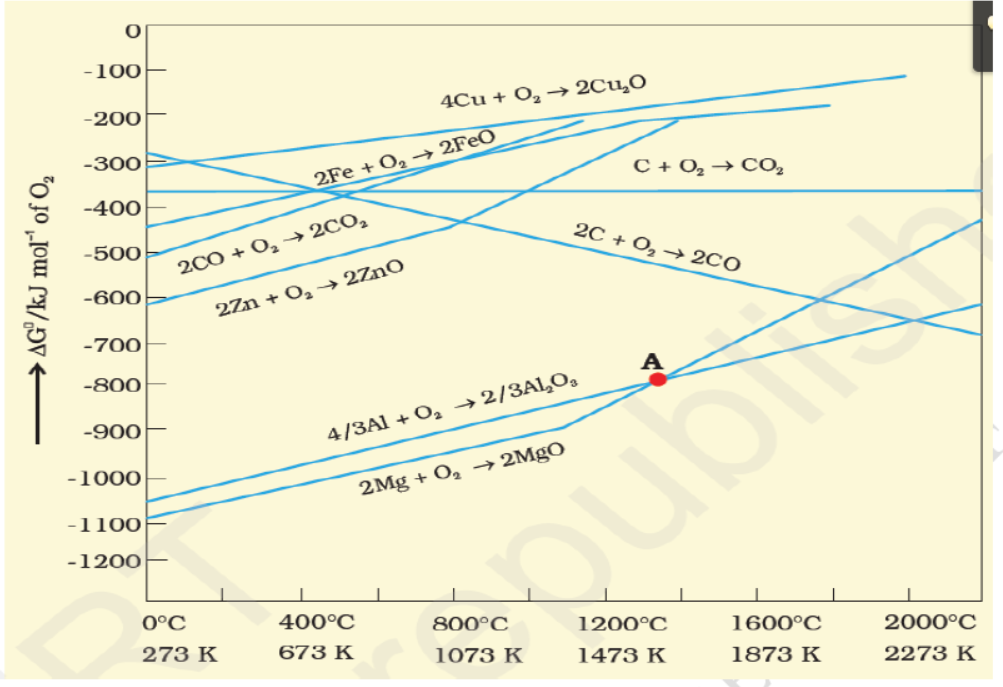
Question. Which of Al and Mg is better reducing agent below and above 1673K?
Answer: Below 1673 K – Mg and above 1673 K – Al
Question. Which of C and CO can reduce MgO at 2000K temperature?
Answer: CO
Question. Suggest a condition under which magnesium could reduce alumina.
Answer: Below the temperature 1600K
Free study material for Chemistry
Free CBSE Practice Worksheets: Class 12 Chemistry Unit 6 General Principles and Processes of Isolation of Elements
Practice Exercises for Class 12 Chemistry Unit 6 General Principles and Processes of Isolation of Elements
Access structured practice worksheets for Unit 6 General Principles and Processes of Isolation of Elements aligned with the 2026 CBSE curriculum. These downloadable exercises for Class 12 Chemistry help students build accuracy and reinforce core concepts for upcoming school tests.
Step-by-Step Solutions and Practice Guidelines
Built using official NCERT guidelines for Class 12 Chemistry, these practice sheets provide reliable academic support. Cross-reference your completed work with our detailed solutions to learn standard answer-writing formats for CBSE exams.
Enhance Speed with Online Practice
Consistent engagement with these exercises builds familiarity with recurring exam themes. If specific areas within Unit 6 General Principles and Processes of Isolation of Elements cause trouble, utilize our dedicated NCERT solutions for Class 12 Chemistry to clear up doubts immediately.
FAQs
You can download the latest chapter-wise printable worksheets for Class 12 Chemistry Unit 6 General Principles and Processes of Isolation of Elements for free from StudiesToday.com. These have been made as per the latest CBSE curriculum for this academic year.
Yes, Class 12 Chemistry worksheets for Unit 6 General Principles and Processes of Isolation of Elements focus on activity-based learning and also competency-style questions. This helps students to apply theoretical knowledge to practical scenarios.
Yes, we have provided solved worksheets for Class 12 Chemistry Unit 6 General Principles and Processes of Isolation of Elements to help students verify their answers instantly.
Yes, our Class 12 Chemistry test sheets are mobile-friendly PDFs and can be printed by teachers for classroom.
For Unit 6 General Principles and Processes of Isolation of Elements, regular practice with our worksheets will improve question-handling speed and help students understand all technical terms and diagrams.