

Class 12 Chemistry Practice Sheet: CBSE Class 12 Chemistry Important Reactions Worksheet
Explore structured practice materials through the CBSE Class 12 Chemistry Important Reactions Worksheet. Tailored for Class 12 learners, utilizing these Chemistry worksheets ensures thorough preparation and strengthens problem-solving accuracy before final school evaluations.
Download Important Reactions Worksheet PDF with Answers
Navigate directly to the solved Chemistry worksheets using the digital viewer below. Each practice set includes detailed step-by-step solutions, allowing students to instantly cross-check their work and identify areas requiring further revision.
CBSE Class 12 Chemistry Worksheet - Important Reactions. CBSE issues sample papers every year for students for class 12 board exams. Students should solve the CBSE issued sample papers to understand the pattern of the question paper which will come in class 12 board exams this year. The sample papers have been provided with marking scheme. It’s always recommended to practice as many CBSE sample papers as possible before the board examinations. Sample papers should be always practiced in examination condition at home or school and the student should show the answers to teachers for checking or compare with the answers provided. Students can download the sample papers in pdf format free and score better marks in examinations. Refer to other links too for latest sample papers.
Please click the link below to download full pdf file for CBSE Class 12 Chemistry Worksheet - Important Reactions.
Page 1
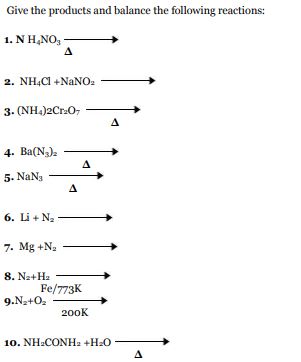
Question 1. \( \text{NH}_4\text{NO}_3 \xrightarrow{\Delta} \)
Answer: \( \text{NH}_4\text{NO}_3 \xrightarrow{\Delta} \text{N}_2\text{O} + 2\text{H}_2\text{O} \)
In simple words: Heating solid ammonium nitrate decomposes it into nitrous oxide (laughing gas) and water vapor.
Exam Tip: Laughing gas (\( \text{N}_2\text{O} \)) is a neutral oxide of nitrogen. Avoid overheating to prevent rapid, explosive decomposition.
Question 2. \( \text{NH}_4\text{Cl} + \text{NaNO}_2 \rightarrow \)
Answer: \( \text{NH}_4\text{Cl} + \text{NaNO}_2 \rightarrow \text{N}_2 + 2\text{H}_2\text{O} + \text{NaCl} \)
In simple words: Mixing ammonium chloride and sodium nitrite produces nitrogen gas, water, and salt.
Exam Tip: This laboratory preparation of nitrogen is safer than direct heating because it avoids explosive intermediates.
Question 3. \( (\text{NH}_4)_2\text{Cr}_2\text{O}_7 \xrightarrow{\Delta} \)
Answer: \( (\text{NH}_4)_2\text{Cr}_2\text{O}_7 \xrightarrow{\Delta} \text{N}_2 + \text{Cr}_2\text{O}_3 + 4\text{H}_2\text{O} \)
In simple words: Heating orange ammonium dichromate causes a dramatic decomposition into nitrogen gas, green chromium oxide, and steam.
Exam Tip: This is often called the "chemical volcano" reaction due to the formation of voluminous green ash (\( \text{Cr}_2\text{O}_3 \)).
Question 4. \( \text{Ba(N}_3)_2 \xrightarrow{\Delta} \)
Answer: \( \text{Ba(N}_3)_2 \xrightarrow{\Delta} \text{Ba} + 3\text{N}_2 \)
In simple words: Thermal decomposition of barium azide yields pure barium metal and highly pure nitrogen gas.
Exam Tip: Use this reaction when the question asks for the preparation of "very pure" or "ultra-pure" nitrogen gas.
Question 5. \( \text{NaN}_3 \xrightarrow{\Delta} \)
Answer: \( 2\text{NaN}_3 \xrightarrow{\Delta} 2\text{Na} + 3\text{N}_2 \)
In simple words: Heating sodium azide breaks it down into sodium metal and nitrogen gas.
Exam Tip: This rapid, gas-releasing reaction is the chemical basis used to inflate automobile airbags instantly during a crash.
Question 6. \( \text{Li} + \text{N}_2 \rightarrow \)
Answer: \( 6\text{Li} + \text{N}_2 \rightarrow 2\text{Li}_3\text{N} \)
In simple words: Lithium metal reacts directly with nitrogen gas to form lithium nitride.
Exam Tip: Lithium is the only alkali metal that reacts directly with gaseous nitrogen to form a solid ionic nitride.
Question 7. \( \text{Mg} + \text{N}_2 \rightarrow \)
Answer: \( 3\text{Mg} + \text{N}_2 \rightarrow \text{Mg}_3\text{N}_2 \)
In simple words: Magnesium metal burns in nitrogen gas to yield magnesium nitride.
Exam Tip: Remember that nitrides like \( \text{Mg}_3\text{N}_2 \) react with water to release ammonia gas.
Question 8. \( \text{N}_2 + \text{H}_2 \xrightarrow{\text{Fe / 773 K}} \)
Answer: \( \text{N}_2 + 3\text{H}_2 \xrightarrow[\text{773 K}]{\text{Fe}} 2\text{NH}_3 \)
In simple words: Nitrogen and hydrogen gases combine in the presence of an iron catalyst to produce ammonia.
Exam Tip: This is Haber's process; always write the catalyst (Fe) and the optimal temperature (~773 K) over the reaction arrow.
Question 9. \( \text{N}_2 + \text{O}_2 \xrightarrow{\text{2000 K}} \)
Answer: \( \text{N}_2 + \text{O}_2 \xrightarrow{\text{2000 K}} 2\text{NO} \)
In simple words: At extremely high temperatures, nitrogen and oxygen gases combine to form nitric oxide.
Exam Tip: This endothermic reaction happens naturally during lightning strikes in the atmosphere.
Question 10. \( \text{NH}_2\text{CONH}_2 + \text{H}_2\text{O} \xrightarrow{\Delta} \)
Answer: \( \text{NH}_2\text{CONH}_2 + 2\text{H}_2\text{O} \rightarrow (\text{NH}_4)_2\text{CO}_3 \rightleftharpoons 2\text{NH}_3 + \text{CO}_2 + \text{H}_2\text{O} \)
In simple words: Urea reacts with water to form ammonium carbonate, which then breaks down into ammonia, carbon dioxide, and water.
Exam Tip: Ammonium carbonate is an unstable intermediate; showing its decomposition into gaseous products is preferred.
Question 11. \( \text{NH}_4\text{Cl} + \text{Ca(OH)}_2 \rightarrow \)
Answer: \( 2\text{NH}_4\text{Cl} + \text{Ca(OH)}_2 \rightarrow \text{CaCl}_2 + 2\text{NH}_3 + 2\text{H}_2\text{O} \)
In simple words: Heating ammonium chloride with calcium hydroxide produces calcium chloride, ammonia gas, and water.
Exam Tip: This is a classic laboratory method for preparing ammonia gas. Use calcium hydroxide as it is non-deliquescent.
Question 12. \( (\text{NH}_4)_2\text{SO}_4 + \text{NaOH} \rightarrow \)
Answer: \( (\text{NH}_4)_2\text{SO}_4 + 2\text{NaOH} \rightarrow \text{Na}_2\text{SO}_4 + 2\text{NH}_3 + 2\text{H}_2\text{O} \)
In simple words: Ammonium sulfate reacts with sodium hydroxide to form sodium sulfate, ammonia gas, and water.
Exam Tip: Any ammonium salt heated with a strong base releases ammonia gas, which turns red litmus paper blue.
Question 13. \( \text{NH}_3 + \text{H}_2\text{O} \rightarrow \)
Answer: \( \text{NH}_3 + \text{H}_2\text{O} \rightleftharpoons \text{NH}_4^+ + \text{OH}^- \)
In simple words: Ammonia dissolves in water to form a weakly basic solution containing ammonium and hydroxide ions.
Exam Tip: The presence of hydroxide ions (\( \text{OH}^- \)) makes aqueous ammonia a weak base that can precipitate many metal hydroxides.
Question 14. \( \text{FeCl}_3 + \text{NH}_4\text{OH} \rightarrow \)
Answer: \( \text{FeCl}_3 + 3\text{NH}_4\text{OH} \rightarrow \text{Fe(OH)}_3 \downarrow + 3\text{NH}_4\text{Cl} \)
In simple words: Iron(III) chloride reacts with ammonium hydroxide to precipitate reddish-brown iron(III) hydroxide.
Exam Tip: The precipitate can also be represented as hydrated ferric oxide, \( \text{Fe}_2\text{O}_3 \cdot x\text{H}_2\text{O} \).
Question 15. \( \text{ZnSO}_4 + \text{NH}_4\text{OH} \rightarrow \)
Answer: \( \text{ZnSO}_4 + 2\text{NH}_4\text{OH} \rightarrow \text{Zn(OH)}_2 \downarrow + (\text{NH}_4)_2\text{SO}_4 \)
In simple words: Zinc sulfate reacts with ammonium hydroxide to form a gelatinous white precipitate of zinc hydroxide.
Exam Tip: This white precipitate dissolves in excess ammonium hydroxide due to the formation of a soluble tetraamminezinc(II) complex.
Question 16. \( \text{Cu}^{2+} + \text{NH}_3 \rightarrow \)
Answer: \( \text{Cu}^{2+} + 4\text{NH}_3 \rightarrow [\text{Cu(NH}_3)_4]^{2+} \)
In simple words: Copper(II) ions react with ammonia to form a soluble complex with a deep blue color.
Exam Tip: This deep blue complex formation is used as a qualitative test to identify copper(II) ions in solution.
Question 17. \( \text{AgCl} + \text{NH}_3 \rightarrow \)
Answer: \( \text{AgCl} + 2\text{NH}_3 \rightarrow [\text{Ag(NH}_3)_2]\text{Cl} \)
In simple words: Insoluble white silver chloride dissolves in ammonia solution to form a clear, soluble diamminesilver(I) complex.
Exam Tip: This reaction is used to distinguish silver chloride (soluble in dilute ammonia) from other halides.
Question 18. \( \text{NaNO}_3 + \text{H}_2\text{SO}_4 \rightarrow \)
Answer: \( \text{NaNO}_3 + \text{H}_2\text{SO}_4 \rightarrow \text{NaHSO}_4 + \text{HNO}_3 \)
In simple words: Sodium nitrate reacts with concentrated sulfuric acid to yield sodium bisulfate and nitric acid.
Exam Tip: Maintain low temperatures during this distillation to avoid thermal decomposition of the produced nitric acid.
Question 19. \( \text{NH}_3 + \text{O}_2 \xrightarrow[\text{9 bar}]{\text{Pt/Rh/500 K}} \)
Answer: \( 4\text{NH}_3 + 5\text{O}_2 \xrightarrow[\text{9 bar}]{\text{Pt/Rh/500 K}} 4\text{NO} + 6\text{H}_2\text{O} \)
In simple words: Ammonia gas is oxidized by oxygen over a platinum-rhodium catalyst to produce nitric oxide and water.
Exam Tip: This catalytic oxidation is the first critical step of the Ostwald process for manufacturing nitric acid.
Question 20. \( \text{NO} + \text{O}_2 \rightarrow \)
Answer: \( 2\text{NO} + \text{O}_2 \rightarrow 2\text{NO}_2 \)
In simple words: Colorless nitric oxide gas reacts rapidly with oxygen to form brown nitrogen dioxide fumes.
Exam Tip: This is the second step in the industrial manufacture of nitric acid by the Ostwald process.
Question 21. \( \text{NO}_2 + \text{H}_2\text{O} \rightarrow \)
Answer: \( 3\text{NO}_2 + \text{H}_2\text{O} \rightarrow 2\text{HNO}_3 + \text{NO} \)
In simple words: Nitrogen dioxide gas dissolves in water to produce nitric acid and nitric oxide gas.
Exam Tip: The released nitric oxide gas is recycled back to react with oxygen, making the process highly efficient.
Question 22. \( \text{HNO}_3 + \text{H}_2\text{O} \rightarrow \)
Answer: \( \text{HNO}_3 + \text{H}_2\text{O} \rightarrow \text{H}_3\text{O}^+ + \text{NO}_3^- \)
In simple words: Nitric acid acts as a strong acid in water, fully ionizing into hydronium and nitrate ions.
Exam Tip: This complete dissociation is why nitric acid is classified as a strong monobasic acid.
Question 23. \( \text{Cu} + \text{HNO}_3\text{ (Dilute)} \rightarrow \)
Answer: \( 3\text{Cu} + 8\text{HNO}_3\text{ (dilute)} \rightarrow 3\text{Cu(NO}_3)_2 + 2\text{NO} + 4\text{H}_2\text{O} \)
In simple words: Copper metal reacts with dilute nitric acid to form copper nitrate, colorless nitric oxide gas, and water.
Exam Tip: Pay close attention to the stoichiometry (3:8 ratio) as this reaction is frequently asked in balancing questions.
Question 24. \( \text{Cu} + \text{HNO}_3\text{ (Conc)} \rightarrow \)
Answer: \( \text{Cu} + 4\text{HNO}_3\text{ (conc)} \rightarrow \text{Cu(NO}_3)_2 + 2\text{NO}_2 + 2\text{H}_2\text{O} \)
In simple words: Copper metal reacts with concentrated nitric acid to yield copper nitrate, brown nitrogen dioxide gas, and water.
Exam Tip: Concentrated nitric acid always yields nitrogen dioxide (\( \text{NO}_2 \)), whereas dilute nitric acid yields nitric oxide (\( \text{NO} \)).
Question 25. \( \text{Zn} + \text{HNO}_3\text{ (Dil)} \rightarrow \)
Answer: \( 4\text{Zn} + 10\text{HNO}_3\text{ (dilute)} \rightarrow 4\text{Zn(NO}_3)_2 + \text{N}_2\text{O} + 5\text{H}_2\text{O} \)
In simple words: Zinc reacts with dilute nitric acid to produce zinc nitrate, nitrous oxide gas (laughing gas), and water.
Exam Tip: Note that dilute nitric acid reacts differently with copper (yields \( \text{NO} \)) than with zinc (yields \( \text{N}_2\text{O} \)).
Question 26. \( \text{Zn} + \text{HNO}_3\text{ (conc)} \rightarrow \)
Answer: \( \text{Zn} + 4\text{HNO}_3\text{ (conc)} \rightarrow \text{Zn(NO}_3)_2 + 2\text{NO}_2 + 2\text{H}_2\text{O} \)
In simple words: Zinc metal reacts with concentrated nitric acid to produce zinc nitrate, brown nitrogen dioxide gas, and water.
Exam Tip: Both zinc and copper react with concentrated nitric acid to produce the same gaseous product: brown \( \text{NO}_2 \).
Question 27. \( \text{I}_2 + \text{HNO}_3\text{ (conc)} \rightarrow \)
Answer: \( \text{I}_2 + 10\text{HNO}_3\text{ (conc)} \rightarrow 2\text{HIO}_3 + 10\text{NO}_2 + 4\text{H}_2\text{O} \)
In simple words: Concentrated nitric acid oxidizes iodine to iodic acid, while being reduced to brown nitrogen dioxide gas.
Exam Tip: This reaction demonstrates the strong oxidizing behavior of concentrated nitric acid towards non-metals.
Question 28. \( \text{C} + \text{HNO}_3\text{ (conc)} \rightarrow \)
Answer: \( \text{C} + 4\text{HNO}_3\text{ (conc)} \rightarrow \text{CO}_2 + 4\text{NO}_2 + 2\text{H}_2\text{O} \)
In simple words: Carbon is oxidized to carbon dioxide gas by concentrated nitric acid, which reduces to nitrogen dioxide.
Exam Tip: Remember that concentrated nitric acid oxidizes carbon to its highest oxidation state (+4) in carbon dioxide.
Question 29. \( \text{S}_8 + \text{HNO}_3\text{ (conc)} \rightarrow \)
Answer: \( \text{S}_8 + 48\text{HNO}_3\text{ (conc)} \rightarrow 8\text{H}_2\text{SO}_4 + 48\text{NO}_2 + 16\text{H}_2\text{O} \)
In simple words: Concentrated nitric acid oxidizes sulfur to sulfuric acid, releasing brown nitrogen dioxide gas and water.
Exam Tip: The stoichiometry for sulfur oxidation is high (1:48), so remember the balanced coefficient ratio to save time in exams.
Question 30. \( \text{P}_4 + \text{HNO}_3\text{ (conc)} \rightarrow \)
Answer: \( \text{P}_4 + 20\text{HNO}_3\text{ (conc)} \rightarrow 4\text{H}_3\text{PO}_4 + 20\text{NO}_2 + 4\text{H}_2\text{O} \)
In simple words: Phosphorus reacts with concentrated nitric acid to form orthophosphoric acid, nitrogen dioxide, and water.
Exam Tip: Concentrated nitric acid always oxidizes non-metals to their respective "-ic" oxoacids (iodic, sulfuric, phosphoric).
Question 31. \( \text{P}_4 + \text{NaOH} + \text{H}_2\text{O} \rightarrow \)
Answer: \( \text{P}_4 + 3\text{NaOH} + 3\text{H}_2\text{O} \rightarrow \text{PH}_3 + 3\text{NaH}_2\text{PO}_2 \)
In simple words: White phosphorus heated with sodium hydroxide solution produces phosphine gas and sodium hypophosphite.
Exam Tip: This disproportionation reaction must be carried out in an inert atmosphere of carbon dioxide to prevent phosphine from catching fire.
Question 32. \( \text{P}_4 + \text{O}_2\text{ (Excess)} \rightarrow \)
Answer: \( \text{P}_4 + 5\text{O}_2 \rightarrow \text{P}_4\text{O}_{10} \)
In simple words: Burning phosphorus in an excess of oxygen yields phosphorus pentoxide (written as the dimer \( \text{P}_4\text{O}_{10} \)).
Exam Tip: In limited oxygen, this reaction would instead yield phosphorus trioxide (\( \text{P}_4\text{O}_6 \)).
Question 33. \( \text{Ca}_3\text{P}_2 + \text{H}_2\text{O} \rightarrow \)
Answer: \( \text{Ca}_3\text{P}_2 + 6\text{H}_2\text{O} \rightarrow 3\text{Ca(OH)}_2 + 2\text{PH}_3 \)
In simple words: Calcium phosphide reacts with water to release flammable phosphine gas and calcium hydroxide.
Exam Tip: This reaction is the chemical basis for Holme's signals used at sea to guide ships.
Question 34. \( \text{Ca}_3\text{P}_2 + \text{HCl} \rightarrow \)
Answer: \( \text{Ca}_3\text{P}_2 + 6\text{HCl} \rightarrow 3\text{CaCl}_2 + 2\text{PH}_3 \)
In simple words: Calcium phosphide reacts with hydrochloric acid to produce calcium chloride and phosphine gas.
Exam Tip: Phosphides react similarly with both water and dilute acids to liberate phosphine gas.
Question 35. \( \text{PH}_3 + \text{HI} \rightarrow \)
Answer: \( \text{PH}_3 + \text{HI} \rightarrow \text{PH}_4\text{I} \)
In simple words: Phosphine reacts with hydrogen iodide to form phosphonium iodide.
Exam Tip: This reaction demonstrates the weakly basic nature of phosphine.
Question 36. \( \text{PH}_3 + \text{HBr} \rightarrow \)
Answer: \( \text{PH}_3 + \text{HBr} \rightarrow \text{PH}_4\text{Br} \)
In simple words: Phosphine gas reacts with hydrogen bromide to yield phosphonium bromide.
Exam Tip: Phosphonium salts are stable only under anhydrous conditions and decompose in the presence of water.
Question 37. \( \text{PH}_4\text{I} + \text{KOH} \rightarrow \)
Answer: \( \text{PH}_4\text{I} + \text{KOH} \rightarrow \text{KI} + \text{H}_2\text{O} + \text{PH}_3 \)
In simple words: Phosphonium iodide reacts with potassium hydroxide to release pure phosphine gas, potassium iodide, and water.
Exam Tip: This reaction is used to purify phosphine gas from its salts.
Question 38. \( \text{P}_4 + \text{Cl}_2 \rightarrow \)
Answer: \( \text{P}_4 + 6\text{Cl}_2 \rightarrow 4\text{PCl}_3 \)
In simple words: Dry chlorine gas reacts with white phosphorus to yield phosphorus trichloride.
Exam Tip: Make sure to specify that chlorine is kept in a limited amount to prevent the formation of phosphorus pentachloride.
Question 39. \( \text{P}_4 + \text{Cl}_2\text{ (excess)} \rightarrow \)
Answer: \( \text{P}_4 + 10\text{Cl}_2 \rightarrow 4\text{PCl}_5 \)
In simple words: Phosphorus reacts with an excess of chlorine gas to yield phosphorus pentachloride.
Exam Tip: The ratio of reactants determines whether you get the liquid trichloride (1:6) or the solid pentachloride (1:10).
Question 40. \( \text{P}_4 + \text{SOCl}_2 \rightarrow \)
Answer: \( \text{P}_4 + 8\text{SOCl}_2 \rightarrow 4\text{PCl}_3 + 4\text{SO}_2 + 2\text{S}_2\text{Cl}_2 \)
In simple words: White phosphorus reacts with thionyl chloride to form phosphorus trichloride, sulfur dioxide, and sulfur monochloride.
Exam Tip: Thionyl chloride (\( \text{SOCl}_2 \)) is used specifically to prepare phosphorus trichloride, not the pentachloride.
Question 41. \( \text{P}_4 + \text{SO}_2\text{Cl}_2 \rightarrow \)
Answer: \( \text{P}_4 + 10\text{SO}_2\text{Cl}_2 \rightarrow 4\text{PCl}_5 + 10\text{SO}_2 \)
In simple words: White phosphorus reacts with sulfuryl chloride to yield phosphorus pentachloride and sulfur dioxide gas.
Exam Tip: Do not confuse sulfuryl chloride (\( \text{SO}_2\text{Cl}_2 \)), which yields \( \text{PCl}_5 \), with thionyl chloride (\( \text{SOCl}_2 \)), which yields \( \text{PCl}_3 \).
Question 42. \( \text{PCl}_3 + \text{H}_2\text{O} \rightarrow \)
Answer: \( \text{PCl}_3 + 3\text{H}_2\text{O} \rightarrow \text{H}_3\text{PO}_3 + 3\text{HCl} \)
In simple words: Phosphorus trichloride reacts violently with water to form phosphorous acid and hydrochloric acid fumes.
Exam Tip: This hydrolysis reaction produces white fumes of hydrochloric acid (\( \text{HCl} \)) in moist air.
Question 43. \( \text{PCl}_3 + \text{CH}_3\text{COOH} \rightarrow \)
Answer: \( 3\text{CH}_3\text{COOH} + \text{PCl}_3 \rightarrow 3\text{CH}_3\text{COCl} + \text{H}_3\text{PO}_3 \)
In simple words: Acetic acid reacts with phosphorus trichloride to yield acetyl chloride and phosphorous acid.
Exam Tip: This reaction is widely used in organic chemistry to replace a hydroxyl group (\( -\text{OH} \)) with a chlorine atom (\( -\text{Cl} \)).
Question 44. \( \text{PCl}_3 + \text{C}_2\text{H}_5\text{OH} \rightarrow \)
Answer: \( 3\text{C}_2\text{H}_5\text{OH} + \text{PCl}_3 \rightarrow 3\text{C}_2\text{H}_5\text{Cl} + \text{H}_3\text{PO}_3 \)
In simple words: Ethanol reacts with phosphorus trichloride to produce ethyl chloride and phosphorous acid.
Exam Tip: Always balance this organic preparation reaction using a 3:1 ratio of alcohol to phosphorus trichloride.
Question 45. \( \text{PCl}_5 + \text{H}_2\text{O} \rightarrow \)
Answer: \( \text{PCl}_5 + \text{H}_2\text{O} \rightarrow \text{POCl}_3 + 2\text{HCl} \)
In simple words: Phosphorus pentachloride reacts with a limited amount of water to yield phosphorus oxychloride and hydrochloric acid.
Exam Tip: Under complete hydrolysis with excess water, the product \( \text{POCl}_3 \) further reacts to form orthophosphoric acid (\( \text{H}_3\text{PO}_4 \)).
Question 46. \( \text{PCl}_5 + \text{CH}_3\text{COOH} \rightarrow \)
Answer: \( \text{CH}_3\text{COOH} + \text{PCl}_5 \rightarrow \text{CH}_3\text{COCl} + \text{POCl}_3 + \text{HCl} \)
In simple words: Acetic acid reacts with phosphorus pentachloride to yield acetyl chloride, phosphorus oxychloride, and hydrochloric acid.
Exam Tip: Compared to \( \text{PCl}_3 \), reaction with \( \text{PCl}_5 \) yields \( \text{POCl}_3 \) and \( \text{HCl} \) as major byproducts.
Question 47. \( \text{PCl}_5 + \text{C}_2\text{H}_5\text{OH} \rightarrow \)
Answer: \( \text{C}_2\text{H}_5\text{OH} + \text{PCl}_5 \rightarrow \text{C}_2\text{H}_5\text{Cl} + \text{POCl}_3 + \text{HCl} \)
In simple words: Ethanol reacts with phosphorus pentachloride to form ethyl chloride, phosphorus oxychloride, and hydrogen chloride gas.
Exam Tip: This reaction is a standard diagnostic test for the presence of a hydroxyl group in organic compounds.
Question 48. \( \text{PCl}_5 + \text{Ag} \rightarrow \)
Answer: \( 2\text{Ag} + \text{PCl}_5 \rightarrow 2\text{AgCl} + \text{PCl}_3 \)
In simple words: Heated silver metal reacts with phosphorus pentachloride to form silver chloride and phosphorus trichloride.
Exam Tip: Finely divided metals are chlorinated by reacting them with phosphorus pentachloride.
Question 49. \( \text{PCl}_5 + \text{Sn} \rightarrow \)
Answer: \( \text{Sn} + 2\text{PCl}_5 \rightarrow \text{SnCl}_4 + 2\text{PCl}_3 \)
In simple words: Tin metal reacts with phosphorus pentachloride to yield tin(IV) chloride and phosphorus trichloride.
Exam Tip: Keep in mind that tin is oxidized to its +4 oxidation state (\( \text{SnCl}_4 \)) in this reaction.
Question 50. \( \text{PCl}_5 \xrightarrow{\text{Heat}} \)
Answer: \( \text{PCl}_5 \xrightarrow{\text{Heat}} \text{PCl}_3 + \text{Cl}_2 \)
In simple words: Heating solid phosphorus pentachloride causes it to break down into phosphorus trichloride and chlorine gas.
Exam Tip: This thermal decomposition occurs easily because the two axial bonds in \( \text{PCl}_5 \) are longer and weaker than the three equatorial bonds.
Question 51. \( \text{H}_3\text{PO}_3 \xrightarrow{\text{Heat}} \)
Answer: \( 4\text{H}_3\text{PO}_3 \xrightarrow{\text{Heat}} 3\text{H}_3\text{PO}_4 + \text{PH}_3 \)
In simple words: Heating phosphorous acid causes it to disproportionate into phosphoric acid and phosphine gas.
Exam Tip: Phosphorous acid contains phosphorus in the +3 oxidation state, which disproportionates to +5 (\( \text{H}_3\text{PO}_4 \)) and -3 (\( \text{PH}_3 \)).
Question 52. \( \text{AgNO}_3 + \text{H}_2\text{O} + \text{H}_3\text{PO}_2 \rightarrow \)
Answer: \( 4\text{AgNO}_3 + 2\text{H}_2\text{O} + \text{H}_3\text{PO}_2 \rightarrow 4\text{Ag} + \text{H}_3\text{PO}_4 + 4\text{HNO}_3 \)
In simple words: Hypophosphorous acid reduces silver nitrate to metallic silver, while itself being oxidized to phosphoric acid.
Exam Tip: This reaction highlights the strong reducing character of hypophosphorous acid (\( \text{H}_3\text{PO}_2 \)), which has two \( \text{P}-\text{H} \) bonds.
Question 53. \( \text{CuSO}_4 + \text{PH}_3 \rightarrow \)
Answer: \( 3\text{CuSO}_4 + 2\text{PH}_3 \rightarrow \text{Cu}_3\text{P}_2 + 3\text{H}_2\text{SO}_4 \)
In simple words: Phosphine gas reacts with copper sulfate solution to yield a black precipitate of copper phosphide and sulfuric acid.
Exam Tip: This precipitation reaction is useful for removing phosphine impurities from gaseous mixtures.
Question 54. \( \text{HgCl}_2 + \text{PH}_3 \rightarrow \)
Answer: \( 3\text{HgCl}_2 + 2\text{PH}_3 \rightarrow \text{Hg}_3\text{P}_2 + 6\text{HCl} \)
In simple words: Passing phosphine gas through mercury(II) chloride solution produces a precipitate of mercuric phosphide and hydrochloric acid.
Exam Tip: Like copper sulfate, mercuric chloride is an effective absorbing agent for phosphine gas.
Question 55. \( \text{Se}_2\text{Cl}_2 \xrightarrow{\text{Heat}} \)
Answer: \( 2\text{Se}_2\text{Cl}_2 \xrightarrow{\text{Heat}} \text{SeCl}_4 + 3\text{Se} \)
In simple words: Heating selenium monochloride causes it to disproportionate into selenium tetrachloride and elemental selenium.
Exam Tip: This is a classic example of disproportionation where selenium goes from a +1 oxidation state to +4 and 0 states.
Page 2
Question 56. \( \text{KClO}_3 \xrightarrow{\text{Heat, MnO}_2} \)
Answer: \( 2\text{KClO}_3 \xrightarrow[\text{MnO}_2]{\text{Heat}} 2\text{KCl} + 3\text{O}_2 \)
In simple words: Heating potassium chlorate in the presence of manganese dioxide catalyst decomposes it into potassium chloride and oxygen gas.
Exam Tip: Manganese dioxide acts as a catalyst here, lowering the decomposition temperature significantly.
Question 57. \( \text{Ag}_2\text{O} \xrightarrow{\text{Heat}} \)
Answer: \( 2\text{Ag}_2\text{O} \xrightarrow{\text{Heat}} 4\text{Ag} + \text{O}_2 \)
In simple words: Heating silver oxide decomposes it into metallic silver and oxygen gas.
Exam Tip: Metals low in the electrochemical series have oxides that decompose easily upon gentle heating.
Question 58. \( \text{HgO} \xrightarrow{\text{Heat}} \)
Answer: \( 2\text{HgO} \xrightarrow{\text{Heat}} 2\text{Hg} + \text{O}_2 \)
In simple words: Heating red mercury(II) oxide decomposes it into liquid mercury and oxygen gas.
Exam Tip: This reaction was historically used by Joseph Priestley to discover oxygen gas.
Question 59. \( \text{Pb}_3\text{O}_4 \xrightarrow{\text{Heat}} \)
Answer: \( 2\text{Pb}_3\text{O}_4 \xrightarrow{\text{Heat}} 6\text{PbO} + \text{O}_2 \)
In simple words: Heating red lead oxide decomposes it into lead(II) oxide and oxygen gas.
Exam Tip: Lead is reduced from its mixed-valence state (+4/3 average) to the stable +2 state.
Question 60. \( \text{PbO}_2 \xrightarrow{\text{Heat}} \)
Answer: \( 2\text{PbO}_2 \xrightarrow{\text{Heat}} 2\text{PbO} + \text{O}_2 \)
In simple words: Heating lead dioxide decomposes it into lead monoxide and oxygen gas.
Exam Tip: Lead(IV) is unstable at high temperatures due to the inert pair effect, converting to the more stable lead(II) state.
Question 61. \( \text{H}_2\text{O}_2 \xrightarrow{\text{MnO}_2} \)
Answer: \( 2\text{H}_2\text{O}_2 \xrightarrow{\text{MnO}_2} 2\text{H}_2\text{O} + \text{O}_2 \)
In simple words: Hydrogen peroxide decomposes into water and oxygen gas rapidly in the presence of manganese dioxide.
Exam Tip: This disproportionation is catalyzed by various substances, including manganese dioxide, metals, and dust.
Question 62. \( \text{Ca} + \text{O}_2 \rightarrow \)
Answer: \( 2\text{Ca} + \text{O}_2 \rightarrow 2\text{CaO} \)
In simple words: Calcium metal burns in oxygen to form white calcium oxide (quicklime).
Exam Tip: Alkaline earth metals burn in oxygen to form simple ionic oxides of the formula \( \text{MO} \).
Question 63. \( \text{Al} + \text{O}_2 \rightarrow \)
Answer: \( 4\text{Al} + 3\text{O}_2 \rightarrow 2\text{Al}_2\text{O}_3 \)
In simple words: Aluminum metal reacts with oxygen at high temperatures to form aluminum oxide.
Exam Tip: This reaction is highly exothermic and is the driving force behind thermite reactions.
Question 64. \( \text{C} + \text{O}_2 \rightarrow \)
Answer: \( \text{C} + \text{O}_2 \rightarrow \text{CO}_2 \)
In simple words: Carbon burns completely in oxygen to produce carbon dioxide gas.
Exam Tip: Complete combustion of carbon yields \( \text{CO}_2 \), whereas incomplete combustion in limited oxygen yields carbon monoxide (\( \text{CO} \)).
Question 65. \( \text{ZnS} + \text{O}_2 \rightarrow \)
Answer: \( 2\text{ZnS} + 3\text{O}_2 \rightarrow 2\text{ZnO} + 2\text{SO}_2 \)
In simple words: Heating zinc sulfide in oxygen (roasting) converts it into zinc oxide and sulfur dioxide gas.
Exam Tip: Roasting is a metallurgical process used to convert sulfide ores into their corresponding oxides.
Question 66. \( \text{CH}_4 + \text{O}_2 \rightarrow \)
Answer: \( \text{CH}_4 + 2\text{O}_2 \rightarrow \text{CO}_2 + 2\text{H}_2\text{O} \)
In simple words: Methane burns in oxygen to form carbon dioxide gas and water.
Exam Tip: Complete combustion of any hydrocarbon always yields \( \text{CO}_2 \) and \( \text{H}_2\text{O} \).
Question 67. \( \text{S} + \text{O}_2 \rightarrow \)
Answer: \( \text{S} + \text{O}_2 \rightarrow \text{SO}_2 \)
In simple words: Sulfur burns in oxygen to produce sulfur dioxide gas.
Exam Tip: This oxidation is the first step in the industrial manufacture of sulfuric acid by the Contact process.
Question 68. \( \text{HCl} + \text{O}_2 \rightarrow \)
Answer: \( 4\text{HCl} + \text{O}_2 \xrightarrow{\text{CuCl}_2} 2\text{Cl}_2 + 2\text{H}_2\text{O} \)
In simple words: Hydrochloric acid gas is oxidized by oxygen in the presence of copper(II) chloride catalyst to produce chlorine gas and water.
Exam Tip: This reaction is known as Deacon's process for the industrial manufacture of chlorine gas.
Question 69. \( \text{C}_2\text{H}_4 + \text{O}_2 \rightarrow \)
Answer: \( \text{C}_2\text{H}_4 + 3\text{O}_2 \rightarrow 2\text{CO}_2 + 2\text{H}_2\text{O} \)
In simple words: Ethene burns in oxygen to yield carbon dioxide gas and water.
Exam Tip: Ensure all elements are balanced on both sides of the equation when dealing with hydrocarbon combustion.
Question 70. \( \text{SO}_2 + \text{H}_2\text{O} \rightarrow \)
Answer: \( \text{SO}_2 + \text{H}_2\text{O} \rightleftharpoons \text{H}_2\text{SO}_3 \)
In simple words: Sulfur dioxide dissolves in water to form sulfurous acid.
Exam Tip: Sulfurous acid (\( \text{H}_2\text{SO}_3 \)) is a weak dibasic acid and exists only in aqueous solution.
Question 71. \( \text{CaO} + \text{H}_2\text{O} \rightarrow \)
Answer: \( \text{CaO} + \text{H}_2\text{O} \rightarrow \text{Ca(OH)}_2 \)
In simple words: Calcium oxide reacts vigorously with water to form calcium hydroxide (slaked lime).
Exam Tip: This reaction is highly exothermic and is commonly known as the slaking of lime.
Question 72. \( \text{Al}_2\text{O}_3 + \text{HCl} + \text{H}_2\text{O} \rightarrow \)
Answer: \( \text{Al}_2\text{O}_3 + 6\text{HCl} + 9\text{H}_2\text{O} \rightarrow 2[\text{Al(H}_2\text{O})_6]^{3+} + 6\text{Cl}^- \)
In simple words: Aluminum oxide reacts with hydrochloric acid and water to form hydrated aluminum ions and chloride ions.
Exam Tip: This reaction demonstrates the basic character of amphoteric aluminum oxide.
Question 73. \( \text{Al}_2\text{O}_3 + \text{NaOH} + \text{H}_2\text{O} \rightarrow \)
Answer: \( \text{Al}_2\text{O}_3 + 2\text{NaOH} + 3\text{H}_2\text{O} \rightarrow 2\text{Na}[\text{Al(OH)}_4] \)
In simple words: Aluminum oxide reacts with sodium hydroxide and water to form soluble sodium tetrahydroxoaluminate.
Exam Tip: This reaction highlights the acidic character of amphoteric aluminum oxide.
Question 74. \( \text{O}_2 \xrightarrow{\text{silent electric discharge}} \)
Answer: \( 3\text{O}_2 \xrightarrow{\text{silent electric discharge}} 2\text{O}_3 \)
In simple words: Passing oxygen gas through a silent electric discharge converts it into ozone.
Exam Tip: A silent electric discharge is used to prevent the decomposition of the produced ozone back into oxygen.
Question 75. \( \text{PbS} + \text{O}_3 \rightarrow \)
Answer: \( \text{PbS} + 4\text{O}_3 \rightarrow \text{PbSO}_4 + 4\text{O}_2 \)
In simple words: Black lead sulfide reacts with ozone to form white lead sulfate and oxygen gas.
Exam Tip: This reaction demonstrates the strong oxidizing power of ozone and is used to restore darkened oil paintings.
Question 76. \( \text{I}^- + \text{H}_2\text{O} + \text{O}_3 \rightarrow \)
Answer: \( 2\text{I}^- + \text{H}_2\text{O} + \text{O}_3 \rightarrow 2\text{OH}^- + \text{I}_2 + \text{O}_2 \)
In simple words: Iodide ions react with water and ozone to form hydroxide ions, iodine, and oxygen gas.
Exam Tip: This reaction is used for the quantitative estimation of ozone by titrating the liberated iodine with sodium thiosulfate.
Question 77. \( \text{I}_2 + \text{Na}_2\text{S}_2\text{O}_3 \rightarrow \)
Answer: \( \text{I}_2 + 2\text{Na}_2\text{S}_2\text{O}_3 \rightarrow 2\text{NaI} + \text{Na}_2\text{S}_4\text{O}_6 \)
In simple words: Iodine reacts with sodium thiosulfate to form sodium iodide and sodium tetrathionate.
Exam Tip: This reaction is the basis of iodometric titrations; the starch indicator turns from blue-black to colorless at the endpoint.
Question 78. \( \text{NO} + \text{O}_3 \rightarrow \)
Answer: \( \text{NO} + \text{O}_3 \rightarrow \text{NO}_2 + \text{O}_2 \)
In simple words: Nitric oxide reacts with ozone to form nitrogen dioxide and oxygen gas.
Exam Tip: This reaction explains how nitric oxide from supersonic jet exhausts contributes to the depletion of the ozone layer.
Question 79. \( \text{SO}_3^{2-} + \text{H}^+ \rightarrow \)
Answer: \( \text{SO}_3^{2-} + 2\text{H}^+ \rightarrow \text{SO}_2 \uparrow + \text{H}_2\text{O} \)
In simple words: Sulfite ions react with hydrogen ions to release sulfur dioxide gas and water.
Exam Tip: This reaction is a standard laboratory test for identifying sulfite ions; the released \( \text{SO}_2 \) has a suffocating sulfur smell.
Question 80. \( \text{FeS}_2 + \text{O}_2 \rightarrow \)
Answer: \( 4\text{FeS}_2 + 11\text{O}_2 \rightarrow 2\text{Fe}_2\text{O}_3 + 8\text{SO}_2 \)
In simple words: Roasting iron pyrites in oxygen yields ferric oxide and sulfur dioxide gas.
Exam Tip: This roasting reaction serves as a major source of sulfur dioxide for the manufacture of sulfuric acid.
Question 81. \( \text{SO}_2 + \text{H}_2\text{O} \rightarrow \)
Answer: \( \text{SO}_2 + \text{H}_2\text{O} \rightleftharpoons \text{H}_2\text{SO}_3 \)
In simple words: Sulfur dioxide dissolves reversibly in water to form weak sulfurous acid.
Exam Tip: This is identical to Reaction 70; it demonstrates the acidic oxide character of sulfur dioxide.
Question 82. \( \text{SO}_2 + \text{NaOH} \rightarrow \)
Answer: \( \text{SO}_2 + 2\text{NaOH} \rightarrow \text{Na}_2\text{SO}_3 + \text{H}_2\text{O} \)
In simple words: Sulfur dioxide reacts with sodium hydroxide to produce sodium sulfite and water.
Exam Tip: This is an acid-base neutralization reaction, confirming that sulfur dioxide is an acidic oxide.
Question 83. \( \text{SO}_2 + \text{Na}_2\text{SO}_3 + \text{H}_2\text{O} \rightarrow \)
Answer: \( \text{SO}_2 + \text{Na}_2\text{SO}_3 + \text{H}_2\text{O} \rightarrow 2\text{NaHSO}_3 \)
In simple words: Sulfur dioxide reacts with sodium sulfite solution to form sodium hydrogen sulfite.
Exam Tip: This reaction is analogous to carbon dioxide forming sodium bicarbonate when passed through sodium carbonate solution.
Question 84. \( \text{SO}_2 + \text{Cl}_2 \rightarrow \)
Answer: \( \text{SO}_2 + \text{Cl}_2 \xrightarrow{\text{charcoal}} \text{SO}_2\text{Cl}_2 \)
In simple words: Sulfur dioxide combines with chlorine gas in the presence of a charcoal catalyst to yield sulfuryl chloride.
Exam Tip: Ensure you include the "charcoal catalyst" over the arrow, as it is required for this reaction to proceed efficiently.
Question 85. \( \text{SO}_2 + \text{O}_2 \xrightarrow{\text{V}_2\text{O}_5} \)
Answer: \( 2\text{SO}_2 + \text{O}_2 \xrightarrow{\text{V}_2\text{O}_5} 2\text{SO}_3 \)
In simple words: Sulfur dioxide is oxidized by oxygen in the presence of a vanadium pentoxide catalyst to form sulfur trioxide.
Exam Tip: This reversible, exothermic catalytic oxidation is the key step in the Contact process.
Question 86. \( \text{SO}_2 + \text{Fe}^{3+} + \text{H}_2\text{O} \rightarrow \)
Answer: \( \text{SO}_2 + 2\text{Fe}^{3+} + 2\text{H}_2\text{O} \rightarrow 2\text{Fe}^{2+} + \text{SO}_4^{2-} + 4\text{H}^+ \)
In simple words: Sulfur dioxide reduces iron(III) ions to iron(II) ions in water, while being oxidized to sulfate ions.
Exam Tip: This reaction demonstrates the reducing property of moist sulfur dioxide gas.
Question 87. \( \text{SO}_2 + \text{MnO}_4^- + \text{H}^+ \rightarrow \)
Answer: \( 5\text{SO}_2 + 2\text{MnO}_4^- + 2\text{H}_2\text{O} \rightarrow 2\text{Mn}^{2+} + 5\text{SO}_4^{2-} + 4\text{H}^+ \)
In simple words: Sulfur dioxide decolorizes purple potassium permanganate solution, reducing it to manganese(II) ions.
Exam Tip: This reaction is used as a qualitative chemical test to confirm the presence of sulfur dioxide gas.
Question 88. \( \text{SO}_3 + \text{H}_2\text{SO}_4 \rightarrow \)
Answer: \( \text{SO}_3 + \text{H}_2\text{SO}_4 \rightarrow \text{H}_2\text{S}_2\text{O}_7 \)
In simple words: Sulfur trioxide gas is absorbed in concentrated sulfuric acid to produce oleum (pyrosulfuric acid).
Exam Tip: Absorbing \( \text{SO}_3 \) directly in water is avoided industrially because it forms a dense, difficult-to-condense acid mist.
Question 89. \( \text{H}_2\text{S}_2\text{O}_7 + \text{H}_2\text{O} \rightarrow \)
Answer: \( \text{H}_2\text{S}_2\text{O}_7 + \text{H}_2\text{O} \rightarrow 2\text{H}_2\text{SO}_4 \)
In simple words: Diluting oleum with water yields sulfuric acid of the desired concentration.
Exam Tip: This step allows safe, controlled production of highly concentrated sulfuric acid.
Question 90. \( \text{MX} + \text{H}_2\text{SO}_4 \rightarrow \text{ (where } \text{X} = \text{F, Cl, } \text{NO}_3\text{)} \)
Answer: \( \text{MX} + \text{H}_2\text{SO}_4 \rightarrow \text{MHSO}_4 + \text{HX} \)
In simple words: Metal halides or nitrates react with concentrated sulfuric acid to produce the corresponding volatile hydrogen acid.
Exam Tip: This reaction showcases the low volatility of sulfuric acid, which is used to displace more volatile acids from their salts.
Question 91. \( \text{C}_{12}\text{H}_{22}\text{O}_{11} \xrightarrow{\text{conc. } \text{H}_2\text{SO}_4} \)
Answer: \( \text{C}_{12}\text{H}_{22}\text{O}_{11} \xrightarrow{\text{conc. } \text{H}_2\text{SO}_4} 12\text{C} + 11\text{H}_2\text{O} \)
In simple words: Concentrated sulfuric acid removes all water elements from sucrose, leaving behind a black, charred mass of carbon.
Exam Tip: This reaction is a classic demonstration of the powerful dehydrating action of concentrated sulfuric acid.
Question 92. \( \text{Cu} + \text{conc. } \text{H}_2\text{SO}_4 \rightarrow \)
Answer: \( \text{Cu} + 2\text{H}_2\text{SO}_4\text{ (conc.)} \rightarrow \text{CuSO}_4 + \text{SO}_2 + 2\text{H}_2\text{O} \)
In simple words: Copper metal reacts with hot, concentrated sulfuric acid to form copper sulfate, sulfur dioxide gas, and water.
Exam Tip: Sulfuric acid acts as a strong oxidizing agent here, rather than a simple acid, since copper is below hydrogen in the activity series.
Question 93. \( \text{S} + \text{conc. } \text{H}_2\text{SO}_4 \rightarrow \)
Answer: \( \text{S} + 2\text{H}_2\text{SO}_4\text{ (conc.)} \rightarrow 3\text{SO}_2 + 2\text{H}_2\text{O} \)
In simple words: Non-metal sulfur is oxidized to sulfur dioxide gas by hot, concentrated sulfuric acid, which is itself reduced to sulfur dioxide.
Exam Tip: Note that sulfur dioxide is the sole gaseous product formed from both the reactant and the acid.
Question 94. \( \text{C} + \text{conc. } \text{H}_2\text{SO}_4 \rightarrow \)
Answer: \( \text{C} + 2\text{H}_2\text{SO}_4\text{ (conc.)} \rightarrow \text{CO}_2 + 2\text{SO}_2 + 2\text{H}_2\text{O} \)
In simple words: Carbon reacts with hot, concentrated sulfuric acid to yield carbon dioxide, sulfur dioxide, and water.
Exam Tip: Concentrated sulfuric acid oxidizes carbon to its highest oxidation state (+4) in carbon dioxide.
Question 95. \( \text{F}_2 + 2\text{X}^- \rightarrow \text{ (where } \text{X} = \text{Cl, Br, I)} \)
Answer: \( \text{F}_2 + 2\text{X}^- \rightarrow 2\text{F}^- + \text{X}_2 \)
In simple words: Strong oxidizing fluorine gas displaces and oxidizes other halide ions to their elemental halogen forms.
Exam Tip: Fluorine is the strongest oxidizing agent among halogens and can oxidize any other halide ion in solution.
Question 96. \( \text{Cl}_2 + 2\text{X}^- \rightarrow \text{ (where } \text{X} = \text{Br, I)} \)
Answer: \( \text{Cl}_2 + 2\text{X}^- \rightarrow 2\text{Cl}^- + \text{X}_2 \)
In simple words: Chlorine gas oxidizes bromide or iodide ions to bromine or iodine, while itself being reduced to chloride.
Exam Tip: Halogens can only oxidize halide ions of elements located below them in Group 17.
Question 97. \( \text{Br}_2 + 2\text{X}^- \rightarrow \text{ (where } \text{X} = \text{I)} \)
Answer: \( \text{Br}_2 + 2\text{I}^- \rightarrow 2\text{Br}^- + \text{I}_2 \)
In simple words: Bromine oxidizes iodide ions to elemental iodine, while converting into bromide ions.
Exam Tip: Bromine cannot oxidize chloride or fluoride ions because it is a weaker oxidizing agent than chlorine and fluorine.
Question 98. \( \text{F}_2 + \text{H}_2\text{O} \rightarrow \)
Answer: \( 2\text{F}_2 + 2\text{H}_2\text{O} \rightarrow 4\text{HF} + \text{O}_2 \)
In simple words: Fluorine reacts violently with water to produce hydrofluoric acid and oxygen gas.
Exam Tip: Fluorine behaves uniquely here because it oxidizes water to oxygen, unlike other halogens which undergo disproportionation.
Question 99. \( \text{X}_2 + \text{H}_2\text{O} \rightarrow \text{ (where } \text{X} = \text{Cl, Br and I)} \)
Answer: For \( \text{X} = \text{Cl} \) or \( \text{Br} \): \( \text{X}_2 + \text{H}_2\text{O} \rightarrow \text{HX} + \text{HOX} \)
For \( \text{X} = \text{I} \): The direct reaction of iodine with water is non-spontaneous. In fact, iodide ion is oxidized by oxygen in acidic medium: \( 4\text{I}^- + 4\text{H}^+ + \text{O}_2 \rightarrow 2\text{I}_2 + 2\text{H}_2\text{O} \)
In simple words: Chlorine and bromine react with water to form a mixture of hydrohalic and hypohalous acids, whereas iodine does not react spontaneously with water.
Exam Tip: Clearly distinguish the behavior of chlorine/bromine from iodine when describing halogen reactions with water.
Question 100. \( \text{I}^- + \text{H}^+ + \text{O}_3 \rightarrow \)
Answer: \( 2\text{I}^- + 2\text{H}^+ + \text{O}_3 \rightarrow \text{I}_2 + \text{H}_2\text{O} + \text{O}_2 \)
In simple words: In an acidic medium, iodide ions are oxidized by ozone to release elemental iodine, water, and oxygen gas.
Exam Tip: This reaction is identical to Reaction 76 but balanced in acidic conditions instead of neutral/alkaline media.
Question 101. \( \text{Mg} + \text{Br}_2 \rightarrow \)
Answer: \( \text{Mg} + \text{Br}_2 \rightarrow \text{MgBr}_2 \)
In simple words: Magnesium metal reacts directly with bromine to produce ionic magnesium bromide.
Exam Tip: This is a simple synthesis reaction forming a metal halide salt.
Question 102. \( \text{MnO}_2 + \text{HCl} \rightarrow \)
Answer: \( \text{MnO}_2 + 4\text{HCl} \rightarrow \text{MnCl}_2 + \text{Cl}_2 + 2\text{H}_2\text{O} \)
In simple words: Manganese dioxide oxidizes hydrochloric acid to yield manganese chloride, chlorine gas, and water.
Exam Tip: This reaction is a primary laboratory method for the preparation of chlorine gas.
Question 103. \( \text{KMnO}_4 + \text{HCl} \rightarrow \)
Answer: \( 2\text{KMnO}_4 + 16\text{HCl} \rightarrow 2\text{KCl} + 2\text{MnCl}_2 + 5\text{Cl}_2 + 8\text{H}_2\text{O} \)
In simple words: Potassium permanganate oxidizes hydrochloric acid to produce potassium chloride, manganese chloride, chlorine gas, and water.
Exam Tip: This is an excellent method for preparing chlorine gas in the lab without needing any external heating.
Question 104. \( \text{NaCl} + \text{MnO}_2 + \text{H}_2\text{SO}_4 \rightarrow \)
Answer: \( 4\text{NaCl} + \text{MnO}_2 + 4\text{H}_2\text{SO}_4 \rightarrow \text{MnSO}_4 + 4\text{NaHSO}_4 + \text{Cl}_2 + 2\text{H}_2\text{O} \)
In simple words: Mixing salt, manganese dioxide, and sulfuric acid generates chlorine gas along with metal sulfates and water.
Exam Tip: Sodium bisulfate (\( \text{NaHSO}_4 \)) is formed instead of sodium sulfate because of the concentrated acid environment.
Question 105. \( \text{Al} + \text{Cl}_2 \rightarrow \)
Answer: \( 2\text{Al} + 3\text{Cl}_2 \rightarrow 2\text{AlCl}_3 \)
In simple words: Aluminum metal reacts directly with chlorine gas to form aluminum chloride.
Exam Tip: Note that anhydrous \( \text{AlCl}_3 \) is covalent and exists as a dimer \( \text{Al}_2\text{Cl}_6 \) in the vapor phase.
Question 106. \( \text{Fe} + \text{Cl}_2 \rightarrow \)
Answer: \( 2\text{Fe} + 3\text{Cl}_2 \rightarrow 2\text{FeCl}_3 \)
In simple words: Heated iron reacts with chlorine gas to produce iron(III) chloride.
Exam Tip: Chlorine is a strong oxidizing agent, so it oxidizes iron to its higher +3 state (\( \text{FeCl}_3 \)) rather than the +2 state.
Question 107. \( \text{H}_2 + \text{Cl}_2 \rightarrow \)
Answer: \( \text{H}_2 + \text{Cl}_2 \xrightarrow{h\nu} 2\text{HCl} \)
In simple words: Hydrogen and chlorine gases react in the presence of sunlight to form hydrogen chloride gas.
Exam Tip: Write \( h\nu \) or "sunlight" over the arrow, as this free-radical reaction is highly photochemical.
Question 108. \( \text{H}_2\text{S} + \text{Cl}_2 \rightarrow \)
Answer: \( \text{H}_2\text{S} + \text{Cl}_2 \rightarrow 2\text{HCl} + \text{S} \)
In simple words: Hydrogen sulfide reacts with chlorine to precipitate yellow elemental sulfur and form hydrogen chloride.
Exam Tip: This reaction highlights the oxidizing action of chlorine, which oxidizes sulfur from -2 to 0.
Question 109. \( \text{C}_{10}\text{H}_{16} + \text{Cl}_2 \rightarrow \)
Answer: \( \text{C}_{10}\text{H}_{16} + 8\text{Cl}_2 \rightarrow 16\text{HCl} + 10\text{C} \)
In simple words: Turpentine reacts violently with chlorine gas to produce carbon soot and hydrogen chloride gas.
Exam Tip: This dramatic reaction demonstrates the high affinity of chlorine for hydrogen.
Question 110. \( 8\text{NH}_3\text{ (excess)} + 3\text{Cl}_2 \rightarrow \)
Answer: \( 8\text{NH}_3 + 3\text{Cl}_2 \rightarrow 6\text{NH}_4\text{Cl} + \text{N}_2 \)
In simple words: When excess ammonia reacts with chlorine, nitrogen gas and dense white fumes of ammonium chloride are formed.
Exam Tip: Distinctly memorize the products for "excess ammonia" versus "excess chlorine" as they are completely different.
Question 111. \( \text{NH}_3 + 3\text{Cl}_2\text{ (excess)} \rightarrow \)
Answer: \( \text{NH}_3 + 3\text{Cl}_2 \rightarrow \text{NCl}_3 + 3\text{HCl} \)
In simple words: Ammonia reacting with an excess of chlorine gas yields explosive nitrogen trichloride and hydrochloric acid.
Exam Tip: Nitrogen trichloride (\( \text{NCl}_3 \)) is a highly explosive, yellow oily liquid.
Page 3
Question 112. \( \text{NaOH} + \text{Cl}_2\text{ (cold and dilute)} \rightarrow \)
Answer: \( 2\text{NaOH} + \text{Cl}_2 \rightarrow \text{NaCl} + \text{NaOCl} + \text{H}_2\text{O} \)
In simple words: Chlorine reacts with cold, dilute sodium hydroxide to produce sodium chloride, sodium hypochlorite, and water.
Exam Tip: Chlorine disproportionates here from an oxidation state of 0 to -1 (in \( \text{NaCl} \)) and +1 (in \( \text{NaOCl} \)).
Question 113. \( \text{NaOH} + \text{Cl}_2\text{ (Hot and conc)} \rightarrow \)
Answer: \( 6\text{NaOH} + 3\text{Cl}_2 \rightarrow 5\text{NaCl} + \text{NaClO}_3 + 3\text{H}_2\text{O} \)
In simple words: Chlorine reacts with hot, concentrated sodium hydroxide to produce sodium chloride, sodium chlorate, and water.
Exam Tip: In hot conditions, chlorine disproportionates further to +5 in sodium chlorate (\( \text{NaClO}_3 \)), rather than +1.
Question 114. \( \text{Ca(OH)}_2 + \text{Cl}_2 \rightarrow \)
Answer: \( 2\text{Ca(OH)}_2 + 2\text{Cl}_2 \rightarrow \text{Ca(OCl)}_2 + \text{CaCl}_2 + 2\text{H}_2\text{O} \)
In simple words: Dry slaked lime reacts with chlorine gas to form calcium hypochlorite (bleaching powder), calcium chloride, and water.
Exam Tip: The active bleaching constituent of bleaching powder is calcium hypochlorite, \( \text{Ca(OCl)}_2 \).
Question 115. \( \text{CH}_4 + \text{Cl}_2 \rightarrow \)
Answer: \( \text{CH}_4 + \text{Cl}_2 \xrightarrow{h\nu} \text{CH}_3\text{Cl} + \text{HCl} \)
In simple words: Methane reacts with chlorine gas in the presence of UV light to yield chloromethane and hydrogen chloride.
Exam Tip: This free-radical substitution reaction continues to replace all hydrogens, yielding \( \text{CH}_2\text{Cl}_2 \), \( \text{CHCl}_3 \), and finally \( \text{CCl}_4 \) if chlorine is in excess.
Question 116. \( \text{C}_2\text{H}_4 + \text{Cl}_2 \rightarrow \)
Answer: \( \text{C}_2\text{H}_4 + \text{Cl}_2 \rightarrow \text{CH}_2\text{Cl}-\text{CH}_2\text{Cl} \)
In simple words: Ethene gas reacts with chlorine to produce 1,2-dichloroethane.
Exam Tip: This is an addition reaction across the double bond, which does not require UV light to proceed.
Question 117. \( \text{FeSO}_4 + \text{H}_2\text{SO}_4 + \text{Cl}_2 \rightarrow \)
Answer: \( 2\text{FeSO}_4 + \text{H}_2\text{SO}_4 + \text{Cl}_2 \rightarrow \text{Fe}_2(\text{SO}_4)_3 + 2\text{HCl} \)
In simple words: Chlorine gas oxidizes iron(II) sulfate in an acidic medium to iron(III) sulfate, producing hydrochloric acid.
Exam Tip: Chlorine acts as an oxidizing agent, converting green ferrous ions to yellow-brown ferric ions.
Question 118. \( \text{Na}_2\text{SO}_3 + \text{H}_2\text{O} + \text{Cl}_2 \rightarrow \)
Answer: \( \text{Na}_2\text{SO}_3 + \text{H}_2\text{O} + \text{Cl}_2 \rightarrow \text{Na}_2\text{SO}_4 + 2\text{HCl} \)
In simple words: Chlorine gas oxidizes sodium sulfite in water to sodium sulfate, forming hydrochloric acid.
Exam Tip: Chlorine behaves as a strong oxidizing agent in the presence of water (moisture).
Question 119. \( \text{SO}_2 + \text{H}_2\text{O} + \text{Cl}_2 \rightarrow \)
Answer: \( \text{SO}_2 + 2\text{H}_2\text{O} + \text{Cl}_2 \rightarrow \text{H}_2\text{SO}_4 + 2\text{HCl} \)
In simple words: Chlorine gas oxidizes moist sulfur dioxide to sulfuric acid, while being reduced to hydrochloric acid.
Exam Tip: This reaction highlights the bleaching action of chlorine which requires water to produce nascent oxygen/oxidizing species.
Question 120. \( \text{I}_2 + \text{H}_2\text{O} + \text{Cl}_2 \rightarrow \)
Answer: \( \text{I}_2 + 6\text{H}_2\text{O} + 5\text{Cl}_2 \rightarrow 2\text{HIO}_3 + 10\text{HCl} \)
In simple words: Iodine is oxidized by moist chlorine gas to form iodic acid and hydrochloric acid.
Exam Tip: Pay attention to the oxidation states: iodine is oxidized from 0 in \( \text{I}_2 \) to +5 in \( \text{HIO}_3 \).
Question 121. \( \text{NaCl} + \text{H}_2\text{SO}_4 \rightarrow \)
Answer: \( \text{NaCl} + \text{H}_2\text{SO}_4 \rightarrow \text{NaHSO}_4 + \text{HCl} \)
In simple words: Sodium chloride reacts with concentrated sulfuric acid to yield sodium bisulfate and hydrogen chloride gas.
Exam Tip: This reaction occurs at low temperatures (below 200°C) and is the first stage in the industrial preparation of \( \text{HCl} \).
Question 122. \( \text{NaHSO}_4 + \text{NaCl} \rightarrow \)
Answer: \( \text{NaHSO}_4 + \text{NaCl} \xrightarrow{\Delta} \text{Na}_2\text{SO}_4 + \text{HCl} \)
In simple words: At high temperatures, sodium bisulfate reacts with more sodium chloride to produce sodium sulfate and hydrogen chloride gas.
Exam Tip: This reaction requires strong heating to proceed, completing the displacement of chloride from salt.
Question 123. \( \text{HCl} + \text{H}_2\text{O} \rightarrow \)
Answer: \( \text{HCl} + \text{H}_2\text{O} \rightarrow \text{H}_3\text{O}^+ + \text{Cl}^- \)
In simple words: Hydrogen chloride gas dissolves completely in water to form hydronium and chloride ions, producing hydrochloric acid.
Exam Tip: The very high value of the acid dissociation constant (\( K_a \)) indicates that \( \text{HCl} \) is a very strong acid in water.
Question 124. \( \text{NH}_3 + \text{HCl} \rightarrow \)
Answer: \( \text{NH}_3 + \text{HCl} \rightarrow \text{NH}_4\text{Cl} \)
In simple words: Ammonia and hydrogen chloride gases react instantly to form dense white fumes of solid ammonium chloride.
Exam Tip: This reaction is a simple gas-phase test to confirm the presence of either ammonia or hydrogen chloride gas.
Question 125. \( \text{Au} + \text{H}^+ + \text{NO}_3^- + \text{Cl}^- \rightarrow \)
Answer: \( \text{Au} + 4\text{H}^+ + \text{NO}_3^- + 4\text{Cl}^- \rightarrow [\text{AuCl}_4]^- + \text{NO} + 2\text{H}_2\text{O} \)
In simple words: Gold dissolves in aqua regia (a mixture of concentrated hydrochloric and nitric acids) to form a soluble tetrachloroaurate complex, nitric oxide, and water.
Exam Tip: Aqua regia is a 3:1 mixture of concentrated \( \text{HCl} \) and concentrated \( \text{HNO}_3 \). It dissolves noble metals like gold and platinum.
Question 126. \( \text{Pt} + \text{H}^+ + \text{NO}_3^- + \text{Cl}^- \rightarrow \)
Answer: \( 3\text{Pt} + 16\text{H}^+ + 4\text{NO}_3^- + 18\text{Cl}^- \rightarrow 3[\text{PtCl}_6]^{2-} + 4\text{NO} + 8\text{H}_2\text{O} \)
In simple words: Platinum dissolves in aqua regia to produce a soluble hexachloroplatinate complex, nitric oxide gas, and water.
Exam Tip: Keep the stoichiometric coefficients (3:16:4:18) in mind, as this balancing is highly detailed and heavily marked.
Question 127. \( \text{Na}_2\text{CO}_3 + \text{HCl} \rightarrow \)
Answer: \( \text{Na}_2\text{CO}_3 + 2\text{HCl} \rightarrow 2\text{NaCl} + \text{H}_2\text{O} + \text{CO}_2 \uparrow \)
In simple words: Sodium carbonate reacts with hydrochloric acid to yield sodium chloride, water, and carbon dioxide gas.
Exam Tip: The reaction is characterized by brisk effervescence due to the rapid release of carbon dioxide gas.
Question 128. \( \text{NaHCO}_3 + \text{HCl} \rightarrow \)
Answer: \( \text{NaHCO}_3 + \text{HCl} \rightarrow \text{NaCl} + \text{H}_2\text{O} + \text{CO}_2 \uparrow \)
In simple words: Sodium bicarbonate reacts with hydrochloric acid to yield sodium chloride, water, and carbon dioxide gas.
Exam Tip: Like carbonates, bicarbonates liberate carbon dioxide gas when treated with dilute acids.
Question 129. \( \text{Na}_2\text{SO}_3 + \text{HCl} \rightarrow \)
Answer: \( \text{Na}_2\text{SO}_3 + 2\text{HCl} \rightarrow 2\text{NaCl} + \text{H}_2\text{O} + \text{SO}_2 \uparrow \)
In simple words: Sodium sulfite reacts with hydrochloric acid to produce sodium chloride, water, and sulfur dioxide gas.
Exam Tip: The released sulfur dioxide can turn acidified potassium dichromate paper from orange to green.
Question 130. \( \text{Fe} + \text{HCl} \rightarrow \)
Answer: \( \text{Fe} + 2\text{HCl} \rightarrow \text{FeCl}_2 + \text{H}_2 \uparrow \)
In simple words: Iron reacts with hydrochloric acid to produce iron(II) chloride and hydrogen gas.
Exam Tip: This reaction produces ferrous chloride (\( \text{FeCl}_2 \)) instead of ferric chloride (\( \text{FeCl}_3 \)) because the liberated hydrogen gas prevents further oxidation.
Question 131. \( \text{Cl}_2 + \text{F}_2 \xrightarrow{\text{437 K}} \)
Answer: \( \text{Cl}_2 + \text{F}_2 \xrightarrow{\text{437 K}} 2\text{ClF} \)
In simple words: Equal volumes of chlorine and fluorine combine at 437 K to produce chlorine monofluoride.
Exam Tip: This is an interhalogen synthesis; temperature and molar ratios must be specified for accuracy.
Question 132. \( \text{Cl}_2 + \text{F}_2\text{ (excess)} \xrightarrow{\text{573 K}} \)
Answer: \( \text{Cl}_2 + 3\text{F}_2\text{ (excess)} \xrightarrow{\text{573 K}} 2\text{ClF}_3 \)
In simple words: Chlorine gas reacts with excess fluorine at 573 K to yield chlorine trifluoride.
Exam Tip: Excess fluorine pushes the oxidation state of chlorine up to +3, forming the highly reactive \( \text{ClF}_3 \).
Question 133. \( \text{I}_2 + \text{Cl}_2 \rightarrow \)
Answer: \( \text{I}_2 + \text{Cl}_2 \rightarrow 2\text{ICl} \)
In simple words: Equimolar amounts of iodine and chlorine combine to form iodine monochloride.
Exam Tip: Iodine monochloride is a solid at room temperature and is used as a reagent in organic synthesis.
Question 134. \( \text{I}_2 + \text{Cl}_2\text{ (excess)} \rightarrow \)
Answer: \( \text{I}_2 + 3\text{Cl}_2\text{ (excess)} \rightarrow 2\text{ICl}_3 \)
In simple words: Iodine reacts with an excess of chlorine gas to yield iodine trichloride.
Exam Tip: Due to steric and electronic factors, iodine can accommodate multiple smaller chlorine atoms around it, forming stable \( \text{ICl}_3 \).
Question 135. \( \text{Br}_2 + \text{F}_2 \rightarrow \)
Answer: \( \text{Br}_2 + \text{F}_2 \rightarrow 2\text{BrF} \)
In simple words: Equimolar bromine and fluorine react to form bromine monofluoride.
Exam Tip: Bromine monofluoride is unstable and undergoes rapid disproportionation into bromine trifluoride and bromine.
Question 136. \( \text{Br}_2 + \text{F}_2\text{ (excess)} \rightarrow \)
Answer: \( \text{Br}_2 + 5\text{F}_2\text{ (excess)} \rightarrow 2\text{BrF}_5 \)
In simple words: Bromine reacts with an excess of fluorine gas to produce bromine pentafluoride.
Exam Tip: Note that with excess fluorine, bromine is oxidized to its +5 oxidation state, forming \( \text{BrF}_5 \).
Question 137. \( \text{ClF} + \text{H}_2\text{O} \rightarrow \)
Answer: \( \text{ClF} + \text{H}_2\text{O} \rightarrow \text{HOCl} + \text{HF} \)
In simple words: Chlorine monofluoride undergoes hydrolysis to form hypochlorous acid and hydrofluoric acid.
Exam Tip: During interhalogen hydrolysis, the larger, less electronegative halogen always forms the oxyacid while the smaller, more electronegative halogen forms the halide acid.
Question 138. \( \text{ClF}_3 + \text{H}_2\text{O} \rightarrow \)
Answer: \( \text{ClF}_3 + 2\text{H}_2\text{O} \rightarrow \text{HClO}_2 + 3\text{HF} \)
In simple words: Chlorine trifluoride reacts violently with water to form chlorous acid and hydrofluoric acid.
Exam Tip: The oxidation state of chlorine (+3) is conserved, so it forms chlorous acid (\( \text{HClO}_2 \)).
Question 139. \( \text{BrF}_5 + \text{H}_2\text{O} \rightarrow \)
Answer: \( \text{BrF}_5 + 3\text{H}_2\text{O} \rightarrow \text{HBrO}_3 + 5\text{HF} \)
In simple words: Bromine pentafluoride reacts with water to form bromic acid and hydrofluoric acid.
Exam Tip: The bromine atom remains in the +5 oxidation state, forming bromic acid (\( \text{HBrO}_3 \)).
Question 140. \( \text{IF}_7 + \text{H}_2\text{O} \rightarrow \)
Answer: \( \text{IF}_7 + 4\text{H}_2\text{O} \rightarrow \text{HIO}_4 + 7\text{HF} \)
In simple words: Iodine heptafluoride undergoes hydrolysis to yield periodic acid and hydrofluoric acid.
Exam Tip: The central iodine atom is in its maximum +7 oxidation state, forming periodic acid (\( \text{HIO}_4 \)).
Question 141. \( \text{U} + \text{ClF}_3 \rightarrow \)
Answer: \( \text{U} + 3\text{ClF}_3 \rightarrow \text{UF}_6 + 3\text{ClF} \)
In simple words: Uranium metal reacts with chlorine trifluoride to form gaseous uranium hexafluoride and chlorine monofluoride.
Exam Tip: This fluorinating reaction is used industrially for the enrichment of uranium-235.
Question 142. \( ^{226}_{88}\text{Ra} \xrightarrow{\alpha\text{ decay}} \)
Answer: \( ^{226}_{88}\text{Ra} \rightarrow ^{222}_{86}\text{Rn} + ^4_2\text{He} \)
In simple words: Radium-226 undergoes alpha decay, losing an alpha particle to transform into radon-222 gas.
Exam Tip: In an alpha decay nuclear equation, both the atomic numbers (bottom) and mass numbers (top) must balance on both sides.
Question 143. \( \text{Xe} + \text{F}_2 \xrightarrow[\text{1 bar}]{\text{673 K}} \)
Answer: \( \text{Xe} + \text{F}_2 \xrightarrow[\text{1 bar}]{\text{673 K}} \text{XeF}_2 \)
In simple words: Xenon reacts with fluorine gas at 673 K and 1 bar pressure under excess xenon conditions to form xenon difluoride.
Exam Tip: Highlighting the reaction conditions (673 K, 1 bar, and excess xenon) is essential to score full marks.
Question 144. \( \text{Xe} + \text{F}_2 \xrightarrow[\text{7 bar}]{\text{873 K}} \)
Answer: \( \text{Xe} + 2\text{F}_2 \xrightarrow[\text{7 bar}]{\text{873 K}} \text{XeF}_4 \)
In simple words: Xenon reacts with fluorine gas in a 1:5 ratio at 873 K and 7 bar pressure to produce xenon tetrafluoride.
Exam Tip: Keep in mind that a 1:5 ratio of reactants and higher pressure are necessary to favor the formation of \( \text{XeF}_4 \).
Question 145. \( \text{Xe} + \text{F}_2 \xrightarrow[\text{60-70 bar}]{\text{573 K}} \)
Answer: \( \text{Xe} + 3\text{F}_2 \xrightarrow[\text{60-70 bar}]{\text{573 K}} \text{XeF}_6 \)
In simple words: Xenon reacts with a large excess of fluorine gas (1:20 ratio) at 573 K and very high pressure to form xenon hexafluoride.
Exam Tip: Memorize the three direct synthesis reactions of xenon fluorides by their distinct pressures: 1 bar, 7 bar, and 60-70 bar.
Question 146. \( \text{XeF}_4 + \text{O}_2\text{F}_2 \rightarrow \)
Answer: \( \text{XeF}_4 + \text{O}_2\text{F}_2 \rightarrow \text{XeF}_6 + \text{O}_2 \)
In simple words: Xenon tetrafluoride is fluorinated by dioxygen difluoride to form xenon hexafluoride and oxygen gas.
Exam Tip: Dioxygen difluoride (\( \text{O}_2\text{F}_2 \)) acts as a highly effective fluorinating agent even at low temperatures.
Question 147. \( \text{XeF}_2 + \text{PF}_5 \rightarrow \)
Answer: \( \text{XeF}_2 + \text{PF}_5 \rightarrow [\text{XeF}]^+[\text{PF}_6]^- \)
In simple words: Xenon difluoride donates a fluoride ion to phosphorus pentafluoride, forming a cationic complex.
Exam Tip: Xenon fluorides act as fluoride-ion donors when reacting with strong Lewis acids like phosphorus or antimony pentafluorides.
Question 148. \( \text{XeF}_4 + \text{SbF}_5 \rightarrow \)
Answer: \( \text{XeF}_4 + \text{SbF}_5 \rightarrow [\text{XeF}_3]^+[\text{SbF}_6]^- \)
In simple words: Xenon tetrafluoride reacts with antimony pentafluoride to yield a fluoride-transferred ionic complex.
Exam Tip: The product consists of a trifluoroxenon cation (\( [\text{XeF}_3]^+ \)) and a hexafluoroantimonate anion (\( [\text{SbF}_6]^- \)).
Question 149. \( \text{XeF}_6 + \text{MF} \rightarrow \text{ (where } \text{M} = \text{Na, K, Rb, Cs)} \)
Answer: \( \text{XeF}_6 + \text{MF} \rightarrow \text{M}^+[\text{XeF}_7]^- \)
In simple words: Xenon hexafluoride accepts a fluoride ion from alkali metal fluorides to form a stable heptafluoroxenate complex.
Exam Tip: Unlike \( \text{XeF}_2 \) and \( \text{XeF}_4 \), \( \text{XeF}_6 \) can act as a fluoride-ion acceptor when reacting with ionic metal fluorides.
Question 150. \( \text{XeF}_2 + \text{H}_2\text{O} \rightarrow \)
Answer: \( 2\text{XeF}_2 + 2\text{H}_2\text{O} \rightarrow 2\text{Xe} + 4\text{HF} + \text{O}_2 \)
In simple words: Xenon difluoride undergoes rapid hydrolysis to yield elemental xenon gas, hydrofluoric acid, and oxygen gas.
Exam Tip: This reaction highlights the weak fluorinating power of \( \text{XeF}_2 \), which is easily reduced to xenon gas by water.
Question 151. \( \text{XeF}_4 + \text{H}_2\text{O} \rightarrow \)
Answer: \( 6\text{XeF}_4 + 12\text{H}_2\text{O} \rightarrow 4\text{Xe} + 2\text{XeO}_3 + 24\text{HF} + 3\text{O}_2 \)
In simple words: Xenon tetrafluoride undergoes violent hydrolysis to yield xenon gas, highly explosive xenon trioxide, hydrofluoric acid, and oxygen gas.
Exam Tip: This disproportionation reaction yields both reduced xenon gas (0 state) and oxidized xenon trioxide (+6 state).
Question 152. \( \text{XeF}_6 + \text{H}_2\text{O} \rightarrow \)
Answer: \( \text{XeF}_6 + 3\text{H}_2\text{O} \rightarrow \text{XeO}_3 + 6\text{HF} \)
In simple words: Complete hydrolysis of xenon hexafluoride produces explosive solid xenon trioxide and hydrofluoric acid.
Exam Tip: Xenon trioxide (\( \text{XeO}_3 \)) is a colorless, highly explosive solid with a trigonal pyramidal geometry.
Question 153. \( \text{XeF}_6 + \text{H}_2\text{O} \xrightarrow{\text{partial hydrolysis}} \)
Answer: \( \text{XeF}_6 + \text{H}_2\text{O} \rightarrow \text{XeOF}_4 + 2\text{HF} \)
In simple words: Partial hydrolysis of xenon hexafluoride with one equivalent of water yields liquid xenon oxytetrafluoride and hydrofluoric acid.
Exam Tip: Pay close attention to the molar ratio of water. One equivalent of water leads to \( \text{XeOF}_4 \), while two equivalents lead to \( \text{XeO}_2\text{F}_2 \).
Question 154. \( \text{XeF}_6 + 2\text{H}_2\text{O} \xrightarrow{\text{partial hydrolysis}} \)
Answer: \( \text{XeF}_6 + 2\text{H}_2\text{O} \rightarrow \text{XeO}_2\text{F}_2 + 4\text{HF} \)
In simple words: Partial hydrolysis of xenon hexafluoride with two equivalents of water produces xenon dioxdifluoride and hydrofluoric acid.
Exam Tip: Remember that both partial hydrolysis products are covalent molecules; \( \text{XeOF}_4 \) is square pyramidal, and \( \text{XeO}_2\text{F}_2 \) is see-saw shaped.
Free study material for Chemistry
Free CBSE Practice Worksheets: Class 12 Chemistry Important Reactions
Download Chapter Worksheets: Class 12 Chemistry
Explore reliable practice questions for Important Reactions tailored for Class 12 Chemistry learners. Use these structured worksheets to evaluate exam preparedness and strengthen problem-solving skills throughout the 2026 academic session.
Concept Clarification for Important Reactions
Each worksheet draws directly from authorized standard textbooks to maintain academic accuracy. Evaluating your finished exercises against expert-verified solutions helps master the formal presentation standards expected in school evaluations.
Effective Revision Strategies for School Exams
Consistent engagement with these exercises builds familiarity with recurring exam themes. If specific areas within Important Reactions cause trouble, utilize our dedicated NCERT solutions for Class 12 Chemistry to clear up doubts immediately.
FAQs
You can download the latest chapter-wise printable worksheets for Class 12 Chemistry Important Reactions for free from StudiesToday.com. These have been made as per the latest CBSE curriculum for this academic year.
Yes, Class 12 Chemistry worksheets for Important Reactions focus on activity-based learning and also competency-style questions. This helps students to apply theoretical knowledge to practical scenarios.
Yes, we have provided solved worksheets for Class 12 Chemistry Important Reactions to help students verify their answers instantly.
Yes, our Class 12 Chemistry test sheets are mobile-friendly PDFs and can be printed by teachers for classroom.
For Important Reactions, regular practice with our worksheets will improve question-handling speed and help students understand all technical terms and diagrams.