

Download Class 12 Chemistry Practice Worksheets
Review targeted academic worksheets with the CBSE Class 12 Chemistry Iupac Nomenclature Worksheet. Built according to official educational standards for the 2026-27 term, these downloadable Class 12 Chemistry resources support effective daily practice and detailed self-evaluation for Iupac Nomenclature.
Access Iupac Nomenclature Practice Papers and Solutions
View or download the dedicated CBSE Class 12 Chemistry Iupac Nomenclature Worksheet resource below. Engaging with these practice papers under focused study conditions ensures continuous academic progress and mastery of the 2026-27 curriculum for Iupac Nomenclature.
CBSE Class 12 Chemistry iupac nomenclature. CBSE issues sample papers every year for students for class 12 board exams. Students should solve the CBSE issued sample papers to understand the pattern of the question paper which will come in class 12 board exams this year. The sample papers have been provided with marking scheme. It’s always recommended to practice as many CBSE sample papers as possible before the board examinations. Sample papers should be always practiced in examination condition at home or school and the student should show the answers to teachers for checking or compare with the answers provided. Students can download the sample papers in pdf format free and score better marks in examinations. Refer to other links too for latest sample papers.
IUPAC Nomenclature
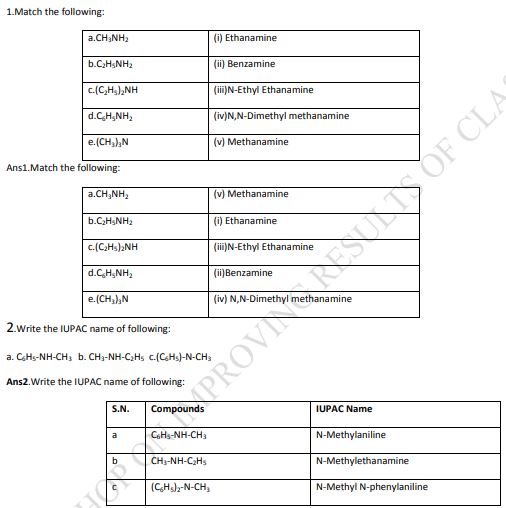
Question 1. Match the following:
| Column I | Column II |
|---|---|
| a.CH3NH2 | (i) Ethanamine |
| b.C2H5NH2 | (ii) Benzamine |
| c.(C2H5)2NH | (iii) N-Ethyl Ethanamine |
| d.C6H5NH2 | (iv) N,N-Dimethyl methanamine |
| e.(CH3)3N | (v) Methanamine |
Answer:
The correct matched pairs are:
| Column I | Matched IUPAC Name |
|---|---|
| a.CH3NH2 | (v) Methanamine |
| b.C2H5NH2 | (i) Ethanamine |
| c.(C2H5)2NH | (iii) N-Ethyl Ethanamine |
| d.C6H5NH2 | (ii) Benzamine |
| e.(CH3)3N | (iv) N,N-Dimethyl methanamine |
In simple words: This matching pairs molecular structures of amines with their systematic names based on the longest carbon chain and the attached alkyl substituents on nitrogen.
Exam Tip: Pay close attention to secondary and tertiary amines where prefixes like "N-alkyl" are utilized to designate substituents attached directly to the nitrogen atom.
Question 2. Write the IUPAC name of following:
a. C6H5-NH-CH3 b. CH3-NH-C2H5 c.(C6H5)2-N-CH3
Answer:
The IUPAC names of the given compounds are:
| S.N. | Compounds | IUPAC Name |
|---|---|---|
| a | C6H5-NH-CH3 | N-Methylaniline |
| b | CH3-NH-C2H5 | N-Methylethanamine |
| c | (C6H5)2-N-CH3 | N-Methyl N-phenylaniline |
In simple words: For secondary and tertiary amines, we name the longest carbon chain attached to nitrogen as the parent chain and other groups as N-alkyl substituents.
Exam Tip: Remember to list substituents alphabetically when multiple different groups are attached to the nitrogen atom in tertiary amines.
Question 3. The IUPAC name of (CH3)2-N-C2H5:
a) N,N-Diethylethanamine b) N,N-Dimethylethanamine
c) N,N-Ethylmethylmethanamine d) Dimethylmethanamine
Answer: (b) N,N-Dimethylethanamine
In simple words: The parent chain has two carbon atoms (ethane), and there are two methyl groups attached to the nitrogen atom, giving N,N-dimethylethanamine.
Exam Tip: Identify the longest alkyl group as the main chain (ethanamine) to avoid selecting wrong options like N,N-ethylmethylmethanamine.
Question 4. Choose the appropriate answer of the following:
a) IUPAC name of CH3-NH-CH3
(i) Ethylmethylamine (ii) Methylethylamine
(iii) N-Methylethanamine (iv) N-Ethylmethanamine
b) Common name of CH3CH2NH2 ?
(i) Ethylamine (ii) Ehanamine (iii)Dimethylamine (iv)None
C) IUPAC name of (C6H5)2NH ?
(i) Diphenylamine (ii) N-Phenylbenzenamine
(iii) 1,2-Diphenylamine (iv) All
d) Common name of (CH3)2CH-NH2
(i) Isopropylamine (ii) Ethaemethanamine
(iii) Methaneehaneamine (iv) 2-Methylethanamine
Answer:
a) (iii) N-Methylethanamine (Note: The formula contains a typographical error in the worksheet and should read CH3-NH-C2H5 instead of CH3-NH-CH3 to match the provided options).
b) (i) Ethylamine
C) (ii) N-Phenylbenzenamine
d) (i) Isopropylamine
In simple words: These questions cover both IUPAC and common nomenclature rules for primary, secondary, and tertiary amines. For IUPAC, secondary aromatic amines are named as N-substituted benzenamines.
Exam Tip: Be careful to distinguish between systematic IUPAC names and common names, as both are frequently tested together to create confusion.
Question 5. Arrange the following alkyl groups in decreasing order
Methyl,Ethyl,Isopropyl,n-Butyl
Answer: The decreasing order of +I (inductive) effect is:
Isopropyl > n-Butyl > Ethyl > Methyl
Alternatively, the decreasing order of steric hindrance near the nitrogen atom is:
Isopropyl > n-Butyl > Ethyl > Methyl
In simple words: Alkyl groups are arranged based on their electron-donating inductive effect. Isopropyl has the strongest +I effect among these, while methyl has the weakest.
Exam Tip: Inductive (+I) power of alkyl groups increases as branching and the total number of carbon atoms in the group increase.
Concept 2: Basic Character of Amines
Page 82
Question 1. Wtite the relation between Basicity of Amine & Pkb
Answer: The basicity of an amine is inversely proportional to its \( pK_b \) value. A lower \( pK_b \) value indicates a stronger basic character, whereas a higher \( pK_b \) value corresponds to a weaker basic character. \[ pK_b = -\log_{10} K_b \]
In simple words: Basicity and pKb are opposites. Stronger bases have lower pKb values, while weaker bases have higher pKb values.
Exam Tip: Clearly show the mathematical relation using \( K_b \) and \( pK_b \) to write a precise, full-mark answer.
Question 2. Arrange the following in decreasing order of Pkb values
C2H5NH2 , C6H5-NH-CH3 , (C2H5)2NH, C6H5NH2
Answer: The decreasing order of \( pK_b \) values is:
C6H5NH2 > C6H5-NH-CH3 > C2H5NH2 > (C2H5)2NH
This sequence goes from the weakest base (highest \( pK_b \)) to the strongest base (lowest \( pK_b \)).
In simple words: Aniline is the weakest base here, so it has the largest pKb. Diethylamine is the strongest base, so it has the lowest pKb.
Exam Tip: Keep in mind that aromatic amines are much weaker bases than aliphatic amines due to the resonance delocalization of nitrogen's lone pair into the benzene ring.
Question 3. Arrange the following Amines in increasing order of Basic character.
a. CH3NH2 , (CH3)2NH, .(CH3)3N in Aq.Solution & in Gaseous Phase
b. C2H5NH2 , (C2H5)2NH , (C2H5)3N in Aq.Solution
Answer:
a. For methyl-substituted amines:
- In Aqueous Solution: (CH3)3N < CH3NH2 < (CH3)2NH
- In Gaseous Phase: CH3NH2 < (CH3)2NH < (CH3)3N
b. For ethyl-substituted amines in Aqueous Solution:
- C2H5NH2 < (C2H5)3N < (C2H5)2NH
In simple words: In the gas phase, more alkyl groups make an amine stronger. In water, steric crowding and hydration stability make the secondary amine the strongest of all.
Exam Tip: Remember the basicity order of aliphatic amines in water: 2° > 1° > 3° for methyl groups and 2° > 3° > 1° for ethyl groups.
Question 4. Which one is more Basic & Why?
C6H5NH2 or C2H5NH2
Answer: Ethylamine (C2H5NH2) is significantly more basic than aniline (C6H5NH2).
Reason: In aniline, the unshared pair of electrons on the nitrogen atom is delocalized into the benzene ring via resonance, making it less available for protonation. In ethylamine, the +I effect of the ethyl group increases the electron density on the nitrogen atom, making its lone pair highly available for donation.
In simple words: Ethylamine is a stronger base because its nitrogen lone pair is free to be donated. In aniline, the benzene ring pulls the lone pair inwards, making it less available.
Exam Tip: Depicting the resonance structures of aniline to show electron delocalization will guarantee full marks.
Question 6. Name the factors affecting the Basicity of Amines in Aq.Solution & in Gaseous Phase .
Answer:
- In Gaseous Phase: The basicity is only governed by the Inductive effect (+I effect) of the alkyl groups.
- In Aqueous Solution: The basicity depends on a combined interplay of three factors:
1. Inductive effect (+I effect)
2. Solvation effect (stabilization of the conjugate acid through hydrogen bonding with water)
3. Steric hindrance of the alkyl groups
In simple words: In gas, only the electron-pushing power of groups matters. In water, how well water can surround the molecules and how crowded the nitrogen is also play major roles.
Exam Tip: When explaining aqueous basicity, you must detail all three factors to present a complete and correct explanation.
Question 7. Match the following .
| Column (I) Amines | Column (II) Pkb Values |
|---|---|
| Methanamine | 3.27 |
| N-Methylmethanamine | 3.29 |
| N,N-Dimethylmethanamine | 3.38 |
| Ethanamine | 4.22 |
| Benzamine | 9.38 |
Answer:
The correct matched pairs are:
| Column (I) Amines | Column (II) \( pK_b \) Values |
|---|---|
| Methanamine | 3.38 |
| N-Methylmethanamine | 3.27 |
| N,N-Dimethylmethanamine | 4.22 |
| Ethanamine | 3.29 |
| Benzamine | 9.38 |
In simple words: This matching aligns each amine with its standard pKb value. Secondary aliphatic amines are the most basic and have the lowest pKb values, while aromatic amines are the least basic with the highest pKb values.
Exam Tip: Remember that a stronger base will always correspond to a smaller \( pK_b \) value.
Concept-3: Boiling Point of Amines
Question (i). Write the Factors Affecting the Boiling Point of Amines
Answer:
1. Intermolecular Hydrogen Bonding: Primary and secondary amines can form intermolecular hydrogen bonds due to polar N-H bonds, whereas tertiary amines cannot. This substantially increases the boiling points of 1° and 2° amines.
2. Molecular Mass: Boiling points increase with an increase in molecular mass because the larger size enhances the van der Waals dispersion forces.
3. Branching: Increased branching in isomeric amines reduces their surface area, leading to weaker van der Waals forces and lower boiling points.
In simple words: Boiling point is determined by how well molecules attract each other. Stronger attractions like hydrogen bonding and larger molecular weights lead to higher boiling points.
Exam Tip: Always describe both polar hydrogen bonding and non-polar van der Waals forces when discussing boiling point trends.
Question (ii). Why is Primary Amine have higher Boiling Point than that Sec & Tert-Amines ?
Answer: Primary amines have two hydrogen atoms directly bonded to nitrogen, which enables them to form an extensive intermolecular hydrogen bond network. Secondary amines have only one N-H bond, which leads to fewer hydrogen bonding interactions. Tertiary amines have no hydrogen atoms attached to nitrogen and cannot form intermolecular hydrogen bonds. Consequently, primary amines require more thermal energy to break the molecular network, resulting in higher boiling points than isomeric secondary and tertiary amines.
In simple words: Primary amines have more hydrogen atoms on their nitrogen. This allows them to stick to each other very tightly via hydrogen bonds, making them harder to separate by heating.
Exam Tip: Mention the specific number of hydrogen atoms available on the nitrogen atom in each class of amine to secure full marks.
Question (iii). Arrange the following Amines in decreasing order of B.P. 1O , 2O , 3O
Answer: The decreasing order of boiling points is:
Primary Amine (1°) > Secondary Amine (2°) > Tertiary Amine (3°)
In simple words: Primary amines have the highest boiling points, followed by secondary amines, and tertiary amines have the lowest boiling points.
Exam Tip: This basic trend represents one of the most frequently asked comparison questions in physical property worksheets.
Page 83
Question 4. Match the following
| Compounds (I) | Boiling point(K) (II) |
|---|---|
| (I)C4H9NH2 | 390.3 |
| (II)(C2H5)2NH | 300.8 |
| (III)C2H5N(CH3)2 | 310.5 |
| (IV)C2H5CH(CH3)2 | 329.3 |
| (V) C4H9OH | 350.8 |
Answer:
The correct matched pairs are:
| Compounds (I) | Matched Boiling point (K) |
|---|---|
| (I) C4H9NH2 | 350.8 |
| (II) (C2H5)2NH | 329.3 |
| (III) C2H5N(CH3)2 | 310.5 |
| (IV) C2H5CH(CH3)2 | 300.8 |
| (V) C4H9OH | 390.3 |
In simple words: Alcohols have the highest boiling points due to strong O-H bonds. Primary amines come next, followed by secondary and tertiary amines, while non-polar alkanes have the lowest boiling points because they only have weak van der Waals forces.
Exam Tip: Alcohols exhibit much stronger intermolecular hydrogen bonding than amines of comparable mass because oxygen is more electronegative than nitrogen.
Question 5. Why are alcohols have higher B.P than that of amines of comparable molecular mass ?
Answer: Oxygen has a higher electronegativity than nitrogen, which makes the polar O-H bond in alcohols significantly more polar than the N-H bond in amines. Consequently, intermolecular hydrogen bonding is much stronger and more extensive in alcohols than in amines of comparable molecular mass, requiring more energy to break.
In simple words: Oxygen is more electronegative than nitrogen, so the hydrogen bonds in alcohols are much tighter and harder to break than those in amines.
Exam Tip: Quote the electronegativity values (Oxygen = 3.5, Nitrogen = 3.0) to make your comparative explanation precise.
Concept-2: To Distinguish Between Pri, Sec & Tert -Amines
Question 1. Distinguish between the (a) CH3NH2 and (CH3)2NH (b) Aniline & N-Methyl Aniline (c) Sec- Amine & Tert-Amine
Answer:
(a) CH3NH2 and (CH3)2NH:
- **Carbylamine Test:** Primary amine (CH3NH2) when heated with chloroform and alcoholic KOH produces a highly foul-smelling methyl isocyanide, while secondary amine ((CH3)2NH) does not respond to this test.
- **Hinsberg's Test:** CH3NH2 reacts with benzene sulphonyl chloride to form a precipitate soluble in aqueous KOH. (CH3)2NH reacts to form a precipitate insoluble in KOH.
(b) Aniline & N-Methyl Aniline:
- **Azo-Dye Test:** Aniline (primary aromatic amine) undergoing diazotisation with HNO2 at 273 - 278 K couples with phenol to form an orange-red dye. N-Methyl Aniline (secondary amine) does not form azo dyes.
- **Carbylamine Test:** Aniline gives a positive carbylamine test with a foul smell, whereas N-methyl aniline does not.
(c) Sec- Amine & Tert-Amine:
- **Hinsberg's Test:** Secondary amines react with benzene sulphonyl chloride to form a precipitate insoluble in alkali, while tertiary amines do not react at all.
- **Nitrous Acid Test:** Secondary amines form yellow oily nitrosamines on reaction with nitrous acid, whereas tertiary amines dissolve in it to form soluble nitrite salts.
In simple words: Primary amines form a terrible smell in the Carbylamine test, while secondary and tertiary amines are distinguished using Hinsberg's reagent.
Exam Tip: Hinsberg's test is the standard method used to differentiate all three classes of amines chemically.
Concept-3: Name Reactions
Question. (i)_ Carbyl amine reaction (ii) Sandmayer reaction (iii) Gatterman reaction
Answer:
(i) Carbylamine reaction: Aliphatic or aromatic primary amines, when heated with chloroform and ethanolic potassium hydroxide, yield highly offensive-smelling isocyanides (carbylamines). \[ \text{R-NH}_2 + \text{CHCl}_3 + 3\text{KOH} \xrightarrow{\Delta} \text{R-NC} + 3\text{KCl} + 3\text{H}_2\text{O} \] (ii) Sandmeyer reaction: Freshly prepared benzenediazonium salt is treated with cuprous chloride, cuprous bromide, or cuprous cyanide, replacing the diazonium group with chlorine, bromine, or a cyano group respectively. \[ \text{C}_6\text{H}_5\text{N}_2^+\text{Cl}^- \xrightarrow{\text{Cu}_2\text{Cl}_2 / \text{HCl}} \text{C}_6\text{H}_5\text{Cl} + \text{N}_2 \] (iii) Gattermann reaction: A modification of the Sandmeyer reaction where the diazonium group is replaced by treating the benzenediazonium salt with metallic copper powder in the presence of hydrochloric or hydrobromic acid. \[ \text{C}_6\text{H}_5\text{N}_2^+\text{Cl}^- \xrightarrow{\text{Cu / HCl}} \text{C}_6\text{H}_5\text{Cl} + \text{N}_2 + \text{CuCl} \]
In simple words: Carbylamine reaction is a test for primary amines using chloroform. Sandmeyer and Gattermann reactions both convert diazonium salts into chlorobenzene or bromobenzene, but they use different copper sources.
Exam Tip: Note that the Sandmeyer reaction generally yields better results than the Gattermann reaction, which is why it is preferred for preparing haloarenes.
Free study material for Chemistry
Download Class 12 Chemistry Iupac Nomenclature Practice Worksheets
Download Chapter Worksheets: Class 12 Chemistry
Review targeted practice exercises for Class 12 Chemistry Iupac Nomenclature. Curated to match official CBSE guidelines, these printable problem sets support daily revision and improve overall test readiness.
Concept Clarification for Iupac Nomenclature
Each worksheet draws directly from authorized standard textbooks to maintain academic accuracy. Evaluating your finished exercises against expert-verified solutions helps master the formal presentation standards expected in school evaluations.
Effective Revision Strategies for School Exams
Wrap up your chapter revision by testing your knowledge against standard objective question formats. Explore our full library of free, up-to-date printable assignments to maximize your academic results in upcoming CBSE evaluations.
FAQs
You can download the latest chapter-wise printable worksheets for Class 12 Chemistry Iupac Nomenclature for free from StudiesToday.com. These have been made as per the latest CBSE curriculum for this academic year.
Yes, Class 12 Chemistry worksheets for Iupac Nomenclature focus on activity-based learning and also competency-style questions. This helps students to apply theoretical knowledge to practical scenarios.
Yes, we have provided solved worksheets for Class 12 Chemistry Iupac Nomenclature to help students verify their answers instantly.
Yes, our Class 12 Chemistry test sheets are mobile-friendly PDFs and can be printed by teachers for classroom.
For Iupac Nomenclature, regular practice with our worksheets will improve question-handling speed and help students understand all technical terms and diagrams.