

Chapter-wise Worksheets for Class 12 Chemistry: Unit 9 Amines
Review targeted academic worksheets with the CBSE Class 12 Chemistry Organic Chemistry Amines Worksheet. Built according to official educational standards for the 2026-27 term, these downloadable Class 12 Chemistry resources support effective daily practice and detailed self-evaluation for Unit 9 Amines.
Practice Class 12 Chemistry Worksheets: Unit 9 Amines
Navigate directly to the solved Chemistry worksheets using the digital viewer below. Each practice set includes detailed step-by-step solutions, allowing students to instantly cross-check their work and identify areas requiring further revision.
Question. What is the correct IUPAC name of H2N-(CH2)5-NH2?
a. Pentan-1,5-diamine
b. 1,5-Diaminopentane
c. Pentamethylenediamine
d. Pentane-1,5-diamine
Answer. D
Question. Which of the following does not react with Hinsberg reagent?
a. C2H5NH2
b. (CH3)2NH
c. (CH3)3N
d. CH3 CH(NH2)CH3
Answer. C
Question. Which of the following amines are insoluble in water?
a. Methanamine
b. Ethanamine
c. Propanamine
d. Benzenamine
Answer. D
Question. In this reaction acetamide is converted to methanamine
a. Gabriel phthalimide synthesis
b. Carbylamine reaction
c. Stephen’s reaction
d. Hoffmann bromamide reaction
Answer. A
Question. Which of the following is not a final product of the reaction between propylamine and nitrous acid?
a. CH3CH2CH2N2Cl
b. CH3CH2CH2OH
c. N2 gas
d. HCI
Answer. A
Question. Hinsberg’s reagent is
a. Benzenesulphonic acid
b. Benzenesulphonyl chloride
c. p-toluenesulphonyl chloride
d. Chlorosulphuric acid
Answer. B
Question. Starting from propanoic acid, the following reactions were carried out, what is the compound Z?
a. CH3-CH2−Br
b. CH3-CH2−NH2
c. CH3-CH2-COBr
d. CH3−CH2−CH2−NH2
Answer. A
Question. Aniline in a set of reactions yielded a product D. The structure of D would be
a. C6H5CH2OH
b. C6H5CH2NH2
c. C6H5NHOH
d. C6H5NHCH2CH3.
Answer. A
Question. The hybridisation state of N of R2NH
a. sp3
b. sp2
c. sp
d. dsp2
Answer. A
ASSERTION -REASON TYPE QUESTIONS
Choose the correct answer from the following choices
a Both assertion and reason are correct statements and reason is correct explanation of assertion
b Both assertion and reason are correct statements but reason is not correct explanation of assertion
c Assertion is correct statement but reason is wrong statement
d Assertion is wrong statement but reason is correct statement
Question. Assertion: Alkylation of amines gives polysubstituted product where as acylation of amines gives a monosubstituted product
Reason: Steric hindrance of an acyl group prevents the approach of further acyl groups.
Answer. C
Question. Assertion: Anilinium chloride is more acidic than ammonium chloride
Reason: Anilinium ion is resonance stabilized.
Answer. C
Question. Assertion: Gabriel phthalimide reaction can be used to prepare aryl and alkyl amines
Reason: Aryl halides have same reactivity as alkyl halides towards nucleophilic substitution reactions.
Answer. D
Question. Assertion: Aniline does not undergo Friedel -Crafts reaction
Reason: Friedel-Crafts reaction is electrophilic substitution reaction
Answer. B
Question. Assertion: CuCl2 gives a deep blue colored solution with ethyl amine
Reason: Ethylamine molecules coordinate with cupric ions forming a blue coloured complex.
Answer. A
Question. Assertion: The order of boiling points of isomeric amines is Primary>Secondary>Tertiary
Reason: Intermolecular association is more in primary ,then in secondary and least in tertiary amines.
Answer. A
Question. Assertion: Aliphatic amines are weaker base than ammonia
Reason:+I effect of alkyl group results in high electron density on nitrogen atom.
Answer. D
Question. Assertion: Pkb value of aniline is low,
Reason: The unshared pair on nitrogen atom to be in conjugation with the benzene ring making it less available
Answer. D
Question. Write the structure of N-methylethanamine.
Answer. CH3CH2NHCH3(N-methylethanamine)
Question. Give the IUPAC name of
H2N — CH2 — CH2 — CH = CH2.
Answer. But-3-en-1-amine
Question. Give reasons for the following :
Primary amines have higher boiling point than tertiary amines.
Answer. Primary amines (R – NH2) have two hydrogen atoms on nitrogen which can undergo intermolecular hydrogen bonding whereas no such hydrogen bonding is present in tertiary amines (R3N). So, primary amines boil at a higher temperature than tertiary amines.
Question. Arrange the following in the increasing order of their boiling point :
C2H5NH2, C2H5OH, (CH3)3N
Answer. Increasing order of boiling points :
(CH3)3N < C2H5NH2 < C2H5OH
Tertiary amine does not have hydrogen to form hydrogen bonding and hydrogen bonding in alcohol is stronger than that of amines because oxygen is more electronegative than nitrogen.
Question. Account for the following :
Ethylamine is soluble in water whereas aniline is not.
Answer. Ethylamine is soluble in water due to formation of intermolecular hydrogen bonds with water molecules. However, in aniline due to large hydrophobic aryl group the extent of hydrogen bonding decreases considerably and hence aniline is insoluble in water.
Question. Account for the following :
Nitro compounds have higher boiling points than the hydrocarbons having almost the same molecular mass.
Answer. The nitro compounds are highly polar molecules. Due to this polarity they have strong intermolecular dipole – dipole interactions which causes them to have higher boiling points in comparison to the hydrocarbons having almost same molecular mass.
Question. Give a simple chemical test to distinguish between the following pair of compounds :
(CH3)2NH and (CH3)3N
Answer. When treated with benzenesulphonyl chloride (Hinsberg’s reagent), (CH3)2NH forms insoluble N, N-dialkylbenzene sulphonamide which is insoluble in KOH whereas tertiary amine does not react at all.
Question. Arrange the following compounds in increasing order of solubility in water :
C6H5NH2, (C2H5)2NH, C2H5NH2
Answer. C6H5NH2 < (C2H5)2NH < C2H5NH2 1° amines are more soluble in water than 2° amines.
Aniline due to large hydrophobic benzene ring is least soluble.
Question. Arrange the following in the decreasing order of their basic strength in aqueous solutions :
CH3NH2, (CH3)2NH, (CH3)3N and NH3
Answer. (CH3)2NH > CH3NH2 > (CH3)3N > NH3
Question. Arrange the following in increasing order of basic strength :
C6H5NH2, C6H5NHCH3, C6H5CH2NH2
Answer. C6H5NH2 < C6H5NHCH3 < C6H5CH2NH2 C6H5NH2 and C6H5NHCH3 are less basic than aliphatic amine C6H5CH2NH2 due to lone pair of nitrogen is in conjugation with benzene ring. But due to +I effect of —CH3 group in C6H5NHCH3, it is more basic than C6H5NH2.
Question. Why cannot primary aromatic amines be prepared by Gabriel phthalimide synthesis?
Answer. Aromatic amines cannot be prepared by Gabriel phthalimide synthesis because aryl halides do not undergo nucleophilic substitution with the anion formed by phthalimide.
Question. Write the chemical equation involved in the following reaction :
Hofmann bromamide degradation reaction
Answer. R — CONH2 + Br2 + 4NaOH →
Acid amide
R — NH2 + Na2CO3 + 2 NaBr + 2H2O
1° amine
Question. Give the chemical tests to distinguish between the following pairs of compounds :
(i) Methylamine and dimethylamine
(ii) Aniline and N-methylaniline
Answer. (i) Methyl amine gives carbylamine test, i.e., on treatment with alc. KOH and chloroform, followed by heating it gives offensive odour of methyl isocyanide. Dimethyl amine does not give this test.
(ii) Aniline gives carbylamine test, i.e., on treatment with alc. KOH and chloroform followed by heating it gives offensive odour of phenylisocyanide but N-methylaniline being secondary amine, does not show this test.
CASE BASED QUESTIONS
1 The basicity of amines of different classes do not follow a simple pattern because the number of groups bonded to nitrogen affects the electron density at the nitrogen atom. And, the stability of the conjugate acid in the solvent has a major effect on basicity. Thus, the basicity of amines can be explained only for amines with similar structures at the nitrogen atoms.
The basicity of an amine is increased by electron-donating groups and decreased by electron- withdrawing groups. Aryl amines are less basic than alkyl-substituted amines because some electron density provided by the nitrogen atom is distributed throughout the aromatic ring. Basicity is expressed using Kb values measured from the reaction of the amine with water. An alternate indicator of basicity is pKb, which is −log Kb. A strong base has a large Kb and a small pKb. The basicity of amines is also expressed by the acidity of their conjugate acids. A strong base has a weak conjugate acid, as given by a small value of Ka and a large pKa.
Question. pKb values for NH3 , CH3NH2,(CH3)2NH and (CH3)3N has 4.75,3.38,3.27 and 4.22 respectively.
Write them in the decreasing order of basic strength. Usually the order of basicity of amines will be different from the expected order.
Answer. (CH3)2NH> CH3NH2>(CH3)3N>NH3
Question. Which are the three main factors affecting basicity of amines?
Answer. +I effect ,extent of hydrogen bonding with water molecules and steric effects of the alkyl group
Question.Write the decreasing order of basicity for CH3CH2NH2,(CH3CH2)2NH and (CH3CH2)3N
Answer. (CH3CH2)2NH>(CH3CH2)3N> CH3CH2NH2>NH3
Question. Compare the basicity of m-toluidine and Aniline.
Answer. m-Toluidine is more basic than aniline due to +I effect from meta position
SHORT ANSWER TYPE QUESTIONS:
Question. Write the chemical equations involved when C2H5NH2 is treated with
(1) CH3COCl/Pyridine (2) CHCl3+KOH.
Answer. (1) C2H5NH2+ CH3COCl/Pyridine → CH3CONHC2H5
(2) C2H5NH2+ CHCl3+3KOH(Alcoholic) →C2H5NC+3KCl+3H2O
Question. How will you convert (1)Aniline to Bromobenzene(2)Aniline to Benzene?
NaNO2/HCl/50C CuBr/HBr
Answer. (1) C6H5NH2 → C6H5N2Cl → C6H5Br
(2) NaNO2/HCl/50C H3PO2/H2O
(1) C6H5NH2 → C6H5N2Cl → C6H6
Question. pKb of aniline is more than that of methylamine. Why?
Answer. Aniline is a weaker base than methylamine since lone pair on N is not available for donation since it is involved in conjugation with pi electrons of benzene ring.
Question. Ethylamine is soluble in water whereas aniline is not. Why?
Answer. Ethylamine can form hydrogen bonding with water while aniline can not due bulky phenyl group.
Question. Give one chemical test to distinguish between the following pairs of compounds
(1) Methylamine and Dimethylamine
(2)Aniline and benzylamine
Answer. (1) Methylamine on reaction with chloroform and alcoholic KOH gives foul smelling methyl isocynide while dimethylamine does not.
(2) Aniline on treatment with nitrous acid forms Benzene diazonium chloride which on coupling with phenol forms orange dye while benzylamine does not.
Question. Give a simple chemical test to distinguish between the following pair of compounds:
(CH3)2NH and (CH3)3N
Answer. When treated with benzenesulphonyl chloride (Hinsberg’s reagent), (CH3)2NH forms insoluble N, N-dialkylbenzene sulphonamide which is insoluble in KOH whereas tertiary amine does not react at all.
Question. Why do amines act as nucleophiles?
Answer. Because the electron pair of nitrogen can coordinate with the electron deficient electrophiles
Question. Give reasons for the following:
(i) Aniline does not undergo Friedel-Crafts reaction.
(ii) (CH3)2NH is more basic than (CH3)3N in an aqueous solution.
Answer. (i) In Friedel - Crafts reaction, AlCl3 is added as a catalyst which is a Lewis acid. It forms a salt with aniline due to which the nitrogen of aniline acquires positive charge. This positively charged nitrogen acts as a strong deactivating group, hence aniline does not undergo Friedel - Crafts reaction.
(ii) In aqueous solution 2° amine is more basic than 3° amine due to the combination of inductive effect, solvation effect and steric reasons.

Nomenclature of Organic Compound
Question. Write the structure of N-methylethanamine.
Answer. Structure of N-methylethanamine : H3C—H2C—NH—CH3
Question. Write the IUPAC name of the following compound:
(CH3)2N-CH2CH3
Answer. IUPAC name: N,N-Dimethylethanamine
Question. Write the IUPAC name of the following compound:
CH3NHCH(CH3)2
Answer. IUPAC name: N-Methylpropan-2-amine
Question. Give the IUPAC name of H2N — CH2—CH2—CH = CH2.
Answer. IUPAC name : But-3-ene-1-amine
Question. Write the structure of prop-2-en-1-amine.
Answer. H2C=CH—H2C—NH2
Question. Write the structure of n-methylethanamine.
Answer. Structure of n-methylethanamine :- H3C—H2C—NH—CH2
Question. Arrange the following in increasing order of basic strength :
C6H5NH2, C6H5NHCH3, C6H5CH2NH2
Answer. C6H5NH2 < C6H5NHCH3 < C6H5CH2NH2
Question. Why is an alkylamine more basic than ammonia?
Answer. Due to electron releasing inductive effect (+I) of alkyl group, the electron density on the nitrogen atom increases and thus, it can donate the lone pair of electrons more easily than ammonia.
Question. Arrange the following compounds in increasing order of solubility in water :
C6H5NH2, (C2H5)2NH, C2H5NH2
Answer. C6H5NH2 < (C2H5)2NH <C2H5NH,
Question. Write IUPAC name of the following compound:
Answer. N-Ethyl-N-methylethanamine
Question. Give the IUPAC name of H2N — CH2—CH2—CH = CH2.
Answer. IUPAC name : But-3-ene-1-amine
Question. State reasons for the following :
(i) pKb value for aniline is more than that for methylamine.
(ii) Ethylamine is soluble in water whereas aniline is not soluble in water.
(iii) Primary amines have higher boiling points than tertiary amines.
Answer. (i) Higher the pKb value, lower will be the basicity therefore aniline is less basic than methylamine because the lone pair of electrons on nitrogen atom gets delocalized over the benzene ring are unavailable for protonation due to resonance in aniline which is absent in case of alkylamine.
(ii) Ethylamine is soluble in water due to its capability to form H-bonds with water while aniline is insoluble in water due to larger hydrocarbon part which tends to retard the formation of H-bonds.
(iii) Due to presence of two H-atoms on N-atom of primary amines, they undergo extensive intermolecular H-bonding while tertiary amines due to the absence of a H-atom on the N-atom, do not undergo H- bonding. As a result, primary amines have higher boiling points than 3° amines.
Assignment - Class XII Organic Chemistry
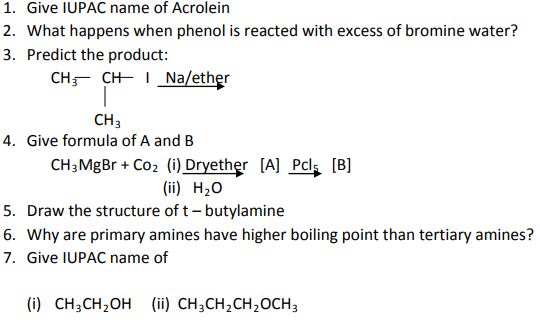
Question 1. Give IUPAC name of Acrolein
Answer: The chemical structure of acrolein is \( \text{CH}_2=\text{CH}-\text{CHO} \). Its systematic IUPAC name is prop-2-enal.
In simple words: Acrolein is a simple aldehyde with a double bond. Its official chemical name is prop-2-enal.
Exam Tip: Always number the carbon chain starting from the aldehyde carbon, as the carbonyl group takes higher priority over the carbon-carbon double bond.
Question 2. What happens when phenol is reacted with excess of bromine water?
Answer: Phenol undergoes rapid electrophilic substitution when treated with excess bromine water, resulting in the formation of a white precipitate of 2,4,6-tribromophenol.
The chemical equation is:
\[ \text{C}_6\text{H}_5\text{OH} + 3\text{Br}_2 \xrightarrow{\text{H}_2\text{O}} \text{C}_6\text{H}_2(\text{Br})_3\text{OH} \downarrow + 3\text{HBr} \]
In simple words: When you mix phenol with a lot of bromine water, it quickly reacts to form a white solid called 2,4,6-tribromophenol.
Exam Tip: Be sure to write the physical state (white precipitate) of the product, as examiners look for this key observation in the answer.
Question 3. Predict the product:
\( \text{CH}_3-\text{CH}-\text{I} \xrightarrow{\text{Na/ether}} \)
|
\( \text{CH}_3 \) Answer: This reaction is a Wurtz coupling of 2-iodopropane (isopropyl iodide). Two molecules of 2-iodopropane react with sodium metal in the presence of dry ether to yield 2,3-dimethylbutane as the primary product.
The chemical equation is:
\[ 2(\text{CH}_3)_2\text{CH-I} + 2\text{Na} \xrightarrow{\text{dry ether}} (\text{CH}_3)_2\text{CH}-\text{CH}(\text{CH}_3)_2 + 2\text{NaI} \]
In simple words: Two isopropyl iodide molecules join together when they react with sodium in ether, making a branched alkane called 2,3-dimethylbutane.
Exam Tip: The Wurtz reaction of secondary alkyl halides can also produce alkenes as by-products due to disproportionation, but the coupled alkane remains the principal product to write down.
Question 4. Give formula of A and B
CH3MgBr + Co2 (i) Dryether [A] Pcl5 [B]
(ii) H2O
Answer: Methyl magnesium bromide reacts with carbon dioxide to form an adduct which, upon acidic hydrolysis, yields ethanoic acid (acetic acid) as compound [A]. Ethanoic acid then reacts with phosphorus pentachloride (\( \text{PCl}_5 \)) to produce acetyl chloride (ethanoyl chloride) as compound [B].
* Formula of [A]: \( \text{CH}_3\text{COOH} \) (Ethanoic acid)
* Formula of [B]: \( \text{CH}_3\text{COCl} \) (Ethanoyl chloride)
In simple words: The Grignard reagent reacts with CO2 to give vinegar-like acetic acid [A], which then turns into acetyl chloride [B] when mixed with PCl5.
Exam Tip: Grignard reagents are extremely useful for increasing the carbon chain length by one carbon when reacted with dry ice (\( \text{CO}_2 \)).
Question 5. Draw the structure of t – butylamine
Answer: The systematic name of t-butylamine is 2-methylpropan-2-amine. It contains a central tertiary carbon atom bonded to three methyl groups and one primary amino group.
The structural formula is:
\( \text{CH}_3 \)
|
\( \text{CH}_3-\text{C}-\text{NH}_2 \)
|
\( \text{CH}_3 \)
Alternatively represented as: \( (\text{CH}_3)_3\text{C}-\text{NH}_2 \)
In simple words: The central carbon has three methyl groups and one NH2 group attached to it.
Exam Tip: Do not confuse t-butylamine with a tertiary amine; it is a primary amine because the nitrogen atom is bonded directly to only one carbon atom.
Question 6. Why are primary amines have higher boiling point than tertiary amines?
Answer: Primary amines contain two hydrogen atoms directly bonded to the highly electronegative nitrogen atom (\( -\text{NH}_2 \)), enabling them to form strong intermolecular hydrogen bonds with each other. In contrast, tertiary amines have no hydrogen atoms directly attached to the nitrogen atom (\( -\text{NR}_3 \)) and cannot form these intermolecular hydrogen bonds. Consequently, more thermal energy is required to separate the molecules of a primary amine, giving it a higher boiling point than a tertiary amine of comparable molecular mass.
In simple words: Primary amines can form hydrogen bonds with one another because they have hydrogen on their nitrogen. Tertiary amines cannot do this, so they boil at lower temperatures.
Exam Tip: Use the keyword "intermolecular hydrogen bonding" to secure full marks in any boiling point comparison question involving amines or alcohols.
Question 7. Give IUPAC name of
(i) CH3CH2OH (ii) CH3CH2CH2OCH3
Answer:
(i) The IUPAC name of \( \text{CH}_3\text{CH}_2\text{OH} \) is Ethanol.
(ii) The IUPAC name of \( \text{CH}_3\text{CH}_2\text{CH}_2\text{OCH}_3 \) is 1-Methoxypropane.
In simple words: The first compound is ethanol (common alcohol), and the second is an ether called 1-methoxypropane.
Exam Tip: For ethers, identify the smaller alkyl group as the "alkoxy" substituent (methoxy) and the larger alkyl group as the parent alkane chain (propane).
Question 8. Explain why: Alkyl halides though polar, are immiscible with water.
Answer: Although alkyl halides are polar molecules, they cannot form hydrogen bonds with water molecules. To dissolve in water, the solute must release enough energy to break the strong hydrogen bonds already existing between water molecules. The dipole-dipole attractions formed between alkyl halides and water are much weaker than these water-water hydrogen bonds. Because the energy released is insufficient to disrupt the hydrogen bonds of water, alkyl halides remain immiscible with water.
In simple words: Even though alkyl halides are polar, they cannot form hydrogen bonds with water. Water molecules prefer to stick to each other, so the two liquids do not mix.
Exam Tip: In solubility reasoning questions, always compare the strength of the solute-solvent interactions with the solvent-solvent hydrogen bonds.
Question 9. The treatment f alkyl chlorides with aqueous KOH leads to the formation of alcohols but in presence of alcoholic KOH, alkenes are major products. Explain.
Answer: Aqueous potassium hydroxide (\( \text{KOH} \)) dissociates completely to provide hydroxide ions (\( \text{OH}^- \)), which are highly hydrated in water. These solvated ions behave as strong nucleophiles and favor substitution reactions (\( \text{S}_\text{N}2 \) or \( \text{S}_\text{N}1 \)), replacing the chlorine atom to form alcohols. In contrast, alcoholic KOH contains alkoxide ions (\( \text{RO}^- \)), which are much stronger bases than hydrated hydroxide ions. These strong bases prefer to abstract a proton from the \( \beta \)-carbon atom rather than acting as nucleophiles, thus driving a dehydrohalogenation (elimination) reaction to produce alkenes as the major product.
In simple words: Water makes the hydroxide ion act like a nucleophile, which swaps places with chlorine to make an alcohol. Alcohol makes the hydroxide act like a strong base, which removes a hydrogen to make a double-bonded alkene.
Exam Tip: Clearly distinguish between the nucleophilic nature of aqueous KOH and the basic (eliminating) nature of alcoholic KOH in your explanations.
Question 10. (i) Out of Br and I ions, which is better nucleophile & why?
(ii) Which will have a higher boiling point I – Chloropentane or 2-chloro-2-Methybutane? Justify your answer.
Answer:
(i) The iodide ion (\( \text{I}^- \)) is a better nucleophile than the bromide ion (\( \text{Br}^- \)). Due to its larger ionic radius, the outer electron cloud of the iodide ion is highly polarizable and less tightly held by the nucleus, allowing it to donate its electron pair to a electrophilic carbon atom more readily.
(ii) 1-Chloropentane (I-chloropentane) will have a higher boiling point than 2-chloro-2-methylbutane. 1-Chloropentane is a straight-chain molecule, whereas 2-chloro-2-methylbutane is highly branched. Branching makes the molecule spherical, which decreases its surface area. This reduction in surface area weakens the intermolecular van der Waals dispersion forces, making it easier to boil.
In simple words: (i) Iodide is larger and can easily share its electrons, making it a better nucleophile. (ii) Straight-chain 1-chloropentane has a larger surface area than the branched isomer, so it has stronger attractions holding its molecules together, leading to a higher boiling point.
Exam Tip: Remember that for isomeric haloalkanes, the boiling point decreases as branching increases due to the reduction in surface area and van der Waals forces.
Question 11. In separating a mixture of ortho and para nitrophenols by steam distillation, name the isomer which is steam volatile. Give reason.
Answer: Ortho-nitrophenol is the steam volatile isomer.
Reason: Ortho-nitrophenol exhibits intramolecular hydrogen bonding (bonding within the same molecule) because the \( -\text{OH} \) and \( -\text{NO}_2 \) groups are close to each other. This prevents it from forming bonds with neighboring molecules. Para-nitrophenol, on the other hand, exhibits intermolecular hydrogen bonding (bonding between different molecules), causing its molecules to associate strongly. Consequently, ortho-nitrophenol has a lower boiling point and easily vaporizes during steam distillation.
In simple words: Ortho-nitrophenol has internal hydrogen bonds, while para-nitrophenol links up with neighboring molecules. This makes ortho-nitrophenol turn into steam much more easily.
Exam Tip: Draw the structures showing intramolecular hydrogen bonding in ortho-nitrophenol and intermolecular hydrogen bonding in para-nitrophenol to secure full marks.
Question 12. Write the names of reagents and equations for the synthesis of given ethers by Williaman’s synthesis:
(i) I - Methoxyethane (ii) I - propoxypropane
Answer: Williamson's ether synthesis involves the \( \text{S}_\text{N}2 \) attack of a sodium alkoxide on a primary alkyl halide. To avoid elimination, the less hindered alkyl group should be chosen as the alkyl halide.
(i) Synthesis of 1-Methoxyethane (\( \text{CH}_3\text{OCH}_2\text{CH}_3 \)):
* Reagents: Sodium ethoxide and chloromethane (or iodomethane).
* Equation:
\[ \text{CH}_3\text{CH}_2\text{ONa} + \text{CH}_3\text{Cl} \rightarrow \text{CH}_3\text{CH}_2\text{OCH}_3 + \text{NaCl} \]
(ii) Synthesis of 1-Propoxypropane (\( \text{CH}_3\text{CH}_2\text{CH}_2\text{OCH}_2\text{CH}_2\text{CH}_3 \)):
* Reagents: Sodium propoxide and 1-chloropropane (or 1-iodopropane).
* Equation:
\[ \text{CH}_3\text{CH}_2\text{CH}_2\text{ONa} + \text{CH}_3\text{CH}_2\text{CH}_2\text{Cl} \rightarrow \text{CH}_3\text{CH}_2\text{CH}_2\text{OCH}_2\text{CH}_2\text{CH}_3 + \text{NaCl} \]
In simple words: This synthesis is done by reacting a sodium alkoxide salt with a primary alkyl halide. The two parts link up to form the ether, releasing salt as a byproduct.
Exam Tip: Always choose the primary alkyl group for the alkyl halide reactant, as secondary or tertiary alkyl halides will undergo elimination instead of substitution.
Question 13. Write the equation for the reaction of HI with:
(i) Benzl ethyl ether (ii) Methoxybenzene
Answer:
(i) Reaction of Benzyl ethyl ether (\( \text{C}_6\text{H}_5\text{CH}_2\text{OCH}_2\text{CH}_3 \)) with HI:
This reaction proceeds via an \( \text{S}_\text{N}1 \) mechanism because the benzyl carbocation (\( \text{C}_6\text{H}_5\text{CH}_2^+ \)) is highly stable due to resonance. Thus, the iodide ion attacks the benzyl group, yielding benzyl iodide and ethanol.
Equation:
\[ \text{C}_6\text{H}_5\text{CH}_2\text{OCH}_2\text{CH}_3 + \text{HI} \rightarrow \text{C}_6\text{H}_5\text{CH}_2\text{I} + \text{CH}_3\text{CH}_2\text{OH} \]
(ii) Reaction of Methoxybenzene (\( \text{C}_6\text{H}_5\text{OCH}_3 \)) with HI:
The \( \text{C}_\text{sp2}-\text{O} \) bond of the phenoxy group has partial double bond character due to resonance and is extremely strong. Therefore, protonation is followed by an \( \text{S}_\text{N}2 \) nucleophilic attack of the iodide ion on the smaller methyl group, yielding phenol and methyl iodide.
Equation:
\[ \text{C}_6\text{H}_5\text{OCH}_3 + \text{HI} \rightarrow \text{C}_6\text{H}_5\text{OH} + \text{CH}_3\text{I} \]
In simple words: (i) Benzyl ethyl ether splits to form stable benzyl iodide and ethanol. (ii) Methoxybenzene cannot split at the benzene ring, so the iodide joins the methyl group to make phenol and methyl iodide.
Exam Tip: Cleavage of alkyl aryl ethers always produces phenol and alkyl halide because the oxygen-benzene bond is too strong to be broken.
Question 14. Write chemical test to distinguish between:
(i) Phenol and Benzoic acid
(ii) Ethanal and propanal
Write the chemical equation for each also
Answer:
(i) Distinction between Phenol and Benzoic acid:
* Test: Sodium bicarbonate (\( \text{NaHCO}_3 \)) test.
* Observation: Benzoic acid reacts with \( \text{NaHCO}_3 \) to release carbon dioxide gas with brisk effervescence, while phenol does not react.
* Equation:
\[ \text{C}_6\text{H}_5\text{COOH} + \text{NaHCO}_3 \rightarrow \text{C}_6\text{H}_5\text{COONa} + \text{H}_2\text{O} + \text{CO}_2 \uparrow \]
(ii) Distinction between Ethanal and Propanal:
* Test: Iodoform test (\( \text{I}_2 + \text{NaOH} \)).
* Observation: Ethanal contains a methyl ketone/carbonyl group (\( \text{CH}_3\text{CO}- \)), so it reacts with alkaline iodine to form a yellow precipitate of iodoform (\( \text{CHI}_3 \)). Propanal (\( \text{CH}_3\text{CH}_2\text{CHO} \)) lacks this group and does not form a yellow precipitate.
* Equation:
\[ \text{CH}_3\text{CHO} + 3\text{I}_2 + 4\text{NaOH} \rightarrow \text{CHI}_3 \downarrow \text{ (yellow ppt)} + \text{HCOONa} + 3\text{NaI} + 3\text{H}_2\text{O} \]
In simple words: (i) Benzoic acid bubbles when mixed with baking soda solution, but phenol does not. (ii) Ethanal forms a yellow solid in the iodoform test because it has a methyl group next to the carbonyl, but propanal does not.
Exam Tip: When asked to distinguish between compounds, always state the reagent, the observed physical change (such as color change or gas evolution), and write the balanced chemical equations.
Question 15. Convert: (i) Ethanol to 3-hydroxybutanal (ii) Propanal to Butanone
(Not more than 2 steps)
Answer:
(i) Conversion of Ethanol to 3-hydroxybutanal:
* Step 1: Oxidize ethanol to ethanal (acetaldehyde) using pyridinium chlorochromate (PCC).
\[ \text{CH}_3\text{CH}_2\text{OH} \xrightarrow{\text{PCC}} \text{CH}_3\text{CHO} \]
* Step 2: Subject ethanal to aldol condensation using dilute sodium hydroxide.
\[ 2\text{CH}_3\text{CHO} \xrightarrow{\text{dil. NaOH}} \text{CH}_3\text{CH(OH)}\text{CH}_2\text{CHO} \]
(ii) Conversion of Propanal to Butanone:
* Step 1: React propanal with methyl magnesium bromide (\( \text{CH}_3\text{MgBr} \)) followed by acid hydrolysis to produce butan-2-ol.
\[ \text{CH}_3\text{CH}_2\text{CHO} \xrightarrow{\text{(i) } \text{CH}_3\text{MgBr, (ii) } \text{H}_3\text{O}^+} \text{CH}_3\text{CH}_2\text{CH(OH)}\text{CH}_3 \]
* Step 2: Oxidize butan-2-ol to butanone using chromic anhydride (\( \text{CrO}_3 \)) or PCC.
\[ \text{CH}_3\text{CH}_2\text{CH(OH)}\text{CH}_3 \xrightarrow{\text{CrO}_3} \text{CH}_3\text{CH}_2\text{CO}\text{CH}_3 \]
In simple words: (i) Turn ethanol into acetaldehyde first, then use a dilute base to link two acetaldehyde molecules together. (ii) React propanal with a Grignard reagent to add a carbon and get an alcohol, then oxidize that alcohol into the ketone.
Exam Tip: Pay close attention to step limits in conversion questions. PCC is a preferred reagent for oxidizing primary alcohols to aldehydes without over-oxidizing them to carboxylic acids.
Question 16. Describe: (i) Cannizzaro’s reaction (ii) Decarboxylation
Answer:
(i) Cannizzaro’s Reaction:
Aldehydes that do not contain any \( \alpha \)-hydrogen atoms (for example, formaldehyde or benzaldehyde) undergo self-oxidation and reduction (disproportionation) when heated with a concentrated alkali solution. One molecule is reduced to its corresponding alcohol, while the other is oxidized to the sodium or potassium salt of the carboxylic acid.
Equation:
\[ 2\text{HCHO} + \text{conc. NaOH} \rightarrow \text{CH}_3\text{OH} + \text{HCOONa} \]
(ii) Decarboxylation Reaction:
Sodium salts of carboxylic acids undergo the elimination of carbon dioxide when heated dry with soda lime (a mixture of \( \text{NaOH} \) and \( \text{CaO} \) in a \( 3:1 \) ratio). This yields an alkane containing one less carbon atom than the starting sodium carboxylate.
Equation:
\[ \text{R-COONa} + \text{NaOH} \xrightarrow{\text{CaO, } \Delta} \text{R-H} + \text{Na}_2\text{CO}_3 \]
In simple words: (i) Cannizzaro's reaction splits aldehydes with no alpha-hydrogens into an alcohol and an acid salt. (ii) Decarboxylation heats a carboxylic acid salt with soda lime to strip away carbon dioxide and make a simpler alkane.
Exam Tip: Clearly state that the absence of alpha-hydrogen atoms is the key prerequisite for the Cannizzaro reaction to occur.
Question 17. Describing the method for the identification of primary, secondary and tertiary amines. Also write the chemical equations.
Answer: Hinsberg’s test is used to distinguish between primary, secondary, and tertiary amines by reacting them with benzenesulfonyl chloride (\( \text{C}_6\text{H}_5\text{SO}_2\text{Cl} \)):
1. Primary Amines:
Primary amines react with benzenesulfonyl chloride to form an N-alkylbenzenesulfonamide. This product contains an acidic hydrogen atom bonded to nitrogen, making it soluble in aqueous potassium hydroxide.
Equation:
\[ \text{C}_6\text{H}_5\text{SO}_2\text{Cl} + \text{R-NH}_2 \rightarrow \text{C}_6\text{H}_5\text{SO}_2\text{NHR} + \text{HCl} \xrightarrow{\text{KOH}} \text{Potassium salt (soluble)} \]
2. Secondary Amines:
Secondary amines react to form an N,N-dialkylbenzenesulfonamide. Since there is no acidic hydrogen remaining on the nitrogen, the resulting sulfonamide is insoluble in potassium hydroxide and remains as a precipitate.
Equation:
\[ \text{C}_6\text{H}_5\text{SO}_2\text{Cl} + \text{R}_2\text{NH} \rightarrow \text{C}_6\text{H}_5\text{SO}_2\text{NR}_2 \downarrow + \text{HCl} \]
3. Tertiary Amines:
Tertiary amines do not react with benzenesulfonyl chloride because they do not have any hydrogen atoms attached to the nitrogen atom.
In simple words: Primary amines form a product that dissolves in alkaline solution. Secondary amines form a product that does not dissolve, and tertiary amines do not react at all.
Exam Tip: Be sure to write why the primary amine product is soluble (due to the presence of an acidic hydrogen atom on nitrogen) as it is a major grading point.
Question 18. Complete the reaction and name the reaction:
(i) C6H5NH2 + CHCl3 + alc.KoH (ii) RCoNH2 + Br2 + NaOH
Answer:
(i) Reaction: \( \text{C}_6\text{H}_5\text{NH}_2 + \text{CHCl}_3 + 3\text{alc. KOH} \xrightarrow{\Delta} \text{C}_6\text{H}_5\text{NC} + 3\text{KCl} + 3\text{H}_2\text{O} \)
* Name of Reaction: Carbylamine Reaction (or Hoffmann's Carbylamine Test).
* Product: Phenyl isocyanide (which has an extremely foul smell).
(ii) Reaction: \( \text{RCONH}_2 + \text{Br}_2 + 4\text{NaOH} \rightarrow \text{R-NH}_2 + \text{Na}_2\text{CO}_3 + 2\text{NaBr} + 2\text{H}_2\text{O} \)
* Name of Reaction: Hoffmann Bromamide Degradation Reaction.
* Product: Primary amine (\( \text{R-NH}_2 \)) containing one carbon atom less than the starting amide.
In simple words: (i) Aniline reacts with chloroform and base to give phenyl isocyanide, which has an incredibly bad smell. (ii) This amide is degraded into a primary amine with one fewer carbon atom using bromine and base.
Exam Tip: The Hoffmann bromamide degradation is a highly useful reaction for stepping down (decreasing the carbon number of) a carbon chain in organic synthesis.
Question 19. Write the structure of reagents / organic compounds A to F in the given sequence reaction
[A] --(HNO3(conc)/H2SO4)--> [B] --(Sn/HCl/Heat)--> [C] --(CHCl3/alc. KOH)--> [F]
|
+--(NaNO2+HCl / 0-5 C)--> [D] --(H2/pt)--> [E]
Answer: Analyzing the organic sequence:
* Compound [A] is Benzene (\( \text{C}_6\text{H}_6 \)). Nitration with \( \text{HNO}_3 / \text{H}_2\text{SO}_4 \) yields nitrobenzene.
* Compound [B] is Nitrobenzene (\( \text{C}_6\text{H}_5\text{NO}_2 \)). Reduction with \( \text{Sn/HCl} \) under heat yields aniline.
* Compound [C] is Aniline (\( \text{C}_6\text{H}_5\text{NH}_2 \)). Aniline reacts via two different paths:
1. Under carbylamine conditions (\( \text{CHCl}_3 / \text{alc. KOH} \)), it forms phenyl isocyanide as [F].
2. Under diazotization conditions (\( \text{NaNO}_2 + \text{HCl} \) at \( 0-5\ ^\circ\text{C} \)), it forms benzenediazonium chloride as [D].
* Compound [F] is Phenyl Isocyanide (\( \text{C}_6\text{H}_5\text{NC} \)).
* Compound [D] is Benzenediazonium Chloride (\( \text{C}_6\text{H}_5\text{N}_2^+\text{Cl}^- \)). Catalytic reduction with \( \text{H}_2/\text{Pt} \) reduces it to phenylhydrazine.
* Compound [E] is Phenylhydrazine (\( \text{C}_6\text{H}_5\text{NHNH}_2 \)).
In simple words: Benzene [A] is nitrated to nitrobenzene [B], then reduced to aniline [C]. Aniline reacts with chloroform to give phenyl isocyanide [F], or with nitrous acid to give diazonium salt [D], which is reduced to phenylhydrazine [E].
Exam Tip: Be sure to write out the full aromatic ring structures or clear condensed formulas for each letter to make it easy for the examiner to read.
Question 20. Write short notes on the following:
(i) Gabriel phthalimide synthesis (ii) Riemer Tieman Reaction
(ii) Rosenmund’s Reaction
Answer:
(i) Gabriel Phthalimide Synthesis:
This method is used exclusively for preparing pure primary aliphatic amines. Phthalimide is treated with ethanolic potassium hydroxide to produce potassium phthalimide. This salt reacts with a primary alkyl halide to form N-alkylphthalimide. Subsequent alkaline hydrolysis yields the primary aliphatic amine and a sodium phthalate byproduct. Note that aromatic amines cannot be prepared this way because aryl halides are unreactive towards nucleophilic substitution with the phthalimide ion.
(ii) Riemer-Tiemann Reaction:
This reaction is used to introduce an aldehyde group (\( -\text{CHO} \)) onto phenol. Phenol is treated with chloroform (\( \text{CHCl}_3 \)) in the presence of sodium hydroxide. This reaction forms an ortho-formyl intermediate, which is hydrolyzed to yield salicylaldehyde (2-hydroxybenzaldehyde) as the major product.
(iii) Rosenmund’s Reaction:
This is a selective reduction method used to prepare aldehydes from acyl chlorides. Hydrogen gas is passed through an acyl chloride in the presence of a palladium catalyst supported on barium sulfate (\( \text{Pd/BaSO}_4 \)), which has been partially deactivated ("poisoned") with sulfur or quinoline to prevent further reduction of the aldehyde to an alcohol.
In simple words: (i) Gabriel synthesis makes primary aliphatic amines using phthalimide and an alkyl halide. (ii) Riemer-Tiemann adds an aldehyde group to phenol using chloroform and base to form salicylaldehyde. (iii) Rosenmund's reaction uses hydrogen and a poisoned palladium catalyst to reduce an acid chloride to an aldehyde.
Exam Tip: For the Rosenmund reaction, always mention the deactivating poison (sulfur or quinoline) to explain why the reaction stops at the aldehyde stage.
Question 21. Give equation for the following chemical reactions:
(i) Oxidation of propan-I-ol with alkaline KMnO4 solution
(ii) Action of dilute HNO3 on phenol
(iii) Friedal crafts acetylation of anisol
Answer:
(i) Oxidation of propan-1-ol with alkaline \( \text{KMnO}_4 \):
Propan-1-ol is oxidized completely to propanoic acid.
\[ \text{CH}_3\text{CH}_2\text{CH}_2\text{OH} \xrightarrow{\text{alkaline } \text{KMnO}_4, \Delta} \text{CH}_3\text{CH}_2\text{COO}^-\text{K}^+ \xrightarrow{\text{H}_3\text{O}^+} \text{CH}_3\text{CH}_2\text{COOH} \]
(ii) Action of dilute \( \text{HNO}_3 \) on phenol:
Phenol reacts with dilute \( \text{HNO}_3 \) at a low temperature of 298 K to yield a mixture of ortho-nitrophenol (steam volatile) and para-nitrophenol.
\[ \text{C}_6\text{H}_5\text{OH} + \text{dil. } \text{HNO}_3 \xrightarrow{298\text{ K}} \text{o-nitrophenol} + \text{p-nitrophenol} \]
(iii) Friedel-Crafts acetylation of anisole:
Anisole reacts with acetyl chloride in the presence of anhydrous aluminium chloride to yield 4-methoxyacetophenone as the major product and 2-methoxyacetophenone as the minor product.
\[ \text{C}_6\text{H}_5\text{OCH}_3 + \text{CH}_3\text{COCl} \xrightarrow{\text{anhyd. } \text{AlCl}_3} \text{p-methoxyacetophenone (major)} + \text{o-methoxyacetophenone (minor)} \]
In simple words: (i) Propanol oxidizes fully to propanoic acid. (ii) Dilute nitric acid adds a nitro group to phenol, creating ortho and para nitrophenol isomers. (iii) Anisole reacts with acetyl chloride to put an acetyl group on the ring, mostly at the para position.
Exam Tip: For Friedel-Crafts reactions, always specify "anhydrous aluminium chloride" on the reaction arrow as the necessary Lewis acid catalyst.
Question 22. Explain why:
(i) Phenols are acidic in nature
(ii) Sulphuric acid is not used during the reaction of alcohols with KI
(iii) Chloroform is not used as anesthetic these days
Answer:
(i) Acidity of Phenols:
The \( -\text{OH} \) group in phenol is attached directly to the electronegative \( \text{sp}^2 \) hybridized carbon of the benzene ring. This polarizes the \( \text{O-H} \) bond, making the hydrogen atom easy to release as a proton (\( \text{H}^+ \)). Furthermore, the resulting phenoxide ion is stabilized by resonance (delocalization of the negative charge over the benzene ring), making the ion highly stable and driving the equilibrium to release more protons.
(ii) Sulphuric acid is not used during the reaction of alcohols with KI:
Sulphuric acid (\( \text{H}_2\text{SO}_4 \)) is a strong oxidizing agent. It oxidizes the hydrogen iodide (\( \text{HI} \)) intermediate produced in the reaction into iodine (\( \text{I}_2 \)), which prevents it from reacting with the alcohol. To avoid this, a non-oxidizing acid like phosphoric acid (\( \text{H}_3\text{PO}_4 \)) is used instead.
(iii) Chloroform is not used as an anesthetic these days:
When exposed to air and light, chloroform is slowly oxidized to phosgene (carbonyl chloride, \( \text{COCl}_2 \)), which is an extremely toxic gas. Due to this potential hazard and its toxic side effects on the liver and kidneys, safer modern anesthetics have replaced it.
In simple words: (i) Phenols easily release a proton because the negative charge left behind is stabilized by the benzene ring. (ii) Sulphuric acid destroys the hydrogen iodide reactant by turning it into inactive iodine. (iii) Chloroform reacts with air to make highly toxic phosgene gas, so it is too dangerous for medical use.
Exam Tip: Be sure to write the reaction equation for the oxidation of chloroform to phosgene (\( 2\text{CHCl}_3 + \text{O}_2 \xrightarrow{\text{light}} 2\text{COCl}_2 + 2\text{HCl} \)) for complete explanation.
Question 23. An unknown aldehyde [A] on reacting with alkali gives I3-hydroxyaldehyde which loses water to form an unsaturated aldehyde but -2-enal. Another aldehyde [B] undergoes disproportion reaction in the presence of concl. alkali to form products [C] and [D]. The compound [C] is an aryl. alcohol with formula C7H8O. (i) Identify [A], [B] & [D] (ii) Name the products when [B] reacts with zinc amalgam and hydrochloric acid.
Answer: Let us identify the compounds step-by-step:
* Aldehyde [A] is Ethanal (Acetaldehyde, \( \text{CH}_3\text{CHO} \)). It undergoes self-aldol condensation in the presence of alkali to form 3-hydroxybutanal, which dehydrates to produce but-2-enal (crotonaldehyde).
* Aldehyde [B] is Benzaldehyde (\( \text{C}_6\text{H}_5\text{CHO} \)). Since it has no \( \alpha \)-hydrogen, it undergoes the Cannizzaro reaction in the presence of concentrated alkali to form benzyl alcohol (\( \text{C}_6\text{H}_5\text{CH}_2\text{OH} \), compound [C]) and sodium benzoate (compound [D]).
* Compound [D] is Sodium Benzoate (\( \text{C}_6\text{H}_5\text{COONa} \)).
(ii) Reaction of Benzaldehyde [B] with Zinc Amalgam and Hydrochloric Acid:
This is the Clemmensen reduction. The carbonyl group (\( -\text{CHO} \)) of benzaldehyde is reduced to a methyl group (\( -\text{CH}_3 \)), producing Toluene and water.
\[ \text{C}_6\text{H}_5\text{CHO} \xrightarrow{\text{Zn-Hg / HCl}} \text{C}_6\text{H}_5\text{CH}_3 + \text{H}_2\text{O} \]
In simple words: Aldehyde [A] is acetaldehyde and [B] is benzaldehyde. When benzaldehyde disproportionates, it makes benzyl alcohol and sodium benzoate [D]. Reducing benzaldehyde with Zn-Hg/HCl gives toluene.
Exam Tip: Be sure to write the correct chemical formula and names of all identified compounds [A], [B], [D], and the final product toluene to maximize points.
Question 24. Identify A, B, C, D, E R and R in the following:
(i) Br + Mg --dry ether--> A --H2O--> B
(ii) R – Br + Mg --dry ether--> C --D2O--> CH3 CH-CH3
|
D
(iii) H3C – C – C – CH3 <---Na, ether--- R – X --Mg--> D --H2O--> E
|
CH3
Answer: Let us solve each part sequentially:
(i) Reaction of Bromocyclohexane:
* Compound [A] is Cyclohexylmagnesium bromide (\( \text{C}_6\text{H}_{11}\text{MgBr} \)) (the Grignard reagent).
* Compound [B] is Cyclohexane (\( \text{C}_6\text{H}_{12} \)) (formed by protonating the Grignard reagent with water).
(ii) Reaction with \( \text{D}_2\text{O} \) yielding 2-deuteriopropane:
Since the deuterated product is 2-deuteriopropane (\( \text{CH}_3\text{CH(D)CH}_3 \)), the starting alkyl group must be isopropyl.
* Group R is the Isopropyl group (\( -\text{CH}(\text{CH}_3)_2 \)), making \( \text{R-Br} \) 2-bromopropane.
* Compound [C] is Isopropylmagnesium bromide (\( (\text{CH}_3)_2\text{CHMgBr} \)).
(iii) Wurtz coupling and Grignard reaction of tert-butyl halide:
The Wurtz coupling of \( \text{R-X} \) yields 2,2,3,3-tetramethylbutane \( (\text{CH}_3)_3\text{C}-\text{C}(\text{CH}_3)_3 \). Therefore, \( \text{R-X} \) must be a tertiary butyl halide.
* Alkyl halide R-X is tert-Butyl chloride (\( (\text{CH}_3)_3\text{C-Cl} \)) (or tert-butyl bromide).
* Compound [D] is tert-Butylmagnesium chloride (\( (\text{CH}_3)_3\text{CMgCl} \)).
* Compound [E] is Isobutane (2-methylpropane, \( (\text{CH}_3)_3\text{CH} \)).
In simple words: (i) A is cyclohexyl Grignard and B is cyclohexane. (ii) R is isopropyl and C is isopropyl Grignard. (iii) R-X is tert-butyl halide, D is tert-butyl Grignard, and E is isobutane.
Exam Tip: Grignard reagents are highly reactive toward any source of proton (like \( \text{H}_2\text{O} \), \( \text{D}_2\text{O} \), or alcohols), yielding the corresponding hydrocarbon. Always keep them in strictly dry, moisture-free conditions.
Free study material for Chemistry
CBSE Class 12 Chemistry Worksheets for Unit 9 Amines
Practice Exercises for Class 12 Chemistry Unit 9 Amines
Explore reliable practice questions for Unit 9 Amines tailored for Class 12 Chemistry learners. Use these structured worksheets to evaluate exam preparedness and strengthen problem-solving skills throughout the 2026 academic session.
Step-by-Step Solutions and Practice Guidelines
Designed around the official curriculum for Class 12 Chemistry, these practice sheets guarantee standard compliance. Reviewing step-by-step solutions after completion sharpens your accuracy and clarifies complex sub-topics within Unit 9 Amines.
Enhance Speed with Online Practice
Wrap up your chapter revision by testing your knowledge against standard objective question formats. Explore our full library of free, up-to-date printable assignments to maximize your academic results in upcoming CBSE evaluations.
FAQs
You can download the latest chapter-wise printable worksheets for Class 12 Chemistry Unit 9 Amines for free from StudiesToday.com. These have been made as per the latest CBSE curriculum for this academic year.
Yes, Class 12 Chemistry worksheets for Unit 9 Amines focus on activity-based learning and also competency-style questions. This helps students to apply theoretical knowledge to practical scenarios.
Yes, we have provided solved worksheets for Class 12 Chemistry Unit 9 Amines to help students verify their answers instantly.
Yes, our Class 12 Chemistry test sheets are mobile-friendly PDFs and can be printed by teachers for classroom.
For Unit 9 Amines, regular practice with our worksheets will improve question-handling speed and help students understand all technical terms and diagrams.