

Official Class 12 Chemistry Worksheets: Unit 10 Biomolecules
Review targeted academic worksheets with the CBSE Class 12 Chemistry Biomolecules Worksheet Set 01. Built according to official educational standards for the 2026-27 term, these downloadable Class 12 Chemistry resources support effective daily practice and detailed self-evaluation for Unit 10 Biomolecules.
Solved Practice Worksheets for Chemistry
Access the complete worksheet PDF for Class 12 Chemistry below. Regular practice with these targeted academic tasks builds familiarity with standard question patterns and helps secure higher marks in final school examinations.
1.Name the sugar present in milk.
A: Lactose,
2.How many monosaccharide units are present in it?
A: two monosaccharide units are present.
3. What are such oligosaccharides called?
A: Such oligosaccharides are called disaccharides
4. How do you explain the presence of all the six carbon atoms in glucose in a straight chain?
A: On prolonged heating with HI, glucose gives n-hexane.
4. Name the linkage connecting monosaccharide units in polysaccharides.
A: Glycosidic linkage.
5. Under what conditions glucose is converted to gluconic and saccharic acid?
A: Glucose is converted to gluconic acid by bromine water and to saccharic acid by conc. HNO3.
6. Which sugar is called invert sugar?
A: Sucrose.
7. During curdling of milk, what happens to sugar present in it?
A: It converts into Lactic acid.
8. . Monosaccharide contain carbonyl group hence are classified, as aldose or ketose. The number of carbon atoms present in the monosaccharide moleculeare also considered for classification. In which class of monosaccharide willyou place fructose?
A:Fructose is a ketohexose.
Question. Which of the following is the correct order of priority of group in D-glyceraldehyde?
(a) OH(1), CHO(2), CH OH(3) 2 and H(4)
(b) OH(1), CH OH(2), 2 CHO(3) and H(4)
(c) CH OH(1), 2 CHO(2), OH(3) and H(4)
(d) CHO(1), OH(2), CH OH 2 (3) and H(4)
Answer. A
Question. Glucose on reaction with Fehling’s solution gives
(a) cupric oxide
(b) cuprous oxide
(c) saccharic acid
(d) Both (b) and (c)
Answer. B
Question. Glucose + Tollen’s reagent → Silver mirror, the above process shows
(a) presence of —COOHgroup
(b) presence of keto group
(c) presence of — CHOgroup
(d) presence of — CONH2 group
Answer. C
Question. Glucose has difference from fructose in that it
(a) does not undergo hydrolysis
(b) gives silver mirror with Tollen’s reagent
(c) monosaccharide
(d) None of the above
Answer. B
Question. In a protein molecule various amino acids are linked together by
(a) b-glycosidic bond
(b) peptide bond
(c) dative bond
(d) a-glycosidic bond
Answer. B
Question. Which of the following compounds can form a Zwitter ion?
(a) Benzoic acid
(b) Acetanilide
(c) Aniline
(d) Glycine
Answer. D
Question. Which structure(s) of proteins remains(s) intact during denaturation process?
(a) Both secondary and tertiary structures
(b) Primary structure only
(c) Secondary structure only
(d) Tertiary structure only
Answer. B
Question. The correct statement regarding RNA and DNA, respectively is
(a) The sugar component in RNA is ribose and the sugar component in DNA is 2¢-deoxyribose
(b) The sugar component in RNA is arabinose and the sugar component in DNA is ribose
(c) The sugar component in RNA is 2¢-deoxyribose and the sugar component in DNA is arabinose
(d) The sugar component in RNA is arabinose and the sugar component in DNA is 2¢-deoxyribose
Answer. A
Question. A codon has a sequence of …A… and specifies a particular …B… that is to be incorporated into …C… . What are A, B, C ?
A B C
(a) 3 bases Amino acid Carbohydrate
(b) 3 acids Carbohydrate Protein
(c) 3 bases Protein Amino acid
(d) 3 bases Amino acid Protein
Answer. D
Question. Which is not the correct statement about RNA and DNA?
(a) DNA is active in virus whereas RNA never appears in virus
(b) DNA exists as dimer while RNA is usually single-stranded
(c) DNA contains deoxyribose as its sugar and RNA contains ribose
(d) RNA contains uracil in place of thymine (found in DNA) as a base
Answer. A
Question. The phenomenon of mutation is
(a) chemical change in DNA molecule
(b) production of macromolecules
(c) synthesis of micromolecules
(d) invasion of foreign microorganism
Answer. A
Question. The spatial arrangement of two or more polypeptide chains with respect to each other is known as
(a) primary structure
(b) secondary structure
(c) tertiary structure
(d) quaternary structure
Answer. D
Question. Match correctly between Column I and Column II –
Column I Column II
A. Collagen I. Glucose transport
B. Trypsin II. Binding with some chemical like for small taste and hormones
C. Insulin III. Hormones
D. Antibody IV. Enzymes
E. Receptor V. Intercellular ground substance
F. GLUT – 4 VI. Fight infectious agents
(a) A – V, B – IV, C – III, D – VI, E – II, F – I
(b) A – II, B – III, C – IV, D – V, E – VI, F – I
(c) A – VI, B – II, C – I, D – V, E – IV, F – III
(d) A – I, B – IV, C – III, D – VI, E – II, F – V
Answer. A
Question. In some places a protein molecule may be folded back on itself. This is called ________ structure and folds or coils are held together in place by ______.
(a) 2°, H – bonds
(b) 2°, Peptide bond
(c) 3°, H – bonds
(d) 1°, Peptide bond
Answer. A
Question. A protein has how many terminal amino acids are called _________?
(a) 2; N-terminal amino acid and C – terminal amino acid
(b) 3; N-terminal amino acid, C-terminal amino acid, R – terminal amino acid
(c) 1; C-terminal amino acid
(d) 4; N-terminal amino acid
Answer. A
Question. The primary structure of a protein is determined by its –
(a) Disulfide brides
(b) α-helix structure
(c) Order of amino acids
(d) 3D-structure
Answer. C
Question. A β-pleated sheet organization in a polypeptide chain is an example of –
(a) 1°structure
(b) 2° structure
(c) 3° Structure
(d) 4° structure
Answer. B
Question. The _____ structure of a protein relates to how separate polypeptides assemble together –
(a) 1°
(b) 2°
(c) 3°
(d) 4°
Answer. D
Question. An α helix is the example of which level of protein structure?
(a) 1°
(b) 2°
(c) 3°
(d) 4°
Answer. B
Question. The overall three dimensional shape of polypeptide is called the –
(a) 1° structure
(b) 2° structure
(c) 3° structure
(d) 4° structure
Answer. C
Question. Which is the highest structural organization found in all enzymes?
(a) 2°
(b) 3°
(c) 1°
(d) 4°
Answer. B
Question. Arachnidonic acid and palmatic acids have many carbons in each of them –
(a) 16, 16
(b) 16, 20
(c) 20, 16
(d) 18, 18
Answer. C
Question. 𝐶𝐻+ − (𝐶𝐻.)01 − 𝐶𝑂𝑂𝐻
The above is the formula
(a) Phospholipid
(b) Palmatic acid
(c) Triglyceride
(d) Arachidonic acid
Answer. B
Question. Lecithin is –
(a) Phospholipid
(b) Carbohydrate
(c) Protein
(d) Amino acid
Answer. A
Question. Plants produce an enormous diversity of substances that have no apparent roles in growth and development processes are classified under the heading of –
(a) Primary metabolites
(b) Secondary metabolites
(c) Necessary metabolites
(d) Tertiary metabolites
Answer. B
Question. Match the Column I with Column II correctly –
Column I (Category) Column II (Secondary Metabolites)
A. Pigments I. Concanavalin A
B. Terpenoides II. Monoterpenes, Diterpenes
C. Alkaloids III. Morphine, Cadeine
D. Lectins IV. Carotenoids, Anthocyanine
(a) A – IV, B – II, C – III, D – I
(b) A – IV, B – III, C – II, D – I
(c) A – I, B – IV, C – III, D – II
(d) A – I, B – III, C – II, D – IV
Answer. A
Question: Carbohydrate that cannot be hydrolysed further to give simpler unit of polyhydroxy aldehyde or ketone is called
a) monosaccharide
b) oligosaccharide
c) polysaccharide
d) sucrose
Answer: a
Question: In sucrose, the two monosaccharides are held together by a glycosidic linkage. The linkage is between
a) C1 of α-D-glucose and C2 of β-D-fructose
b) C2 of α-D-glucose and C1 of β-D-fructose
c) C1 of β-D-glucose and C2 of β-D-fructose
d) C1 of β-D-glucose and C2 of β-D-fructose
Answer: a
Question: Which of the following is not an example of polysaccharide?
a) Starch
b) Cellulose
c) Glycogen
d) Maltose
Answer: d
Question: Which of the following act as epimeric pair?
a) Glucose and fructose
b) Fructose and mannose
c) Glucose and mannose
d) Glucose and sucrose
Answer: c
Question: Invert sugar is a mixture of
a) D-glucose + D-fructose
b) L-glucose + D-fructose
c) L-glucose + D-glucose
d) L-glucose + L-glucose
Answer: a
Question: Which of the following is known as animal starch?
a) Amylose
b) Amylopectin
c) Glycogen
d) Cellulose
Answer: c
Question: Which of the following amino acids can be synthesised in the body?
a) Valine
b) Leucine
c) Lysine
d) Glycine
Answer: d
Question: The spatial arrangement of the two or more polypeptide chains with respect to each other is known as
a) primary structure
b) secondary structure
c) tertiary structure
d) quaternary structure
Answer: d
Question: Which of the following structure of protein is formed when polypeptide in a protein has amino acids linked with each other in a specific sequence?
a) primary structure
b) secondary structure
c) tertiary structure
d) quaternary structure
Answer: a
Question: Which of the following is/are example(s) of denaturation of protein?
a) Coagulation of egg white
b) Clotting of blood
c) Curdling of milk
d) Both (a) and (c)
Answer: d
Question: What is the common name given to the enzyme which catalyse the oxidation of one substrate with simultaneous reduction of another substrate?
a) Reductioxidase
b) Oxidonductase
c) Oxidoreductase
d) Reductoxides
Answer: c
Question: Which of the following combination is correct between nucleic acid and its respective sugar base?
a) DNA →β-D-3-deoxyribose
b) DNA →β-D-1-deoxyribose
c) RNA →β-D-ribose
d) RNA →β-D-3-deoxyribose
Answer: c
Question: Name the product which is formed by the oxidation of glucose and gluconic acid with nitric acid.
a) Rhamnose
b) Saccharic acid
c) Citric acid
d) Oxalic acid
Answer: b
Question: Which of the following is a fat soluble vitamin?
a) Vitamin A
b) Vitamin B6
c) Vitamin C
d) Vitamin B2
Answer: a
Question: The total number of amino acids to form protein in human body is
a) 25
b) 100
c) 20
d) 10
Answer: c
Question: Water soluble vitamin is
a) vitamin C
b) vitamin D
c) vitamin E
d) vitamin K
Answer: a
Question: Pyridoxine is also known as
a) vitamin B2
b) vitamin B6
c) vitamin B12
d) vitamin B1
Answer: b
Question: Which of the following disease is caused by the deficiency of vitamin E?
a) Beri-beri
b) Rickets
c) Scurvy
d) Muscular weakness
Answer: d
Question: Which one of the following does not constitute the nucleic acid?
a) Uracil
b) Ribose sugar
c) Phosphoric acid
d) Guanidine
Answer: d
Question: Which of the following is not a hormone?
a) Insulin
b) Endorphins
c) Norepinephrine
d) Thymine
Answer: d
Question: Which of the following is a type of RNA?
a) m-RNA
b) t-RNA
c) r-RNA
d) All of these
Answer: d
Question: The major role of insulin is
a) to decrease the glucose level in human body
b) to keep the blood glucose level within the narrow limit
c) to regulate growth
d) to transport minerals
Answer: b
ONE MARK QUESTIONS
1. What are the three types of RNA molecules which perform different functions?
2. What type of bonding helps in stabilizing the𝛼−ℎ𝑒𝑙𝑖𝑥structure of proteins?
3. Name the products of hydrolysis of lactose.
4. What is denaturation of protein?
TWO MARK QUESTIONS
1. Write the important structural difference between DNA and RNA. Of the two bases, thymine and uracil, which one is present in DNA?
2. Name the products obtained on reaction of glucose with a) HI b) HNO3
3. State what you understand by primary structure and secondary structure of proteins.
4. What are essential and non-essential amino acids? Give one example of each type.
THREE MARKQUESTIONS
1. Differentiate between
a) Amylose and amylopectin
b) Fibrous and globular proteins
c) Nucleoside and nucleotide
2. Name a disease that is caused due to the deficiency of the following vitamins:
a) Thiamine (b) Riboflavin (c) D
3. The two strands in DNA are not identical but are complementary. Explain.
FIVE MARKS QUESTIONS
1. a) What is glycogen? How is it different from starch? How is starch structurally different from cellulose? b) Explain what is meant by the following: i) Peptide linkage ii) Pyranose structure of glucose (2012)
VALUE BASED QUESTION
1. A person in Mahesh’s neighbourhood was suffering from bleeding gums. Mahesh suggested him to include citrus fruits in the diet.
a) Which disease was the person in Mahesh’s neighbourhood suffering from?
b) What is the cause of this disease?
c) What are vitamins?
d) Mention the value associated with Mahesh.
Q1. What are carbohydrates? What are sugars and non sugars?
Q2. How is glucose prepared commercially?
Q3. Give one chemical test to justify that:-
(a) glucose has five hydroxyl groups
(b) glucose contains a carboxyl gp.
(c) glucose contains one primary alcoholic gp.
(d) In glucose all six C atoms are linked by a linear chain.
Q4. How would you convert: - (a) glucose to gluconic acid (b) glucose to saccharic acid.
Q5. What does ‘D’ and ‘L’ signify? Draw Fischer projection formula of D(+) and L(+) glucose.
Q6. How does D-glucose react with excess of phenyl hydrazine?
Q7. Fructose doesn’t contain an aldehydic gp. yet it reduces fehling and tollen’s reagant in alkaline medium why ?
Q8. What are anomers? Draw Haworth projection of α-D (+) glucopyranose E-β-D(+) glucopyranoose.
Q9. What is meant by “inversion” of sugar?
Q10. Give the products of hydrolysis of: - (a) sucrose (b) lactose (c) maltose
Q11. What is composition of invert sugar?
Q12. Sucrose on hydrolysis produces glucose and fructose both of which reduce tollen’s’ and Fehling solun yet sucrose doesn’t reduce tollen’s and Fehling solu. Why?
Q13 What is glycosidic linkage? Give example of substances constituting α- glycosidic linkage and β- glycosidic linkage?
Q14. Why cellulose is not digestible?
Q15. Starch constitutes two polysaccharides, amylase and amyl pectin. What is the difference between the two?
Q16. Why is glycogen called animal starch?
Q17. What forces hold β-pleated structures? Why is it less stable than α-helix structure?
Q18. Two samples of DNA; A and B have Tm 340 K and 380K respectively. What conclusion can be drawn from its value regarding their base content?
Q19. How are nucleotides and nucleic acids related?
Q20. Classify the following as fibrous / globular proteins – insulin, haemoglobin, fibroin, collagen, albumin, myosin.
Q21. Give terms used to describe the following:-
(a) A molecule with full positive & full negative charge on different parts of molecule.
(b) A sub formed by condensing together of a number of amino acids.
(c) The change which occurs when a solution of protein is heated.
(d) Linkage that holds nucleotides together. (e) Sub. That sends message for protein synthesis.
Q22. Construct the daughter strands that will be formed on the given DNA strands:-
Show clearly the bonds between the bases on the complementary strands;-
Section A (One Mark Question)
Question 1. Name the sugar present in milk.
Answer: Lactose is the principal sugar found in milk.
In simple words: The sweet substance naturally found in milk is called lactose.
Exam Tip: Always associate lactose with milk sugar, and remember it is a disaccharide.
Question 2. How many monosaccharide units are present in it?
Answer: It is composed of two monosaccharide units.
In simple words: Lactose is made up of two smaller, simple sugars linked together.
Exam Tip: Be ready to name these two units as \( \beta \)-D-galactose and \( \beta \)-D-glucose if asked for more details.
Question 3. What are such oligosaccharides called?
Answer: Oligosaccharides of this type are referred to as disaccharides.
In simple words: Sugars made from exactly two simple units are called disaccharides.
Exam Tip: Disaccharides are a sub-class of oligosaccharides which yield two monosaccharide molecules upon hydrolysis.
Question 4. How do you explain the presence of all the six carbon atoms in glucose in a straight chain?
Answer: When glucose is heated with hydrogen iodide (\( \text{HI} \)) over a long period, it undergoes reduction to yield n-hexane, showing that its six carbon atoms are arranged in a continuous, unbranched chain. \[ \text{C}_6\text{H}_{12}\text{O}_6 \xrightarrow{\text{HI, }\Delta} \text{CH}_3\text{-CH}_2\text{-CH}_2\text{-CH}_2\text{-CH}_2\text{-CH}_3 \]
In simple words: Heating glucose with strong acid turns it into a straight-line six-carbon chain called hexane, proving it has a straight backbone.
Exam Tip: This reaction is the standard proof for the linear structure of the carbon backbone of glucose in organic chemistry exams.
Question 4. Name the linkage connecting monosaccharide units in polysaccharides.
Answer: The individual monosaccharide units in polysaccharides are joined together by a glycosidic linkage.
In simple words: The chemical bridge that holds simple sugar units together in long chains is called a glycosidic bond.
Exam Tip: A glycosidic linkage is an oxide linkage formed by the loss of a water molecule between two monosaccharide units.
Question 5. Under what conditions glucose is converted to gluconic and saccharic acid?
Answer: Glucose is oxidized to gluconic acid using a mild oxidizing agent like bromine water, while it is oxidized to a dicarboxylic acid called saccharic acid using a strong oxidizing agent like concentrated nitric acid (\( \text{HNO}_3 \)).
In simple words: Weak chemical oxidation turns glucose into gluconic acid, whereas strong acid oxidation converts it into saccharic acid.
Exam Tip: Bromine water selectively oxidizes the aldehyde group to carboxylic acid, whereas nitric acid oxidizes both the aldehyde and the terminal primary alcohol group.
Question 6. Which sugar is called invert sugar?
Answer: Sucrose is commonly called invert sugar.
In simple words: Invert sugar is another term for sucrose because its optical rotation reverses after hydrolysis.
Exam Tip: The name arises because hydrolysis changes the sign of optical rotation of sucrose from dextrorotatory (\( + \)) to levorotatory (\( - \)).
Question 7. During curdling of milk, what happens to sugar present in it?
Answer: Curdling causes the lactose sugar present in milk to undergo fermentation, turning it into lactic acid.
In simple words: When milk turns to curd, the milk sugar changes chemically into lactic acid, making it sour.
Exam Tip: This process is mediated by lactic acid bacteria, which denature milk proteins through acid production.
Question 8. Monosaccharide contain carbonyl group hence are classified, as aldose or ketose. The number of carbon atoms present in the monosaccharide molecule are also considered for classification. In which class of monosaccharide will you place fructose?
Answer: Fructose is categorized as a ketohexose.
In simple words: Fructose is a six-carbon sugar containing a ketone functional group.
Exam Tip: Contrast this with glucose, which has the same molecular formula (\( \text{C}_6\text{H}_{12}\text{O}_6 \)) but is classified as an aldohexose.
Question 9. The letters ‘D’ or ‘L’ before the name of a stereoisomer of a compound indicate the correlation of configuration of that particular stereoisomer. This refers to their relation with one of the isomers of glyceraldehyde. Predict whether the following compound has ‘D’ or ‘L’ configuration.
|
HO -+- H
|
CH₂OH
Answer: The given Fischer projection represents the 'L' configuration.
In simple words: The compound has an 'L' configuration because the hydroxyl group (\( \text{-OH} \)) on the bottom-most chiral carbon is positioned on the left side.
Exam Tip: Always look at the lowest asymmetric carbon in a Fischer projection: if \( \text{-OH} \) is on the right, it is 'D'; if on the left, it is 'L'.
Question 10. What are constituents of Starch?
Answer: Starch is made up of two distinct polysaccharides: amylose and amylopectin.
In simple words: Starch contains a mixture of two molecules: straight-chain amylose and branched-chain amylopectin.
Exam Tip: Remember that amylose is water-soluble (15-20%), while amylopectin is insoluble in water (80-85%).
Question 11. What D N A & R N A Stand for?
Answer: DNA stands for Deoxyribonucleic acid, and RNA represents Ribonucleic acid.
In simple words: These are the full chemical names for the genetic codes in our cells.
Exam Tip: Mind your spelling of "Deoxyribonucleic" and "Ribonucleic" as spelling accuracy is expected in chemistry sheets.
Question 12. What are Zwitter ions?
Answer: A zwitterion is a neutral dipolar molecule that is created when a proton shifts internally from an acidic group to a basic group within the same molecule.
In simple words: It is a molecule that has both positive and negative charges at the same time, but is neutral overall.
Exam Tip: Amino acids typically exist as zwitterions in aqueous solutions, where the carboxyl group loses a proton to the amino group.
Question 13. What is non reducing sugar? Give example.
Answer: A non-reducing sugar is a carbohydrate where the aldehyde or ketone carbonyl groups are engaged in glycosidic bonding and are not free. As a result, these sugars do not reduce Tollens' or Fehling's reagents. Sucrose is a classic example.
In simple words: These are sugars that cannot react with test chemicals because their reactive parts are locked up in bonds.
Exam Tip: Sucrose is non-reducing because both reducing groups of glucose and fructose are involved in the glycosidic linkage.
Question 14. Define mutarotation? Give example.
Answer: Mutarotation is the spontaneous change in the specific optical rotation of an optically active compound over time until an equilibrium mixture is reached. For instance, fresh \( \alpha \)-D-glucose (specific rotation \( +112^\circ \)) and fresh \( \beta \)-D-glucose (specific rotation \( +19^\circ \)) both transition in aqueous solution to an equilibrium mixture with a rotation of \( +52.7^\circ \).
In simple words: It is when the optical rotation of a sugar solution slowly changes on its own until it settles at a fixed value.
Exam Tip: Mutarotation is characteristic of hemiacetal/hemiketal forms of reducing sugars that can open into a free aldehyde/ketone chain.
Question 15. Amino acids are amphoteric in behavior? Explain.
Answer: Amino acids are amphoteric because they possess both acidic carboxyl groups (\( \text{-COOH} \)) and basic amino groups (\( \text{-NH}_2 \)) in the same molecule. In aqueous solutions, they form dipolar zwitterions which can react with both acids and bases.
In simple words: They can act as both acids and bases because they carry both positive and negative charges at the same time.
Exam Tip: In acidic media, zwitterions accept a proton to become cationic, while in basic media, they lose a proton to become anionic.
SECTION - B (2 Mark Questions.)
Question 1. Define native state and denaturation of protein. What happens when: a. Protein is cooled to zero degree C? b. Protein is heated to 80 degree C
Answer:
Native State: This is the natural three-dimensional conformation of a protein in which it is biologically active.
Denaturation: This occurs when a native protein is exposed to physical or chemical changes (like temperature or pH shifts) that disrupt hydrogen bonds and secondary/tertiary structures without affecting the primary amino acid chain.
Effects:
a. Cooling to \( 0^\circ\text{C} \): No denaturation occurs; the protein structure remains unaffected, though biological activity may temporarily slow down.
b. Heating to \( 80^\circ\text{C} \): The protein undergoes denaturation, causing coagulation and irreversible loss of biological activity.
In simple words: Native state is the protein in its natural active shape. Denaturation is when heat or chemicals warp that shape. Cooling to freezing does not change it, but heating it to \( 80^\circ\text{C} \) cooks and ruins its structure permanently.
Exam Tip: Emphasize that denaturation affects secondary, tertiary, and quaternary structures, but the primary structure (peptide bonds) remains completely intact.
Question 2. Which forces are responsible for stability of alpha Helix of protein? Why it is called 3.613 helix?
Answer: The \( \alpha \)-helix structure of a protein is stabilized by intramolecular hydrogen bonds formed between the \( \text{-NH-} \) group of an amino acid residue and the \( \text{-C=O} \) group of an amino acid located four residues down the chain.
It is called a \( 3.6_{13} \) helix because each complete turn of the helix contains an average of \( 3.6 \) amino acid residues, and the hydrogen-bonded loop forms a closed ring containing \( 13 \) atoms.
In simple words: Hydrogen bonds hold the spiral shape of the protein together. The name \( 3.6_{13} \) comes from having about three and a half amino acids per turn, which forms a ring made of thirteen atoms.
Exam Tip: Be sure to clarify that the hydrogen bonds in an \( \alpha \)-helix are intramolecular, which differentiates it from the intermolecular bonds in \( \beta \)-sheets.
Question 3. What are essential amino acids? Give example and what happens when it is polymerized?
Answer: Essential amino acids are those that the human body cannot synthesize on its own and must be obtained through our diet. Lysine is a prime example.
When amino acids are polymerized, they form long peptide chains linked by peptide bonds, which eventually fold to create proteins.
In simple words: Essential amino acids are building blocks we must get from food. When linked together in long chains, they form proteins.
Exam Tip: Always write a chemical equation or describe the elimination of a water molecule to illustrate how a peptide bond (\( \text{-CO-NH-} \)) forms during polymerization.
Question 4. Glucose and sucrose are soluble in water but Cyclohexane and benzene are not soluble. Why?
Answer: Glucose and sucrose contain multiple polar hydroxyl groups (\( \text{-OH} \)) that readily form extensive hydrogen bonds with water molecules, facilitating dissolution. Cyclohexane and benzene are non-polar hydrocarbons that cannot form hydrogen bonds with water, making them insoluble.
In simple words: Glucose and sugar have active oxygen-hydrogen groups that bond with water. Cyclohexane and benzene are oils that cannot bond with water, so they do not mix.
Exam Tip: Use the rule "like dissolves like" to explain how polar molecules dissolve in polar solvents, while non-polar molecules require non-polar solvents.
Question 5. (i) Write the sequence of base on mRNA molecule synthesized on the following strand of DNA: TATCTACCTGGA (ii) Name a powerful antioxidant which is a water soluble vitamin.
Answer:
(i) The complementary \( \text{mRNA} \) base sequence synthesized from the \( \text{DNA} \) template \( \text{5'-TATCTACCTGGA-3'} \) is: AUAGAUGGACCU.
(ii) Vitamin C (ascorbic acid) is a highly potent, water-soluble antioxidant vitamin.
In simple words: (i) The genetic matching rules swap thymine for uracil in the RNA chain. (ii) Vitamin C is the famous water-soluble antioxidant.
Exam Tip: In transcription, remember that Adenine (\( \text{A} \)) pairs with Uracil (\( \text{U} \)) in \( \text{mRNA} \), not Thymine (\( \text{T} \)).
SECTION- C (THREE MARKS QUESTIONS)
Question 1. (i) Protein found in a biological system with a unique three-dimensional structure and biological activity is called a native protein. When a protein in its native form, is subjected to a physical change like change in temperature or a chemical change like, change in pH, denaturation of protein takes place. Explain the cause. (ii) Structures of glycine and alanine are given below. Show the peptide linkage in glycylalanine.
\( \text{H}_2\text{N-CH}_2\text{-COOH} \) ; \( \text{H}_2\text{N-CH(CH}_3\text{)-COOH} \)
Answer:
(i) Denaturation is caused because physical or chemical variations disrupt the weak hydrogen bonds and hydrophobic interactions stabilizing the tertiary and secondary structures. This causes the protein globules to unfold and helices to uncoil, resulting in a complete loss of biological activity, while leaving the primary structure intact.
(ii) The condensation reaction between glycine and alanine forms glycylalanine, creating a peptide linkage (\( \text{-CO-NH-} \)) with the loss of a water molecule: \[ \text{H}_2\text{N-CH}_2\text{-COOH} + \text{H}_2\text{N-CH(CH}_3\text{)-COOH} \xrightarrow{\text{-H}_2\text{O}} \text{H}_2\text{N-CH}_2\text{-CO-NH-CH(CH}_3\text{)-COOH} \]
In simple words: (i) Changes in heat or pH disrupt the weak bonds holding the protein's complex shape, causing it to unravel like a ball of yarn and stop working. (ii) Combining glycine and alanine releases water and creates a peptide bond holding the two together.
Exam Tip: Draw the \( \text{-CO-NH-} \) peptide bond clearly in your chemical structures, as examiners look for this specific amide connection.
Question 2. (i) What are the expected products of hydrolysis of lactose? (ii) How do you explain the absence of aldehyde group in the pentaacetate of D-glucose?
Answer:
(i) Hydrolysis of lactose yields equal amounts of \( \beta \)-D-galactose and \( \beta \)-D-glucose: \[ \text{Lactose} + \text{H}_2\text{O} \xrightarrow{\text{Lactase}} \beta\text{-D-Galactose} + \beta\text{-D-Glucose} \]
(ii) In glucose pentaacetate, the aldehyde group is locked within a stable cyclic hemiacetal structure and cannot open up to form a free carbonyl group. Consequently, it does not react with carbonyl reagents like hydroxylamine (\( \text{NH}_2\text{OH} \)), indicating the lack of a free aldehyde group.
In simple words: (i) Breaking down milk sugar yields glucose and galactose. (ii) In the pentaacetate form, the reactive aldehyde is locked inside a closed ring, so it cannot undergo reactions typical of open aldehydes.
Exam Tip: The non-reactivity of glucose pentaacetate with hydroxylamine is crucial evidence supporting the cyclic ring structure of glucose.
Question 3. (i) What products would be formed when a nucleotide from DNA containing thymine is hydrolysed? (ii) How will you distinguish 1° and 2° hydroxyl groups present in glucose?
Answer:
(i) Hydrolysis of a thymine-containing \( \text{DNA} \) nucleotide yields three parts: a 2-deoxy-D-ribose sugar, phosphoric acid (\( \text{H}_3\text{PO}_4 \)), and the nitrogenous base thymine.
(ii) They are distinguished using nitric acid oxidation. Nitric acid (a strong oxidizer) oxidizes the primary alcohol (\( 1^\circ\text{ -OH} \)) and the aldehyde group to carboxylic acids, forming dicarboxylic saccharic acid. It does not oxidize the secondary alcohol (\( 2^\circ\text{ -OH} \)) groups under mild conditions, which differentiates their reactivity.
In simple words: (i) Hydrolyzing a DNA unit breaks it down into a sugar, a phosphate, and a thymine base. (ii) Strong nitric acid selectively attacks the primary alcohol at the end of the chain, converting it into a dicarboxylic acid, leaving the secondary alcohols alone.
Exam Tip: Be sure to write "saccharic acid" (or glucaric acid) as the product when glucose or gluconic acid is oxidized with nitric acid.
Question 4. Write the reactions of D-glucose which can’t be explained by its open-chain structure. How can cyclic structure of glucose explain these reactions?
Answer: The following reactions and properties cannot be explained by an open-chain structure:
1. Glucose does not form a hydrogensulphite addition product with \( \text{NaHSO}_3 \) and fails to give Schiff's test despite having an aldehyde group.
2. Glucose pentaacetate does not react with hydroxylamine (\( \text{NH}_2\text{OH} \)), indicating the absence of a free \( \text{-CHO} \) group.
3. Glucose exists in two distinct crystalline forms, \( \alpha \) (m.p. \( 419\text{ K} \)) and \( \beta \) (m.p. \( 423\text{ K} \)), which exhibit mutarotation.
The cyclic hemiacetal structure explains these anomalies because the aldehyde carbon participates in ring closure, locking the carbonyl group and keeping the amount of open-chain aldehyde extremely low in solution.
In simple words: Even though glucose has an aldehyde, it fails common tests like Schiff's and bisulphite addition because the aldehyde is locked in a ring. It also exists as two different forms (\( \alpha \) and \( \beta \)) which can only happen if the molecule closes into a ring.
Exam Tip: Explain that ring closure occurs when the \( \text{-OH} \) group at C5 adds to the carbonyl carbon at C1, forming a six-membered pyranose ring.
Question 5. Write the evidences for the following on the basis open chain structure of Glucose.(I) all the six carbon atoms are linked in a straight chain. (ii) the presence of a carbonyl group (>C = O) in glucose. (iii) five –OH groups are attached to different carbon atoms.
Answer:
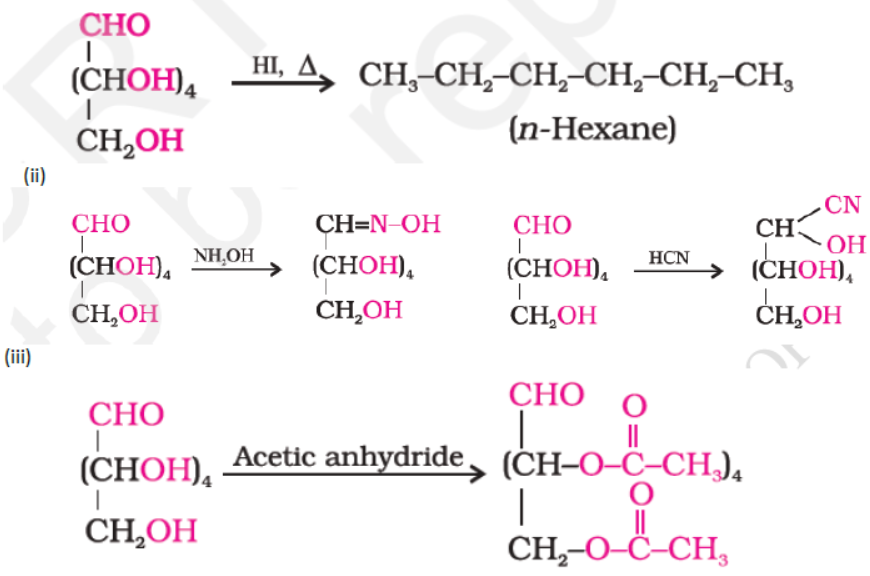
(i) Straight Chain: Prolonged heating of glucose with hydrogen iodide (\( \text{HI} \)) and red phosphorus yields n-hexane, confirming that all six carbons are linked in a straight chain: \[ \text{C}_6\text{H}_{12}\text{O}_6 \xrightarrow{\text{HI, }\Delta} \text{CH}_3\text{CH}_2\text{CH}_2\text{CH}_2\text{CH}_2\text{CH}_3 \]
(ii) Carbonyl Group: Glucose reacts with hydroxylamine (\( \text{NH}_2\text{OH} \)) to form an oxime, and adds hydrogen cyanide (\( \text{HCN} \)) to form a cyanohydrin, demonstrating the presence of a carbonyl group: \[ \text{R-CHO} + \text{NH}_2\text{OH} \rightarrow \text{R-CH=N-OH} + \text{H}_2\text{O} \]
(iii) Five -OH Groups: Acetylation of glucose with acetic anhydride yields glucose pentaacetate, indicating the presence of five hydroxyl groups attached to five different carbon atoms: \[ \text{C}_6\text{H}_{12}\text{O}_6 + 5(\text{CH}_3\text{CO})_2\text{O} \rightarrow \text{Glucose pentaacetate} + 5\text{CH}_3\text{COOH} \]
In simple words: (i) Heating with HI produces hexane, confirming a straight chain. (ii) Reacting with hydroxylamine to make an oxime proves a carbonyl group exists. (iii) Reacting with acetic anhydride to make pentaacetate confirms there are five hydroxyl groups on different carbons.
Exam Tip: Since stable compounds rarely contain more than one hydroxyl group on a single carbon atom, the formation of a stable pentaacetate proves the five \( \text{-OH} \) groups are on separate carbons.
Question 6. Explain the terms primary structure of proteins.
Answer: The primary structure of a protein refers to the specific linear sequence in which various amino acids are joined by peptide bonds to form polypeptide chains. Any change or error in this precise amino acid sequence alters the identity and biological function of the protein entirely.
In simple words: Primary structure is simply the exact order in which amino acids are linked like beads on a string to make a protein.
Exam Tip: Cite sickle cell anemia as a classic example of how changing just a single amino acid in the primary structure of hemoglobin can cause severe disease.
Question 7. Explain the terms secondary structure of proteins. What is the difference between α-helix and β-pleated sheet structure of proteins?
Answer: The secondary structure of a protein refers to the local spatial conformation of the polypeptide backbone, stabilized by hydrogen bonding.
The main differences between \( \alpha \)-helix and \( \beta \)-pleated sheet structures are:
- \( \alpha \)-Helix: The polypeptide chain twists into a right-handed coil, stabilized by intramolecular hydrogen bonds between the \( \text{-NH-} \) group of one residue and the \( \text{-C=O} \) group of a residue four positions ahead.
- \( \beta \)-Pleated Sheet: The polypeptide chains are almost fully extended, laid side-by-side, and stabilized by intermolecular hydrogen bonds between adjacent chains, forming a folded, sheet-like arrangement.
In simple words: Secondary structure is the shape the protein chain folds into. In an \( \alpha \)-helix, the chain twists into a tight spiral held by internal bonds. In a \( \beta \)-pleated sheet, several flat chains sit side-by-side, held together by bonds between them.
Exam Tip: Be sure to highlight the difference in bonding: \( \alpha \)-helix uses *intramolecular* hydrogen bonds, while \( \beta \)-pleated sheet uses *intermolecular* hydrogen bonds.
Question 8. Explain tertiary structure of Protein.
Answer: The tertiary structure of a protein represents the overall three-dimensional folding of the entire polypeptide chain, which is a further folding of its secondary structure. This conformation is stabilized by various molecular interactions, such as hydrogen bonds, disulphide linkages, van der Waals forces, and electrostatic attractions, giving rise to either fibrous or globular shapes.
In simple words: Tertiary structure is the complete, three-dimensional folding of the protein chain into a compact, functional shape, like folding a twisted ribbon into a tight ball.
Exam Tip: Name the four stabilizing forces (hydrogen bonds, disulphide bonds, ionic bonds, and hydrophobic interactions) to construct a comprehensive exam answer.
Question 9. What are structural difference between Cellulose and Starch ?
Answer: The primary structural differences are:
1. Monomer units: Starch is a polymer composed of \( \alpha \)-D-glucose units, whereas cellulose is a polymer of \( \beta \)-D-glucose units.
2. Linkages: In starch, glucose units are linked by \( \alpha \)-1,4-glycosidic bonds (and \( \alpha \)-1,6-bonds at branch points in amylopectin). In cellulose, the glucose units are connected solely by \( \beta \)-1,4-glycosidic linkages, forming a straight, unbranched chain.
3. Composition: Starch contains two distinct fractions (linear amylose and branched amylopectin), whereas cellulose is strictly a linear, straight-chain polysaccharide.
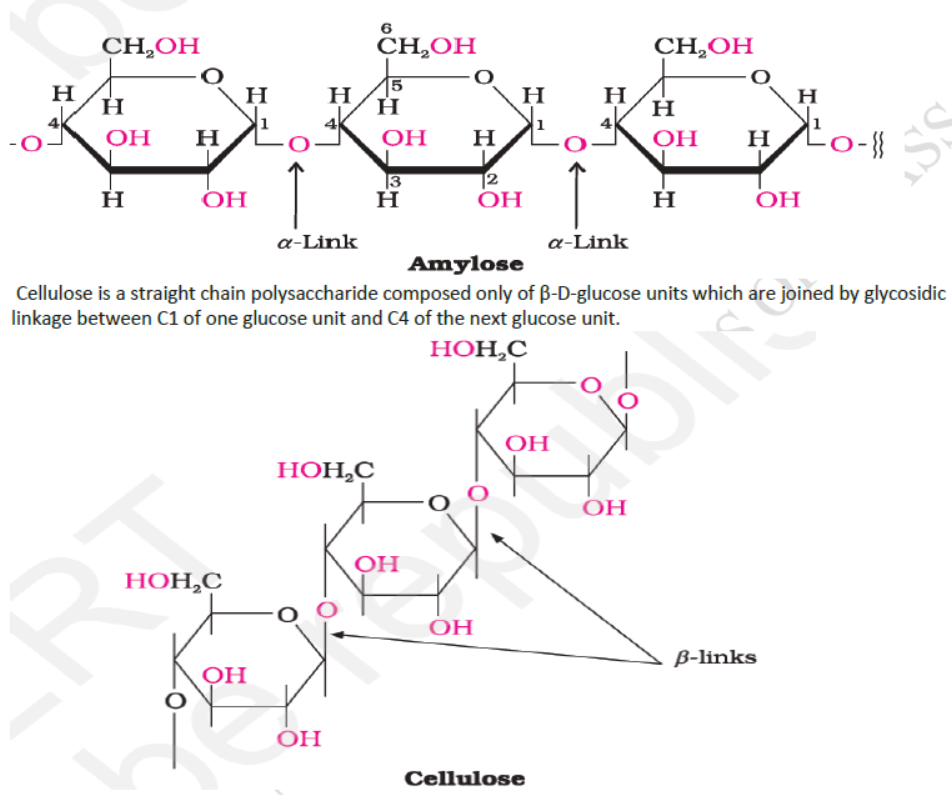
In simple words: Starch is made of \( \alpha \)-glucose units and can be branched, while cellulose is made of \( \beta \)-glucose units linked in straight, unbranched chains.
Exam Tip: Highlight that the \( \beta \)-linkages in cellulose allow it to form strong hydrogen-bonded linear fibers, which are ideal for plant cell walls.
Free study material for Chemistry
Download Class 12 Chemistry Unit 10 Biomolecules Practice Worksheets
Daily Practice Questions for Class 12 Chemistry
Review targeted practice exercises for Class 12 Chemistry Unit 10 Biomolecules. Curated to match official CBSE guidelines, these printable problem sets support daily revision and improve overall test readiness.
Detailed Answers for Class 12 Chemistry Unit 10 Biomolecules
Designed around the official curriculum for Class 12 Chemistry, these practice sheets guarantee standard compliance. Reviewing step-by-step solutions after completion sharpens your accuracy and clarifies complex sub-topics within Unit 10 Biomolecules.
Complete Your Chapter Revision
Wrap up your chapter revision by testing your knowledge against standard objective question formats. Explore our full library of free, up-to-date printable assignments to maximize your academic results in upcoming CBSE evaluations.
FAQs
You can download the latest chapter-wise printable worksheets for Class 12 Chemistry Unit 10 Biomolecules for free from StudiesToday.com. These have been made as per the latest CBSE curriculum for this academic year.
Yes, Class 12 Chemistry worksheets for Unit 10 Biomolecules focus on activity-based learning and also competency-style questions. This helps students to apply theoretical knowledge to practical scenarios.
Yes, we have provided solved worksheets for Class 12 Chemistry Unit 10 Biomolecules to help students verify their answers instantly.
Yes, our Class 12 Chemistry test sheets are mobile-friendly PDFs and can be printed by teachers for classroom.
For Unit 10 Biomolecules, regular practice with our worksheets will improve question-handling speed and help students understand all technical terms and diagrams.