

Class 12 Chemistry Practice Sheet: CBSE Class 12 Chemistry Purification Of Metals Worksheet
Review targeted academic worksheets with the CBSE Class 12 Chemistry Purification Of Metals Worksheet. Built according to official educational standards for the 2026-27 term, these downloadable Class 12 Chemistry resources support effective daily practice and detailed self-evaluation for Purification Of Metals.
Download Purification Of Metals Worksheet PDF with Answers
Navigate directly to the solved Chemistry worksheets using the digital viewer below. Each practice set includes detailed step-by-step solutions, allowing students to instantly cross-check their work and identify areas requiring further revision.
CBSE Class 12 Chemistry Purification of Metals. CBSE issues sample papers every year for students for class 12 board exams. Students should solve the CBSE issued sample papers to understand the pattern of the question paper which will come in class 12 board exams this year. The sample papers have been provided with marking scheme. It’s always recommended to practice as many CBSE sample papers as possible before the board examinations. Sample papers should be always practiced in examination condition at home or school and the student should show the answers to teachers for checking or compare with the answers provided. Students can download the sample papers in pdf format free and score better marks in examinations. Refer to other links too for latest sample papers.
CONCEPTS COVERED:
- Process of refining
- Reactions utilized in various processes
- Identification of reagents used in various processes
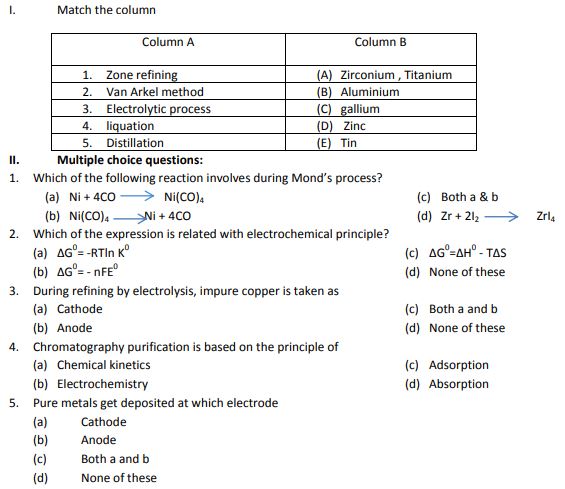
Question. Match the column:
Column A
1. Zone refining
2. Van Arkel method
3. Electrolytic process
4. Liquation
5. Distillation
Column B
(A) Zirconium, Titanium
(B) Aluminium
(C) Gallium
(D) Zinc
(E) Tin
Answer: 1 - (C), 2 - (A), 3 - (B), 4 - (E), 5 - (D)
Question. Which of the following reaction involves during Mond’s process?
(a) \( \text{Ni} + 4\text{CO} \rightarrow \text{Ni(CO)}_4 \)
(b) \( \text{Ni(CO)}_4 \rightarrow \text{Ni} + 4\text{CO} \)
(c) Both a & b
(d) \( \text{Zr} + 2\text{I}_2 \rightarrow \text{ZrI}_4 \)
Answer: (c) Both a & b
Question. Which of the expression is related with electrochemical principle?
(a) \( \Delta G^0 = -RT\ln K^0 \)
(b) \( \Delta G^0 = -nFE^0 \)
(c) \( \Delta G^0 = \Delta H^0 - T\Delta S \)
(d) None of the options
Answer: (b) \( \Delta G^0 = -nFE^0 \)
Question. During refining by electrolysis, impure copper is taken as
(a) Cathode
(b) Anode
(c) Both a and b
(d) None of the options
Answer: (b) Anode
Question. Chromatography purification is based on the principle of
(a) Chemical kinetics
(b) Electrochemistry
(c) Adsorption
(d) Absorption
Answer: (c) Adsorption
Question. Pure metals get deposited at which electrode
(a) Cathode
(b) Anode
(c) Both a and b
(d) None of the options
Answer: (a) Cathode
Question. Give one example of a metal purified by zone refining.
Answer: Gallium (Ga)
Question. Give one example of a metal purified by vapour phase refining.
Answer: Titanium
Question. Give one example of a metal purified by electrolysis.
Answer: Silver
Question. Give one example of a metal purified by liquation.
Answer: Tin (Sn)
Question. Give one example of a metal purified by distillation.
Answer: Zinc (Zn)
Question. During froth floatation process, the froth is stabilized using ________________.
Answer: cresol
Question. For an ore containing PbS and ZnS, ________________is used as a depressant.
Answer: NaCN
Question. The sulphide ore is made more hydrophobic using collectors like _________.
Answer: pine oil
Question. During the extraction of copper having iron as impurity, the slag formed is _________.
Answer: \( \text{FeSiO}_3 \)
Question. Apart from cryolite, _________can be used in the metallurgy of aluminium.
Answer: \( \text{CaF}_2 \)
Question. Identify the process: \( 2\text{Al}_2\text{O}_3 + 3\text{C} \rightarrow 4\text{Al} + 3\text{CO}_2 \)
Answer: Hall-Heroult process
Question. Identify the process: \( \text{ZrI}_4 \rightarrow \text{Zr} + 2\text{I}_2 \)
Answer: Van Arkel method
Question. Identify the process: \( \text{CaO} + \text{SiO}_2 \rightarrow \text{CaSiO}_3 \)
Answer: Extraction of iron (formation of slag)
Question. Identify the process: \( \text{ZnCO}_3 \rightarrow \text{ZnO} + \text{CO}_2 \)
Answer: Calcination
Question. Identify the process: \( \text{ZnS} + 3\text{O}_2 \rightarrow 2\text{ZnO} + 2\text{SO}_2 \)
Answer: Roasting
Question. Match the ore with the processes involved during the extraction of the metal:
Ores: bauxite, zinc blende, haematite, copper pyrite, zinc carbonate.
Processes: reduction with coke, leaching, reduction in a blast furnace, roasting of sulphide ore, electrochemical reduction, reduction in a reverberatory furnace.
Answer:
1. Bauxite: Leaching and electrochemical reduction
2. Zinc blende: Roasting of sulphide ore and reduction with coke
3. Haematite: Reduction in blast furnace
4. Copper pyrite: Roasting of sulphide ore and reduction in a reverberatory furnace
5. Zinc carbonate: Reduction with coke
Question. Complete the analogy: \( \text{Al}_2\text{O}_3 : \text{NaOH} :: \text{Ag}_2\text{S} : \text{____} \)
Answer: NaCN
Question. Complete the analogy: \( \text{FeO} : \text{SiO}_2 :: \text{SiO}_2 : \text{____} \)
Answer: CaO
Question. Complete the analogy: Aluminium : bauxite :: silver : ______
Answer: silver glance
Question. Complete the analogy: \( \text{Ni} : \text{Ni(CO)}_4 :: \text{Zr} : \text{____} \)
Answer: \( \text{ZrI}_4 \)
Question. Complete the analogy: \( \text{Na[Al(OH)}_4\text{]} : \text{CO}_2 :: \text{[Au(CN)}_2\text{]}^- : \text{____} \)
Answer: Zn
Free study material for Chemistry
Download Class 12 Chemistry Purification Of Metals Practice Worksheets
Practice Exercises for Class 12 Chemistry Purification Of Metals
Review targeted practice exercises for Class 12 Chemistry Purification Of Metals. Curated to match official CBSE guidelines, these printable problem sets support daily revision and improve overall test readiness.
Step-by-Step Solutions and Practice Guidelines
Designed around the official curriculum for Class 12 Chemistry, these practice sheets guarantee standard compliance. Reviewing step-by-step solutions after completion sharpens your accuracy and clarifies complex sub-topics within Purification Of Metals.
Enhance Speed with Online Practice
Consistent engagement with these exercises builds familiarity with recurring exam themes. If specific areas within Purification Of Metals cause trouble, utilize our dedicated NCERT solutions for Class 12 Chemistry to clear up doubts immediately.
FAQs
You can download the latest chapter-wise printable worksheets for Class 12 Chemistry Purification Of Metals for free from StudiesToday.com. These have been made as per the latest CBSE curriculum for this academic year.
Yes, Class 12 Chemistry worksheets for Purification Of Metals focus on activity-based learning and also competency-style questions. This helps students to apply theoretical knowledge to practical scenarios.
Yes, we have provided solved worksheets for Class 12 Chemistry Purification Of Metals to help students verify their answers instantly.
Yes, our Class 12 Chemistry test sheets are mobile-friendly PDFs and can be printed by teachers for classroom.
For Purification Of Metals, regular practice with our worksheets will improve question-handling speed and help students understand all technical terms and diagrams.