

Official Class 12 Chemistry Worksheets: Redox Titration
Access comprehensive chapter-wise worksheets for Redox Titration using the CBSE Class 12 Chemistry Redox Titration Worksheet. Designed to align with the 2026-27 academic syllabus for Class 12 Chemistry, these printable practice sets help students reinforce key concepts and improve their overall exam readiness.
Solved Practice Worksheets for Chemistry
View or download the dedicated CBSE Class 12 Chemistry Redox Titration Worksheet resource below. Engaging with these practice papers under focused study conditions ensures continuous academic progress and mastery of the 2026-27 curriculum for Redox Titration.
CBSE Class 12 Redox Titration. CBSE issues sample papers every year for students for class 12 board exams. Students should solve the CBSE issued sample papers to understand the pattern of the question paper which will come in class 12 board exams this year. The sample papers have been provided with marking scheme. It’s always recommended to practice as many CBSE sample papers as possible before the board examinations. Sample papers should be always practiced in examination condition at home or school and the student should show the answers to teachers for checking or compare with the answers provided. Students can download the sample papers in pdf format free and score better marks in examinations. Refer to other links too for latest sample papers. Click here to get important questions for class 12 chemistry chapter wise.
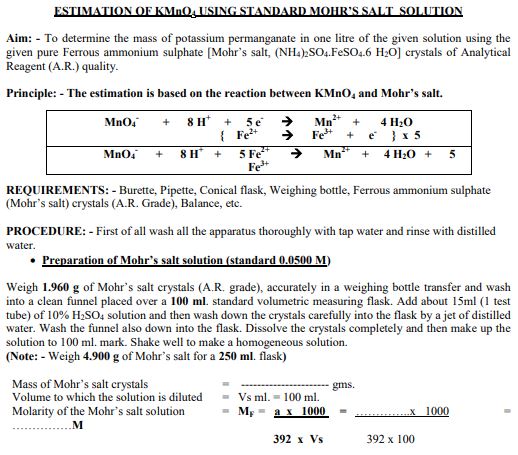
ESTIMATION OF \( \text{KMnO}_4 \) USING STANDARD MOHR’S SALT SOLUTION
Aim: To determine the mass of potassium permanganate in one litre of the given solution using the given pure Ferrous ammonium sulphate [Mohr’s salt, \( (\text{NH}_4)_2\text{SO}_4\cdot\text{FeSO}_4\cdot6\text{H}_2\text{O} \)] crystals of Analytical Reagent (A.R.) quality.
Principle: The estimation is based on the reaction between \( \text{KMnO}_4 \) and Mohr’s salt.
\[ \text{MnO}_4^- + 8\text{H}^+ + 5\text{e}^- \rightarrow \text{Mn}^{2+} + 4\text{H}_2\text{O} \] \[ \{ \text{Fe}^{2+} \rightarrow \text{Fe}^{3+} + \text{e}^- \} \times 5 \]
\[ \text{MnO}_4^- + 8\text{H}^+ + 5\text{Fe}^{2+} \rightarrow \text{Mn}^{2+} + 4\text{H}_2\text{O} + 5\text{Fe}^{3+} \]
REQUIREMENTS: Burette, Pipette, Conical flask, Weighing bottle, Ferrous ammonium sulphate (Mohr’s salt) crystals (A.R. Grade), Balance, etc.
PROCEDURE: First of all wash all the apparatus thoroughly with tap water and rinse with distilled water.
Preparation of Mohr’s salt solution (standard 0.0500 M)
Weigh 1.960 g of Mohr’s salt crystals (A.R. grade), accurately in a weighing bottle transfer and wash into a clean funnel placed over a 100 ml. standard volumetric measuring flask. Add about 15ml (1 test tube) of 10% \( \text{H}_2\text{SO}_4 \) solution and then wash down the crystals carefully into the flask by a jet of distilled water. Wash the funnel also down into the flask. Dissolve the crystals completely and then make up the solution to 100 ml. mark. Shake well to make a homogeneous solution.
(Note: - Weigh 4.900 g of Mohr’s salt for a 250 ml. flask)
Mass of Mohr’s salt crystals = ---------------------- gms.
Volume to which the solution is diluted = \( \text{V}_s \) ml. = 100 ml.
Molarity of the Mohr’s salt solution = \( \text{M}_F = \frac{\text{a} \times 1000}{392 \times \text{V}_s} = \frac{\dots\dots\dots\dots\text{ x } 1000}{392 \text{ x } 100} = \dots\dots\dots\dots\text{M} \)
Estimation of Potassium permanganate solution
Pipette out 20 ml. of Mohr’s salt solution into a conical flask and add about 20 ml. (1 ½ test tubes) of Dil. Sulphuric acid to it. The solution is then titrated with \( \text{KMnO}_4 \) solution taken in the burette. The end point is indicated by the appearance of pale pink colour in the solution. The titration is repeated till concordant titre values are obtained.
| Sl. No | Volume of F A S (ml) | Burette reading | Titre value (Volume of \( \text{KMnO}_4 \) consumed) (X – Y) ml | |
|---|---|---|---|---|
| Initial reading Y ml | Final reading X ml | |||
| 1 | 20 ml | |||
| 2 | 20 ml | |||
Calculation: -
Molarity of the Mohr’s salt solution = \( \text{M}_F \) = ------------- M
Volume of FAS used = \( \text{V}_F \) = 20 ml
Volume of \( \text{KMnO}_4 \) used up = \( \text{V}_K \) ml. = --------------- ml.
By law of equivalence: - \( 5 \text{M}_K\text{V}_K = \text{M}_F\text{V}_F \)
| \( \text{M}_K \) = Molarity of \( \text{KMnO}_4 \) | \( \text{V}_K \) = Volume of \( \text{KMnO}_4 \) used up (Burette reading). | 5 = Number of electrons consumed |
| \( \text{M}_F \) = Molarity of Mohr’s salt used. | \( \text{V}_F \) = Volume of Mohr’s salt (Volume of the pipette). | Only one electron is released |
Molarity of the \( \text{KMnO}_4 \) solution = \( \text{M}_K = \frac{\text{M}_F\text{V}_F}{5 \text{V}_K} = \frac{\dots\dots\dots\dots\text{ x } 20}{5 \text{ x }\dots\dots\dots\dots} = \dots\dots\dots\dots\text{M} \)
Result: -
Molarity of the given \( \text{KMnO}_4 \) solution = ------------- M.
N.B: - (Do not enter in your journal)
- 1. If during the reaction a brown precipitate of hydrated manganese dioxide is observed, insufficient sulphuric acid is indicated. More acid should then be added to the solution.
- 2. Since the lower meniscus cannot be seen clearly through the purple colour of the \( \text{KMnO}_4 \) solution, the burette readings are taken at the highest level of the liquid surface (upper meniscus).
- 3. A burette, which has been used for \( \text{KMnO}_4 \) solution, should be emptied and cleaned immediately after use. Any brown stain due to \( \text{MnO}_2 \) should be removed by oxalic acid solution or Mohr’s salt solution.
Experiment Number: 02
Date: ----------
ESTIMATION OF \( \text{KMnO}_4 \) USING STANDARD OXALIC ACID SOLUTION
Aim: To determine the mass of potassium permanganate in one litre of the given solution using the given pure oxalic acid crystals of Analytical Reagent (A.R.) quality.
Principle: The estimation is based on the reaction between \( \text{KMnO}_4 \) and Oxalic acid.
\[ \{ \text{MnO}_4^- + 8\text{H}^+ + 5\text{e}^- \rightarrow \text{Mn}^{2+} + 4\text{H}_2\text{O} \} \times 2 \] \[ \{ \text{C}_2\text{O}_4^{2-} \rightarrow 2\text{CO}_2 + 2\text{e}^- \} \times 5 \]
\[ 2\text{MnO}_4^- + 16\text{H}^+ + 5\text{C}_2\text{O}_4^{2-} \rightarrow 2\text{Mn}^{2+} + 8\text{H}_2\text{O} + 10\text{CO2} \]
REQUIREMENTS: Burette, Pipette, Conical flask, Weighing bottle, Oxalic acid crystals (AR grade), Balance, etc.
PROCEDURE: First of all wash all the apparatus thoroughly with tap water and rinse with distilled water.
Preparation of oxalic acid solution (standard 0.0500 M)
Weigh 0.6300 g of Oxalic acid crystals (A.R. grade), accurately in a weighing bottle wash and transfer into a clean funnel placed over a 100 ml. standard volumetric measuring flask. Wash the funnel also down into the flask. Dissolve the crystals completely and then make up the solution to 100ml. mark. Shake well to make a homogeneous solution.
(Note: - Weigh 1.575 g of oxalic acid for a 250ml. flask)
Mass of oxalic acid crystals = X g
Volume of solution prepared = Vs ml = 100 ml.
Molarity of the Oxalic acid solution (Mo) = \( \frac{\text{X x } 1000}{126 \text{ x Vs}} = \frac{\dots\dots\dots\dots\text{ x } 1000}{126 \text{ x } 100} = \dots\dots\dots\dots\text{M} \)
Estimation of Potassium permanganate solution
Pipette out 20 ml. of oxalic acid into a conical flask, about 20 ml. (1 ½ test tubes) of Dil. Sulphuric acid is added and the mixture is heated to \( 60^\circ\text{C} \) to \( 70^\circ\text{C} \) (bearable warmth). The solution is then titrated with \( \text{KMnO}_4 \) solution taken in the burette. The end point is indicated by the appearance of pale pink colour in the solution. The titration is repeated till concordant titre values are obtained.
| Sl No | Volume of Oxalic acid used (ml) | Burette reading | Titre value (Volume of \( \text{KMnO}_4 \) consumed) (Z – Y) ml | |
|---|---|---|---|---|
| Initial reading Y ml | Final reading Z ml | |||
| 1 | 20 ml | |||
| 2 | 20 ml | |||
Calculation: -
Molarity of the Oxalic acid solution = Mo = ………………M
Volume of oxalic acid used = Vo = 20 ml
Volume of \( \text{KMnO}_4 \) used up = \( \text{V}_K \) ml. = ................ ml.
By law of equivalence: - \( 5 \text{M}_K\text{V}_K = 2 \text{M}_O\text{V}_O \)
| \( \text{M}_K \) = Molarity of \( \text{KMnO}_4 \) | \( \text{V}_K \) = Volume of \( \text{KMnO}_4 \) used up (Burette reading). | 5 = Number of electrons consumed |
| \( \text{M}_O \) = Molarity of Oxalic acid used. | \( \text{V}_O \) = Volume of Oxalic acid (Volume of the pipette). | 2 = Number of electrons released. |
Molarity of the \( \text{KMnO}_4 \) solution = \( \text{M}_K = \frac{2 \text{M}_O\text{V}_O}{5 \text{V}_K} = \frac{2 \text{ x }\dots\dots\dots\dots\text{ x } 20}{5 \text{ x }\dots\dots\dots\dots} = \dots\dots\dots\dots\text{ M} \)
Mass of \( \text{KMnO}_4 \) in one litre of the given solution = \( \text{M}_K \text{ x } 158 = \dots\dots\dots\dots\text{ x } 158 = \dots\dots\dots\dots\text{ g.} \)
Result: -
Molarity of the given \( \text{KMnO}_4 \) solution = ------------------- M.
Mass of \( \text{KMnO}_4 \) in one litre of the given solution = ------------------- g.
N.B: - (Do not enter in your journal)
1. If during the reaction a brown precipitate of hydrated manganese dioxide is observed, insufficient sulphuric acid is indicated. More acid should then be added to the solution.
2. Since the lower meniscus cannot be seen clearly through the purple colour of the \( \text{KMnO}_4 \) solution, the burette readings are taken at the highest level of the liquid surface (upper meniscus).
3. A burette, which has been used for \( \text{KMnO}_4 \) solution, should be emptied and cleaned immediately after use. Any brown stain due to \( \text{MnO}_2 \) should be removed by oxalic acid solution or Mohr’s salt solution.
Free study material for Chemistry
CBSE Class 12 Chemistry Worksheets for Redox Titration
Practice Exercises for Class 12 Chemistry Redox Titration
Explore reliable practice questions for Redox Titration tailored for Class 12 Chemistry learners. Use these structured worksheets to evaluate exam preparedness and strengthen problem-solving skills throughout the 2026 academic session.
Step-by-Step Solutions and Practice Guidelines
Designed around the official curriculum for Class 12 Chemistry, these practice sheets guarantee standard compliance. Reviewing step-by-step solutions after completion sharpens your accuracy and clarifies complex sub-topics within Redox Titration.
Enhance Speed with Online Practice
Wrap up your chapter revision by testing your knowledge against standard objective question formats. Explore our full library of free, up-to-date printable assignments to maximize your academic results in upcoming CBSE evaluations.
FAQs
You can download the latest chapter-wise printable worksheets for Class 12 Chemistry Redox Titration for free from StudiesToday.com. These have been made as per the latest CBSE curriculum for this academic year.
Yes, Class 12 Chemistry worksheets for Redox Titration focus on activity-based learning and also competency-style questions. This helps students to apply theoretical knowledge to practical scenarios.
Yes, we have provided solved worksheets for Class 12 Chemistry Redox Titration to help students verify their answers instantly.
Yes, our Class 12 Chemistry test sheets are mobile-friendly PDFs and can be printed by teachers for classroom.
For Redox Titration, regular practice with our worksheets will improve question-handling speed and help students understand all technical terms and diagrams.