

Official Class 12 Chemistry Worksheets: Unit 7 The p-Block Elements
Access comprehensive chapter-wise worksheets for Unit 7 The p-Block Elements using the CBSE Class 12 Chemistry P Block Elements Type Mll Worksheet. Designed to align with the 2026-27 academic syllabus for Class 12 Chemistry, these printable practice sets help students reinforce key concepts and improve their overall exam readiness.
Solved Practice Worksheets for Chemistry
View or download the dedicated CBSE Class 12 Chemistry P Block Elements Type Mll Worksheet resource below. Engaging with these practice papers under focused study conditions ensures continuous academic progress and mastery of the 2026-27 curriculum for Unit 7 The p-Block Elements.
MCQ Questions for NCERT CBSE Class 12 Chemistry P Block Elements
Question. Nitrogen forms N2 but Phosphorous is converted into P4 from Phosphorous, the reason is
(a) Triple bond is present between Phosphorous atom
(b) Pπ-Pπ bonding is strong
(c) Pπ-Pπ Bonding is weak
(d) Multiple bonds are formed easily
Answer: C
Question. Partial hydrolysis of XeF4 gives
(a) XeO3
(b) XeOF2
(c) XeOF4
(d) XeF2
Answer: B
Question. What is the correct order of reactivity of group 16 elements?
(a) O > Se > S > Tè > Po
(b) S > O > Tè > Po > Se
(c) S > O > Se > Tè > Po
(d) O > S > Se > Tè > Po
Answer: D
Question. Matching type questions – Match the entries of column I with appropriate entries of column II and choose the correct option out of the four options (a), (b), (c) and (d) given at the end of each question 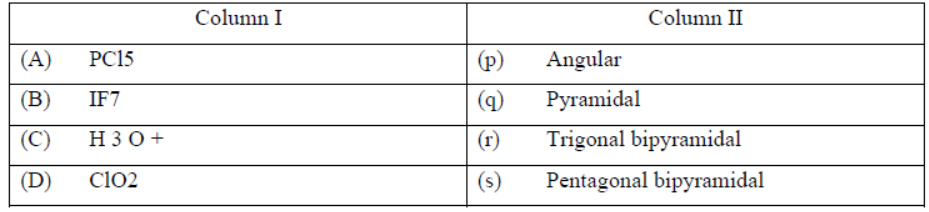
(a) A-r, B-s, C-q, D-p
(b) A-r, B-q, C-p, D-s
(c) A-p, B-s, C-q, D-r
(d) A-s, B-p, C-r, D-q
Answer: A
Question. In which of the following sulphur is present in +5 oxidation state?
(a) Di thionic acid
(b) Sulphurous acid
(c) Sulphuric acid
(d) Disulphuric acid
Answer: A
Question. Which of the following statements regarding group 16 elements is not true?
(a) The electronic configuration of Oxygen is [He]2s22p4
(b) The electronic configuration of Sulphur is [Ne]3s23p4
(c) The atomic radii of the elements of group 16 are larger than those of the corresponding elements of group 15.
(d) The electronic configuration of Tellurium is [Kr]4d105s25p4
Answer: C
Question. H2S is more acidic than H2O because
(a) oxygen is more electronegative than sulphur.
(b) atomic number of Sulphur is higher than oxygen.
(c) H — S bond dissociation energy is less as compared to H — O bond.
(d) H — O bond dissociation energy is less also compared to H — S bond
Answer: B
Question. Interhalogen compounds are more reactive than individual halogens because
(a) They are prepared by direct combination of halogens
(b) X-X" bond is weaker than X-X and X”-X” bond
(c) They are thermally more stable than Halogens
(d) There is large difference in their electronegativity
Answer: D
Question. The set with correct order of acidity is
(a) HClO < HClO2 < HClO3 < HClO4
(b) HClO4 < HClO3 < HClO2 < HClO
(c) HClO < HClO4 < HClO3 < HClO2
(d) HClO4 < HClO2 < HClO3 < HClO
Answer: A
Question. Fluorine differs from rest of the halogens in some of its properties. This is due to
(a) its smaller size and high electronegativity.
(b) lack of d-orbitals.
(c) low bond dissociation energy
(d) All of the these
Answer: B
Question. A gas (X) is obtained when Copper reacts with dilute nitric acid. The gas thus formed reacts with oxygen to give brown fumes of (Y). (Y) when dissolved in water gives an important acid (Z) and the gas (X).X, Y and Z respectively are
(a) Nitrogen monoxide, Nitrogen dioxide, Nitric acid.
(b) Nitrogen dioxide, Nitrogen monoxide, Nitric acid.
(c) Nitrous oxide, Nitrogen monoxide, Nitrous acid.
(d) Nitrogen monoxide, Nitrous oxide, Nitric acid.
Answer: A
Question. What happens when white phosphorous is heated at 473 Kelvin under high pressure?
(a) α-Black phosphorous is formed
(b) β-Black phosphorous is formed
(c) Red Phosphorous is formed
(d) No change is observed
Answer: B
Question. If Chlorine is passed through a solution of Hydrogen sulphide in water, the solution turns turbid due to the formation of
(a) Free chlorine
(b) Free sulphur
(c) Nascent Oxygen
(d) Nascent Hydrogen
Answer: B
Question. In BrF3 (bromine trifluoride) molecule the lone pairs occupy equatorial positions to minimize -
(a) lone pair –bond pair repulsions only
(b) bond pair-bond pair repulsions only
(c) lone pair-lone pair and lone pair-bond pair repulsions
(d) lone pair-lone pair repulsions only
Answer: C
Assertion Reason Based Question :
(a) If both assertion and reason are correct and reason is the correct explanation of the assertion
(b) If both assertion and reason are correct but reason is not the correct explanation of the assertion.
(c) If assertion is correct but reason is the wrong statement.
(d) If both the assertion and reason are incorrect.
Question. Assertion: Dinitrogen is less reactive than Phosphorous.
Reason: Nitrogen has more electron gain enthalpy than phosphorous.
Answer: C
Question. Assertion: HI cannot be prepared by the reaction of KI with concentrated sulphuric acid.
Reason: HI has lowest H-X bond strength among halogen acids.
Answer: B
Question. Chile saltpetre is the common name of
(a) AgNO3
(b) NaNO3
(c) NaSO4
(d) AgCl
Answer: b
Question. The first noble gas compound obtained was
(a) Xe+ PtF6−
(b) XeF4
(c) XeF2
(d) XeOF4
Answer: a
Question. The common oxidation states of group 15 elements are
(a) + 3 and + 5
(b) − 3 and − 5
(c) − 5 and + 5
(d) − 3, + 3 and + 5
Answer: d
Question. Peroxoacids of sulphur are
(a) H2S2O8 and H2SO5
(b) H2S2O8 and H2S2O7
(c) H2S2O7 and H2S2O6
(d) H2 SO5 and 2S2O7
Answer: a
Question. Nitrogen lacks d-orbital in its valence shell and hence, it cannot
(a) exhibit orbital hybridisation
(b) exhibit the oxidation state of + 5
(c) forms oxides with oxidation state greater than +3
(d) have covalency greater than three
Answer: b
Question. Among XeO3 , XeO4 and XeF6 , the molecules having same number of lone pairs on Xe are
(a) XeO3 and XeO4
(b) XeO3 and XeF6
(c) XeO4 and XeF6
(d) XeO3 , XeO4 F and XeF6
Answer: d
Question. Which of the following are the applications of dinitrogen gas?
(a) Preservation of biological materials and food items
(b) Production of inert atmosphere in copper and steel industry
(c) In the preparation of explosives
(d) Etching of metals
Answer: a
Question. On heating HNO3 with P4O10 , the oxide of nitrogen produced is
(a) NO2
(b) N2O5
(c) N2O4
(d) N2O3
Answer: b
Question. Red phosphorus is less reactive, less volatile and less soluble in non-polar solvent than white/yellow phosphorus because
(a) it has high molecular energy
(b) it has low molecular energy
(c) it forms condensation products
(d) it possesses highly polymerised structures
Answer: d
Question. Which of the following hydrides has the lowest boiling point?
(a) PH3
(b) AsH3
(c) SbH3
(d) NH3
Answer: a
Question. PH3 produces smoky rings when it comes in contact with air because
(a) PH3 reacts with water vapours
(b) PH3 reacts with N2
(c) PH3 burns in air
(d) PH3 contains impurities of P4H2
Answer: d
Question. The compound that cannot act both as oxidising and reducing agent is
(a) H2SO3
(b) H3PO4
(c) HNO2
(d) H2O2
Answer: b
Question. Sulphur exhibits valencies of 2, 4 and 6, whereas oxygen has a valency of 2 due to
(a) being less electronegative than S
(b) presence of d-orbitals in S
(c) S is bigger atom
(d) S has higher ionisation potential
Answer: b
Question. All the hydrides (of group 16 elements) except one possess reducing property. Identity the hydride
(a) H2Se
(b) H2O
(c) H2S
(d) H2Te
Answer: b
Question. Tetrafluorides of elements of group-16 have hybridisation and structure respectively are
(a) sp3 and trigonal pyramidal
(b) sp3 d and tetrahedral
(c) sp3 d and trigonal bipyramidal
(d) sp3 d and tetrahedral
Answer: c
Question. Water is much less volatile than H2S because
(a) H2O has a bond angle of nearly 150°
(b) hydrogen is loosely bonded with the sulphur
(c) S-atom is less electronegative than O-atom
(d) S-atom is more electronegative than O-atom
Answer: c
Question. Among the following, the number of compounds that can react with PCl 5 to give POCl 3 is
I. O2 II. CO2 III. CH3COOH IV. H2O V. C2H5OH VI. P4O10
(a) 1
(b) 2
(c) 3
(d) 4
Answer: d
Question. Correct order of bond dissociation energy is
(a) Br2 > Cl2
(b) F2 > Cl2
(c) I2 > F2
(d) F2 > I2
Answer: d
Question. Which of the following oxides is amphoteric in nature?
(a) Cl2O7
(b) Na2O
(c) N2O
(d) Al2O3
Answer: d
Question. Extra pure N2 can be obtained by thermal decomposition of
(a) NH3 with CuO
(b) NH4NO3
(c) (NH4)2 Cr2 O7
(d) Ba(N3)2
Answer: d
Question. Angular shape of ozone molecule consists of
(a) 1σ-bond and 1π-bond
(b) 2σ-bond and 2π-bonds
(c) 1σ-bond and 2π-bonds
(d) 2σ-bond and 1π-bond
Answer: d
Question. H2SO4 is used in
(a) petroleum refining
(b) manufacture of paints, pigments and dyestuff intermediates
(c) detergent industry
(d) All of the above
Answer: d
Question. The industrial preparation of SO2 is
(a) S(s) + O2 (g ) → SO2 (g )
(b) SO32−(aq) + 2H+(aq) → H2O(l) + SO2 (g)
(c) 4FeS2 (s) 11O2(g) → 2Fe2O3(s) + 8SO2 (g)
(d) All of the above
Answer: c
Question. The anomalous behaviour of fluorine is due to
(a) its small size
(b) its highest electronegativity
(c) low F—F bond dissociation enthalpy and non-availability of d-orbitals in valence shell
(d) All of the above
Answer: d
Question. HCl gas can be dried by passing through
(a) conc. H2 SO4
(b) dil. H2SO4
(c) conc. HNO3
(d) dil. HNO3
Answer: a
One Mark questions
1. Why is H3PO3 diprotic?
2. Nitrogen does not form pentahalide like phosphorous,why?
3. H2O is a liquid while H2s is a gas ,why?
4. Arrange NH3 PH3 AsH3 BiH3 SbH3 in the increasing order of basic strength.
5. Oxygen is a gas while sulphur is a solid,why?
6. Write the formula of hyponitros acid.
7. Why does Al not react with conc.nitricacid?
8. Can PCl5 act as an oxidising agent and reducing agent?
9. Why does NO2 readily dimerise?
10. Why is BiH3 the strongest reducing agent amongst all the hydrides of nitrogen family?
11. Write the chemical formula of peroxodisulphuric acid.
12. Why does NH3 act as a Lewis base /complexing agent?
13. What is the basicity of H3PO4?
14. Why does R3P = O exist but R3N = O does not (R = alkyl group)?
15. Why does the reactivity of nitrogen differ from phosphorus?
16. Why is white phosphorous highly reactive?
17. Why group 16 members are called chalcogens?
18. OF4 is not known but SF4 is known .Explain
19. Solid PCl5 exists as an ionic solid,Why?
20. Bismuth is a strong oxidizing agent in pentavalentstate,why?
One Mark Questions
Question. Why is \( \text{H}_3\text{PO}_3 \) diprotic?
Answer: Two ionisable hydrogen
Question. Nitrogen does not form pentahalide like phosphorous, why?
Answer: Absence of d-orbitals in nitrogen.
Question. \( \text{H}_2\text{O} \) is a liquid while \( \text{H}_2\text{S} \) is a gas, why?
Answer: H-bonding in \( \text{H}_2\text{O} \)
Question. Arrange \( \text{NH}_3 \), \( \text{PH}_3 \), \( \text{AsH}_3 \), \( \text{BiH}_3 \), \( \text{SbH}_3 \) in the increasing order of basic strength.
Answer: \( \text{NH}_3 > \text{PH}_3 > \text{AsH}_3 > \text{SbH}_3 > \text{BiH}_3 \)
Question. Oxygen is a gas while sulphur is a solid, why?
Answer: Absence of \( p\pi-p\pi \) bonding in oxygen.
Question. Write the formula of hyponitros acid.
Answer: \( \text{HNO}_2 \)
Question. Why does Al not react with conc. nitric acid?
Answer: Formation of passive oxide film
Question. Can \( \text{PCl}_5 \) act as an oxidising agent and reducing agent?
Answer: No, can act as oxidizing agent only.
Question. Why does \( \text{NO}_2 \) readily dimerise?
Answer: To pair up odd electron.
Question. Why is \( \text{BiH}_3 \) the strongest reducing agent amongst all the hydrides of nitrogen family?
Answer: Low bond dissociation enthalpy.
Question. Write the chemical formula of peroxodisulphuric acid.
Answer: \( \text{H}_2\text{S}_2\text{O}_8 \)
Question. Why does \( \text{NH}_3 \) act as a Lewis base / complexing agent?
Answer: It can donate lone pair of electrons very easily.
Question. What is the basicity of \( \text{H}_3\text{PO}_4 \)?
Answer: 3
Question. Why does \( \text{R}_3\text{P}=\text{O} \) exist but \( \text{R}_3\text{N}=\text{O} \) does not (\( \text{R} \) = alkyl group)?
Answer: Presence of d-orbitals in phosphorous.
Question. Why does the reactivity of nitrogen differ from phosphorus?
Answer: Absence of d-orbitals, H-bonding, tendency to form multiple bond.
Question. Why is white phosphorous highly reactive?
Answer: Strained structure.
Question. Why group 16 members are called chalcogens?
Answer: Ore forming nature.
Question. \( \text{OF}_4 \) is not known but \( \text{SF}_4 \) is known. Explain.
Answer: Absence of d-orbitals in oxygen.
Question. Solid \( \text{PCl}_5 \) exists as an ionic solid, Why?
Answer: It exists as \( [\text{PCl}_4]^+[\text{PCl}_6]^- \) in solid state.
Question. Bismuth is a strong oxidizing agent in pentavalent state, why?
Answer: Inert pair effect.
Two Marks Questions
Question. Draw the shapes of \( \text{SF}_4 \), \( \text{BrF}_3 \) on the basis of VSEPR theory.
Answer: \( \text{SF}_4 \) (See-saw), \( \text{BrF}_3 \) (T-shape).
Question. (a) Why is atomic radius of Argon more than that of Chlorine ?
(b) Why is ionization enthalpy of Nitrogen more than oxygen?
Answer: (a) Ar has van der Waals radius while Cl has covalent radius; the magnitude of \( \text{V}_r > \text{C}_r \).
(b) Half-filled configuration shown by nitrogen.
Question. (a) Arrange \( \text{F}_2 \), \( \text{Cl}_2 \), \( \text{Br}_2 \), \( \text{I}_2 \) in the increasing order of bond dissociation energy.
(b) Arrange \( \text{HOClO} \), \( \text{HOClO}_2 \), \( \text{HOClO}_3 \) in the increasing order of acidic strength.
Answer: (a) \( \text{Cl}_2 > \text{Br}_2 > \text{F}_2 > \text{I}_2 \)
(b) \( \text{HOClO}_3 > \text{HOClO}_2 > \text{HOClO} \)
Question. Explain giving suitable reasons:
(i) \( \text{NH}_3 \) has higher boiling point than \( \text{PH}_3 \)
(ii) \( \text{SbF}_5 \) is known but \( \text{BiF}_5 \) is unknown.
Answer: (i) H-bonding in ammonia.
(ii) Inert pair effect shown by Bi.
Question. Explain giving suitable reasons:
(i) \( \text{SF}_6 \) is well known but \( \text{SH}_6 \) is not known.
(ii) Proton affinity of \( \text{NH}_3 \) is more than \( \text{PH}_3 \).
Answer: (i) The enthalpy of atomization of \( \text{H-H} \) is very high as compared to \( \text{F-F} \). High enthalpy of dissociation cannot be compensated by energy released during bond formation.
(ii) High electronegativity of nitrogen.
Question. Explain giving suitable reasons.
(i) Sulphur in vapour form is paramagnetic in nature.
(ii) Catenation properties of Phosphorous is more than Nitrogen.
Answer: (i) In vapour form sulphur behaves like \( \text{O}_2 \).
(ii) Phosphorous is unable to form multiple bonds.
Question. Give chemical equations, when:
(a) Ammonium dichromate is heated?
(b) Sodium azide is heated?
Answer: (a) \( (\text{NH}_4)_2\text{Cr}_2\text{O}_7 \xrightarrow{\Delta} \text{N}_2 + \text{Cr}_2\text{O}_3 + 4\text{H}_2\text{O} \)
(b) \( 2\text{NaN}_3 \xrightarrow{\Delta} 2\text{Na} + 3\text{N}_2 \)
Question. Complete the following equations:
(i) \( \text{HgCl}_2 + \text{PH}_3 \rightarrow \)
(ii) \( \text{P}_4 + \text{NaOH} + \text{H}_2\text{O} \rightarrow \)
Answer: (i) \( 3\text{HgCl}_2 + 2\text{PH}_3 \rightarrow \text{Hg}_3\text{P}_2 + 6\text{HCl} \)
(ii) \( \text{P}_4 + 3\text{NaOH} + 3\text{H}_2\text{O} \rightarrow \text{PH}_3 + 3\text{NaH}_2\text{PO}_2 \)
Question. Write main differences between the properties of white phosphorus and red phosphorus.
Answer: White Phosphorous: Strained structure, Highly reactive, Insoluble in water.
Red Phosphorous: Stable structure, Less reactive, soluble in water.
Question. Arrange \( \text{H}_2\text{O} \), \( \text{H}_2\text{S} \), \( \text{H}_2\text{Se} \), \( \text{H}_2\text{Te} \) in the increasing order of (i) Acidic Character (ii) Thermal stability.
Answer: (i) Acidic Character: \( \text{H}_2\text{O} < \text{H}_2\text{S} < \text{H}_2\text{Se} < \text{H}_2\text{Te} \)
(ii) Thermal stability: \( \text{H}_2\text{Te} < \text{H}_2\text{Se} < \text{H}_2\text{S} < \text{H}_2\text{O} \)
Three Marks Questions
Question. (i) Why is \( \text{ICl} \) more reactive than \( \text{I}_2 \)?
(ii) Interhalogen compounds are strong Oxidizing agents, why?
(iii) Bleaching of flowers by \( \text{Cl}_2 \) is permanent while \( \text{SO}_2 \) is temporary, why?
Answer: (i) \( \text{I-Cl} \) bond is more polar and weaker than \( \text{I-I} \) bond.
(ii) Low bond dissociation enthalpy of \( \text{X-Y} \) bond.
(iii) \( \text{Cl}_2 \) bleaches the colour by oxidation while \( \text{SO}_2 \) bleaches by Reduction.
Question. Give Reasons:
(a) Iodine is more soluble in KI solution than in water.
(b) HF is stored in wax-coated bottle.
(c) HCl is not used to make the medium acidic in titrations involving \( \text{KMnO}_4 \).
Answer: (a) Formation of \( \text{KI}_3 \) complex.
(b) HF reacts with silica frequently.
(c) HCl can oxidise into \( \text{Cl}_2 \).
Question. Explain giving suitable reasons:
(i) \( \text{SbF}_5 \) is known but \( \text{BiF}_5 \) is unknown.
(ii) \( \text{CN}^- \) ion is known but \( \text{CP}^- \) is not.
(iii) Compounds of Noble gases are known with Xe and fluorine.
Answer: (i) Due to Inert pair effect \( \text{BiF}_5 \) is not known.
(ii) Phosphorous is unable to form multiple bonds.
(iii) Low ionisation enthalpy of Xe and high electronegativity of F.
Question. Explain giving suitable reasons:
(i) \( \text{PH}_3 \) has lower boiling point than \( \text{NH}_3 \).
(ii) Nitric oxide becomes brown when released in air.
(iii) When HCl reacts with finely powered iron, it forms ferrous chloride and not ferric chloride.
Answer: (i) Absence of hydrogen bonding in \( \text{PH}_3 \).
(ii) Due to formation of \( \text{NO}_2 \).
(iii) Fe on reaction with HCl forms \( \text{H}_2 \) which hinders the formation of \( \text{FeCl}_3 \).
Question. (i) Which Xe compound has distorted octahedral shape?
(ii) How does Chlorine react with hot and concentrated NaOH?
(iii) Write the chemical reaction involved in the ring test.
Answer: (i) \( \text{XeF}_6 \)
(ii) \( 3\text{Cl}_2 + 6\text{NaOH (hot and conc.)} \rightarrow \text{NaClO}_3 + 5\text{NaCl} + 3\text{H}_2\text{O} \)
(iii) \( \text{NO}_3^- + \text{Fe}^{2+} + 5\text{H}_2\text{O} \rightarrow [\text{Fe}(\text{H}_2\text{O})_5\text{NO}]^{2+} \)
Question. (a) Are all the bonds in \( \text{PCl}_5 \) equivalent in length?
(b) On the basis of structure show that \( \text{H}_3\text{PO}_2 \) is a good reducing agent.
(c) How many P-OH bonds are present in Pyrophosphoric acid?
Answer: (a) No, axial bonds are slightly longer than equatorial bonds.
(b) \( \text{H}_3\text{PO}_2 \) has one \( \text{P-H} \) bond.
(c) 4
Question. Complete the following equations:
- \( \text{P}_4 + \text{SOCl}_2 \rightarrow \)
- \( \text{NH}_3 + \text{CuSO}_4(\text{aq}) \rightarrow \)
- \( \text{XeF}_4 + \text{H}_2\text{O} \rightarrow \)
Answer:
- \( \text{P}_4 + 8\text{SOCl}_2 \rightarrow 4\text{SO}_2 + 4\text{PCl}_3 + 2\text{S}_2\text{Cl}_2 \)
- \( 4\text{NH}_3 + \text{CuSO}_4(\text{aq}) \rightarrow [\text{Cu}(\text{NH}_3)_4]\text{SO}_4 \)
- \( 6\text{XeF}_4 + 12\text{H}_2\text{O} \rightarrow 2\text{XeO}_3 + 24\text{HF} + 4\text{Xe} + \text{O}_2 \)
Question. (i) Arrange M-F, M-Cl, M-Br, M-I in the increasing order of ionic character.
(ii) Arrange HF, HCl, HBr, HI in the increasing order of reducing behavior.
(iii) Arrange \( \text{F}_2 \), \( \text{Cl}_2 \), \( \text{Br}_2 \), \( \text{I}_2 \) in the increasing order of bond dissociation energy.
Answer: (i) \( \text{M-I} < \text{M-Br} < \text{M-Cl} < \text{M-F} \)
(ii) \( \text{HF} < \text{HCl} < \text{HBr} < \text{HI} \)
(iii) \( \text{I}_2 < \text{F}_2 < \text{Br}_2 < \text{Cl}_2 \)
Question. Starting from sulphur, how would you manufacture \( \text{H}_2\text{SO}_4 \) by contact process.
Answer:
(a) \( \text{S} + \text{O}_2 \rightarrow \text{SO}_2(\text{g}) \)
(b) \( 2\text{SO}_2 + \text{O}_2 \xrightarrow{\text{V}_2\text{O}_5} 2\text{SO}_3 \)
(c) \( \text{SO}_3 + \text{H}_2\text{SO}_4 \rightarrow \text{H}_2\text{S}_2\text{O}_7 \)
(d) \( \text{H}_2\text{S}_2\text{O}_7 + \text{H}_2\text{O} \rightarrow 2\text{H}_2\text{SO}_4 \)
Question. Write the reaction involved in formation of ammonia by Habers process? State the favorable conditions for good yield of ammonia.
Answer: \( \text{N}_2 + 3\text{H}_2 \xrightarrow{\text{Fe/Mo}} 2\text{NH}_3(\text{g}) \). Favorable conditions are Low temperature and High Pressure.
Five Marks Questions
Question. A gas “X” is soluble in water. Its aq. Solution turns red litmus blue with excess of aq. \( \text{CuSO}_4 \) solution it gives deep blue colour and with \( \text{FeCl}_3 \) solution a brownish ppt. soluble in \( \text{HNO}_3 \) is obtained. Identify gas ”X” and write reactions for changes observed.
Answer: \( \text{X} = \text{NH}_3 \)
\( 4\text{NH}_3 + \text{CuSO}_4(\text{aq}) \rightarrow [\text{Cu}(\text{NH}_3)_4]\text{SO}_4 \)
\( 3\text{NH}_3 + 3\text{H}_2\text{O} + \text{FeCl}_3 \rightarrow \text{Fe(OH)}_3 + 3\text{NH}_4\text{Cl} \) (Brown ppt)
Question. Write the reaction involved in formation of Nitric acid by Ostwald's process? State the favorable conditions for good yield of Nitric oxide.
Answer:
\( 4\text{NH}_3 + 5\text{O}_2 \rightarrow 4\text{NO} + 6\text{H}_2\text{O} \)
\( 2\text{NO} + \text{O}_2 \rightarrow 2\text{NO}_2 \)
\( 3\text{NO}_2 + \text{H}_2\text{O} \rightarrow 2\text{HNO}_3 + \text{NO} \)
Question. Complete the following equations:
(i) \( \text{XeF}_4 + \text{H}_2\text{O} \rightarrow \)
(ii) \( \text{XeF}_6 + \text{PF}_5 \rightarrow \)
(iii) \( \text{Cl}_2 + \text{F}_2 \text{ (excess)} \rightarrow \)
(iv) \( \text{HgCl}_2 + \text{PH}_3 \rightarrow \)
(v) \( \text{SO}_3 + \text{H}_2\text{SO}_4 \rightarrow \)
Answer:
(i) \( 6\text{XeF}_4 + 12\text{H}_2\text{O} \rightarrow 2\text{XeO}_3 + 24\text{HF} + 4\text{Xe} + \text{O}_2 \)
(ii) \( \text{XeF}_6 + \text{PF}_5 \rightarrow [\text{XeF}_5]^+[\text{PF}_6]^- \)
(iii) \( \text{Cl}_2 + 3\text{F}_2 \text{ (excess)} \rightarrow 2\text{ClF}_3 \)
(iv) \( 3\text{HgCl}_2 + 2\text{PH}_3 \rightarrow \text{Hg}_3\text{P}_2 + 6\text{HCl} \)
(v) \( \text{SO}_3 + \text{H}_2\text{SO}_4 \rightarrow \text{H}_2\text{S}_2\text{O}_7 \)
Question. A translucent white waxy solid ‘A’ on heating in an inert atmosphere is converted in to its allotropic form (B). Allotrope ‘A’ on reaction with very dilute aqueous KOH liberates a highly poisonous gas ‘C’ having rotten fish smell. With excess of chlorine ‘A’ forms ‘D’ which hydrolysis to compound ‘E’. Identify compounds ‘A’ to ‘E’.
Answer: \( \text{A} = \text{White } \text{P}_4 \)
\( \text{B} = \text{Red } \text{P}_4 \)
\( \text{C} = \text{PH}_3 \)
\( \text{D} = \text{PCl}_5 \)
\( \text{E} = \text{H}_3\text{PO}_4 \)
Question. What happens when Concentrated \( \text{H}_2\text{SO}_4 \) is added to / Give the reactions of \( \text{H}_2\text{SO}_4 \) with (i) calcium fluoride (ii) KCl, (iii) Sugar (iv) Cu turnings, (v) Sulphur.
Answer:
(i) \( \text{CaF}_2 + \text{H}_2\text{SO}_4 \text{ (conc.)} \rightarrow \text{CaSO}_4 + 2\text{HF} \)
(ii) \( 2\text{KCl} + \text{H}_2\text{SO}_4 \text{ (conc.)} \rightarrow 2\text{HCl} + \text{K}_2\text{SO}_4 \)
(iii) \( \text{C}_{12}\text{H}_{22}\text{O}_{11} + \text{H}_2\text{SO}_4 \text{ (conc.)} \rightarrow 12\text{C} + 11\text{H}_2\text{O} \)
(iv) \( \text{Cu} + 2\text{H}_2\text{SO}_4 \text{ (conc.)} \rightarrow \text{CuSO}_4 + \text{SO}_2 + 2\text{H}_2\text{O} \)
(v) \( 3\text{S} + 2\text{H}_2\text{SO}_4 \text{ (conc.)} \rightarrow 3\text{SO}_2 + 2\text{H}_2\text{O} \)
Free study material for Chemistry
CBSE Class 12 Chemistry Worksheets for Unit 7 The p-Block Elements
Download Chapter Worksheets: Class 12 Chemistry
Review targeted practice exercises for Class 12 Chemistry Unit 7 The p-Block Elements. Curated to match official CBSE guidelines, these printable problem sets support daily revision and improve overall test readiness.
Concept Clarification for Unit 7 The p-Block Elements
Designed around the official curriculum for Class 12 Chemistry, these practice sheets guarantee standard compliance. Reviewing step-by-step solutions after completion sharpens your accuracy and clarifies complex sub-topics within Unit 7 The p-Block Elements.
Effective Revision Strategies for School Exams
Follow up your worksheet practice by attempting the interactive online MCQ tests for Unit 7 The p-Block Elements to evaluate your execution speed. All printable assignments and revision sheets on our platform are updated for the 2026 session and available free of charge.
FAQs
You can download the latest chapter-wise printable worksheets for Class 12 Chemistry Unit 7 The p-Block Elements for free from StudiesToday.com. These have been made as per the latest CBSE curriculum for this academic year.
Yes, Class 12 Chemistry worksheets for Unit 7 The p-Block Elements focus on activity-based learning and also competency-style questions. This helps students to apply theoretical knowledge to practical scenarios.
Yes, we have provided solved worksheets for Class 12 Chemistry Unit 7 The p-Block Elements to help students verify their answers instantly.
Yes, our Class 12 Chemistry test sheets are mobile-friendly PDFs and can be printed by teachers for classroom.
For Unit 7 The p-Block Elements, regular practice with our worksheets will improve question-handling speed and help students understand all technical terms and diagrams.