

Official Class 12 Chemistry Worksheets: Unit 1 The Solid State
Review targeted academic worksheets with the CBSE Class 12 Chemistry Solid State Worksheet Set 02. Built according to official educational standards for the 2026-27 term, these downloadable Class 12 Chemistry resources support effective daily practice and detailed self-evaluation for Unit 1 The Solid State.
Solved Practice Worksheets for Chemistry
View or download the dedicated CBSE Class 12 Chemistry Solid State Worksheet Set 02 resource below. Engaging with these practice papers under focused study conditions ensures continuous academic progress and mastery of the 2026-27 curriculum for Unit 1 The Solid State.
II) Multiple choice questions.
1. Percentage of empty space in a body centre cubic arrangement is
a) 74 b) 32 c) 26 d) 68
2.The total no of tetrahedral voids in fcc is
a) 6 b) 8 c) 10 d) 12
3. Which of the following statement is/ are not true in the hexagonal close packing.
a) Packing efficiency 74% b) C.N=12
c) Tetrahedral voids of the second layer are covered by the spheres of the third layers.
d) Spheres of the fourth layer are exactly aligned with those of the first layer
4. In which pair most efficient packing is present.
a. hcp & bcc
b. bcc& ccp
c. hcp& ccp
d. bcc& simple cubic
5. In which of the arrangement octahedral voids are formed
a. Hcp
b. bcc
c. fcc
d. simple cubic
III) FILL IN THE BLANKS
1. The C.N of each sphere in hcp is ----------- while that of bcc is __________.
2. An octrahedral void is ----------------times larger than a tetrahedral void.
3. ABAB… type of packing is called---------- where as ABCABC…type of packing is called fcc.
4. For bcc, r=31/2 a /4, then for fcc, r=---------.
Ans: I) a-4, b-1, c-3, d-2
Important Questions for NCERT Class 12 Chemistry Solid State
Question. In crystals of which one of the following ionic compounds would you expect maximum distance between centres of cations and anions?
(a) CsI
(b) CsF
(c) LiF
(d) LiI
Answer : A
Question. The second order Bragg diffraction of X-rays with λ = 1.00 Å from a set of parallel planes in a metal occurs at an angle 60°. The distance between the scattering planes in the crystal is
(a) 2.00 Å
(b) 1.00 Å
(c) 0.575 Å
(d) 1.15 Å
Answer : D
Question. The intermetallic compound LiAg crystallizes in cubic lattice in which both lithium and silver have coordination number of eight. The crystal class is
(a) face-centred cube
(b) simple cube
(c) body-centred cube
(d) none of these.
Answer : C
Question. In the fluorite structure, the coordination number of Ca2+ ion is
(a) 4
(b) 6
(c) 8
(d) 3
Answer : C
Question. The vacant space in bcc lattice unit cell is
(a) 48%
(b) 23%
(c) 32%
(d) 26%
Answer : C
Question. If a is the length of the side of a cube, the distance between the body-centred atom and one corner atom in the cube will be
(a) 2/√3a
(b) 4/√3a
(c) √3/4a
(d) √3/2a
Answer : D
Question. A metal crystallises with a face-centred cubic lattice.The edge of the unit cell is 408 pm. The diameter of the metal atom is
(a) 288 pm
(b) 408 pm
(c) 144 pm
(d) 204 pm
Answer : A
Question. AB crystallizes in a body-centred cubic lattice with edge length ‘a’ equal to 387 pm. The distance between two oppositely charged ions in the lattice is
(a) 335 pm
(b) 250 pm
(c) 200 pm
(d) 300 pm
Answer : A
Question. Lithium metal crystallises in a body-centred cubic crystal. If the length of the side of the unit cell of lithium is 351 pm, the atomic radius of lithium will be
(a) 151.8 pm
(b) 75.5 pm
(c) 300.5 pm
(d) 240.8 pm
Answer : A
Question. The pyknometric density of sodium chloride crystal is 2.165 × 10³ kg m–3 while its X-ray density is 2.178 × 10³ kg m–3. The fraction of unoccupied sites in sodium chloride crystal is
(a) 5.96
(b) 5.96 × 10⁻²
(c) 5.96 × 10⁻¹
(d) 5.96 × 10⁻³
Answer : D
Question. The edge length of face-centred unit cubic cells is 508 pm. If the radius of the cation is 110 pm, the radius of the anion is
(a) 144 pm
(b) 398 pm
(c) 288 pm
(d) 618 pm
Answer : A
Question. Iron exhibits bcc structure at room temperature.
Above 900°C, it transforms to fcc structure. The ratio of density of iron at room temperature to that at 900°C (assuming molar mass and atomic radii of iron remains constant with temperature) is
(a) √3/√2
(b) 4√3 /3√2
(c) 3√3 /4√2
(d) 1/2
Answer : C
MCQs Questions for NCERT Class 12 Chemistry Solid State
Question. Structure of a mixed oxide is cubic close packed (ccp). The cubic unit cell of mixed oxide is composed of oxide ions. One fourth of the tetrahedral voids are occupied by divalent metal A and the octahedral voids are occupied by a monovalent metal B. The formula of the oxide is
(a) ABO2
(b) A2BO2
(c) A2B3O4
(d) AB2O2
Answer : D
Question. A solid compound XY has NaCl structure. If the radius of the cation is 100 pm, the radius of the anion (Y–) will be
(a) 275.1 pm
(b) 322.5 pm
(c) 241.5 pm
(d) 165.7 pm
Answer : C
Question. An element crystallising in body centered cubic lattice has an edge length of 500 pm. If its density is 4 g cm-3, the atomic mass of the element (in g mol-1) is (consider NA= 6x10²³)
(a) 100
(b) 150
(c) 200
(d) 250
Answer: B
Question. In face centered cubic unit cell, what is the volume occupied
(a) 4Πr3/3
(b) 8Πr3/3
(c) 16Πr3/3
(d) 64r3/3√ 3
Answer: C
Question. Consider the bcc unit cells of the solids 1 and 2 with the position of atoms as shown below . The radius of atoms B is twice that of atoms A . The unit cell edge length is 50% more in solid 2 than 1. What is the approximate packing efficiency in solid 2. 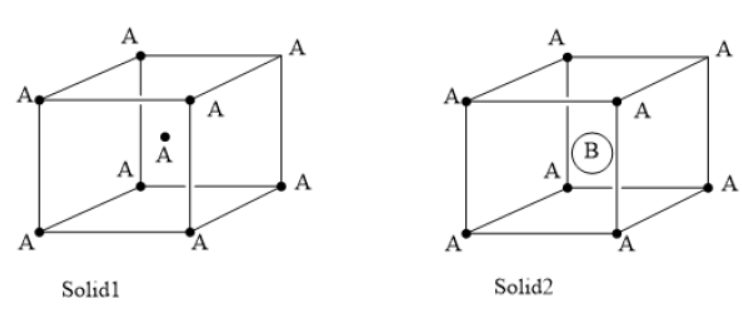
(a) 45%
(b) 65%
(c) 90%
(d) 75%
Answer: C
Question. A crystalline solid has a cubic structure in which tungsten (W) atoms are located at cubic corners of the unit cell, oxygen atoms at edges of the cube and sodium atom at the cube centre. The molecular formula of the compound is
(a) Na2WO3
(b) NaWO4
(c) NaWO3
(d) Na2WO4
Answer: C
Question. If ‘a’ stands for edge length of cubic systems: body centered and face centered cubic then the ratio of the radii of the sphere in these systems will be respectively
(a) √ 3 a: a/√ 2
(b) √ 3 a/2: √ 2 a/2
(c) √ 3 a/4:a/2√ 2
(d) √ 3 a: √ 2 a
Answer: C
Question. In a face-centred cubic lattice, a unit cell is shared equally by how many unit cells?
(a) 2
(b) 4
(c) 6
(d) 8
Answer : C
Question. When Zn converts from melted state to its solid state, it has hcp structure, then find the number of nearest atoms.
(a) 6
(b) 8
(c) 12
(d) 4
Answer : C
Question. A compound is formed by cation C and anion A.
The anions form hexagonal close packed (hcp) lattice and the cations occupy 75% of octahedral voids. The formula of the compound is
(a) C4A3
(b) C2A3
(c) C3A2
(d) C3A4
Answer : D
Question. In calcium fluoride, having the fluorite structure, the coordination numbers for calcium ion (Ca2+) and fluoride ion (F–) are
(a) 4 and 2
(b) 6 and 6
(c) 8 and 4
(d) 4 and 8
Answer : C
Question. The ionic radii of A+ and B– ions are 0.98 × 10⁻¹⁰ m and 1.81 × 10⁻¹⁰ m. The coordination number of each ion in AB is
(a) 8
(b) 2
(c) 6
(d) 4
Answer : C
Question. Lithium has a bcc structure. Its density is 530 kg m–3 and its atomic mass is 6.94 g mol–1. Calculate the edge length of a unit cell of lithium metal. (NA = 6.02 × 10²³ mol–1)
(a) 527 pm
(b) 264 pm
(c) 154 pm
(d) 352 pm
Answer : D
Question. A metal has a fcc lattice. The edge length of the unit cell is 404 pm. The density of the metal is 2.72 g cm–3.
The molar mass of the metal is (NA Avogadro’s constant = 6.02 × 10²³ mol–1)
(a) 27 g mol–1
(b) 20 g mol–1
(c) 40 g mol–1
(d) 30 g mol–1
Answer : A
Question. The number of octahedral void(s) per atom present in a cubic close-packed structure is
(a) 1
(b) 3
(c) 2
(d) 4
Answer : A
Question. A compound formed by elements X and Y crystallises in a cubic structure in which the X atoms are at the corners of a cube and the Y atoms are at the facecentres.
The formula of the compound is
(a) XY3
(b) X3Y
(c) XY
(d) XY2
Answer : A
Question. In cube of any crystal A-atom placed at every corners and B-atom placed at every centre of face. The formula of compound is
(a) AB
(b) AB3
(c) A2B2
(d) A2B3
Answer : B
Assertion Reason Based Question :
(a) Assertion and Reason both are correct statements and Reason is correct explanation for Assertion.
(b) Assertion and Reason both are correct statements but Reason is not correct explanation for Assertion.
(c) Assertion is correct statement but Reason is wrong statement.
(d) Assertion is wrong statement but Reason is correct statement.
Question. Assertion : In closed packed structure the number of tetrahedral void is twice the number of atoms present
Reason : Tetrahedral voids are located above each atom in the first layer and below each atom in second layer
Answer: A
Question. Assertion : Semiconductors show some conductivity.
Reason : They have only small difference in energy between the filled valence band and empty conduction band.
Answer: A
Question. Assertion: Fe3O4 is an example of ferrimagnetism.
Reason: Ferrimagnetism has resulting net magnetic moment
Answer: B
Question. Assertion : Distance between the nearest lattice points in BCC is greater than the same in FCC having same edge length
Reason: FCC has greater packing efficiency than BCC.
Answer: A
ONE MARK QUESTIONS
1.What is meant by forbidden zone in reference to band theory of solids?
2. Refractive index of a solid is observed to have the same value along all directions. Comment on the nature of this solid. Would it show cleavage property?
3. Write the formula of a compound in which the element Y forms ccplattice and atoms of X occupies 1/3rd of tetrahedral voids.
4. An alloy of gold and cadmium crystallizes with a cubic structure in which gold atoms occupies the corners and cadmium atoms fit into the face center. Assign formula of this alloy.
TWO MARK QUESTIONS
1.Iron has a bcc unit cell with a cell dimension of 286.65pm. The density of Fe is7.874gcm-3. Use this information to calculate Avogadro’s number. (Fe = 55.845u)
2.Silver crystallizes in fcc unit cell. If the edge length of Ag atom is 4.07 x 10⁻⁸ cm and density of silver is 10.5 g cm-3calculate the atomic mass of silver.
3.An element crystallizes in fcc structure with edge length 200pm. Calculate the density if 200g of the element contains 24 x 1023 atoms.
4.How are the following properties of crystal affected by Schottky and Frenkel defect:
a) Density
b) Electrical conductivity
5.a) Why does the presence of excess of lithium make LiCl crystals pink?
b) Calculate the number of atoms in cube based unit cell having one atom on each corner and two atoms on its each body diagonal.
2. Explain the following properties giving suitable examples:
a) Ferromagnetism
b) Para magnetism
c) Ferrimagnetism
3. An element A crystallizes in fcc structure. 208g of it have 4.28 x 1024 atoms. Calculate the edge length if the density is 7.2g/cc.
4. An element crystallizes in cubic structure. The edge length of the unit cell is 350pm. If its molar mass is 6.94g/mole, and the density 0.534g/cc, how many atoms are present in one unit cell of the element?
5. Define the following : (i) Schottky defect (ii) Frenkel defect (iii) F-centre
FIVE MARKS QUESTIONS
1. Differentiate between:
a) Face centered and end centered unit cells
b) Ferromagnetic and ferrimagnetic substances
c) n-type and p-type semiconductors
d) Tetragonal and orthorhombic unit cells
e) Crystal lattice and unit cell
1 MARK QUESTIONS
Question. What type of solids are electrical conductors, malleable and ductile?
Answer : metallic
Question. Give the significance of lattice point.
Answer : It signifies position of constituent particles of the unit cell
Question. Name the parameters that characterize the unit cell
Answer : edge lengths a,b,c and angles (alpha,beta,&gamma)
Question. What is the two dimensional coordination number of a molecule in square close packed structure.
Answer : 4
Question. Which of the following lattice has the highest packing efficiency, (I) simple cubic (II) BCC (III) HCP
Answer : hcp
Question. What type of stoichiometric defect is shown by ( i) ZnS (ii) AgBr
Answer : (i). frenkel (ii). Both schottky and frenkel
Question. What type of substances make better permanent magnets? Justify your answer.
Answer : ferromagnetic, domains aligned in the same direction
Question. Why glass is considered as super cooled liquid?
Answer : pseudo solid or shows fluidity
Question. Why KCl appear s pink when heated in K vapors ?
Answer : F- centres
Question. Give the relationship between density and edge length in an unit cell.
Answer : density = Z .M/a3.NA
Question. what is F-centre?
Answer : vacant anionic sites occupied by electrons
Question. Give the coordination number of fcc structure.
Answer : 12
Question. Give an example of a solid that shows both schottky and frenkel defect
Answer : AgBr
Question. What defect is observed when CdCl2 is doped with AgCl?
Answer : impurity defect
Question. Give an example of a network solid.
Answer : SiC
Question. Give an example each of 13-15 & 12-16 compounds
Answer : AlP,ZnS
Question. How is quartz different from quartz glass?
Answer : long range order of constituents in quartz, short range order of constituents in quartz glass
Question. What is a semiconductor?
Answer : energy gap between valence band and conduction band is small or conductivity range is between 10-6ohm-1 m-1 to 104 ohm-1 m-1
Question. FeO is mostly found with a composition of Fe0.95 O 1.00 . Why?
Answer : Metal deficiency defect
Question. What is a n-type semiconductor?
Answer : When a group -14 element is doped with gr-15 element an electron 0f gr-15 element remains as free electron. That increases conductivity
2 MARKS QUESTIONS
Question. The edge length of a unit cell having molecular weight 75g/mol is 5 A0 which crystallizes in bcc lattice . If the density is 2g/cc then find the radius of the metal atom.
Answer : r = 216.5pm
Question. Potssium crystallizes in bcc lattice. Calculate the approximate number of unit cell in 1gm of potassium. (atomic mass of K = 39)
Answer : 7.72*1021
Question. A compound is formed by two elements M &N .The element N forms ccp & atoms of M occupy 1/3rd of tetrahedral voids. What is the formula of the compound?
Answer : M2N3
Question. A unit cell consists of a cube in which there are atoms A at the corners and atoms B at the face centres.Two A atoms are missing from the two corners of a unit cell.Whati is the formula of the compound.
Answer : AB4
Question. Analysis shows that nickel oxide has formula Ni 0.98 O 1.00 .What fraction of nickel exist as Ni 2+ and Ni 3+.
Answer : Ni 2+ = 96% Ni 3+ = 4%
Question. If NaCl is doped with 10-3 mol % of SrCl 2 . What is the concentration of cation vacancy?
Answer : 10 -3 /100 mol = 10-5 x 6.022 x 1023 = 6.022 x 10¹⁸
Question. Under what conditions will sodium chloride conduct electricity
Answer : molten state or in aq. Solution
Question. Name the binding force in each of the following. (a) Molecular (b) Ionic (c) Covalent (d) Metallic.
Answer : (a) vanderwaals forces (b) electrostatic (c) covalent bond (d) metallic bond
Question. Differentiate between anisotropy & isotropy by giving examples.
Answer : Substances show different properties in diffrent direction & the reverse
Question. Derive the relationship between edge length and radius of atom in fcc unit cell.
Answer : a = 2.2 1/2 r
3 MARKS QUESTION
Question. Calcium metal crystalises in a fcc lattice with edge length of 0.556nm calculate the density of the metal if it contains , (i) 0.5% frenkel defect (ii) 0.2% schottky defect.
Answer : (i) d =1.5458g cm-3 (ii)1.5427g cm-3
Question. How is ferromagnetism different from paramagnetism & antiferromagnetism & explain what type substances show antiferromagnetism
Answer : Attracted strongly by magnetic field ,paramagnetic substances are weakly attracted ,antiferromagnetic substances not attracted
Question. What is electrical conductivity due to in (i) metals (ii) ionic solids (iii) semiconductors
Answer : due to flow of electrons
b. flow of ions in solution or melt and defects in solid
c. due to presence of impurities and defects
Question. What is the difference between schottky defect & frenkel defect .
Answer : Schottjy defect- vacancy defect,density lowers frenkel defect- interstitial defect density is not affected.
Question. How would account for the following
a. Frenkel defcts are not found in alkali metal halides.
b. schottky defects lower the density of related solids.
c. impurity dopped silicon is a semiconductor .
Answer : (i) similar size of cations and anions
(ii) equal no of cations and anions are missing results into decrease in mass
(iii) due to presence of free electrons or creation of positive hole.
Question. Define the following terms in relation to crystaline solids
a. Unit cell
b. co ordination number
c. P- type semiconductor
Answer : (i) it is the smallest portion of the crystal lattice which when repeated in all directions gives the entire lattice.
(ii) Number of nearest neighbour iii) gr-14 doped with gr-13 creates positive hole
Important Questions for NCERT Class 12 Chemistry Solid State
Question. CsBr crystallises in a body-centred cubic lattice. The unit cell length is 436.6 pm. Given that the atomic mass of Cs = 133 and that of Br = 80 amu and Avogadro number being 6.02 × 10²³ mol–1, the density of CsBr is
(a) 4.25 g/cm3
(b) 42.5 g/cm3
(c) 0.425 g/cm3
(d) 8.25 g/cm3
Answer : A
Question. With which one of the following elements silicon should be doped so as to give p-type of semiconductor?
(a) Selenium
(b) Boron
(c) Germanium
(d) Arsenic
Answer : B
Question. If NaCl is doped with 10–4 mol % of SrCl2,the concentration of cation vacancies will be (NA = 6.02 × 10²³ mol–1)
(a) 6.02 × 10¹⁶ mol–1
(b) 6.02 × 10¹⁷ mol–1
(c) 6.02 × 10¹⁴ mol–1
(d) 6.02 × 10¹⁵ mol–1
Answer : B
Question. An element (atomic mass = 100 g/mol) having bcc structure has unit cell edge 400 pm. The density of element is
(a) 7.289 g/cm3
(b) 2.144 g/cm3
(c) 10.376 g/cm3
(d) 5.188 g/cm3
Answer : D
Question. Formula of nickel oxide with metal deficiency defect in its crystal is Ni0.98O. The crystal contains Ni2+ and Ni3+ ions. The fraction of nickel existing as Ni2+ ions in the crystal is
(a) 0.96
(b) 0.04
(c) 0.50
(d) 0.3
Answer : A
Question. The correct statement regarding defects in crystalline solids is
(a) Frenkel defects decrease the density of crystalline solids
(b) Frenkel defect is a dislocation defect
(c) Frenkel defect is found in halides of alkaline metals
(d) Schottky defects have no effect on the density of crystalline solids.
Answer : B
Question. The appearance of colour in solid alkali metal halides is generally due to
(a) interstitial positions
(b) F-centres
(c) Schottky defect
(d) Frenkel defect.
Answer : B
Question. Schottky defect in crystals is observed when
(a) density of the crystal is increased
(b) unequal number of cations and anions are missing from the lattice
(c) an ion leaves its normal site and occupies an interstitial site
(d) equal number of cations and anions are missing from the lattice
Answer : D
Question. Copper crystallises in a face-centred cubic lattice with a unit cell length of 361 pm. What is the radius of copper atom in pm?
(a) 157
(b) 181
(c) 108
(d) 128
Answer : D
Question. Which of the following statements is not correct?
(a) The number of carbon atoms in a unit cell of diamond is 8.
(b) The number of Bravais lattices in which a crystal can be categorized is 14.
(c) The fraction of the total volume occupied by the atoms in a primitive cell is 0.48.
(d) Molecular solids are generally volatile.
Answer : C
Question. Ionic solids, with Schottky defects, contain in their structure
(a) cation vacancies only
(b) cation vacancies and interstitial cations
(c) equal number of cation and anion vacancies
(d) anion vacancies and interstitial anions.
Answer : c
Question. Which is the incorrect statement?
(a) Density decreases in case of crystals with Schottky defect.
(b) NaCl(s) is insulator, silicon is semiconductor, silver is conductor, quartz is piezoelectric crystal.
(c) Frenkel defect is favoured in those ionic compounds in which sizes of cation and anions are almost equal.
(d) FeO0.98 has non-stoichiometric metal deficiency defect.
Answer : C,D
Question. If we mix a pentavalent impurity in a crystal lattice of germanium, what type of semiconductor formation will occur?
(a) n-type semiconductor
(b) p-type semiconductor
(c) Both (a) and (b)
(d) None of these
Answer : A
Question. On doping Ge metal with a little of In or Ga, one gets
(a) p-type semiconductor
(b) n-type semiconductor
(c) insulator
(d) rectifier.
Answer : A
Question. What is photovoltaic cell?
Answer : device which converts sunlight into electrical energy.
Question. What do you mean by the term Doping?
Answer : Introduction of defects in solid by incorporating foreign particles.
Question. What the term 12 – 16 compounds stand for?
Answer : compounds formed by combination of group 12 elements and group 16 elements.e.gZnS
Question. What is the number of tetrahedral voids in a ccp structure of solid?
Answer : 2N or 8
Question. Crystalline solids are anisotropic in nature.comment on this statement.
Answer : a single property differs in different direction in solids.
Question. What is the percentage efficiency of a solid whose particles are having ccp structure?
Answer : 74%
Question. LiCl crystal appears to be pink in colour .Why?
Answer : presence of F – centre .
Question. WhenGe is doped with slight amount of In,what type of semiconductor will be formed?
Answer : p – type semiconductor
Question. Metal deficiency defect with extra anions in interstitial sites can’t be produced in solids.Why?
Answer : usually anions are larger in size and hence donot fit into interstitial sites
Question. The electrical conductivity of semiconductors increases with increase in temperature but in case of metals conductivity decreases with rise in temp. Why?
Answer : kernels makesxibration and creates obstacles in the motion of electrons in case of metals.
Question. The window panes seem to be thicker at the bottom in case of old buildings.what can be the reason?
Answer : Glass is supercooled liquid and has floed under the influence of gravity.
Question. Assign the relationship between edge length (a,b,c) and values of α,β and ϒ for tetragonal unit cell.
Answer : a = b ≠ c, α =β =ϒ =900
Question. Give an example of solid which can exhibit schottky defect as well as frenkel defect.
Answer : AgBr.
Question. Atoms of element A are occupying all the octrahedral voids while atoms of B are in 1/4thtetrahedral voids and atoms of C are arranged in hexagonal arrays .what will be the formula of the compound?
Answer : A2BC2
Question. What is the co-ordination number of a particle in ccp structure?
Answer : 12
Question. What happens when Na vapours is passed over crystalline NaCl?
Answer : Appears yellow due to creation of F – centre.
Question. Ferromagnetic and ferrimagneetic solids on heating converted into paramagnetic in nature.justify the reason.
Answer : Due to randomization of electrons.
Question. Gjass is assumed to be supercooledliquid.why?
Answer : Flowing tendency under influence of gravity.
Question. Give an example of solid which has its structure as fluorite type structure.
Answer : CaF2
Question. Copper is conducting as such while copper sulphate is conducting only in aqueous solution .why?
Answer : Copper is electronic conductor but copper sulphate is ionic conductor so ions are free only in molten or in aqueous state.
Question. Potassium crystallizes in a BCC Lattice. Find number of unit cells in one gram of potassium. (K = 39u)
Answer : 7.72×10²¹
Question. The edge length of unit cell of a metal having molecular mass 75g/mol is 5A◦ which crystallizes in cubic lattice. If the density is 2g/cc, find the radius of metal atom.
Answer : 216.5pm
Question. The metal Calcium crystallizes in a FCC unit cell with A = 0.556nm. Find the density of the metal if (Ca =40u)
i. It contains 0.2% Frenkel defects
ii. It contains 0.1% Schottky defect.
Answer : i. 1.5463
ii. 1.5448g/cm3
Question. Analysis shows that a metal oxide has an emperical formula M0.96O. Find the percentage of M2+ and M3+ ion in the sample.
Answer : 91.67%; 8.33%
Question. Metal crystallizes in 2 cubic phases FCC and BCC whose unit cell lengths are 3.5A◦ and 3.0A◦ respectively. Find the ratio of the densities of FCC and BCC.
Answer : 1.259
Question. An element ‘X’ with at mass of 60g/mol has density of 6.23gcm3. If the edge length of its cubic unit cell is 400pm. Identify the type of cubic unit cell. Find the radius of an atom of this element.
Answer : Z = 4; R = 141.4pm
Question. An element with molar mass 2.7×10⁻²kg/mol forms a cubic unit cell with edge length 405pm. If the density is 2.7×10³kg/m3. What is the nature of this cubic unit cell?
Answer : 4 FCC
Question. Silver crystallizes in FCC lattice. If edge length of this cell is 4.077×10⁻⁸cm and density us 10.5gm/cm3.
Find the atomic mass of silver.
Answer : 107.12g
Question. Niobium crystallizes in BCC structure. If the density is 8.55g/cm3. Find the radius of niobium using its atomic mass 93u.
Answer : 14.29×10⁻⁷cm
Question. Aluminum crystallizes in cubic close-packed structure gets metallic radius is 125pm.
i. What is the length of the side of unit cell
ii. How many unit cells are there in 1cm3 of Aluminum?
Answer : i. 354pm
ii. 2.26×1028
Question. An element (atomic mass 60) having FCC unit cell has the density of 6.23g/cm3. What is the edge length of this cell?
Answer : 400pm
Question. A BCC unit cell has density 10.3g/cm3 with edge length 314pm. Find atomic mass.
Answer : 96g
Question. Find the type of cubic lattice to which the iron crystal belongs if its unit cell has an edge length of 286pm and density of iron is 7.86g/cm3
Answer : 2 BCC
Question. An element (A) crystallizes in FCC structure, 200g of this element has 4.12×1024 atoms. The density of A is 7.2g/cm3. Find the edge length of unit cell.
Answer : 6.46A◦
Question. Lithium metal has a BCC structure. Its density is 0.53 g/cm3 and its atomic mass is 6.94g/mol. Find the volume.
Answer : 4.348×10⁻²³cm3
Question. Sodium crystallizes in cubic lattices and the edge of the unit cell 430pm. Find the number of atoms in the unit cell. Density is 0.9623g/cm3
Answer : Z=2
Question. Chromium crystallis3es in BCC structure with edge 286pm. Find atomic radius, number of atoms per unit cell and density.
Answer : 124.27pm; 27.3g/cm3
Question. The nearest neighbor silver atom in the silver crystal are 287pm apart. What is the density of silver? It forms FCC structure and molecular mass of silver is 107.87g/mol.
Answer : 10.72g/cm3
Question. Iron metal has BCC with edge 286.65pm. The density is 7.87 g/cm3. Find Avogadro’s number.
Answer : 6.043×10²³
Question. Silver crystallizes in FCC with side length with side length of 409pm. What is the radius of an atom of silver?
Answer : 144.6pm
Close Packing of Solids
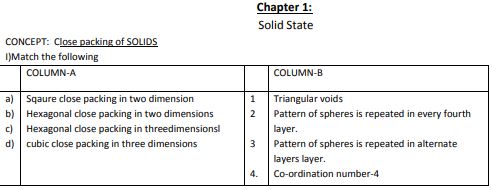
Question. Match the following columns for close packing of solids:
COLUMN-A
(a) Square close packing in two dimensions
(b) Hexagonal close packing in two dimensions
(c) Hexagonal close packing in three dimensions
(d) Cubic close packing in three dimensions
COLUMN-B
(1) Triangular voids
(2) Pattern of spheres is repeated in every fourth layer.
(3) Pattern of spheres is repeated in alternate layers.
(4) Co-ordination number-4
Answer: (a) - 4, (b) - 1, (c) - 3, (d) - 2
Question. Percentage of empty space in a body centre cubic arrangement is
(a) 74
(b) 32
(c) 26
(d) 68
Answer: (b) 32
Question. The total no of tetrahedral voids in fcc is
(a) 6
(b) 8
(c) 10
(d) 12
Answer: (b) 8
Question. Which of the following statement is/ are not true in the hexagonal close packing.
(a) Packing efficiency 74%
(b) C.N=12
(c) Tetrahedral voids of the second layer are covered by the spheres of the third layers.
(d) Spheres of the fourth layer are exactly aligned with those of the first layer
Answer: (d) Spheres of the fourth layer are exactly aligned with those of the first layer
Question. In which pair most efficient packing is present.
(a) hcp & bcc
(b) bcc & ccp
(c) hcp & ccp
(d) bcc & simple cubic
Answer: (c) hcp & ccp
Question. In which of the arrangement octahedral voids are formed
(a) hcp
(b) bcc
(c) fcc
(d) simple cubic
Answer: (c) fcc
Question. The C.N of each sphere in hcp is ----------- while that of bcc is __________.
Answer: 12 & 8
Question. An octahedral void is ----------------times larger than a tetrahedral void.
Answer: two
Question. ABAB… type of packing is called---------- where as ABCABC…type of packing is called fcc.
Answer: HCP
Question. For bcc, r=\( 3^{1/2} a /4 \), then for fcc, r=---------.
Answer: \( \sqrt{2} a/4 \)
Classification of Solids
Question. Match the following columns for classification of solids:
COLUMN-A
(a) Ionic crystal
(b) Metallic crystal
(c) Covalent crystal
(d) Non polar crystal
(e) Hydrogen bonded crystal
COLUMN-B
(1) Graphite
(2) Ice
(3) MgO
(4) Gold
(5) Dry ice
Answer: (a) - 3, (b) - 4, (c) - 1, (d) - 5, (e) - 2
Question. Which of the following is a network solid?
(a) \( \text{I}_2 \)
(b) \( \text{SO}_2 \) (solid)
(c) Diamond
(d) Argon
Answer: (c) Diamond
Question. Which of the following is not an electrical conductor?
(a) only b
(b) only c
(c) a & d
(d) b, c & d
Answer: (c) a & d
Question. Which of the following is not a characteristic of a crystalline solid?
(a) True solid
(b) long range order
(c) isotropic in nature
(d) definite heat of fusion
Answer: (c) isotropic in nature
Question. A solid is very hard, electrical insulator in solid state as well as in molten state & melts at extremely high temperature . It may be
(a) covalent solid
(b) metallic solid
(c) molecular solid
(d) ionic solid
Answer: (a) covalent solid
Question. Iodine molecules are held in crystals by
(a) London forces
(b) coulombic forces
(c) dipole- dipole interactions
(d) covalent bonds
Answer: (a) London forces
Question. Graphite is a good conductor due to presence of -----------.
Answer: Free electrons
Question. Glass is a ---------- solid as it shows fluidity.
Answer: Pseudo solid
Question. If the electrical conductivity is same in all direction through a solid the substance is an amorphous solid & this property is called ------------.
Answer: Isotropy
Defects in Crystals
Question. Match the following columns for defects in crystals:
COLUMN-A
(a) Schottky defect
(b) Doping silicon with aluminium
(c) Doping silicon with arsenic
(d) Heating NaCl crystal in presence of sodium vapour.
(e) Impurity defects
COLUMN-B
(1) Crystals become coloured
(2) n-type of semiconductors are formed
(3) NaCl with \( \text{Sr}^{+2} \) & some cationic sites vacant.
(4) Density of the crystals decreases
(5) p-type of semiconductor is formed
Answer: (a) - 4, (b) - 5, (c) - 2, (d) - 1, (e) - 3
Question. Which kind of defects are introduced by doping?
(a) dislocation defect
(b) Schottky defect
(c) Frenkel defect
(d) Electronic defects
Answer: (a) dislocation defect
Question. Which of the following is also known as dislocation defect?
(a) Schottky defect
(b) Frenkel defect
(c) nonstoichiometric defect
(d) simple interstitial defect
Answer: (b) Frenkel defect
Question. Which of the following defects are shown by AgBr?
(a) i
(b) ii
(c) iii
(d) iv
Answer: (a) i
Question. To get an n-type of semiconductor from silicon it should be doped with a substance with valence --------electrons
(a) 1
(b) 2
(c) 3
(d) 5
Answer: (d) 5
Question. Schottky defect is observed in the crystal when
(a) some cations move from their lattice sites to interstitial sites
(b) equal number of cations and anions are missing from the lattice
(c) some lattice sites are occupied by the electrons
(d) some impurity is present in the lattice
Answer: (b) equal number of cations and anions are missing from the lattice
Question. NaCl crystals have some yellow colour is due to the presence of -----------.
Answer: F-centre
Question. The process of adding impurities to a crystalline substance so as to change its properties like conductivities etc is called ----------------
Answer: doping
Question. Frenkel defect is shown by crystals having low coordination number & ---------- difference in the size of the cations & anions.
Answer: large
Question. Schottky defect in ionic crystals always results in --------- of density.
Answer: decrease
Question. ----------- crystal defect is produced when NaCl is doped with \( \text{MgCl}_2 \).
Answer: impurity defect
Solid State - Practice Cards
Question. The excess of lithium in LiCl makes it pink is due to -----------------------------
Answer: F-centre
Question. The compound that shows both Schottky and Frenkel defect is -----------------------
Answer: AgBr
Question. Doping ---------(minimizes, maximizes) the forbidden energy gap.
Answer: minimizes
Question. The forbidden energy is maximum in -------- ( Ge, Mg, NaCl, Ge doped with In )
Answer: NaCl
Question. Which one show metal excess defects ( FeO, ZnO)
Answer: ZnO
Question. When an electron is trapped in an anion vacant centre, it is called ------------------------.
Answer: F-centre
Question. Si, Ge can be doped with a group -------------- elements to produce p-type semiconductor. ( Gp- 12,13,14,15)
Answer: 13
Question. Solar cell is an efficient -------------------------- ( photo-diode, photo-triode)
Answer: photo-diode
Question. Diode acts as a ------- ( rectifier, amplifier)
Answer: rectifier
Question. ---------------- oxide is like metallic cu in its conductivity and appearance .
Answer: \( \text{ReO}_3 \)
Question. The process of adding an appropriate amount of suitable impurity to increase the conductivity of an intrinsic semi-conductor like Si, Ge is called
Answer: Doping
Question. When in a substance the magnetic moments of the domains are aligned in parallel and antiparallel directions in unequal numbers, the phenomenon observed is called ----------- . (ferromagnetism, anti-ferromagnetism, ferrimagnetism)
Answer: ferrimagnetism
Question. In which type of semi-conductor, electron holes are moving towards negatively charged plate under the influence of electric field? ( p-type, n-type)
Answer: p-type
Question. If an atom is missing from its lattice site and it occupies the interstitial site, the electrical neutrality as well as the stoichiometry of the compound are maintained. This type of defect is called -------------------- defect.
Answer: Frenkel defect
Question. The set of molecular orbitals generated due to overlap of atomic orbitals having very close in energy is called ---------
Answer: Bands
Question. Frenkel defect is shown by the crystals having --------------- (high, low) co-ordination number and ---- (large, small) difference in the size of the cations and the anions .
Answer: low, large
Question. ---------------- is a covalent crystal ( Iodine, NaCl, ice, Carborundum)
Answer: Carborundum
Question. Which one will show anisotropy? ( quartz, paraffin wax, rubber, quartz glass )
Answer: quartz
Question. ---- solids conducts electricity in molten state but not in solid state. ( molecular, ionic, metallic, covalent)
Answer: ionic
Question. ---------------- solids have very high melting point ( molecular, ionic, metallic, covalent)
Answer: covalent
Question. Solar cell is an efficient ------------------- ( photo-diode, photo-triode)
Answer: photo-diode
Question. Photovoltaic material is -------------------- ( Amorphous silicon, Pure silicon crystal)
Answer: Amorphous silicon
Question. Some of the glass from ancient civilizations which are with us are milky in appearance due to
Answer: Due to some crystallization
Question. In end-centred unit cell of an atomic substance there are four atoms per unit cell. [True/False]
Answer: False
Question. In rock-salt structure, the number of formula units per unit cell is four. [True/False]
Answer: True
Question. Schottky defects disturb the ratio of cations and anions in the compound. [True/False]
Answer: False
Question. NaCl is a paramagnetic substance. [True/False]
Answer: False
Question. A compound having radius ratio (r+/r-) in the range 0.732—1 generally has CsCl structure. [True/False]
Answer: True
Question. \( \text{Fe}_3\text{O}_4 \) is ferrimagnetic. Among the three type of arrangement, hcp, ccp, and bcc, the most efficient packing is bcc. [True/False]
Answer: False
Question. If the radius ratio is in the range 0.225—0.414 the cation prefers to be present in an octahedral void. [True/False]
Answer: False
Question. Diamond is an example of atomic solid. [True/False]
Answer: True
Question. Orthorhombic unit cell has least symmetry. [True/False]
Answer: False
Question. F-centre is a type of stoichiometric defect. [True/False]
Answer: True
Question. 14 kinds of space lattices are possible in the crystal. [True/False]
Answer: True
Question. Pure alkali halides show Frenkel Defects. [True/False]
Answer: True
Question. When temperature increases conductivity of semi-conductor decreases. [True/False]
Answer: False
Question. Frenkel defect is shown by ionic substance in which there is a large difference in the size of ions. [True/False]
Answer: True
Question. The existence of different chemical compounds in the same crystalline form is called allotropy. [True/False]
Answer: False
Free study material for Chemistry
Free CBSE Practice Worksheets: Class 12 Chemistry Unit 1 The Solid State
Download Chapter Worksheets: Class 12 Chemistry
Access structured practice worksheets for Unit 1 The Solid State aligned with the 2026 CBSE curriculum. These downloadable exercises for Class 12 Chemistry help students build accuracy and reinforce core concepts for upcoming school tests.
Concept Clarification for Unit 1 The Solid State
Built using official NCERT guidelines for Class 12 Chemistry, these practice sheets provide reliable academic support. Cross-reference your completed work with our detailed solutions to learn standard answer-writing formats for CBSE exams.
Effective Revision Strategies for School Exams
Wrap up your chapter revision by testing your knowledge against standard objective question formats. Explore our full library of free, up-to-date printable assignments to maximize your academic results in upcoming CBSE evaluations.
FAQs
You can download the latest chapter-wise printable worksheets for Class 12 Chemistry Unit 1 The Solid State for free from StudiesToday.com. These have been made as per the latest CBSE curriculum for this academic year.
Yes, Class 12 Chemistry worksheets for Unit 1 The Solid State focus on activity-based learning and also competency-style questions. This helps students to apply theoretical knowledge to practical scenarios.
Yes, we have provided solved worksheets for Class 12 Chemistry Unit 1 The Solid State to help students verify their answers instantly.
Yes, our Class 12 Chemistry test sheets are mobile-friendly PDFs and can be printed by teachers for classroom.
For Unit 1 The Solid State, regular practice with our worksheets will improve question-handling speed and help students understand all technical terms and diagrams.