

Chapter-wise Worksheets for Class 12 Chemistry: Unit 16 Chemistry in Everyday Life
Access comprehensive chapter-wise worksheets for Unit 16 Chemistry in Everyday Life using the CBSE Class 12 Chemistry Chemistry In Every Day Life Worksheet. Designed to align with the 2026-27 academic syllabus for Class 12 Chemistry, these printable practice sets help students reinforce key concepts and improve their overall exam readiness.
Practice Class 12 Chemistry Worksheets: Unit 16 Chemistry in Everyday Life
Navigate directly to the solved Chemistry worksheets using the digital viewer below. Each practice set includes detailed step-by-step solutions, allowing students to instantly cross-check their work and identify areas requiring further revision.
ONE MARK QUESTIONS
1. Name one antioxidant commonly used to increase the storage life of butter.
2. State a reason for the following statement: The use of the sweetener aspartame is limited to cold food and drinks.
TWO MARK QUESTIONS
1. What are BHT and BHA? Give their uses and structures.
2. Explain the working of
a) drugs as enzyme inhibitors
b) noradrenaline as an antidepressant
3. a) Define Antihistamine with an example.b) Which one of the following drug is an antibiotic? Morphine, Equanil , Chloramphenicol , Aspirin
4. Cimetidine and Ranitidine are better antacids than magnesium and aluminium hydroxides. Explain.
5. Explain the cleansing action of soap. Why do soaps not work in hard water?
6. a) What class of drug is Ranitidine b) If water contains dissolved Ca2+ ions, out of soaps and synthetic detergents, which will you use for cleaning clothes?
THREE MARK QUESTIONS
1. Define the terms: a) Chemotherapy b) Allosteric Centre c) Tranquillizers
2. Name :
a) The constituents of dettol
b) A substance that can be used as antiseptic as well as disinfectant.
c) An abrasive in detergents.
3. Explain the following terms with one example in each case:
a) Food preservative
b) Detergents
c) Antacids
4.Differentiate giving examples:
a) Narrow and broad spectrum antibiotics
b) Bactericidal and bacteriostatic
c) Analgesic and antipyretic
5.a) Differentiate between disinfectant and an antiseptic. Give one example of each. b) What is tincture of iodine and what is it used for? (2011)
VALUEBASED QUESTION
1.Seeing the growing cases of diabetes and depression among youngchildren, Mr. Lugani, the principal of one reputed school organized aseminar in which he invited parents and principals. They all resolvedthis issue by strictly banning junk food in schools and introducinghealthy snacks and drinks like soup, lassi, milk, etc. in school canteens.They also decided to make compulsory half an hour of daily physicalactivities for the students in the morning assembly. After six months, Mr. Lugani conducted the health survey in most of the schools anddiscovered a tremendous improvement in the health of the students. After reading the above passage, answer the following questions :
a) What are the values (at least two) displayed by Mr. Lugani?
b) As a student, how can you spread awareness about this issue?
c) What are antidepressant drugs? Give an example.
d) Name the sweetening agent used in the preparation of sweets for a diabetic patient.
1. Name a drug which is an analgesic and antipyretic?
A:aspirin
2. Elucidate the structural differences between biodegradable and non- bio degradable detergent?
A:Biodegradable detergents have straight chains Eg:sodium dodecyl benzene sulphonate.Nonbiodegradable detergents have branched chains Eg:sodium(1,3,5,7- tetramethyloctyl)benzene sulphonate.
3. Why are ranitidine and cimetidine better antacids than sodium bicarbonate?
A:Sodium bicarbonate if taken in excess makes the stomach alkaline and thus more HCl is released which causes ulcers.
Whereas ranitidine prevent the interaction of histamineinthe stomach wall and thus lesser release of HCl.
4. Though saccharin is 550 times sweeter than sugar it is used as a sweetening agent by diabetic patient. Why?
A:as it is eliminated in urine and provide less calorie.
5. Distinguish between drugs and medicine.
A:Drugs have addictive action but medicine is not addictive in nature.
6. If water contains (CaHCO3)2,out of soap and detergent which one will you choose for cleaning clothes.?
A:Calcium ion forms scum, hence detergents are preferred.
7. Why cationic detergent has limited use?
A:they are quarternary ammonium salts of amines with acetates, chlorides, bromides. As they have germicidal properties and are expensive so are of limited use.
8. While antacids and antiallergic drugs interfere with the function of histamine. Why do not interfere with the function of each other?Explain.
A:As they work on different receptors .eg release of histamine causes allergy and also causes acidity due to release of HCl.But antihistamine removes allergy while antacids remove acidic.
9. Aspirin helps in prevention of heart attack.
A:Dueto its anti-blood clotting action.
10. Give One example of drugs used as antiseptics and disinfectants.?
A: 0.2% solution of phenol is an antiseptic while its one % solution disinfectant.
Question. Why do we need to classify drugs in different ways?
Answer : The classification of drugs and the reasons for classification are as follows:
(i) On the basis of pharmacological effect:
This classification provides doctors the whole range of drugs available for the treatment of a particular type of problem. Hence, such a classification is very useful to doctors.
(ii) On the basis of drug action:
This classification is based on the action of a drug on a particular biochemical process.
Thus, this classification is important.
(iii) On the basis of chemical structure:
This classification provides the range of drugs sharing common structural features and often having similar pharmacological activity.
(iv) On the basis of molecular targets:
This classification provides medicinal chemists the drugs having the same mechanism of action on targets. Hence, it is the most useful to medicinal chemists.
Question. Explain the term target molecules or drug targets as used in medicinal chemistry.
Answer : In medicinal chemistry, drug targets refer to the key molecules involved in certain metabolic pathways that result in specific diseases. Carbohydrates, proteins, lipids, and nucleic acids are examples of drug targets.
Drugs are chemical agents designed to inhibit these target molecules by binding with the active sites of the key molecules.
Question. Name the macromolecules that are chosen as drug targets.
Answer : The macromolecules chosen as drug targets are carbohydrates, lipids, proteins, and nucleic acids.
Question. Why should not medicines be taken without consulting doctors?
Answer : A medicine can bind to more than one receptor site. Thus, a medicine may be toxic for some receptor sites. Further, in most cases, medicines cause harmful effects when taken in higher doses than recommended. As a result, medicines may be poisonous in such cases. Hence, medicines should not be taken without consulting doctors.
Question. Define the term chemotherapy.
Answer : The use of chemicals for therapeutic effect is called chemotherapy. For example: the use of chemicals in the diagnosis, prevention, and treatment of diseases
Question. Which forces are involved in holding the drugs to the active site of enzymes?
vEither of the following forces can be involved in holding drugs to the active sites of enzymes.
(i) Ionic bonding
(ii) Hydrogen bonding
(iii) Dipole − dipole interaction
(iv) van der Waals force
Question. While antacids and antiallergic drugs interfere with the function of histamines, why do these not interfere with the function of each other?
Answer : Specific drugs affect particular receptors. Antacids and anti-allergic drugs work on different receptors. This is the reason why antacids and anti-allergic drugs do not interfere with each other’s functions, but interfere with the functions of histamines.
Question. Low level of noradrenaline is the cause of depression. What types of drugs are needed to cure this problem? Name two drugs.
Answer : Anti-depressant drugs are needed to counteract the effect of depression. These drugs inhibit enzymes catalysing the degradation of the neurotransmitter, noradrenaline. As a result, the important neurotransmitter is slowly metabolised and then it can activate its receptor for longer periods of time.
Two anti-depressant drugs are:
(i) Iproniazid
(ii) Phenelzine
Question. What is meant by the term ‘broad spectrum antibiotics’? Explain.
Answer : Antibiotics that are effective against a wide range of gram-positive and gram-negative bacteria are known as broad spectrum antibiotics. Chloramphenicol is a broad spectrum antibiotic.
It can be used for the treatment of typhoid, dysentery, acute fever, pneumonia, meningitis, and certain forms of urinary infections. Two other broad spectrum antibiotics are vancomycin and ofloxacin. Ampicillin and amoxicillin −synthetically modified from penicillin − are also broad spectrum antibiotics.
Question. How do antiseptics differ from disinfectants? Give one example of each.
Answer : Antiseptics and disinfectants are effective against micro-organisms. However, antiseptics are applied to the living tissues such as wounds, cuts, ulcers, and diseased skin surfaces, while disinfectants are applied to inanimate objects such as floors, drainage system, instruments, etc. Disinfectants are harmful to the living tissues. Iodine is an example of a strong antiseptic. Tincture of iodine (2 − 3 percent of solution of iodine in alcohol − water mixture) is applied to wounds. 1 percent solution of phenol is used as a disinfectant.
Question. Why are cimetidine and ranitidine better antacids than sodium hydrogen carbonate or magnesium or aluminium hydroxide?
Answer : Antacids such as sodium hydrogen carbonate, magnesium hydroxide, and aluminium hydroxide work by neutralising the excess hydrochloric acid present in the stomach.
However, the root cause for the release of excess acid remains untreated.
Cimetidine and rantidine are better antacids as they control the root cause of acidity.
These drugs prevent the interaction of histamine with the receptors present in the stomach walls. Consequently, there is a decrease in the amount of acid released by the stomach. This is why cimetidine and rantidine are better antacids than sodium hydrogen carbonate, magnesium hydroxide, and aluminium hydroxide.
Question. Name a substance which can be used as an antiseptic as well as disinfectant.
Answer : Phenol can be used as an antiseptic as well as a disinfectant. 0.2 percent solution of phenol is used as an antiseptic, while 1 per cent of its solution is used as a disinfectant.
Question. What are the main constituents of dettol?
Answer : The main constituents of dettol are chloroxylenol and α-terpineol.
Question. What is tincture of iodine? What is its use?
Answer : Tincture of iodine is a 2 − 3 percent solution of iodine in alcohol − water mixture. It is applied to wounds as an antiseptic.
Question. What are food preservatives?
Answer : Food preservatives are chemicals that prevent food from spoilage due to microbial growth. Table salt, sugar, vegetable oil, sodium benzoate (C6H3COONa), and salts of propanoic acid are some examples of food preservatives.
Question. Why is use of aspartame limited to cold foods and drinks?
Answer : Aspartame becomes unstable at cooking temperature. This is the reason why its use is limited to cold foods and drinks.
Question. What are artificial sweetening agents? Give two examples.
Answer : Artificial sweetening agents are chemicals that sweeten food. However, unlike natural sweeteners, they do not add calories to our body. They do not harm the human body. Some artificial sweeteners are aspartame, saccharin, sucrolose, and alitame.
Question. Name a sweetening agent used in the preparation of sweets for a diabetic patient.
Answer : Artificial sweetening agents such as saccharin, alitame, and aspartame can be used in preparing sweets for diabetic patients.
Question. What problem arises in using alitame as artificial sweetener?
Answer : Alitame is a high potency sweetener. It is difficult to control the sweetness of food while using alitame as an artificial sweetener.
Question. How are synthetic detergents better than soap?
Answer : Soaps work in soft water. However, they are not effective in hard water. In contrast, synthetic detergents work both in soft water and hard water.
Therefore, synthetic detergents are better than soaps.
Question. Explain the following terms with suitable examples
(i) Cationic detergents
(ii) Anionic detergents and
(iii) Non-ionic detergents
Answer : (i) Cationic detergent
Cationic detergents are quaternary ammonium salts of acetates, chlorides, or bromides.
These are called cationic detergents because the cationic part of these detergents contains a long hydrocarbon chain and a positive charge on the N atom.
For example: cetyltrimethylammonium bromide
(ii) Anionic detergents
Anionic detergents are of two types:
1.Sodium alkyl sulphates: These detergents are sodium salts of long chain alcohols.
They are prepared by first treating these alcohols with concentrated sulphuric acid and then with sodium hydroxide. Examples of these detergents include sodium lauryl sulphate (C11H23CH2OSO3−Na+) and sodium stearyl sulphate (C17H35CH2OSO3−Na+).
2. Sodium alkylbenzenesulphonates: These detergents are sodium salts of long chain alkylbenzenesulphonic acids. They are prepared by Friedel-Crafts alkylation of benzene with long chain alkyl halides or alkenes. The obtained product is first treated with concentrated sulphuric acid and then with sodium hydroxide. Sodium 4-(1-dodecy) benzenesulphonate (SDS) is an example of anionic detergents.
(iii) Non-ionic detergents
Molecules of these detergents do not contain any ions. These detergents are esters of alcohols having high molecular mass. They are obtained by reacting polyethylene glycol and stearic acid.
Question. What are biodegradable and non-biodegradable detergents? Give one example of each.
Answer : Detergents that can be degraded by bacteria are called biodegradable detergents. Such detergents have straight hydrocarbon chains. For example: sodium lauryl sulphate Detergents that cannot be degraded by bacteria are called non-biodegradable detergents. Such detergents have highly-branched hydrocarbon chains. For example: sodium -4- (1, 3, 5, 7- tetra methyl octyl) benzene sulphonate
Question. Why do soaps not work in hard water?
Answer : Soaps are sodium or potassium salts of long-chain fatty acids. Hard water contains calcium and magnesium ions. When soaps are dissolved in hard water, these ions displace sodium or potassium from their salts and form insoluble calcium or magnesium salts of fatty acids. These insoluble salts separate as scum.
This is the reason why soaps do not work in hard water.
Question. Can you use soaps and synthetic detergents to check the hardness of water?
Answer : Soaps get precipitated in hard water, but not in soft water. Therefore, soaps can be used for checking the hardness of water.
However, synthetic detergents do not get precipitated either in hard water or in soft water. Therefore, synthetic detergents cannot be used for checking the hardness of water.
Question. Explain the cleansing action of soaps.
Answer : Soap molecules form micelles around an oil droplet (dirt) in such a way that the hydrophobic parts of the stearate ions attach themselves to the oil droplet and the hydrophilic parts project outside the oil droplet. Due to the polar nature of the hydrophilic parts, the stearate ions (along with the dirt) are pulled into water, thereby removing the dirt from the cloth.
Question. If water contains dissolved calcium hydrogen carbonate, out of soaps and synthetic detergents which one will you use for cleaning clothes?
Answer : Synthetic detergents are preferred for cleaning clothes. When soaps are dissolved in water containing calcium ions, these ions form insoluble salts that are of no further use.
However, when synthetic detergents are dissolved in water containing calcium ions, these ions form soluble salts that act as cleansing agents.
Question. Label the hydrophilic and hydrophobic parts in the following compounds.
(i) CH3(CH2)10CH2OSO3-Na+
(ii) CH3(CH2)15N+(CH3)3Br-
(iii) CH3(CH2)16COO(CH2CH2O)nCH2CH2OH
Answer :
(i) CH3(CH2)10CH2 OSO3-Na+
(ii) CH3(CH2)15 N+(CH3)3Br-
(iii) CH3(CH2)16 COO(CH2CH2O)nCH2CH2OH
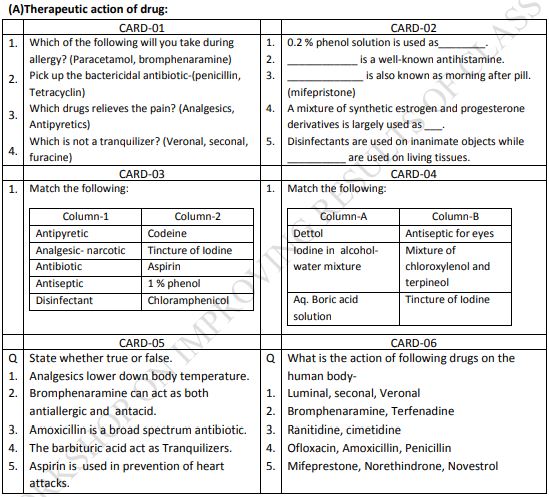
(A) Therapeutic action of drug:
CARD-01
Question 1. Which of the following will you take during allergy? (Paracetamol, bromphenaramine)
Answer: Brompheniramine is taken to manage allergic symptoms.
In simple words: Brompheniramine is an antihistamine that reduces allergy symptoms like sneezing or runny nose.
Exam Tip: Antihistamines work by blocking histamine receptors in the body, which prevents allergic reactions.
Question 2. Pick up the bactericidal antibiotic-(penicillin, Tetracyclin)
Answer: Penicillin is the bactericidal antibiotic among the given options.
In simple words: Penicillin is a medicine that kills bacteria directly.
Exam Tip: Penicillin is bactericidal (kills bacteria), whereas tetracycline is bacteriostatic (prevents bacterial replication).
Question 3. Which drugs relieves the pain? (Analgesics, Antipyretics)
Answer: Analgesics are the class of medications used to relieve pain.
In simple words: Analgesics are painkillers.
Exam Tip: Be clear that analgesics reduce pain without causing loss of consciousness, whereas antipyretics lower high body temperatures.
Question 4. Which is not a tranquilizer? (Veronal, seconal, furacine)
Answer: Furacine is not a tranquilizer; it is used as an antibacterial antiseptic.
In simple words: Furacine is used on skin cuts to prevent infection, not as a calming drug.
Exam Tip: Veronal and seconal are barbiturate drugs used as tranquilizers to control anxiety and promote sleep.
CARD-02
Question 1. 0.2 % phenol solution is used as________.
Answer: A 0.2% solution of phenol acts as an antiseptic.
In simple words: A mild phenol solution is used to kill germs on living tissues.
Exam Tip: Phenol is unique because it serves as an antiseptic at low concentrations (0.2%) and as a disinfectant at higher concentrations (1%).
Question 2. ____________ is a well-known antihistamine.
Answer: Brompheniramine (or terfenadine) is a widely recognized antihistamine.
In simple words: This medication helps block allergy triggers in the body.
Exam Tip: Synthetic antihistamines like brompheniramine are designed to treat rashes, nasal congestion, and mild allergic reactions.
Question 3. _____________ is also known as morning after pill. (mifepristone)
Answer: Mifepristone is commonly referred to as the morning after pill.
In simple words: Mifepristone is an emergency contraceptive pill.
Exam Tip: Mifepristone is an antifertility drug that works by blocking the action of progesterone hormones.
Question 4. A mixture of synthetic estrogen and progesterone derivatives is largely used as ___.
Answer: A combination of synthetic estrogen and progesterone derivatives is used as an antifertility drug.
In simple words: These hormone mixtures are used to make birth control pills.
Exam Tip: Oral contraceptives contain progesterone derivatives (like norethindrone) which suppress ovulation.
Question 5. Disinfectants are used on inanimate objects while __________ are used on living tissues.
Answer: Antiseptics are used on living tissues.
In simple words: Antiseptics clean skin wounds, while disinfectants clean floors and tables.
Exam Tip: The main difference between these two categories is tissue toxicity; antiseptics are safe to apply directly to living flesh.
CARD-03
Question 1. Match the following:
| Column-1 | Column-2 |
|---|---|
| Antipyretic | Codeine |
| Analgesic- narcotic | Tincture of Iodine |
| Antibiotic | Aspirin |
| Antiseptic | 1 % phenol |
| Disinfectant | Chloramphenicol |
Answer:
The correct matched table for the pharmaceutical categories and their drug representatives is:
| Column-1 (Drug Class) | Column-2 (Active Agent) |
|---|---|
| Antipyretic | Aspirin |
| Analgesic- narcotic | Codeine |
| Antibiotic | Chloramphenicol |
| Antiseptic | Tincture of Iodine |
| Disinfectant | 1 % phenol |
In simple words: This grid links medical functions, such as killing bacteria or stopping pain, to their correct chemical ingredients.
Exam Tip: Aspirin works as an antipyretic to lower fever and an analgesic to stop mild pain, while codeine is a strong narcotic derived from opium.
CARD-04
Question 1. Match the following:
| Column-A | Column-B |
|---|---|
| Dettol | Antiseptic for eyes |
| Iodine in alcohol-water mixture | Mixture of chloroxylenol and terpineol |
| Aq. Boric acid solution | Tincture of Iodine |
Answer:
The correct matched table is:
| Column-A (Material) | Column-B (Composition or Use) |
|---|---|
| Dettol | Mixture of chloroxylenol and terpineol |
| Iodine in alcohol-water mixture | Tincture of Iodine |
| Aq. Boric acid solution | Antiseptic for eyes |
In simple words: This match-up identifies the chemical structures of daily disinfectants and medical antiseptics.
Exam Tip: Remember that dettol is a commercial antiseptic formulation made from chloroxylenol and terpineol dissolved in water.
CARD-05
Question 1. State whether true or false. Analgesics lower down body temperature.
Answer: False.
In simple words: Analgesics are used to stop pain, not to lower body temperature.
Exam Tip: Antipyretics are the drugs designed specifically to reduce body temperature during a fever.
Question 2. State whether true or false. Bromphenaramine can act as both antiallergic and antacid.
Answer: False.
In simple words: Brompheniramine works solely to fight off allergies and does not reduce stomach acid.
Exam Tip: While some antihistamines like cimetidine double as antacids, brompheniramine is strictly used to treat allergy symptoms.
Question 3. State whether true or false. Amoxicillin is a broad spectrum antibiotic.
Answer: True.
In simple words: Amoxicillin is capable of treating many different types of bacterial infections.
Exam Tip: Broad spectrum antibiotics are highly effective against both Gram-positive and Gram-negative bacteria.
Question 4. State whether true or false. The barbituric acid act as Tranquilizers.
Answer: True.
In simple words: Barbituric acid derivatives help relax the nervous system and induce sleep.
Exam Tip: Barbiturates are non-addictive, central nervous system depressants used to manage severe sleep and mental disorders.
Question 5. State whether true or false. Aspirin is used in prevention of heart attacks.
Answer: True.
In simple words: Aspirin prevents blood clots, which helps keep the heart safe from attacks.
Exam Tip: Aspirin has anti-blood-clotting (anti-platelet) properties, making it very helpful for patients at risk of cardiovascular issues.
CARD-06
Question 1. What is the action of following drugs on the human body- Luminal, seconal, Veronal
Answer: These substances function as tranquilizers (or sleep-inducing sedatives) on the human body.
In simple words: These medicines calm the brain and help people with high anxiety or sleep issues.
Exam Tip: These compounds are barbituric acid derivatives that reduce central nervous system activity.
Question 2. What is the action of following drugs on the human body- Bromphenaramine, Terfenadine
Answer: These drugs act as antihistamines to combat allergic responses.
In simple words: They prevent allergies like runny nose and skin rashes.
Exam Tip: Antihistamines block the release of histamines, which trigger inflammatory responses during allergies.
Question 3. What is the action of following drugs on the human body- Ranitidine, cimetidine
Answer: These compounds act as antacids and antihistamines to treat acidity and stomach ulcers.
In simple words: They reduce the amount of acid produced in the stomach.
Exam Tip: Unlike simple neutralizing antacids, ranitidine works by blocking histamine receptors in the stomach wall to decrease acid production.
Question 4. What is the action of following drugs on the human body- Ofloxacin, Amoxicillin, Penicillin
Answer: These medications function as antibiotics that inhibit or destroy bacterial pathogens.
In simple words: They are powerful medicines used to cure bacterial infections.
Exam Tip: Penicillin and amoxicillin interfere with bacterial cell wall synthesis, causing the bacteria to burst and die.
Question 5. What is the action of following drugs on the human body- Mifeprestone, Norethindrone, Novestrol
Answer: These synthetic hormone derivatives function as antifertility drugs.
In simple words: These compounds are used in oral birth control pills to prevent pregnancy.
Exam Tip: They act by mimicking or blocking progesterone and estrogen to prevent ovulation and fertilization.
(B) Chemicals in food:
CARD-01
Question 1. The food additives used to prevent the oxidation of food are called_______
Answer: These substances are known as food antioxidants.
In simple words: Antioxidants stop oxygen from making packaged food go stale.
Exam Tip: Common food antioxidants include BHT (Butylated Hydroxytoluene) and BHA (Butylated Hydroxyanisole).
Question 2. The food additives used to prevent the spoilage of food due to microbes are called_______
Answer: These protective compounds are called chemical food preservatives.
In simple words: Preservatives keep food fresh by stopping mold and bacteria from growing on it.
Exam Tip: Sodium benzoate is one of the most widely used industrial food preservatives for carbonated drinks and pickles.
Question 3. The food additives that sweeten the food but do not add calorie are ________
Answer: These sweetening compounds are classified as artificial sweeteners.
In simple words: These are calorie-free sugar substitutes used in diet foods.
Exam Tip: Artificial sweeteners provide high sweetness without being digested or metabolized to generate energy in the body.
CARD-02
Question 1. State whether true or false. Sucrolose is trichloro derivative of sucrose.
Answer: True.
In simple words: Sucralose is made by replacing three hydroxyl groups on sugar with chlorine atoms.
Exam Tip: Sucralose is stable at high temperatures, making it suitable for baking and cooking.
Question 2. State whether true or false. Alitame is not largely used because the control of sweetness of food is difficult.
Answer: True.
In simple words: Alitame is so sweet that even a tiny extra pinch can make food taste way too sweet.
Exam Tip: Alitame is a high-potency sweetener that is roughly 2,000 times sweeter than regular table sugar.
Question 3. State whether true or false. Sucrolose provides calories.
Answer: False.
In simple words: Sucralose passes through the body without being digested, so it adds zero calories.
Exam Tip: Sucralose looks and tastes like sugar but is not recognized by the body as a carbohydrate, rendering it calorie-free.
Question 4. State whether true or false. Salts of sorbic acid and propanoic acid used as preservatives.
Answer: True.
In simple words: These organic salts are added to food to stop yeast and mold from growing.
Exam Tip: Sorbates and propionates are commonly used in bakery goods and cheese to extend shelf life.
CARD-03
Question 1. Match the following:
| Column-1 | Column-2 |
|---|---|
| Antioxidant | Aspartame |
| Preservative | Sugar |
| Artificial sweetener | Sodium benzoate |
| Natural sweetener | BHA |
| Artificial sweetener that breaks at cooking | Sucrolose |
Answer:
The correct matched table is:
| Column-1 (Food Additive) | Column-2 (Correct Chemical) |
|---|---|
| Antioxidant | BHA |
| Preservative | Sodium benzoate |
| Artificial sweetener | Sucrolose |
| Natural sweetener | Sugar |
| Artificial sweetener that breaks at cooking | Aspartame |
In simple words: This matching pairs food ingredients like preservatives and sweeteners with their actual scientific names.
Exam Tip: Aspartame decomposes at high temperatures, which restricts its use to cold foods and drinks.
CARD-04
Question 1. Give reason for the following: The people suffering from diabetes are advised to use artificial sweeteners.
Answer: Artificial sweeteners do not add calories or raise blood sugar levels, making them a safe sugar substitute for diabetic patients.
In simple words: Diabetic patients use these because they can enjoy a sweet taste without dangerous spikes in blood sugar.
Exam Tip: Artificial sweeteners are excreted unchanged by the kidneys, so they do not participate in carbohydrate metabolism.
Question 2. Give reason for the following: Aspartame is used in cold food items only.
Answer: Aspartame is thermally unstable and decomposes at cooking temperatures, losing its sweet taste.
In simple words: Heat breaks down aspartame, so it can only be used in cold items like ice cream and diet sodas.
Exam Tip: This thermal instability is a significant limitation of aspartame compared to heat-stable sweeteners like sucralose.
Question 3. Give reason for the following: Alitame is not much in use as artificial sweetener.
Answer: Alitame is an extremely high-potency sweetener, making it difficult to control the exact level of sweetness in food products.
In simple words: Alitame is so strong that even a microscopic extra amount makes food unpalatably sweet.
Exam Tip: Alitame is roughly 2,000 times sweeter than sucrose, which limits its practical use in domestic cooking.
Question 4. Give reason for the following: Antioxidants are generally reducing agents.
Answer: Antioxidants are strong reducing agents that react with oxygen more rapidly than food does, thereby getting oxidized themselves and preserving the food.
In simple words: They act like a shield, absorbing the oxygen before it can reach and spoil the food.
Exam Tip: By acting as radical scavengers, antioxidants sacrifice themselves to stop the chain reaction of food rancidification.
(C) Cleansing agents:
CARD-01
Question 1. Chemically soaps are sodium or potassium salts of ___________.
Answer: Soaps are sodium or potassium salts of long-chain fatty acids.
In simple words: Soaps are made by combining natural fats and oils with strong alkaline bases.
Exam Tip: Fatty acids commonly used in soap making include stearic acid, palmitic acid, and oleic acid.
Question 2. Chemically detergents are sodium or potassium salts of ___________.
Answer: Synthetic detergents are sodium or potassium salts of long-chain alkyl hydrogen sulfates or alkylbenzene sulfonic acids.
In simple words: Detergents are synthetic cleaners made from petroleum-derived chemicals.
Exam Tip: Unlike soaps, detergents contain sulfonic acid groups instead of carboxylic acid groups.
Question 3. _____________ is an example of detergent.
Answer: Sodium lauryl sulfate is a widely used synthetic detergent.
In simple words: This chemical is found in many commercial shampoos and dishwashing liquids to create foam and clean.
Exam Tip: Sodium lauryl sulfate is an anionic detergent containing a hydrophilic sulfate head group.
Question 4. _____________ is an example of soap.
Answer: Sodium stearate (or sodium palmitate) is a common example of soap.
In simple words: This is a typical soap molecule used for washing hands and skin.
Exam Tip: Soap is prepared through saponification, which is the alkaline hydrolysis of fats and oils.
Question 5. Among detergent and soap,________ Is better cleansing agent.
Answer: Synthetic detergents are better cleansing agents than soaps.
In simple words: Detergents wash clothes better because they work in any water, including hard water.
Exam Tip: Detergents maintain their cleansing efficiency even in hard water, acidic water, and cold water, making them superior to soap.
CARD-02
Question 1. Match the following:
| Column-1 | Column-2 |
|---|---|
| Cationic detergent | Sodium stearate |
| Anionic detergent | Ester of stearic acid and polyethyleneglycol |
| Non-ionic detergent | Cetyltrimethyl ammonium bromide |
| Soap | Sodium lauryl sulphate |
Answer:
The correct matched table is:
| Column-1 (Cleanser Class) | Column-2 (Chemical Example) |
|---|---|
| Cationic detergent | Cetyltrimethyl ammonium bromide |
| Anionic detergent | Sodium lauryl sulphate |
| Non-ionic detergent | Ester of stearic acid and polyethyleneglycol |
| Soap | Sodium stearate |
In simple words: This matching connects different types of detergents (positive, negative, or neutral) with their exact chemical ingredients.
Exam Tip: Cationic detergents are quaternary ammonium salts and often exhibit germicidal properties, making them common in hair conditioners.
CARD-03
Question 1. Give reason for the following: Nowadays long chain hydrocarbon is preferred over branched one to prepare detergents.
Answer: Straight-chain hydrocarbons are highly biodegradable and do not cause persistent water pollution, whereas branched-chain hydrocarbons resist bacterial breakdown.
In simple words: Straight-chain cleaners dissolve naturally and are safer for fish and rivers, unlike branched-chain ones that cause massive foam buildup.
Exam Tip: Branched-chain detergents are non-biodegradable and accumulate in rivers, creating long-lasting foam sheets that disrupt aquatic life.
Question 2. Give reason for the following: Detergents are preferred in hard water.
Answer: Detergents do not form insoluble scum in hard water because their calcium and magnesium salts are highly soluble in water.
In simple words: Detergents keep foaming and cleaning even in hard water, unlike soaps which turn into a sticky white mess.
Exam Tip: Sulfonate salts in detergents remain dissolved in the presence of calcium and magnesium ions, ensuring they clean effectively in hard water.
Question 3. Give reason for the following: Soaps form scum in hard water.
Answer: Soaps react with the dissolved calcium and magnesium ions in hard water to form insoluble calcium and magnesium salts of fatty acids, which precipitate out as scum.
In simple words: The calcium in hard water locks onto soap molecules, turning them into a sticky, useless residue instead of foam.
Exam Tip: This precipitation reaction deprives the soap of its active sodium salts, rendering it ineffective as a cleansing agent until all hard water ions are precipitated.
Question 4. Give reason for the following: NaCl is used for precipitation of soap.
Answer: Sodium chloride is added during soap manufacture to precipitate (salt out) the soap from the glycerol solution through the common ion effect.
In simple words: Adding table salt reduces the solubility of soap, forcing it to clump together at the top so it can be easily collected.
Exam Tip: This salting-out process relies on the common ion effect of sodium ions (\( \text{Na}^+ \)) to force the soap out of solution.
CARD-04
Question 1. State whether true or false. Soap can be used in hard water.
Answer: False.
In simple words: Soap cannot be used in hard water because it forms sticky, insoluble scum instead of cleaning.
Exam Tip: Hard water contains calcium and magnesium ions that precipitate soaps out of solution.
Question 2. State whether true or false. Soaps are better cleansing agents than detergents.
Answer: False.
In simple words: Detergents are superior cleansers because they work well in both hard and soft water.
Exam Tip: While detergents are better cleaners, soaps are preferred for personal hygiene because they are gentler and less irritating to the skin.
Question 3. State whether true or false. Soap solution will turn blue litmus to red.
Answer: False.
In simple words: Soap solutions are alkaline, so they turn red litmus paper blue, not the other way around.
Exam Tip: Since soaps are sodium salts of weak fatty acids and strong bases, they undergo hydrolysis in water to produce alkaline solutions.
Question 4. State whether true or false. Soap is a biodegradable polymer.
Answer: True. (Note: Soaps are biodegradable organic salts, but they are not technically macromolecular polymers; however, based on the provided worksheet answers, the statement is marked True).
In simple words: Soap molecules are easily broken down naturally by soil and water bacteria.
Exam Tip: Microorganisms can easily digest the linear hydrocarbon chains of soaps, preventing environmental accumulation.
Free study material for Chemistry
Unit 16 Chemistry in Everyday Life Printable Worksheets and Exercises for Class 12 Chemistry
Mastering Unit 16 Chemistry in Everyday Life with Printable Worksheets
Explore reliable practice questions for Unit 16 Chemistry in Everyday Life tailored for Class 12 Chemistry learners. Use these structured worksheets to evaluate exam preparedness and strengthen problem-solving skills throughout the 2026 academic session.
Verified Solutions and NCERT Alignment
Each worksheet draws directly from authorized standard textbooks to maintain academic accuracy. Evaluating your finished exercises against expert-verified solutions helps master the formal presentation standards expected in school evaluations.
Additional Study Resources for Class 12 Chemistry
Follow up your worksheet practice by attempting the interactive online MCQ tests for Unit 16 Chemistry in Everyday Life to evaluate your execution speed. All printable assignments and revision sheets on our platform are updated for the 2026 session and available free of charge.
FAQs
You can download the latest chapter-wise printable worksheets for Class 12 Chemistry Unit 16 Chemistry in Everyday Life for free from StudiesToday.com. These have been made as per the latest CBSE curriculum for this academic year.
Yes, Class 12 Chemistry worksheets for Unit 16 Chemistry in Everyday Life focus on activity-based learning and also competency-style questions. This helps students to apply theoretical knowledge to practical scenarios.
Yes, we have provided solved worksheets for Class 12 Chemistry Unit 16 Chemistry in Everyday Life to help students verify their answers instantly.
Yes, our Class 12 Chemistry test sheets are mobile-friendly PDFs and can be printed by teachers for classroom.
For Unit 16 Chemistry in Everyday Life, regular practice with our worksheets will improve question-handling speed and help students understand all technical terms and diagrams.