

Class 12 Chemistry Practice Sheet: CBSE Class 12 Chemistry Halo Alkanes And Haloarene Worksheet
Explore structured practice materials through the CBSE Class 12 Chemistry Halo Alkanes And Haloarene Worksheet. Tailored for Class 12 learners, utilizing these Chemistry worksheets ensures thorough preparation and strengthens problem-solving accuracy before final school evaluations.
Download Unit 6 Haloalkanes and Haloarenes Worksheet PDF with Answers
Navigate directly to the solved Chemistry worksheets using the digital viewer below. Each practice set includes detailed step-by-step solutions, allowing students to instantly cross-check their work and identify areas requiring further revision.
MCQ Questions for NCERT CBSE Class 12 Chemistry Halo Alkanes And Haloarene
Question. Which of the following has the highest nucleophilicity ?
(a) F-
(b) OH-
(c) CH3-
(d) NH2-
Answer: C
Question. The addition of propane with HOCl proceeds via the addition of
(a) H+ in the first step
(b) Cl+ in the first step
(c) OH- in the first step
(d) Cl+ and OH- in a single step
Answer: B
Question. Which of the following compound is allylic halide?
(a). 1- Chloropropane.
(b). 3- Chloropropene.
(c). 2- Chloropropene.
(d). 1-Chloropropene
Answer: B
Question. Aromatic nitrile (ArCN) are not prepared by the reaction:
(a) ArX. +KCN.
(b) Ar N2+ + CuCN.
(c) Ar CONH2 + P2 O5
(d) ArCONH2 + SOCl2
Answer: A
Question. In the presence of peroxide, hydrogen chloride and hydrogen iodide do not give anti markownikov’s addition to alkenes because
(a) both are high ionic.
(b) one is oxidizing and the other is reducing
(c) one of the steps are exotheric in both the cases
(d) all the Steps are exotheric in both the reaction
Answer: C
Question. 1,1 Dicholopropane on hydrolysis gives
(a) propanone.
(b) propapnal
(c) ethanol
(d) 1,1-Propanediol
Answer: B
Question. Best reagent for preparing a cholroalkane from an alcohol is…….
(a) SOCl2.
(b) HCl/ZnCl2.
(c) PCl3.
(d) Cl2/CCl4
Answer: A
Question. An SN2 reaction at an asymmetric carbon of a compound always gives
(a) an a enantiomer of the substrate
(b) a of opposite optical rotation
(c) a mixture of diastereomers
(d) a single stereoisomer
Answer: D
Question. Molecules whose mirror image is non superimposable over them are known as chiral. Which of the following molecules are chiral in nature.
(a) 2-Bromobutane
(b)1-Bromobutane
(c) 2-Bromopropane
(d) 2-Bromobutane-2-ol
Answer: A , D
Question. Toluene reacts with a chlorine in the presence of iron (lll)chloride gives ortho and Para chloro compounds . The reaction is………..
(a) Electrphilic elimination reaction
(b) Electrophilic substitution reaction
(c) Free radical substitution reaction
(d) Nucleophilic substitution reaction
Answer: B
Question. The order of reactivity of the following alkyl halides for a SN2 reaction is
(a) RF>RCl > RBr >RI.
(b) RF> RBr >RCl >RI.
(c) RCl >RBr >RF. >RI.
(d). RI. >RBr. >RCl. >RF
Answer: D
Question. Which of the following represents a gem halide?
(a) Ethylene dichloride.
(b) 2.2 Dichroichloroprpane
(c) 1,3 Dichloropropane
(d) 1,2- Dicholoprpane
Answer: B
Question. Which of the following are the examples of vic – dihalide?
(a) Dichloromethane
(b) 1,2-dichloroethane
(c) Ethylidene chloride
(d)2,3-Dichloro butane
Answer: B , D
Question. Haloalkane contain halogen atom(s) attached to the sp2 hybridized carbon atom of an alkyd group . Identify Haloalkanes among the following compounds.
(a) 2-Bromopentane
(b) vinyl chloride
(c) Allyl chloride
(d) Chlorocyclohexane
Answer: A , C , D
Question. Which of the following statements are correct about the SN1 mechanism.
(a) reaction takes place via carbocation as the intermediate.
(b) The order of reactivity of various alkyl halide is 3°>2°>1°
(c) Inversion of configuration takes place
(d) The rate of the reaction depends upon the concentration of the nucleophile
Answer: A , B
Question. Which of the following compound don’t under go Nucleophilic substitution reaction easily?
(a) p-Chlorotoluene
(b) 3 -Chloropropene
(c) Benzyl chloride
(d) 2- Chloropentane
Answer: A , B
Question. The correct IUPAC name of the compound (C2H5)3CBr is……..
(a) 3- Bromo-3-ethylpentane
(b) 1-Bromo-3,3-diethylpropane
(c) 1 -Bromo -1,1,1-triethylmethane
(d) 1 Bromo-1,1-diethylpropane
Answer: A
Question. Which of the following statements are correct for ethylene dichloride and ethylidene chloride?
(a) There are structural isomers
(b) Both of these yield same product on reaction with alcoholic KOH solution
(c) both of these yield same product on treatment with aqueous KOH
(d) Both of these yield same product on reduction
Answer: A , B, D
Assertion Reason Based Question :
The following questions consist of two statements one labelled as Assertion A and other REASON R.
Examine both the statements carefully and mark the correct choice according to the instructions given below
(a) if both A and R are correct and R is the correct reason of A
(b) If both A and R are correct but R is not correct reason of A
(c) If A is correct R is wrong
(d) If A is wrong R is correct.
Question. ASSERTION A: Addition of halogen acids to alkenes takes place via carbocations as intermediates.
REASON R: HBr adds to propene more readily than ethereal.
Answer: B
Question. ASSERTION A :Benzyl chloride undergoes nucleophilic substitution much more readily than CH3Cl.
REASON R The intermediates Carbocation formed in case of substitution of Benzyl chloride is less stable than in case of CH3Cl.
Answer: C
Question. ASSERTION A : Among the isomeric dichlorobenzenes o- dichlorobenzene has the highest melting point.
REASON R: O -Dicholobenzene is the most polar among the isomeric dichlorobenzene
Answer: D
One Mark Questions:
1. Give IUPAC name of the following organic compound:
CH3-CH=C- CH-CH3
CH3 Br
2. Write the structural formulae of 4-Chloropent-2-ene.
Q3.Arrange the following halides in order of increasing SN2 reactivity
CH3Cl,CH3Br,CH3CH2Cl, (CH3)2CHCl
Q5.What is the order of reactivity of different alkyl halides in nucleophilic substitution reaction?
Q4.An alkyl halide C4H9Cl is optically active. What is its structure?
Q7.Which type of solvents aregenerally used to carry out SN1 reaction?
Q8.Identify the chiral and achiral molecules in following pair of compounds?
A:CH3CHCH2CH3 B :CH3CH2CH2CH2Br
Br
Q9.Give two uses of iodoform (CHI3)?
Q10.Write a chemical reaction in which iodide ion displaces diazonium group from a diazonium salt?
Q11.How you will convert 2-Bromopropane to 1-bromopropane?
Q12.In following pairs of halogen compound which compound undergoes faster SN1 reaction?
A) Cl Cl iii) Cl iv)
i) ii) B)
Q13.How you will convert aniline into cholobenzene? Cl
Q14.Name the iodine containing hormone, the deficiency of which causes goiter?
Q15.Name the synthetic halogen compound which is used in treatment of malaria?
Q16.Which isomer of C4H9Br will have lowest boiling point?
Q17.Write the IUPAC name of DDT?
Q18.Why sulphuric acid is not used during reaction of alcohol with KI?
Q19.Out of CH3Br and CH3Cl which will have higher boiling point and why?
Q20.Which one of following has highest dipole moment?
(i) CH2Cl2 (ii) CHCl3 (iii) CCl4
Two marks questions:
Q1.Define the following terms:
(i) Ambidient nucleophile (ii) Chirality
Q2.Write short note on sandmeyer reaction?
Q3.Write the structures of main products:
(i).Chlorination of benzene in presence of UV light.
(ii).Propene is treated with HBr in presence of benzoyl peroxide.
Q4.Complete the following reactions:
(i).C6H5N2Cl +KI ?
(ii) CH2=CH2 +Br2 CCl4 ?
Q5.Explain why haloarenes are much less reactive than haloalkanes towards nucleophilic substitution
reaction?
Q6.Write short note on:
(i).Wurtz reaction
(ii).Wurtz-Fittig reaction.
Q7.How you will convert:
(i).Ethyl chloride into ethyl alcohol.
(ii).Ethyl chloride to ethane
Q8.Alkyl halides are insoluble in water though they contain polar C-X bond?
Q9.Give one test to distinguish between:
(i).Chloroform and carbontetrachloride
(ii).Methanol and ethanol.
Q10.Write short note on :
(i).Finkelstein reaction
(ii).Hundsdiecker reaction
Three Marks Questions:
1.Explain why:
(a).Dipole moment of cholorobenzene is lower than cyclohexyl chloride.
(b).Grignard reagent should be prepared under anhydrous conditions?
(c).Chloroform is stored in dark Brown bottles?
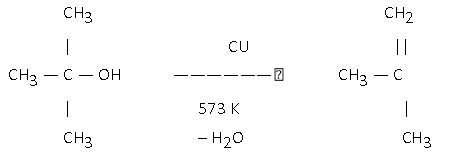
Question. What happens when tert-butyl alcohol is treated with Cu / at 573 K.?
Answer :
Question. Arrange the following halides in order of increasing SN² reactivity :
CH3 — Cl, CH3 — Br, CH3CH2Cl, (CH3)2 CHCl
Answer : (CH3)2 CHCl < CH3CH2Cl < CH3Cl < CH3Br.
(Hint : As the size of the alkyl group increases SN² reactivity decreases.)
Question. Alkyl halides, though polar, are immiscible with water. Why?
Answer : Alkyl halides cannot form H-bonds with water molecules and hence are insoluble in water
Question. Grignard reagents should be prepared under anhydrous conditions. Why?
Answer : Because Grignard reagents have a very strong affinity for H+ ions. In presence of water, they abstract H+ ions from water and form alkanes. To prevent this, they should be prepared under anhydrous conditions
Question. Which of the following two compounds would react faster by SN² pathway: 1-bromobutane (OR) 2-bromobutane.
Answer : The reactivity in SN² reaction depends upon the extent of steric hindrance. i-bromobutane is a 1° alkyl halide and 2-bromobutane is a 2° alkyl halide. Since there will be some steric hindrance in 2° alkyl halide than in 1° alkylhalide, therefore 1°-bromobutane will react faster than 2-bromobutane in SN² reaction.
Question. Allyl Chloride is more reactive than n-propyl Chloride towards nucleophilic substitution reactions. Explain.
Answer : Allyl Chloride readily undergoes ionization to produce resonance stabilized allyl carbocation. Since carbocations are reactive species they readily combine with OH– ions to form allyl alcohol.
Question. Explain why is Chlorobenzene difficult to hydrolyse than ethyl chloride ?
Answer : The lone pair of electrons of Chlorine is Chlorbenzene participates into resonance with the benzene ring.As a result C — Cl bond acquires a partial double bond character. Therefore, this C — Cl bond is stronger than C — Cl bond in ethyl chloride which is a pure single bond. As such the Chlorobenzene is difficult to hydrolyse than ethyl chloride
Question. R—Cl is hydrolysed to R—OH slowly but the reaction is rapid if a catalytic amount of KI is added to the reaction mixture.Why?
Answer : Iodide ion is a powerful nucleophile and hence reacts rapidly with RCl to form RI.
KI ——— + + I–; R — Cl + I– ——— — I + Cl–
Question. Why haloalkanes are more reactive than haloarenes.
Answer : In haloarenes, there is double bond character b/w carbon and halogen due to resonance effect which makes him less reactive.
Question. Why do haloalkenes undergo nucleophillic substitution whereas haloarenes under go electophillic substitution?
Answer : Due to more electro negative nature of halide atom in haloalkanes carbon atom becomes slightly positive and is easily attacked by nucleophillic reagents.
While in haloarenes due to resonance, carbon atom becomes slightly negative and attacked by electrophillic reagents.
Question. Aryl halides cannot be prepared by the action of sodium halide in the presence H2SO4 .Why?
Answer : Due to resonance the carbon- oxygen bond in phenols has partial double bond and it is stronger than carbon oxygen single bond.
Question. Why is Sulphuric acid not used during the reaction of alcohols with KI ?
Answer : It is because HI formed will get oxidized to I2 by concentrated Sulphuric acid which is an oxidizing agent
Question. p- dichlorobenzene has highest m.p. than those of ortho and m-isomers.?
Answer : p- dichlorobenzene is symmetrical, fits into crystal lattice more readily and has higher melting point.
Question. Although chlorine is an electron- withdrawing group, yet it is ortho and para directing in electrophillic aromatic substitution reactions.Why?
Answer : Chlorobenzene is resonance hybrid, there is –ve charge at 0 and para positions, electrophillic substitution reaction will take place at 0 and para position due to +R effect. +R effect is dominating over – I effect. .
Question. Explain why vinyl chloride is unreactive in nucleophillic substitution reaction?
Answer : Vinyl chloride is unreactive in nucleophillic substitution reaction because of double bond character between C = CL bond which is difficult to break
Question. Arrange the following compounds according to reactivity towards nucleophillic substitution reaction with reagents mentioned :-
a. 4- nitro chloro benzene, 2,4 di nitro chloro bemzene, 2,4,6, trinitrochlorobenzene with CH3ONa
Answer : 2,4,6, trinitrochlorobenzene > 2,4 dinitrochlorobemzene > 4- nitrochlorobenzene
Question. Arrange in order of boiling points.
a. Bromobenzene, Bromoform, chloromethane,Dibromo-methane
b. 1-chloropropane, Isopropyle chloride, 1-Chlorobutane.
Answer : (a) chloromethane < Bromobenzene < Dibromo-methane < , Bromoform
(b) , Isopropyle chloride <1-chloropropane <1-Chlorobutane 30 > 20> 10 (SN1)
Question. Predict the reactivity in SN1
Answer : a. C6H5CH2Br, C6H5CH (C6H5)Br, C6H5CH(CH3)Br, C6H5C(CH3)(C6H5)Br
C6H5C(CH3)(C6H5)Br > C6H5(C6H5)Br > C6H5CH(CH3)Br > C6H5CH2Br
(30) (20) (20) (10)
Question. Why is vinyl chloride less reactive than ethyl chloride?
Answer : Due to the sp2 hybridization and resonance in vinyl chloride.
Question. Chloroform is stored in dark coloured & sealed bottle. Why?
Answer : Because it undergoes oxidation and converting to poisonous gas phosgene
2 MARK QUESTIONS
Question. The treatment of alkyl chlorides with aqueous KOH lead to the formation of alcohols but in presence of alcoholic KOH alkenes are major products. Explain?
Answer : In aqueous KOH,OH- is nucleophile which replaces another nucleophile.
R-X +KOH R-OH +KX
Where as in alcoholic KOH
C2H5OH +KOH → C2H5O- + K+
CH3CH2-Cl + alcoholic KOH--------→ CH2 =CH2 + C2H5OH
(C2H5O-)
Question. p-Dichlorbenzene has higher melting point and lower solubility than those of o- and m- isomers. Discuss.
Answer : The p-isomer being more symmetrical fits closely in the crystal lattice and thus has stronger
intermolecular forces of attraction than those of o- and m- isomers. Since during melting or dissolution, the crystal lattice breaks, therefore a larger amount of energy is needed to melt or dissolve the p- isomer than the corresponding o- and meta isomers.
Question. Haloalkanes react with KCN to form alkyl cyanides as major product while AgCN form isocyanide as the chief product. Explain
Answer : KCN is a ionic compound and provides cyanide ions in solution. Although both carbon and nitrogen atoms are in a position to donate electron pairs, the attack takes place mainly through Carbon atom and not through nitrogen atom since C — C bond is more stable than C — N bond. However AgCN is mainly covalent in nature and nitrogen is free to donate electron pair forming isocyanide as the main product.
Question. Explain why is Chlorobenzene difficult to hydrolyse than ethyl chloride ?
Answer : The lone pair of electrons of Chlorine is Chlorbenzene participates into resonance with the benzene ring.
As a result C — Cl bond acquires a partial double bond character. Therefore, this C — Cl bond is stronger than C — Cl bond in ethyl chloride which is a pure single bond. As such the Chlorobenzene is difficult to hydrolyse than ethyl chloride
Question. Which compound will react faster in SN2 reaction with OH---?
a. CH3Br and CH3I (SN2)
b. (CH3)3C-Cl or CH3Cl (SN2)
Answer : a) CH3I will react faster than CH3Br
b) CH3Cl will react faster than 30 halide
Question. Alcohols reacts with halogen acids to form haloalkenes but phenol does not form halobenzene. Explain
Answer : The C-O bond in phenol acquires partial double bond character due to resonance and hence be cleared by X- ions to form halobenzenes. But in alcohols a pure C — O bond is maintained and can be cleared by X–ions.
Question. How the following conversions can be carried out?
a. Propene to propan-1-ol
b. 1-Bromopropane to 2-bromopropane
Answer : a)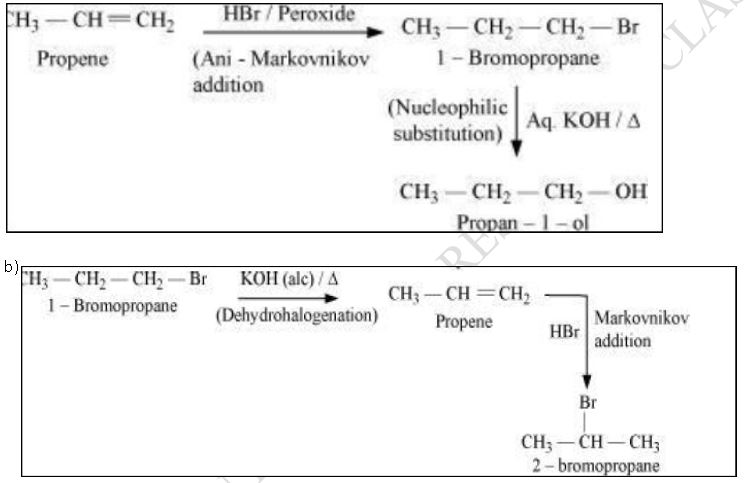
Question. The treatment of alkyl chlorides with aq KOH leads to the formation of alcohols but in presence of alcoholic KOH, alkenes are the major products. Explain.
Answer : In aq. solution, KOH is almost completely ionised to give OH– ions which being a strong nucleophile brings about a substitution reaction to form alcohols. Further in aq. solution, OH– ions are highly solvated (hydrated).
This solution reduces the basic character of OH– ions which fail to abstract a hydrogen from the -carbon of the alkyl halide to form an alkene.
However an alcoholic solution of KOH contains alkoxide (RO–) ions which being a much stronger
base than OH– ions preferentially abstracts a hydrogen from the -carbon of the alkyl halide to form alkene.
Question. Tert-butyl chloride reacts with aq. NaOH by SN¹ mechanism while n-butyl chloride reacts by SN² mechanism. Why ?
Answer : Tert-butyl chloride reacts via SN¹ mechanism because the heterolytic cleavage of C — Cl bond in tertbutyl chloride gives 3 carbocation which is highly stable and favourable for SN¹ mechanism.
Moreover, tert-butyl chloride (3°) bring a bulky molecule has steric hindrance which will not allow SN² mechanism to take place. Hence only SN1 mechanism can occur in tert-butyl chloride. However n-butyl chloride (1°) reacts via SN² because ‘C’ of C — Cl bond is less crowded and favourable for nucleophile to attack from back side results in the formation of transition state. It has less steric hindrance which is a favourable factor for SN² mechanism.
Question. Why alkyl halides are generally not prepared in laboratory by free radical halogenation of alkanes ?
Answer : It is because :
(i) It gives a mixture of isomeric monohalogenated products whose boiling points are so close
that they cannot be separated easily.
(ii) Polyhalogenation may also take place, thereby making the mixture more complex and hence
difficult to separate.
3 MARK QUESTIONS
Question. Haloalkanes undego nucleophilic substitutions whereas Haloarenes undegoes electrophilic substitutions.
Answer : Haloalkanes are more polar than haloarenes.
C-atom carrying the halogen in haloalkanes is mroe e– deficient than that in haloarenes.
Haloalkanes undergo nucleophilic substitution readily
In haloarenes, the love pair of electrons present on the halogen atom goes into resonance with the aryl ring. The aryl ring being rich in electron density, undergoes electrophilic substitutions.
Question. Why alkyl halides are generally not prepared in laboratory by free radical halogenation of alkanes?
Answer : It is because :
(i) It gives a mixture of isomeric monohalogenated products whose boiling points are so close
that they cannot be separated easily.
(ii) Polyhalogenation may also take place, thereby making the mixture more complex and hence
difficult to separate.
Question. Why preparation of aryl iodide by electrophilic substitution requires presence of an oxidising agent?
Why can aryl flouride not be prepared by this method?
Answer : Reactions with I2 are reversible in nature and require presence of oxidising agent (HNO3, etc.) to oxidise HI formed during iodination and promote forward reaction.
Fluoro compounds cannot be prepared due to high reactivity of flourine.
Question. Why aryl halides are extremely less reactive towards nucleophilic substitution?
Answer : (i) Resonance effect :
Due to resonance C — Cl bond acquires partial double bond character.
(ii) Difference in hybridisation of Carbon in C —X bond : in haloarene C-atom attached to halogen in sp2 hybrid while sp³ in haloalkane.
C — X bond length in sp2 hybrid is shorter and hence stronger and difficult to break.
(iii) Instability of phenyl cation
(iv) Possible repulsion of nucleophile to approach e– rich arenes.
Question. (i) Arrange in order of property indicated :
CH3CH2CH2CH2Br, (CH3)3 Br, (CH3)3 CHCH2 Br
(Increasing boiling point)
(ii) CH3F, CH3I, CH3Cl, CH3Br (nucleophilic substitution)
Answer : (i) B. P. decreases with increase in branching due to decrease in Van der Waals forces of attraction.
(CH3)3 CBr < (CH3)2 CHCH2 Br < CH3CH2CH2CH2Br
(ii) Reactivity increases as C — X bond dissociation energy decreases.
CH3F < CH3Cl < CH3Br < CH3I
Question. Why does 2 bromopentane gives pent-2-ene as major product in elimination reaction ?
Answer : 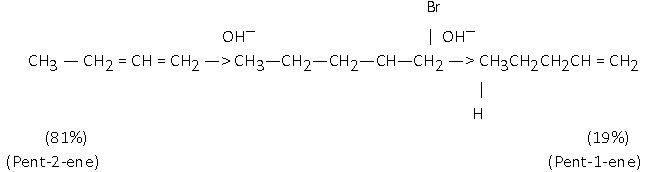
This is because of Saytzeff’s rule — In dehydrohalogen reactions, the preferred product is that alkene which has the greater number of alkyl groups attached to the doubly bonded carbon atoms.
Question. Complete the reaction :
(a) CH3OCH3 + PCl5 ———
(b) C2H5OCH3 + HCl ———
(c) (C2H5)2 O + HCl ———
Answer : (a) 2CH3Cl
(b) CH3Cl + C2H5OH
(c) C2H5Cl + C2H5OH
Question. Distinguish between the following pair of organic compounds
i) CCl4 and CHCI3
ii) Chlorobenzene and Benzyl chloride
Answer : i) Carblamine reaction : chloroform gives offensive smell due to formation isocyanide but CCl4 don’t.
ii) Diazotisation test will be given by benzyl chloride
Question. How are the following conversions carried out?
(i) Benzyl chloride → Benzyl alcohol. (ii) Ethyl magnesium chloride → Propan-1-ol.
Cu /HCl
(iii) C6H5N2Cl ───────→
Answer : i) Hydrolysis with water.
ii) Nucleophillic addition with HCHO followed by hydrolysis.
iii) Cu /HCl
C6H5N2Cl ───────→C6H5Cl
Question. Write the formula of main product formed in the following chemical reactions.
Na
(i) (CH3)2 CH-C1 ──────→
Dry ether
Δ
(ii) CH3Br + AgF──────→
Dry acetone
(iii) CH3CH2Br + Nal ───────→
Answer : (a) (CH3)2 CH-C1 ──────→ (CH3)2 CH-CH(CH3)2
Dry ether
Δ
(b) CH3Br + AgF──────→CH3F
Dry acetone
(c) CH3CH2Br + Nal ───────→ CH3CH2I
5 MARKS QUESTIONS
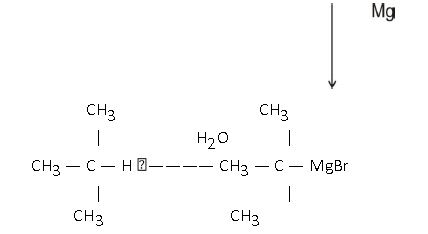
Question. Identify A, B, C, D, E, R, R¹ in the following
Answer : 
Question. a).p-dichlorobenzene has higher melting point and lower solubility than o- and m-isomer. Explain?
b) Which will have a higher boiling point?
1 - Chloro enthane or - 2 methyl -2- chlorobutane
Give reasons?
c) Chloroform is not used as anesthetic nowadays. Why?
Answer : a) The p-isomer being more symmetrical fits directly in the crystal lattice and thus has stronger inter molecular forces of attraction than o- and m- isomers.During melting or dissolution, the crystal lattice breaks. Therefore, a large amount of energy is needed to melt or dissolve the p-isomer than the resultant oand m- isomers.
b) 1-chloro pentane
Surface area and hence Van der Waal’s forces of attraction decreases on branching.
c) Due to the formation of poisonous gas during oxidation.
Question. (a) p - nitro chlorobenzene undergoes nucleophilic substitution faster than chlorobenzene. Explain giving the resonating structures as well.
(b)Allyl chloride is more reactive than n - propyl chloride towards nucleophilic substitution reaction. Explain why?
(c) Give IUPAC name of the following organic compound C6H5CH2Cl
Answer : (a) In this reaction a carbanion intermediate is formed. This is stabilized by Resonance in p-nitrochloro benzene Resonance Structure
(b) In allyl chloride, the carbocation formed is stabilised due to resonance while the carbocation formed form n - propyl chloride i.e. is less stable, so allyl chloride is more reactive towards nucleophilic substitution reaction.
(c) Chlorophenylmethane
Question. a) Why do alcohols have higher boiling points than the halo alkanes of the same molecular mass?
b) Convert the following:
i) Benzene to aniline.
ii) Benzene to diphenyl
iii) Benzene to p-Chloro toluene.
Answer : a) Alcohols are capable of forming intermolecular H-bonds .
b) i) C6H6 + Cl2 -----------→ C6H5Cl + NH3 ---------------→ C6H5NH2 + HCl
FeCl3 Cu2O,Δ
ii) C6H6 + Cl2 -----------→ C6H5Cl + 2Na + C6H5Cl ------------→ C6H5-C6H5 + 2NaCl
FeCl3 Dry ether
iii) C6H6 + CH3Cl ------------→ C6H5CH3 + Cl2 ------------------→ C6H4CH3Cl + HCl
AlCl3 FeCl3
One Mark Questions
Question 1. Give IUPAC name of the following organic compound:
\( \text{CH}_3\text{-CH}=\text{C(CH}_3\text{)-CH(Br)-CH}_3 \)
Answer: 4-Bromo-3-methylpent-2-ene.
In simple words: The systematic IUPAC name for this structure is 4-bromo-3-methylpent-2-ene because we number the longest carbon chain starting from the double bond end.
Exam Tip: Remember to give the double bond lower numbering preference over substituents like halogen and alkyl groups when numbering the main carbon chain.
Question 2. Write the structural formulae of 4-Chloropent-2-ene.
Answer: \( \text{CH}_3\text{-CH}=\text{CH-CH(Cl)-CH}_3 \)
In simple words: To draw this, make a chain of five carbons with a double bond at the second carbon and a chlorine atom attached to the fourth carbon.
Exam Tip: Start numbering the carbon chain from the side that gives the double bond the lowest locant, then attach the chlorine group on carbon-4.
Question 3. Arrange the following halides in order of increasing SN2 reactivity CH3Cl,CH3Br,CH3CH2Cl, (CH3)2CHCl
Answer: The order of increasing \( \text{S}_{\text{N}}2 \) reactivity is: \( (\text{CH}_3)_2\text{CHCl} < \text{CH}_3\text{CH}_2\text{Cl} < \text{CH}_3\text{Cl} < \text{CH}_3\text{Br} \)
In simple words: Less bulky methyl and primary halides react much faster in \( \text{S}_{\text{N}}2 \) reactions than crowded secondary ones, and bromine is a better leaving group than chlorine.
Exam Tip: Keep in mind that \( \text{S}_{\text{N}}2 \) reactivity decreases with increased steric hindrance (bulky groups) around the carbon bearing the halogen.
Question 5. What is the order of reactivity of different alkyl halides in nucleophilic substitution reaction?
Answer: For nucleophilic substitution, the reactivity order of alkyl halides is \( \text{R-I} > \text{R-Br} > \text{R-Cl} > \text{R-F} \).
In simple words: Alkyl iodides react the fastest because the bond between carbon and iodine is the weakest and easiest to break.
Exam Tip: Since bond dissociation enthalpy decreases from C-F to C-I, the rate of nucleophilic substitution always increases in the order of larger halogen atoms.
Question 4. An alkyl halide C4H9Cl is optically active. What is its structure?
Answer: The optically active alkyl halide is 2-chlorobutane, with the structure: \( \text{CH}_3\text{-C}^*\text{H(Cl)-CH}_2\text{-CH}_3 \)
In simple words: This compound is optically active because the central carbon is asymmetric, meaning it is connected to four completely different groups.
Exam Tip: Mark the chiral carbon with an asterisk (\( * \)) in your structural drawing to clearly demonstrate chirality to the examiner.
Question 7. Which type of solvents aregenerally used to carry out SN1 reaction?
Answer: Polar protic solvents, like water or alcohol, are typically employed for conducting \( \text{S}_{\text{N}}1 \) reactions.
In simple words: Polar protic solvents have hydrogen atoms that can bond with the leaving group, helping to stabilize the carbocation intermediate.
Exam Tip: Remember that polar protic solvents accelerate \( \text{S}_{\text{N}}1 \) reactions by stabilizing both the transition state and the carbocation.
Question 8. Identify the chiral and achiral molecules in following pair of compounds? A:CH3CHCH2CH3 B :CH3CH2CH2CH2Br
Answer: Molecule A, \( \text{CH}_3\text{CH(Br)CH}_2\text{CH}_3 \) (2-bromobutane), is chiral because it contains an asymmetric carbon atom. Molecule B, \( \text{CH}_3\text{CH}_2\text{CH}_2\text{CH}_2\text{Br} \) (1-bromobutane), is achiral as it does not have any asymmetric carbon center.
In simple words: Compound A has a carbon with four different groups attached, making it chiral, whereas compound B does not have such a carbon.
Exam Tip: A molecule is chiral if it has at least one stereocenter (asymmetric carbon) and lacks a plane of symmetry.
Question 9. Give two uses of iodoform (CHI3)?
Answer: Iodoform has two main applications:
(i) It serves as an antiseptic due to the gradual liberation of free iodine.
(ii) It is utilized as a photosensitizer in silver bromide emulsions for making photographic films.
In simple words: Iodoform is used to clean wounds because it releases iodine to kill germs, and it is also used in old-style photography.
Exam Tip: State clearly that the antiseptic action of iodoform is due to the release of free iodine, not the iodoform molecule itself.
Question 10. Write a chemical reaction in which iodide ion displaces diazonium group from a diazonium salt?
Answer: The reaction of benzene diazonium chloride with potassium iodide yields iodobenzene: \[ \text{C}_6\text{H}_5\text{N}_2^+\text{Cl}^- + \text{KI} \rightarrow \text{C}_6\text{H}_5\text{I} + \text{KCl} + \text{N}_2 \]
In simple words: When benzene diazonium chloride is mixed with potassium iodide, the nitrogen group is replaced by iodine, producing iodobenzene.
Exam Tip: Unlike chlorination or bromination, iodination of diazonium salts does not require a cuprous halide catalyst; simple warming with potassium iodide is sufficient.
Question 11. How you will convert 2-Bromopropane to 1-bromopropane?
Answer: This two-step conversion is carried out as follows:
1. Dehydrohalogenation of 2-bromopropane with alcoholic KOH yields propene: \[ \text{CH}_3\text{-CH(Br)-CH}_3 \xrightarrow{\text{alcoholic KOH, }\Delta} \text{CH}_3\text{-CH=CH}_2 + \text{KBr} + \text{H}_2\text{O} \]
2. Hydrobromination of propene in the presence of benzoyl peroxide (anti-Markovnikov addition) yields 1-bromopropane: \[ \text{CH}_3\text{-CH=CH}_2 + \text{HBr} \xrightarrow{\text{Peroxide}} \text{CH}_3\text{-CH}_2\text{-CH}_2\text{Br} \]
In simple words: First, remove HBr using a strong base to form a double bond. Then, add HBr back with peroxide to put the bromine on the outer carbon.
Exam Tip: Always specify "peroxide" with HBr for anti-Markovnikov addition; omitting the peroxide will yield 2-bromopropane instead.
Question 12. In following pairs of halogen compound which compound undergoes faster SN1 reaction?
A) i) Cyclohexyl chloride, ii) Cyclohexylmethyl chloride
B) iii) tert-Butyl chloride, iv) sec-Butyl chloride
Answer: For pair A, compound (i) undergoes a faster \( \text{S}_{\text{N}}1 \) reaction than (ii). For pair B, compound (iii) reacts faster than (iv).
In simple words: In \( \text{S}_{\text{N}}1 \) reactions, compounds that form more stable carbocations (like tertiary and secondary over primary) react much more quickly.
Exam Tip: To predict \( \text{S}_{\text{N}}1 \) rates, always draw the carbocation intermediate formed by losing the halide and check its stability order: \( 3^\circ > 2^\circ > 1^\circ \).
Question 13. How you will convert aniline into cholobenzene?
Answer: Aniline is converted to chlorobenzene in two steps:
1. Diazotization: Aniline is reacted with nitrous acid (prepared from \( \text{NaNO}_2 \) and \( \text{HCl} \)) at a low temperature of \( 273 - 278 \text{ K} \) to form benzene diazonium chloride: \[ \text{C}_6\text{H}_5\text{-NH}_2 + \text{NaNO}_2 + 2\text{HCl} \xrightarrow{273 - 278\text{ K}} \text{C}_6\text{H}_5\text{-N}_2^+\text{Cl}^- + \text{NaCl} + 2\text{H}_2\text{O} \]
2. Sandmeyer Reaction: The benzene diazonium chloride solution is treated with freshly prepared cuprous chloride dissolved in hydrochloric acid to yield chlorobenzene: \[ \text{C}_6\text{H}_5\text{-N}_2^+\text{Cl}^- \xrightarrow{\text{CuCl/HCl}} \text{C}_6\text{H}_5\text{-Cl} + \text{N}_2 \]
In simple words: First, turn aniline into a diazonium salt using ice-cold sodium nitrite and acid. Then, replace the diazonium group with chlorine using cuprous chloride.
Exam Tip: Clearly state the temperature range (\( 0 - 5^\circ\text{C} \) or \( 273 - 278\text{ K} \)) for the diazotization step, as diazonium salts decompose at higher temperatures.
Question 14. Name the iodine containing hormone, the deficiency of which causes goiter?
Answer: The iodine-containing hormone is thyroxine, and its deficiency leads to goitre.
In simple words: Thyroxine is the hormone that has iodine in it, and not having enough of it causes goitre.
Exam Tip: Be sure of the spelling of "Thyroxine" and mention that it is secreted by the thyroid gland if asked for more details.
Question 15. Name the synthetic halogen compound which is used in treatment of malaria?
Answer: Chloroquine is the synthetic halogen-containing compound widely prescribed to treat malaria.
In simple words: Chloroquine is a human-made medicine containing chlorine that is used to cure malaria.
Exam Tip: Do not confuse "chloroquine" (used for malaria) with "halothane" (used as an anesthetic) or "chloramphenicol" (used for typhoid).
Question 16. Which isomer of C4H9Br will have lowest boiling point?
Answer: The isomer with the lowest boiling point is tert-butyl bromide (2-bromo-2-methylpropane).
In simple words: tert-Butyl bromide has the lowest boiling point because it is highly branched, which makes it spherical and reduces its surface area and intermolecular attraction.
Exam Tip: Remember the general trend: as branching increases, the surface area decreases, leading to weaker van der Waals forces and a lower boiling point.
Question 17. Write the IUPAC name of DDT?
Answer: The IUPAC name of DDT is 2,2-bis(4-chlorophenyl)-1,1,1-trichloroethane (also written as 1,1,1-trichloro-2,2-bis(4-chlorophenyl)ethane).
In simple words: DDT stands for dichlorodiphenyltrichloroethane, and its proper systematic name is 2,2-bis(4-chlorophenyl)-1,1,1-trichloroethane.
Exam Tip: Use "bis" instead of "di" when naming complex substituents like the chlorophenyl groups in DDT.
Question 18. Why sulphuric acid is not used during reaction of alcohol with KI?
Answer: Sulfuric acid is a strong oxidizing agent. Instead of just generating hydrogen iodide (\( \text{HI} \)) from potassium iodide (\( \text{KI} \)), it oxidizes the formed \( \text{HI} \) to iodine gas (\( \text{I}_2 \)), preventing the reaction with alcohol from producing the alkyl iodide.
In simple words: Sulfuric acid turns the iodide into iodine molecules instead of letting it react with the alcohol to make alkyl iodide.
Exam Tip: Mention that non-oxidizing acids like phosphoric acid (\( \text{H}_3\text{PO}_4 \)) are used instead of sulfuric acid to prepare alkyl iodides.
Question 19. Out of CH3Br and CH3Cl which will have higher boiling point and why?
Answer: Methyl bromide (\( \text{CH}_3\text{Br} \)) has a higher boiling point than methyl chloride (\( \text{CH}_3\text{Cl} \)). This is because bromine has a larger size and greater molecular mass than chlorine, resulting in stronger van der Waals attractive forces.
In simple words: Methyl bromide is heavier and larger than methyl chloride, which makes its molecules stick together more strongly, requiring more heat to boil.
Exam Tip: For the same alkyl group, boiling points of haloalkanes always follow the order: \( \text{R-I} > \text{R-Br} > \text{R-Cl} > \text{R-F} \).
Question 20. Which one of following has highest dipole moment? (i) CH2Cl2 (ii) CHCl3 (iii) CCl4
Answer: Dichloromethane (\( \text{CH}_2\text{Cl}_2 \)) has the highest dipole moment. In \( \text{CH}_2\text{Cl}_2 \), the individual bond dipoles combine constructively, whereas in chloroform (\( \text{CHCl}_3 \)), they partially cancel, and in carbon tetrachloride (\( \text{CCl}_4 \)), they cancel out completely due to perfect symmetry.
In simple words: Dichloromethane is less symmetrical than the other two, so its electrical charges do not cancel each other out, giving it the strongest overall dipole moment.
Exam Tip: The order of dipole moments is \( \text{CH}_2\text{Cl}_2 > \text{CHCl}_3 > \text{CCl}_4 = 0 \). Make sure to mention molecular symmetry and vector cancellation of bond dipoles.
Two marks questions
Question 1. Define the following terms: (i) Ambidient nucleophile (ii) Chirality
Answer:
(i) Ambident nucleophile: These are nucleophiles that possess two different nucleophilic donor centers, allowing them to attack the electrophilic carbon through either of the two atoms. For instance, the cyanide ion (\( \text{CN}^- \)) can bind via carbon to form nitriles or via nitrogen to form isocyanides.
(ii) Chirality: Chirality refers to the geometric property of an object or molecule of being non-superimposable on its mirror image. Such molecules lack an internal plane of symmetry and are optically active.
In simple words: An ambident nucleophile is a molecule that can bond from two different sides, like a key that can open two different locks. Chirality means being asymmetric, like your left and right hands which cannot perfectly overlap on each other.
Exam Tip: For ambident nucleophiles, always provide an example like \( \text{CN}^- \) / \( \text{NC}^- \) or \( \text{NO}_2^- \) / \( \text{ONO}^- \) to score full marks.
Question 2. Write short note on sandmeyer reaction?
Answer: The Sandmeyer reaction is an important synthetic method used to prepare aryl halides (chlorobenzene or bromobenzene) from primary aromatic amines.
1. In the first step, aniline is treated with nitrous acid (sodium nitrite and hydrochloric acid) at a chilly temperature of \( 273 - 278\text{ K} \) to form benzene diazonium chloride: \[ \text{C}_6\text{H}_5\text{NH}_2 + \text{NaNO}_2 + 2\text{HCl} \xrightarrow{273 - 278\text{ K}} \text{C}_6\text{H}_5\text{N}_2^+\text{Cl}^- + \text{NaCl} + 2\text{H}_2\text{O} \]
2. Next, the freshly formed diazonium salt is mixed with a cuprous halide dissolved in its corresponding halogen acid (such as \( \text{CuCl/HCl} \) or \( \text{CuBr/HBr} \)), which replaces the diazonium group with the halogen atom: \[ \text{C}_6\text{H}_5\text{N}_2^+\text{Cl}^- \xrightarrow{\text{CuCl/HCl}} \text{C}_6\text{H}_5\text{Cl} + \text{N}_2 \]
In simple words: This reaction is a two-step process that replaces the nitrogen group of aniline with a chlorine or bromine atom using copper salts.
Exam Tip: Write both steps of the reaction clearly, with the appropriate reagents and temperatures, to secure full marks.
Question 3. Write the structures of main products: (i).Chlorination of benzene in presence of UV light. (ii).Propene is treated with HBr in presence of benzoyl peroxide.
Answer:
(i) Chlorination of benzene in the presence of UV light results in an addition reaction, forming benzene hexachloride (\( \text{C}_6\text{H}_6\text{Cl}_6 \)), also known as Gammexane or Lindane: \[ \text{C}_6\text{H}_6 + 3\text{Cl}_2 \xrightarrow{\text{UV Light}} \text{C}_6\text{H}_6\text{Cl}_6 \]
(ii) Treating propene with hydrogen bromide in the presence of benzoyl peroxide leads to anti-Markovnikov addition, yielding 1-bromopropane: \[ \text{CH}_3\text{-CH=CH}_2 + \text{HBr} \xrightarrow{\text{Benzoyl Peroxide}} \text{CH}_3\text{-CH}_2\text{-CH}_2\text{Br} \]
In simple words: In UV light, chlorine adds to every carbon of benzene to make benzene hexachloride. With peroxide, HBr adds to propene such that bromine goes to the outermost carbon.
Exam Tip: Be careful not to draw chlorobenzene for part (i). UV light promotes addition across the double bonds of benzene, not electrophilic substitution.
Question 4. Complete the following reactions: (i).C6H5N2Cl +KI -------> ? (ii) CH2=CH2 +Br2 --CCl4---> ?
Answer:
(i) When benzene diazonium chloride reacts with potassium iodide, iodobenzene is formed along with potassium chloride and nitrogen gas: \[ \text{C}_6\text{H}_5\text{N}_2^+\text{Cl}^- + \text{KI} \rightarrow \text{C}_6\text{H}_5\text{I} + \text{KCl} + \text{N}_2 \]
(ii) Bromine in carbon tetrachloride adds across the double bond of ethene to form 1,2-dibromoethane (vicinal dihalide): \[ \text{CH}_2\text{=CH}_2 + \text{Br}_2 \xrightarrow{\text{CCl}_4} \text{CH}_2\text{Br-CH}_2\text{Br} \]
In simple words: The first reaction replaces the nitrogen group with iodine. The second reaction adds a bromine atom to each carbon of the double bond.
Exam Tip: Part (ii) is the classic test for unsaturation; the reddish-brown color of bromine is decolored upon reaction with an alkene.
Question 5. Explain why haloarenes are much less reactive than haloalkanes towards nucleophilic substitution reaction?
Answer: Haloarenes exhibit significantly lower reactivity than haloalkanes towards nucleophilic substitution due to the following factors:
1. Resonance Effect: The lone pairs of electrons on the halogen atom are delocalized with the \( \pi \)-electrons of the benzene ring. This gives the carbon-halogen (\( \text{C-X} \)) bond partial double-bond character, making it much stronger and harder to cleave than a single bond.
2. Hybridization of Carbon: In haloarenes, the halogen is attached to an \( sp^2 \) hybridized carbon, whereas in haloalkanes it is attached to an \( sp^3 \) hybridized carbon. The higher s-character of \( sp^2 \) carbon makes it more electronegative, resulting in a shorter, stronger, and less polar carbon-halogen bond.
3. Instability of Phenyl Cation: If the halogen leaves, the resulting phenyl cation cannot be stabilized by resonance, which prevents any \( \text{S}_{\text{N}}1 \) mechanism from taking place.
In simple words: The chlorine in chlorobenzene is locked tightly to the ring because of shared resonance electrons and a stronger carbon bond, so it resists being replaced.
Exam Tip: Mention both the resonance effect (partial double bond character) and the hybridization difference (\( sp^2 \) vs \( sp^3 \)) to ensure full marks for this very common exam question.
Question 6. Write short note on: (i).Wurtz reaction (ii).Wurtz-Fittig reaction.
Answer:
(i) Wurtz Reaction: This reaction is used to prepare symmetrical alkanes by reacting two molecules of alkyl halides with sodium metal in the presence of dry ether: \[ 2\text{R-X} + 2\text{Na} \xrightarrow{\text{Dry Ether}} \text{R-R} + 2\text{NaX} \]
(ii) Wurtz-Fittig Reaction: In this reaction, a mixture of an alkyl halide and an aryl halide is treated with sodium metal in dry ether to produce an alkylarene: \[ \text{Ar-X} + 2\text{Na} + \text{R-X} \xrightarrow{\text{Dry Ether}} \text{Ar-R} + 2\text{NaX} \]
In simple words: The Wurtz reaction joins two carbon chains together using sodium. The Wurtz-Fittig reaction joins a carbon chain to a benzene ring.
Exam Tip: Don't forget to write "dry ether" over the reaction arrow, as sodium is highly reactive with moisture.
Question 7. How you will convert: (i).Ethyl chloride into ethyl alcohol. (ii).Ethyl chloride to ethane
Answer:
(i) Ethyl chloride is heated with aqueous potassium hydroxide (\( \text{KOH} \)) to undergo nucleophilic substitution, producing ethyl alcohol: \[ \text{C}_2\text{H}_5\text{Cl} + \text{KOH (aq)} \rightarrow \text{C}_2\text{H}_5\text{OH} + \text{KCl} \]
(ii) Ethyl chloride can be reduced to ethane by treatment with nascent hydrogen generated using a zinc-copper couple in ethanol: \[ \text{C}_2\text{H}_5\text{Cl} + 2[\text{H}] \xrightarrow{\text{Zn-Cu / C}_2\text{H}_5\text{OH}} \text{C}_2\text{H}_6 + \text{HCl} \]
In simple words: Use watery potassium hydroxide to replace the chlorine with an alcohol group. To make ethane, use a zinc-copper reduction to swap the chlorine with a hydrogen atom.
Exam Tip: Be sure to specify "aqueous KOH" for substitution; using "alcoholic KOH" will cause elimination to form ethene instead.
Question 8. Alkyl halides are insoluble in water though they contain polar C-X bond?
Answer: Although alkyl halides are polar molecules, they are insoluble in water. This is because they cannot form new hydrogen bonds with water molecules. Additionally, the energy released when weak intermolecular forces are established between the alkyl halide and water is insufficient to overcome the strong hydrogen bonding forces holding the water molecules together.
In simple words: Water molecules are bonded tightly to each other by strong hydrogen bonds, and alkyl halides aren't strong enough to break in and mix with them.
Exam Tip: Frame your answer around the energy balance: the energy required to break existing hydrogen bonds in water is greater than the energy released during new interactions.
Question 9. Give one test to distinguish between: (i).Chloroform and carbontetrachloride (ii).Methanol and ethanol.
Answer:
(i) Distinguishing Chloroform and Carbon Tetrachloride: By performing the Carbylamine Test: When chloroform is warmed with aniline and alcoholic \( \text{KOH} \), a highly foul-smelling substance called phenyl isocyanide is produced. Carbon tetrachloride does not undergo this reaction: \[ \text{C}_6\text{H}_5\text{NH}_2 + \text{CHCl}_3 + 3\text{KOH (alc.)} \xrightarrow{\Delta} \text{C}_6\text{H}_5\text{NC} + 3\text{KCl} + 3\text{H}_2\text{O} \]
(ii) Distinguishing Methanol and Ethanol: By performing the Iodoform Test: Ethanol reacts with sodium hypoiodite (\( \text{I}_2 + \text{NaOH} \)) upon gentle heating to form a characteristic yellow precipitate of iodoform (\( \text{CHI}_3 \)). Methanol, lacking the \( \text{CH}_3\text{CH(OH)}- \) group, does not yield any yellow precipitate: \[ \text{CH}_3\text{CH}_2\text{OH} + 4\text{I}_2 + 6\text{NaOH} \xrightarrow{\Delta} \text{CHI}_3\downarrow + \text{HCOONa} + 5\text{NaI} + 5\text{H}_2\text{O} \]
In simple words: Chloroform creates a terribly smelly compound when heated with aniline and base, while carbon tetrachloride does not. Ethanol reacts with iodine and base to form yellow crystals, but methanol stays clear.
Exam Tip: For chemical distinction questions, always state the visible observation (like "offensive smell" or "yellow precipitate") alongside the reaction equations.
Question 10. Write short note on : (i).Finkelstein reaction (ii).Hundsdiecker reaction
Answer:
(i) Finkelstein Reaction: This is a halogen-exchange reaction where an alkyl chloride or bromide is converted to an alkyl iodide by treating it with sodium iodide in dry acetone: \[ \text{R-Cl} + \text{NaI} \xrightarrow{\text{Acetone}} \text{R-I} + \text{NaCl}\downarrow \] The precipitation of \( \text{NaCl} \) or \( \text{NaBr} \) in dry acetone drives the equilibrium forward.
(ii) Hunsdiecker Reaction: This reaction is used to prepare alkyl bromides by heating the silver salt of a carboxylic acid with bromine in carbon tetrachloride: \[ \text{RCOOAg} + \text{Br}_2 \xrightarrow{\text{CCl}_4, 350\text{ K}} \text{R-Br} + \text{AgBr}\downarrow + \text{CO}_2\uparrow \]
In simple words: The Finkelstein reaction swaps chlorine or bromine with iodine. The Hunsdiecker reaction converts a silver carboxylic acid salt into an alkyl bromide, releasing carbon dioxide.
Exam Tip: For the Hunsdiecker reaction, remember that the carbon chain of the product is one carbon shorter than the starting carboxylic acid salt.
Three Marks Questions
Question 1. Explain why: (a).Dipole moment of cholorobenzene is lower than cyclohexyl chloride. (b).Grignard reagent should be prepared under anhydrous conditions? (c).Chloroform is stored in dark Brown bottles?
Answer:
(a) In chlorobenzene, the chlorine atom is attached to an \( sp^2 \) hybridized carbon, which is more electronegative than the \( sp^3 \) hybridized carbon in cyclohexyl chloride. This reduces the electron density shift towards the chlorine atom, weakening the \( \text{C-Cl} \) dipole. Additionally, the resonance effect introduces partial double-bond character, shortening the bond length, which further lowers the dipole moment (since dipole moment is a product of charge and distance).
(b) Grignard reagents (\( \text{RMgX} \)) are highly reactive organometallic compounds. They act as strong bases and nucleophiles, reacting immediately with any moisture or source of acidic hydrogen (such as water or alcohols) to decompose into hydrocarbons: \[ \text{RMgX} + \text{H}_2\text{O} \rightarrow \text{R-H} + \text{Mg(OH)X} \]
(c) Chloroform is stored in dark brown bottles because it undergoes slow oxidation when exposed to light and air, producing a highly poisonous gas called phosgene (carbonyl chloride): \[ \text{CHCl}_3 + \frac{1}{2}\text{O}_2 \xrightarrow{\text{Sunlight}} \text{COCl}_2 + \text{HCl} \] The dark bottle blocks light, halting this hazardous reaction.
In simple words: Chlorobenzene has a shorter, less polar bond than cyclohexyl chloride, reducing its dipole moment. Grignard reagents are extremely sensitive to water and will turn back into alkanes if any moisture is present. Chloroform turns into toxic phosgene gas when hit by sunlight and oxygen, so it must be kept in the dark.
Exam Tip: Be sure to write the chemical equation for phosgene formation, including the formula \( \text{COCl}_2 \), to earn maximum credit.
Question 2. What happens when: (a).Chloroform is heated with silver power. (b).Ethyl chloride treated with alcoholic KOH (c).Alcohol reacts with thionyl chloride?
Answer:
(a) Heating chloroform with silver powder brings about dehalogenation, producing acetylene (ethyne) gas: \[ 2\text{CHCl}_3 + 6\text{Ag} \xrightarrow{\Delta} \text{CH}\equiv\text{CH} + 6\text{AgCl}\downarrow \]
(b) Treating ethyl chloride with alcoholic potassium hydroxide (\( \text{KOH} \)) induces dehydrohalogenation (elimination), yielding ethene gas: \[ \text{C}_2\text{H}_5\text{Cl} + \text{KOH (alc.)} \xrightarrow{\Delta} \text{CH}_2\text{=CH}_2 + \text{KCl} + \text{H}_2\text{O} \]
(c) Reacting an alcohol with thionyl chloride (\( \text{SOCl}_2 \)) yields an alkyl chloride along with gaseous by-products (sulfur dioxide and hydrogen chloride), which escape easily: \[ \text{R-OH} + \text{SOCl}_2 \rightarrow \text{R-Cl} + \text{SO}_2\uparrow + \text{HCl}\uparrow \]
In simple words: Silver powder pulls the chlorine off chloroform to form acetylene gas. Alcoholic KOH causes ethyl chloride to lose hydrogen and chlorine, forming ethene. Thionyl chloride converts alcohol cleanly to alkyl chloride, with the other products bubbling away as gases.
Exam Tip: Mention that the reaction of alcohols with thionyl chloride is the preferred method for preparing alkyl chlorides because the gaseous byproducts leave behind pure alkyl chloride.
Question 3. How you will conert: (a).Chlorobenzene into toluene (b).Chlorobenzene to phenol (c).Ethyl bromide to diethyl ether.
Answer:
(a) Chlorobenzene to Toluene: Conducted via the Wurtz-Fittig reaction by reacting chlorobenzene and methyl chloride with sodium metal in dry ether: \[ \text{C}_6\text{H}_5\text{Cl} + 2\text{Na} + \text{CH}_3\text{Cl} \xrightarrow{\text{Dry Ether}} \text{C}_6\text{H}_5\text{CH}_3 + 2\text{NaCl} \]
(b) Chlorobenzene to Phenol (Dow's Process): Chlorobenzene is heated with aqueous sodium hydroxide at \( 623\text{ K} \) and \( 300\text{ atm} \) to form sodium phenoxide, which is then acidified with dilute acid to yield phenol: \[ \text{C}_6\text{H}_5\text{Cl} \xrightarrow[\text{300 atm}]{\text{NaOH, 623 K}} \text{C}_6\text{H}_5\text{ONa} \xrightarrow{\text{H}^+ / \text{H}_2\text{O}} \text{C}_6\text{H}_5\text{OH} \]
(c) Ethyl Bromide to Diethyl Ether: Two molecules of ethyl bromide are heated with dry silver oxide to form diethyl ether: \[ 2\text{C}_2\text{H}_5\text{Br} + \text{Ag}_2\text{O (dry)} \xrightarrow{\Delta} \text{C}_2\text{H}_5\text{-O-C}_2\text{H}_5 + 2\text{AgBr} \]
In simple words: To make toluene, join methyl chloride to chlorobenzene using sodium and dry ether. To make phenol, heat chlorobenzene with strong base under high pressure, then add acid. To make diethyl ether, heat ethyl bromide with dry silver oxide.
Exam Tip: For Dow's process, specify both the high temperature (\( 623\text{ K} \)) and pressure (\( 300\text{ atm} \)) as the benzene ring resists nucleophilic substitution under normal conditions.
Question 4. Complete the following reactions: (a).CHCl3 +CH3COCH3 -------> ? (b).CH3CH2CH2Br +KOH(alc.) -------> ? (c).CHCl3 +HNO3 --Heat-----> ?
Answer:
(a) Chloroform reacts with acetone in the presence of potassium hydroxide to form chloretone (a hypnotic drug): \[ \text{CH}_3\text{-CO-CH}_3 + \text{CHCl}_3 \xrightarrow{\text{KOH}} (\text{CH}_3)_2\text{C(OH)(CCl}_3) \]
(b) Heating 1-bromopropane with alcoholic potassium hydroxide leads to elimination (dehydrohalogenation) to produce propene: \[ \text{CH}_3\text{-CH}_2\text{-CH}_2\text{Br} + \text{KOH (alc.)} \xrightarrow{\Delta} \text{CH}_3\text{-CH=CH}_2 + \text{KBr} + \text{H}_2\text{O} \]
(c) Heating chloroform with concentrated nitric acid yields chloropicrin (commonly known as tear gas): \[ \text{CHCl}_3 + \text{HNO}_3 \xrightarrow{\Delta} \text{CCl}_3\text{NO}_2 + \text{H}_2\text{O} \]
In simple words: Acetone and chloroform combine to make chloretone. Bromopropane loses HBr to form propene gas. Chloroform reacts with nitric acid to yield chloropicrin (tear gas).
Exam Tip: Chloropicrin (\( \text{CCl}_3\text{NO}_2 \)) is a very popular chemical compound in exams; write both its IUPAC name (trichloronitromethane) and common name (tear gas).
Question 5. Give the chemical test to distinguish between following pair of compounds: (i) Cyclohexyl chloride and Chlorobenzene (ii) Ethyl chloride and ethyl bromide (iii) Chlorobenzene and benzyl chloride
Answer:
(i) Cyclohexyl chloride and Chlorobenzene: Boil each compound with aqueous \( \text{KOH} \), cool, and acidify with dilute \( \text{HNO}_3 \), followed by adding \( \text{AgNO}_3 \) solution. Cyclohexyl chloride undergoes nucleophilic substitution to release chloride ions, yielding a white precipitate of silver chloride (\( \text{AgCl} \)). Chlorobenzene does not react and shows no precipitate due to resonance stabilization of the \( \text{C-Cl} \) bond.
(ii) Ethyl chloride and Ethyl bromide: Heat both compounds with aqueous \( \text{KOH} \), cool, acidify with dilute nitric acid, and add silver nitrate. Ethyl chloride produces a white precipitate (\( \text{AgCl} \)) that is completely soluble in ammonium hydroxide (\( \text{NH}_4\text{OH} \)). Ethyl bromide produces a pale yellow precipitate (\( \text{AgBr} \)) that is only partially soluble in ammonium hydroxide.
(iii) Chlorobenzene and Benzyl chloride: Boil both with aqueous \( \text{KOH} \), acidify with dilute \( \text{HNO}_3 \), and add silver nitrate. Benzyl chloride is highly reactive and readily undergoes nucleophilic substitution, producing a white precipitate of \( \text{AgCl} \). Chlorobenzene does not yield any precipitate under these conditions.
In simple words: Boil the compounds with watery base and then add silver nitrate. Cyclohexyl chloride and benzyl chloride will easily drop their chlorines to form white silver chloride clouds, but chlorobenzene won't. Ethyl chloride forms a white cloud, whereas ethyl bromide forms a pale yellow cloud.
Exam Tip: Always describe the chemical reagents used (aqueous KOH followed by silver nitrate) and specify the color and solubility of the resulting precipitates.
Question 6. Give reasons: (i).Boiling point of alkyl bromide is higher than alkyl chloride. (ii).Alkyl halides are better solvents than aryl halides. (iii).Haloalkanes are used as solvent in industry are chloro compounds rather than bromo compounds.
Answer:
(i) Alkyl Bromide vs. Alkyl Chloride: Alkyl bromides have a larger molecular size and higher molecular mass than corresponding alkyl chlorides. This leads to a greater magnitude of van der Waals dispersion forces, requiring more thermal energy to separate the molecules, resulting in a higher boiling point.
(ii) Alkyl Halides vs. Aryl Halides: Alkyl halides are more polar than aryl halides because the halogen in alkyl halides is bonded to a less electronegative \( sp^3 \) carbon, while in aryl halides it is attached to an \( sp^2 \) carbon. This higher dipole moment makes alkyl halides better polar solvents.
(iii) Chloro vs. Bromo Alkyl Solvents: Chloroalkanes are preferred over bromoalkanes as industrial solvents because they are cheaper to manufacture, structurally more stable (since the \( \text{C-Cl} \) bond is stronger than the \( \text{C-Br} \) bond), and less toxic/harmful to the environment.
In simple words: Alkyl bromides are heavier and experience stronger molecular forces, giving them higher boiling points. Alkyl halides are more polar, making them better at dissolving substances. Chloroalkanes are cheaper, more stable, and safer than bromoalkanes, making them the favorite choice for industrial solvents.
Exam Tip: When explaining solvent preferences, emphasize practical factors like cost, thermal stability, and toxicity alongside chemical properties.
Question 7. Answer the following: (i).What effect should the following resonance of vinyl chloride has on its dipole moment. CH2=CH-Cl <----> -CH2—CH=Cl+ (ii).Iodoform is obtained by the reactions of acetone with hypoiodite but not with iodide ion. (iii).Vinyl chloride is hydrolysed more slowly than ethyl chloride.
Answer:
(i) The resonance in vinyl chloride shifts electrons away from the chlorine atom towards the \( \beta \)-carbon. Since this resonance effect operates in the opposite direction of the strong electronegative inductive effect of chlorine, it significantly reduces the overall dipole moment of vinyl chloride.
(ii) The haloform reaction requires active iodination of the methyl ketone group, which is mediated by electrophilic iodine (\( \text{I}^+ \)). The hypoiodite ion (\( \text{IO}^- \)) serves as an effective source of this electrophile, whereas the iodide ion (\( \text{I}^- \)) lacks the ability to act as an iodinating agent.
(iii) In vinyl chloride, the lone pairs on the chlorine atom are conjugated with the double bond (\( \text{CH}_2\text{=CH-Cl} \)). This resonance creates partial double bond character in the \( \text{C-Cl} \) bond, strengthening it and making nucleophilic substitution (hydrolysis) extremely slow compared to the purely single \( \text{C-Cl} \) bond in ethyl chloride.
In simple words: Resonance shifts electrons back into the chain, canceling out some of chlorine's pull and lowering the dipole moment. Hypoiodite acts as an active oxidizing agent that donates the right kind of iodine, while iodide ions cannot. Vinyl chloride has a double-bond like connection to its chlorine, so it's much harder to break off during hydrolysis.
Exam Tip: For part (iii), draw the resonance structures of vinyl chloride to illustrate the positive charge on chlorine and the double-bond character of the \( \text{C-Cl} \) bond.
Question 8. Write the structure of major organic product in each of following reactions: (i).CH3-CH2-CH2-Cl +NaI --Acetone--> (ii).CH3-CH2-CH2-OH +SOCl2-------> (iii).CH3CH2CH=CH2 +HBr --Peroxide--->
Answer:
(i) This Finkelstein reaction yields 1-iodopropane: \[ \text{CH}_3\text{-CH}_2\text{-CH}_2\text{-Cl} + \text{NaI} \xrightarrow{\text{Acetone}} \text{CH}_3\text{-CH}_2\text{-CH}_2\text{-I} + \text{NaCl}\downarrow \]
(ii) Replaced with chlorine using thionyl chloride to yield 1-chloropropane: \[ \text{CH}_3\text{-CH}_2\text{-CH}_2\text{-OH} + \text{SOCl}_2 \rightarrow \text{CH}_3\text{-CH}_2\text{-CH}_2\text{-Cl} + \text{SO}_2\uparrow + \text{HCl}\uparrow \]
(iii) Anti-Markovnikov addition of hydrogen bromide to but-1-ene yields 1-bromobutane: \[ \text{CH}_3\text{-CH}_2\text{-CH=CH}_2 + \text{HBr} \xrightarrow{\text{Peroxide}} \text{CH}_3\text{-CH}_2\text{-CH}_2\text{-CH}_2\text{-Br} \]
In simple words: Sodium iodide replaces chlorine with iodine. Thionyl chloride swaps the hydroxyl group cleanly with chlorine. HBr adds to the alkene in an anti-Markovnikov fashion, placing the bromine on the terminal carbon.
Exam Tip: Remember that peroxide effect (anti-Markovnikov addition) only applies to \( \text{HBr} \), not to \( \text{HCl} \) or \( \text{HI} \).
Question 9. Give uses of following: (i) CCl4 (ii) DDT (iii) Chloroform
Answer:
(i) Carbon Tetrachloride (\( \text{CCl}_4 \)): Primarily utilized as an industrial solvent for oils, fats, and varnishes, and historically used as a fire extinguisher under the name Pyrene.
(ii) DDT: Extensively used as a powerful synthetic insecticide to control mosquito populations carrying malaria and lice carrying typhus.
(iii) Chloroform (\( \text{CHCl}_3 \)): Historically employed as a general anesthetic during surgical operations, and widely used today as an industrial solvent and in the manufacture of Freon refrigerant.
In simple words: Carbon tetrachloride dissolves grease and was once used to put out fires. DDT is a bug spray used to stop malaria-spreading mosquitoes. Chloroform is a solvent and was famously used to put patients to sleep for surgery.
Exam Tip: Always list distinct, clear industrial or medical applications for each organic compound to secure full marks.
Question 10. Distinguish between SN1 and SN2 reactions?
Answer:
| Property | \( \text{S}_{\text{N}}1 \) Reaction | \( \text{S}_{\text{N}}2 \) Reaction |
|---|---|---|
| Mechanism | Two steps via a carbocation intermediate. | Single step via a concerted transition state. |
| Reaction Kinetics | First-order reaction: \( \text{Rate} = k[\text{R-X}] \) | Second-order reaction: \( \text{Rate} = k[\text{R-X}][\text{Nu}^-] \) |
| Alkyl Halide Reactivity | \( 3^\circ > 2^\circ > 1^\circ \) | \( 1^\circ > 2^\circ > 3^\circ \) |
| Stereochemistry | Accompanied by racemization. | Accompanied by complete inversion of configuration. |
| Solvent Preferred | Favored by polar protic solvents (e.g., water, alcohols). | Favored by polar aprotic solvents (e.g., acetone, DMSO). |
| Nucleophile Strength | Can occur with weak nucleophiles. | Requires a strong nucleophile. |
In simple words: \( \text{S}_{\text{N}}1 \) reactions happen in two steps and work best with bulky tertiary carbons, while \( \text{S}_{\text{N}}2 \) reactions happen in a single step and prefer uncrowded primary carbons with inverted geometry.
Exam Tip: Be sure to write the rate law expressions for both mechanisms to clearly present the kinetic differences between the two types of reactions.
Five Marks Question
Question 1. Identify A,B,C,D,E,R,R' in the following:
\( \text{Cyclohexyl bromide} + \text{Mg} \xrightarrow{\text{dry ether}} \text{A} \xrightarrow{\text{H}_2\text{O}} \text{B} \)
\( \text{R-Br} + \text{Mg} \xrightarrow{\text{dry ether}} \text{C} \xrightarrow{\text{D}_2\text{O}} \text{CH}_3\text{-CH(D)-CH}_3 \)
\( 2\text{R'-X} + 2\text{Na} \xrightarrow{\text{ether}} \text{CH}_3\text{-C(CH}_3)_2\text{-C(CH}_3)_2\text{-CH}_3 \)
\( \text{R'-X} + \text{Mg} \xrightarrow{\text{dry ether}} \text{D} \xrightarrow{\text{H}_2\text{O}} \text{E} \)
Answer: By analyzing each reaction step:
1. In the first reaction, cyclohexyl bromide reacts with magnesium in dry ether to form the Grignard reagent A, which is then hydrolyzed by water to give cyclohexane B: \[ \text{A} = \text{Cyclohexylmagnesium bromide } (\text{C}_6\text{H}_{11}\text{MgBr}) \] \[ \text{B} = \text{Cyclohexane } (\text{C}_6\text{H}_{12}) \]
2. In the second reaction, since the deuterated product is 2-deuteropropane, the starting alkyl group R must be isopropyl, and C is isopropylmagnesium bromide: \[ \text{R} = \text{Isopropyl group } (-\text{CH(CH}_3)_2) \] \[ \text{C} = \text{Isopropylmagnesium bromide } ((\text{CH}_3)_2\text{CH-MgBr}) \]
3. In the third reaction, the symmetrical dimer formed by Wurtz reaction is 2,2,3,3-tetramethylbutane. Thus, the reactant alkyl group R' is a tert-butyl group. Reacting this tert-butyl halide with magnesium gives D, which is hydrolyzed to give E: \[ \text{R'} = \text{tert-Butyl group } (-\text{C(CH}_3)_3) \] \[ \text{D} = \text{tert-Butylmagnesium halide } ((\text{CH}_3)_3\text{C-MgX}) \] \[ \text{E} = \text{2-Methylpropane (Isobutane) } ((\text{CH}_3)_3\text{C-H}) \]
In simple words: This problem traces how Grignard reagents are formed from alkyl halides and magnesium, and how they react with water or heavy water to yield alkanes. It also includes a Wurtz reaction which doubles the size of a tert-butyl group.
Exam Tip: In organic conversions, work backwards from the final product (like deuterated propane or the symmetrical alkane dimer) to identify the starting alkyl groups.
Question 2. What happens when: (a).n-butyl chloride is treated with alcoholic KOH (b).Bromobenzene is treated with Mg in presence of dry ether (c).ethyl chloride is treated with aqueous KOH (d).Ethyl bromide is treated with Na in presence of dry ether. (e).Methyl chloride is treated with KCN
Answer:
(a) When n-butyl chloride is boiled with alcoholic potassium hydroxide (\( \text{KOH} \)), it undergoes \( \beta \)-elimination (dehydrohalogenation) to form but-1-ene: \[ \text{CH}_3\text{-CH}_2\text{-CH}_2\text{-CH}_2\text{-Cl} + \text{KOH (alc.)} \rightarrow \text{CH}_3\text{-CH}_2\text{-CH=CH}_2 + \text{KCl} + \text{H}_2\text{O} \]
(b) Treating bromobenzene with magnesium turnings in dry ether produces phenylmagnesium bromide (a Grignard reagent): \[ \text{C}_6\text{H}_5\text{-Br} + \text{Mg} \xrightarrow{\text{Dry Ether}} \text{C}_6\text{H}_5\text{-MgBr} \]
(c) Boiling ethyl chloride with aqueous potassium hydroxide (\( \text{KOH} \)) results in nucleophilic substitution, yielding ethyl alcohol: \[ \text{C}_2\text{H}_5\text{-Cl} + \text{KOH (aq)} \rightarrow \text{C}_2\text{H}_5\text{-OH} + \text{KCl} \]
(d) Reacting ethyl bromide with sodium metal in the presence of dry ether (Wurtz reaction) produces n-butane: \[ 2\text{C}_2\text{H}_5\text{-Br} + 2\text{Na} \xrightarrow{\text{Dry Ether}} \text{CH}_3\text{-CH}_2\text{-CH}_2\text{-CH}_3 + 2\text{NaBr} \]
(e) Heating methyl chloride with an alcoholic solution of potassium cyanide (\( \text{KCN} \)) leads to substitution, forming acetonitrile (methyl cyanide): \[ \text{CH}_3\text{-Cl} + \text{KCN} \rightarrow \text{CH}_3\text{-CN} + \text{KCl} \]
In simple words: n-Butyl chloride undergoes elimination to form but-1-ene. Bromobenzene forms phenylmagnesium bromide, a Grignard reagent. Ethyl chloride forms ethanol. Ethyl bromide doubles its size to become butane. Methyl chloride swaps its chlorine for a cyanide group.
Exam Tip: Be precise about the type of reagent used: alcoholic KOH causes elimination, whereas aqueous KOH leads to substitution.
Question 3. Primary alkyl halide A C4H9Br reacted with alcoholic KOH give compound B.Compound B is reacted with HBr to give C which ia an isomer of A.When A was reacted with Na metal it give a compound (D) C8H18 that was different than the compound when n-butyl bromide reacted with sodium .Give the strural formulae for A and write the equations for all the reactions?
Answer: Based on the reaction sequence, we can deduce the structures:
1. Alkyl halide A (\( \text{C}_4\text{H}_9\text{Br} \)) is a primary alkyl halide. When it reacts with sodium in dry ether (Wurtz reaction), it gives a dimer D (\( \text{C}_8\text{H}_{18} \)) that is different from n-octane (which would form from n-butyl bromide). This implies A has a branched structure, specifically isobutyl bromide (1-bromo-2-methylpropane): \[ \text{A} = \text{CH}_3\text{-CH(CH}_3\text{-CH}_2\text{Br} \]
2. Treating A with alcoholic \( \text{KOH} \) gives B (2-methylprop-1-ene): \[ \text{CH}_3\text{-CH(CH}_3\text{)-CH}_2\text{Br} + \text{KOH(alc.)} \rightarrow \text{CH}_3\text{-C(CH}_3\text{)=CH}_2 + \text{KBr} + \text{H}_2\text{O} \] \[ \text{B} = \text{CH}_3\text{-C(CH}_3\text{)=CH}_2 \]
3. Reacting alkene B with \( \text{HBr} \) yields C (2-bromo-2-methylpropane), which is a tertiary isomer of A (by Markovnikov addition): \[ \text{CH}_3\text{-C(CH}_3\text{)=CH}_2 + \text{HBr} \rightarrow \text{CH}_3\text{-C(CH}_3\text{)(Br)-CH}_3 \] \[ \text{C} = \text{CH}_3\text{-C(CH}_3\text{)(Br)-CH}_3 \]
4. Reacting A with sodium metal in dry ether yields D (2,5-dimethylhexane): \[ 2\text{CH}_3\text{-CH(CH}_3\text{)-CH}_2\text{Br} + 2\text{Na} \xrightarrow{\text{Dry Ether}} (\text{CH}_3)_2\text{CH-CH}_2\text{-CH}_2\text{-CH(CH}_3)_2 + 2\text{NaBr} \] \[ \text{D} = 2,5\text{-Dimethylhexane} \]
In simple words: Compound A must be branched because its dimer in the Wurtz reaction is not straight-chain octane. This allows us to identify A as isobutyl bromide, which undergoes elimination to form propene B, adds HBr to make tert-butyl bromide C, and doubles to make 2,5-dimethylhexane D.
Exam Tip: When solving organic puzzle questions, always write down the molecular formula of each intermediate to double-check that your proposed structures fit the stoichiometry.
Question 4. Write short note on: (i).Fittig reaction (ii).Friedal Craft Alkylation (iii).Friedal Craft Acylation (iv).Gatterman reaction (v).Carbylaaminereation
Answer:
(i) Fittig Reaction: In this reaction, two molecules of aryl halides react with sodium metal in the presence of dry ether to form diphenyl (biphenyl): \[ 2\text{C}_6\text{H}_5\text{-Cl} + 2\text{Na} \xrightarrow{\text{Dry Ether}} \text{C}_6\text{H}_5\text{-C}_6\text{H}_5 + 2\text{NaCl} \]
(ii) Friedel-Crafts Alkylation: Benzene reacts with an alkyl halide (like methyl chloride) in the presence of anhydrous aluminum chloride (\( \text{AlCl}_3 \)) catalyst to yield an alkylbenzene (like toluene): \[ \text{C}_6\text{H}_6 + \text{CH}_3\text{Cl} \xrightarrow{\text{Anhyd. AlCl}_3} \text{C}_6\text{H}_5\text{CH}_3 + \text{HCl} \]
(iii) Friedel-Crafts Acylation: An aromatic compound (such as benzene or chlorobenzene) reacts with an acyl halide (like acetyl chloride) in the presence of anhydrous \( \text{AlCl}_3 \) to introduce an acyl group into the ring, forming ketones: \[ \text{C}_6\text{H}_6 + \text{CH}_3\text{COCl} \xrightarrow{\text{Anhyd. AlCl}_3} \text{C}_6\text{H}_5\text{COCH}_3 + \text{HCl} \]
(iv) Gattermann Reaction: Diazonium salts react with copper powder in the presence of a halogen acid (like \( \text{HCl} \) or \( \text{HBr} \)) to yield haloarenes. This is a modification of the Sandmeyer reaction: \[ \text{C}_6\text{H}_5\text{N}_2^+\text{Cl}^- \xrightarrow{\text{Cu / HCl}} \text{C}_6\text{H}_5\text{Cl} + \text{N}_2 \]
(v) Carbylamine Reaction: When primary aliphatic or aromatic amines are heated with chloroform and alcoholic \( \text{KOH} \), they yield highly foul-smelling isocyanides (carbylamines): \[ \text{R-NH}_2 + \text{CHCl}_3 + 3\text{KOH(alc.)} \xrightarrow{\Delta} \text{R-NC} + 3\text{KCl} + 3\text{H}_2\text{O} \]
In simple words: The Fittig reaction connects two benzene rings together. Friedel-Crafts alkylation adds an alkyl chain to benzene, while acylation adds an acetyl group. Gattermann reaction makes chlorobenzene using copper powder and diazonium salts. Carbylamine reaction tests for primary amines by producing an extremely bad smell.
Exam Tip: Distinguish between the Gattermann reaction (uses copper powder, \( \text{Cu} \)) and the Sandmeyer reaction (uses copper salts, \( \text{CuCl} \) or \( \text{CuBr} \)).
Question 5. Give reasons: (i).Benzyl chloride undergoes SN1 reactions faster than cyclohexy methyl chloride. (ii).p-Dichlorobenzene has higher melting point than ortho-dichlorobenzene. (iii).Out of chlorobenzene and choloromethane ,which is more reactive towards nucleophilic substitution reaction? (iv). Thionyl chloride is preffered for preparing alkyl chlorides from alcohols. (V).Iodide ion is a better nucleophile than bromide ion?
Answer:
(i) Benzyl chloride vs. Cyclohexylmethyl chloride: Benzyl chloride undergoes \( \text{S}_{\text{N}}1 \) hydrolysis faster because ionization of the \( \text{C-Cl} \) bond yields the benzyl carbocation (\( \text{C}_6\text{H}_5\text{CH}_2^+ \multi_angle_bracket \)), which is highly stabilized by resonance with the benzene ring. No such resonance stabilization is possible for the cyclohexylmethyl carbocation.
(ii) p-Dichlorobenzene vs. o-Dichlorobenzene: The para-isomer is highly symmetrical. This symmetry allows its molecules to pack more closely and tightly within the crystal lattice than those of the asymmetric ortho-isomer, requiring more energy to break the lattice during melting, which results in a higher melting point.
(iii) Chloromethane vs. Chlorobenzene: Chloromethane is significantly more reactive. In chlorobenzene, the lone pair on chlorine is conjugated with the \( \pi \)-system of the ring, creating partial double-bond character in the \( \text{C-Cl} \) bond, which is harder to break.
(iv) Preference for Thionyl Chloride: Reacting alcohols with thionyl chloride (\( \text{SOCl}_2 \)) is preferred because both by-products, sulfur dioxide (\( \text{SO}_2 \)) and hydrogen chloride (\( \text{HCl} \)), are gases that spontaneously escape, leaving behind pure alkyl chloride without any tedious separation.
(v) Iodide vs. Bromide Nucleophilicity: The iodide ion (\( \text{I}^- \)) is a better nucleophile than the bromide ion (\( \text{Br}^- \)) because iodide has a larger ionic radius and lower electronegativity, making it highly polarizable and more ready to donate its electron pair to an electrophilic carbon.
In simple words: Benzyl chloride forms a highly stable carbocation that enjoys aromatic resonance support. para-Dichlorobenzene fits together beautifully in a solid grid like perfect puzzle pieces, raising its melting point. Chloromethane doesn't have double-bond resonance to hold its chlorine back, so it is far more reactive. Thionyl chloride makes pure products since its waste materials turn into gases and float away. Iodide ions are larger and soft, letting them easily attack carbon centers.
Exam Tip: For the melting point question, always use the keyword "crystal lattice symmetry" as it is highly valued by examiners in the official marking schemes.
Free study material for Chemistry
Free CBSE Practice Worksheets: Class 12 Chemistry Unit 6 Haloalkanes and Haloarenes
Download Chapter Worksheets: Class 12 Chemistry
Access structured practice worksheets for Unit 6 Haloalkanes and Haloarenes aligned with the 2026 CBSE curriculum. These downloadable exercises for Class 12 Chemistry help students build accuracy and reinforce core concepts for upcoming school tests.
Concept Clarification for Unit 6 Haloalkanes and Haloarenes
Built using official NCERT guidelines for Class 12 Chemistry, these practice sheets provide reliable academic support. Cross-reference your completed work with our detailed solutions to learn standard answer-writing formats for CBSE exams.
Effective Revision Strategies for School Exams
Wrap up your chapter revision by testing your knowledge against standard objective question formats. Explore our full library of free, up-to-date printable assignments to maximize your academic results in upcoming CBSE evaluations.
FAQs
You can download the latest chapter-wise printable worksheets for Class 12 Chemistry Unit 6 Haloalkanes and Haloarenes for free from StudiesToday.com. These have been made as per the latest CBSE curriculum for this academic year.
Yes, Class 12 Chemistry worksheets for Unit 6 Haloalkanes and Haloarenes focus on activity-based learning and also competency-style questions. This helps students to apply theoretical knowledge to practical scenarios.
Yes, we have provided solved worksheets for Class 12 Chemistry Unit 6 Haloalkanes and Haloarenes to help students verify their answers instantly.
Yes, our Class 12 Chemistry test sheets are mobile-friendly PDFs and can be printed by teachers for classroom.
For Unit 6 Haloalkanes and Haloarenes, regular practice with our worksheets will improve question-handling speed and help students understand all technical terms and diagrams.