

Biology Concept Notes for Class 12: Chapter 04 Principles of Inheritance and Variation
Review targeted revision notes for Class 12 Biology with the CBSE Class 12 Biology Principles Of Inheritance And Variation Notes Set 01. Built according to official educational guidelines for the 2026-27 academic year, these downloadable summaries for Chapter 04 Principles of Inheritance and Variation support daily study and last-minute exam readiness.
Download Chapter 04 Principles of Inheritance and Variation Revision Notes PDF
View or download the dedicated Chapter 04 Principles of Inheritance and Variation revision resource below. Engaging with these structured concept notes daily ensures continuous academic progress and mastery of the 2026-27 curriculum for Biology.
Genetics: Genetics is a branch of biology which deals with principles of inheritance and its practices.
Heredity: It is transmission of traits from one generation to another through the molecular mechanism.
Variation: Variation is the degree by which progeny differ from their parents.
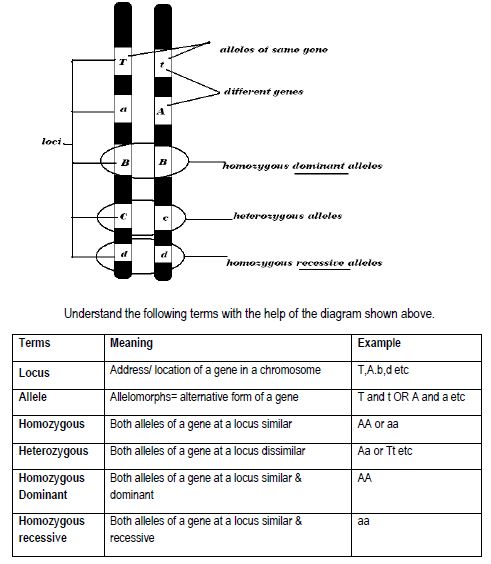
Allele: Various or slightly different forms of a gene, having same position on chromosomes.
Phenotype: The observable or external characteristics of an organism.
Genotype: The genetic constitution of an organism.
Monohybrid cross : A cross between two individuals of species, considering the inheritance of single pair of contrasting character e.g., a cross between pure tall (TT) and Dwarf (tt).
Dihybrid cross: A cross between two individuals of a species, considering the inheritance of two pairs of contrasting traits/characters e.g., a cross between Round & Yellow seeds (RRYY) and wrinkled & green seeds (rryy).
Incomplete dominance: When one of the two alleles of a gene is incompletely dominant over the other allele.
Co-dominance: When two alleles of a gene are equally dominant and express themselves even when they are together.
Multiple allelism : When a gene exists in more than two allelic forms e.g., gene for human blood group exist in three allelic forms, IA, IB and i.
Aneuploidy : The phenomenon of gain or loss of one or more chromosome(s), that results due to failure of separation of homologous pair of chromosomes during meiosis.
Trisomy : The condition in which a particular chromosome is present in three copies in a diploid cell/nucleus.
Male heterogamety : When male produces two different types of gametes/sperms e.g., In human beings X and Y.
Female Heterogamety : When female produces two different types of gametes/ova e.g., female bird produces Z and W gametes.
Mutation : The sudden heritable change in the base sequence of DNA, or structure of chromosome or a change in the number of chromosomes.
Pedigree Analysis : The analysis of the distribution and movement of trait in a series of generations of a family.
Law of Dominance: i) Characters are controlled by discrete units called factors. Ii) Factors occur in pairs. iii) In a dissimilar pair of other (recessive).
Law of Segregation: The members of allelic pair that remained together in the parent Segregate/separate during gamete formation and only one of the factors enters a gamete.
Law of Independent Assortment: In the inheritance of two pairs of contrasting characters, the factors of each pair of characters segregate independently of the factors of the other pair of characters.
Test Cross: When offspring or individual with dominant phenotype, whose genotype is not known, is crossed with an individual who is homozygous recessive for the trait.
Aneuploidy: Failure of segregation of chromatids during cell division results in the gain or loss of a chromosome(s) called aneuploidy.
Polyploidy: Failure of cytokinesis after telophase stage of cell division results in an increase in a whole set of chromosomes in an organism and this phenomenon is known as polyploidy.
Pleiotropism: Pleiotropism is defined as a phenomenon when single gene may produce more than one effect (the multiple effect of a gene) or control several phenotypes depending on its position.
Carrier: A person with a ‘defective recessive gene’ and a ‘dominant normal gene’ on homologous pair of chromosomes and therefore, not affected by the disorder but transmit the defective gene to the next
progeny through gametes.
Genome: All the genetic material in the chromosomes of a particular organism; size generally given as its total number of base pairs.
Germ Cell- An egg or sperm cell. A gamete. In humans, a germ cell contains 23 chromosomes. Haploid= A single set of chromosomes (half the full set of genetic material), present in the egg and sperm cells of animals and in the egg and pollen cells of plants. Human beings have 23 chromosomes in their reproductive cells.
Hemophilia = sex-linked recessive. Males get it most often.
Homologous chromosomes: A pair of chromosomes containing the same linear gene sequences, each derived from one parent
Karyotype: Photomicrograph of an individual’s chromosomes arranged in a standard format showing the number, size, and shape of each chromosome type.
Linkage: Proximity of two or more genes on a chromosome. The closer together the genes, the lower the probability that they will be separated during meiosis and hence the greater the probability that they will be inherited together.
Linkage map: relative positions of genetic loci on a chromosome, determined on the basis of how often the loci are inherited together.
Locus (pl. loci): The position on a chromosome of a gene or other chromosome marker; also, the DNA at that position. The use of locus is sometimes restricted to mean regions of DNA that are expressed.
Non-Disjunction: When homologous chromosomes fail to segregate properly during meiosis. Down syndrome, Turner syndrome and Klinefelter syndrome result from non-disjunction.
Relationship between genes and chromosome of diploid organism and the terms used to describe them
Exceptions to Mendel’s laws of inheritance
I. Incomplete Dominance
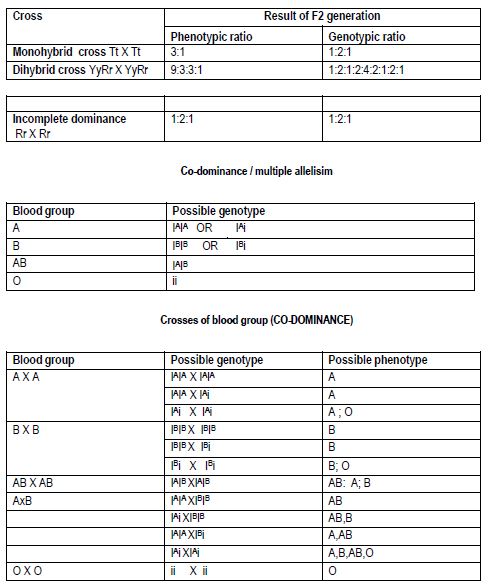
When the dominant allele does not completely the phenotypic expression of the recessive allele in a heterozygote, then a blending of both dominant and recessive traits takes place in F1 and F2 hybrids. This phenomenon is called incomplete dominance.
e.g.i) In snapdragon, broad leaf is incomplete dominant over narrow leaf.
ii) In snapdragon,(or Antirrhinum sp./dog flower) red flower is incompletely dominant over white flower
iii) In Mirabilis, red flower is incompletely dominant, over white flower.
II. Co-dominance ( Multiple allelism)
When both dominant and recessive allele lack dominant recessive relationship, then both are expressed side by side. This phenomenon is known as co-dominance.
e.g. ABO blood groups in human beings are controlled by the gene I. The gene (I) has three alleles IA, IB and i. Since there are three different alleles, there are six different combinations of these three alleles that are possible a total of six different genotypes of the human ABO blood types.
III. Polygenic Inheritance
At least in some instances the same character can be determined by more than one gene, each with the same but cumulative phenotypic effect Quantitative characters like plant height, yield of crops (size, shape and number of seeds and fruits per plant), intelligence in human beings and milk yield in animals have been found to be determined by many genes and their effects have been found to be cumulative. This phenomenon is known as polygenic inheritance. This is also considered as “ Quantitative inheritance” or “multiple factor inheritance”.
Other examples that can be studied are the kernel colour in wheat and inheritance of cob length in maize.
IV. Pleiotropism
Pleiotropism is defined as a phenomenon when single gene may produce more than one effect (the multiple effect of a gene) or control several phenotypes depending on its position.
Eg.In drosophila white eye mutation leads to depigmentation in many other parts of the body, giving a pleitropic effect.
In transgenic organisms, the introduced gene can produce different effects depending on where the gene has introgressed.
CHROMOSOMAL THEORY OF INHERITANCE
Sutton and Boveri argued that the pairing and separation of a pair of chromosomes would lead to the segregation of a pair of factors they carried. Sutton united the knowledge of chromosomal segregation with Mendelian principles and called it the “chromosomal theory of inheritance”.
Linkage and Recombination
The Mendel’s laws were extended in the form of ‘Chromosomal Theory of Inheritance’. Later, it was found that Mendel’s law of independent assortment does not hold true for the genes that were located on the same chromosomes. These genes were called as ‘linked genes’. Closely located genes assorted together, and distantly located genes, due to recombination, assorted independently. Linkage maps, therefore, corresponded to arrangement of genes on a chromosome.
• T.H. Morgan : Father of experimental genetics
• Alfred Sturtevant: Used the “ frequency of recombination” between gene pairs on the same chromosome as a “measure of distance” between genes and “mapped’ their position on the chromosome.
Sex Determination
• The term sex refers to sexual phenotype. Most organisms have only two sexual phenotypes: male and females.
• Sex determination: The mechanism by which sex is established is termed as sex determination.
• Henking(1891) was the first to identify the sex chromosome as ‘X body’, but he could not explain its significance.
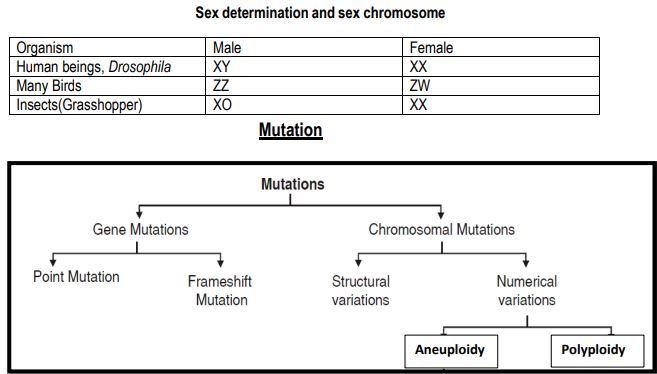
• Male heterogamety and female heterogamety ( refer key point definitions mentioned above) are commonly observed patterns that decide the sex of an organism.
Pedigree Analysis
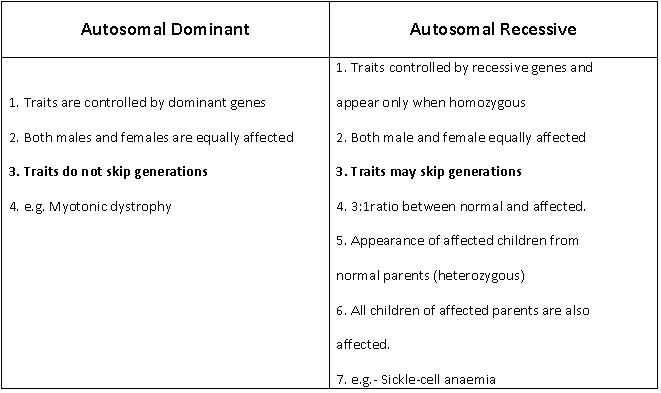
Pedigree Analysis : The analysis of the distribution and movement of trait in a series of generations of a family.
Note: Refer NCERT Text Book Page No. 88 for the symbols used in the human pedigree analysis.
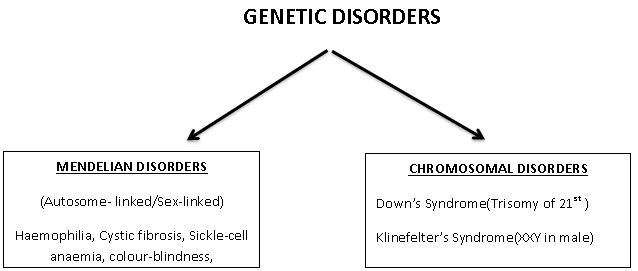
Principles of Inheritance and Variation
Pleiotropy
Pleiotropism is defined as a phenomenon when single gene may produce more than one effect (the multiple effect of a gene) or control several phenotypes depending on its position.
The basis of Pleiotropy is the interrelationship between the metabolic pathways that may contribute towards different phenotypes. In phenylketonuria, mutation of a gene that codes for the enzyme phenyl alanine hydroxylase.
This results in a phenotypic expression characterized by mental retardation and a reduction in hair and skin pigmentation.
In drosophila white eye mutation leads to depigmentation in many other parts of the body, giving a pleitropic effect.
In transgenic organisms, the introduced gene can produce different effects depending on where the gene has introgressed.
Sex-determination in honey bee
The brood cells in a hive reveal two distinct sizes. The smaller of the two are reserved for the development of the workers, which are females, whereas the larger ones are for drones which are males. During the queen’s nuptial flight, she is pursued by many drones. She finally allows herself to be inseminated by a drone. Sperms are stored in a seminal receptacle within her body. When she lays an egg in a worker cell, sperms are emitted from the seminal receptacle to fertilise the egg which will develop into a female, as all fertilised eggs form females (Incidentally, the workers can make this egg into a queen by enlarging the cell and feeding the developing larva on a rich diet, but both workers and queens are females.)
When the queen comes to a drone cell she exerts some sort of pressure on the ducts leading from the seminal receptacles so that the sperm cannot pass out and fertilise the egg as it passes down the oviduct. Thus an unfertilised egg is laid, which later hatches and produces a male. All unfertilized eggs produce males.
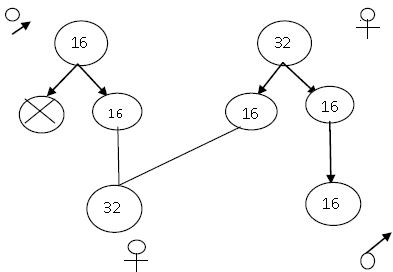
A diploid male could be obtained in the following manner. Suppose, there is a hetero zygous female Xa and Xz. When crossed with a male Xm,the females would be Xa/Xm and Xz/Xm. If the male with Xm is crossed with either of the females i.e. Xa/Xmor Xz/Xm then diploid male Xm/Xm. At the same time, the females would lay some infertile eggs which would hatch into normal, fertile, haploid males.
COLOUR BLINDNESS
Colour blindness is a recessive sex-linked trait in which the eye fails to distinguish red and green colours. The gene for normal vision is dominant. The normal gene and its recessive allele are carried by X-chromosome. In female colour blindness appears only when both the sex chromosomes carry the recessive gene (Xc Xc). The females have normal vision but function as carrier if a single recessive gene for colour blindness is present (XXc). However, in human males the defect appears in the presence of a single recessive gene (Xc Y) because Y chromosomes of males do not carry any gene for colour vision. Colour blindness, like any other sex-linked trait, shows criss-cross inheritance.

1 Normal Girl: 1 Carrier girl
1 Normal Boy: 1 Colour Blind Boy
Colour blindness
Colourblindness does not mean not seeing any colour at all, it means that those who are colourblind have trouble in seeing the differences between certain colours.
Most colourblind people can’t tell the difference between red or green. That does not mean that they can not do their normal work - Infact they can also drive – they learn to respond to the way the traffic signal lights up-the red light is generally on the top and green is on the bottom.
THALASSAEMIA
Thalassaemia is a genetic defect, originated in Mediterranean region – by their mutation or deletion. In thalassaemia too few globins are synthesised whereas in sickle cell anaemia there is a synthesis of incorrectly functioning globin.
Thalassemias are a group of disorders caused by defects in the synthesis of globin polypeptide. Absence or reduced synthesis of one of the globin chains results in an excess of the other. In this situation free globin chains, which are insoluble, accumulate inside the red cells and form precipitates which damage the cell, causing cell lysis and resulting in anemia. There are two main types of Thalassemias in which synthesis of or globin is defective. It is common in Mediterranean, Middle East, Indian subcontinent and in south east Africa.
Alpha (α) Thalassaemia
The α Thalassaemias involve the genes HBA1 and HBA2, inherited in a Mendelian recessive fashion. There are two gene loci and so four alleles. It is also connected to the deletion of the 16p chromosome. α Thalassaemias result in decreased alpha-globin production, therefore fewer alpha-globin chains are produced, resulting in an excess of β chains in adults and excess γ chains in newborns. The excess β chains form unstable tetramers (called Hemoglobin H or HbH of 4 beta chains) which have abnormal oxygen dissociation curves.
Beta (β) Thalassaemia
Beta Thalassaemias are due to mutations in the HBB gene on chromosome 11 , also inherited in an autosomal-recessive fashion. The severity of the disease depends on the nature of the mutation. Mutations are characterized as (βo or β Thalassaemia major) if they prevent any formation of β chains (which is the most severe form of β Thalassaemia); they are characterized as (β+ or β Thalassaemia intermedia) if they allow some β chain formation to occur. In either case there is a relative excess of α chains, but these do not form tetramers: rather, they bind to the red blood cell membranes, producing membrane damage, and at high concentrations they form toxic aggregates.
Delta (δ) Thalassaemia
As well as alpha and beta chains being present in hemoglobin about 3% of adult hemoglobin is made of alpha and delta chains. Just as with beta Thalassaemia, mutations can occur which affect the ability of this gene to produce delta chains.
Please click the link below to download pdf file for CBSE Class 12 Biology Principles of Inheritance and Variation.
Free study material for Biology
Download CBSE Revision Notes: Class 12 Biology Chapter 04 Principles of Inheritance and Variation
Key Concepts and Summary for Class 12 Biology Chapter 04 Principles of Inheritance and Variation
Review targeted chapter notes for Class 12 Biology Chapter 04 Principles of Inheritance and Variation. Built according to official CBSE guidelines, these summaries highlight high-yield topics frequently tested in school evaluations.
NCERT-Aligned Chapter Summary and Notes
Each chapter summary is structured around standard CBSE textbooks, allowing students to check their understanding and clarify complex ideas early in their revision.
Next Steps in Your Exam Preparation
Follow up your revision by attempting the interactive online Biology MCQ test and practice worksheets for this chapter to verify your mastery. All platform resources are free to access.
FAQs
You can download the teacher prepared revision notes for CBSE Class 12 Biology Principles Of Inheritance And Variation Notes Set 01 from StudiesToday.com. These notes are designed as per 2026-27 academic session to help Class 12 students get the best study material for Biology.
Yes, our CBSE Class 12 Biology Principles Of Inheritance And Variation Notes Set 01 include 50% competency-based questions with focus on core logic, keyword definitions, and the practical application of Biology principles which is important for getting more marks in 2026 CBSE exams.
Yes, our CBSE Class 12 Biology Principles Of Inheritance And Variation Notes Set 01 provide a detailed, topic wise breakdown of the chapter. Fundamental definitions, complex numerical formulas and all topics of CBSE syllabus in Class 12 is covered.
These notes for Biology are organized into bullet points and easy-to-read charts. By using CBSE Class 12 Biology Principles Of Inheritance And Variation Notes Set 01, Class 12 students fast revise formulas, key definitions before the exams.
No, all study resources on StudiesToday, including CBSE Class 12 Biology Principles Of Inheritance And Variation Notes Set 01, are available for immediate free download. Class 12 Biology study material is available in PDF and can be downloaded on mobile.