

Biology Concept Notes for Class 12: Chapter 01 Sexual Reproduction In Flowering Plants
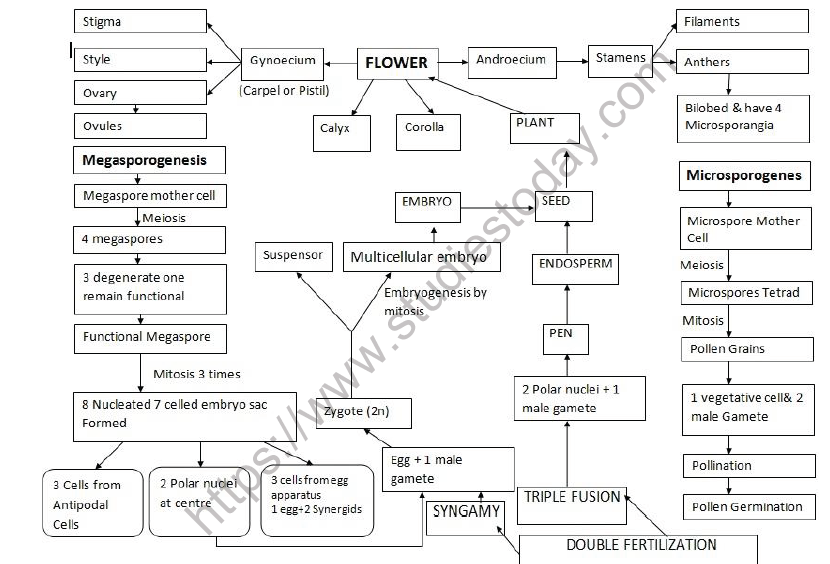
Access comprehensive revision notes for Chapter 01 Sexual Reproduction In Flowering Plants using the CBSE Class 12 Biology Sexual Reproduction In Flowering Plants Minds Map. Designed to align with the 2026-27 academic syllabus for Class 12 Biology, these concept summaries help students streamline their exam preparation and review complex topics efficiently.
Download Chapter 01 Sexual Reproduction In Flowering Plants Revision Notes PDF
Access the complete concept summary PDF for Chapter 01 Sexual Reproduction In Flowering Plants below. Regular review of these targeted notes builds familiarity with complex Class 12 Biology themes and helps secure higher marks in final school evaluations.
Important Questions for NCERT Class 12 Biology Sexual Reproduction in Flowering Plants
Ques. The role of double fertilisation in angiosperms is to produce
(a) cotyledons
(b) endocarp
(c) endosperm
(d) integuments.
Answer: C
Ques. Double fertilisation is characteristic of
(a) angiosperms
(b) anatropous
(c) gymnosperms
(d) bryophytes.
Answer: A
Ques. Double fertilisation is fusion of
(a) two eggs
(b) two eggs and polar nuclei with pollen nuclei
(c) one male gamete with egg and other with synergid
(d) one male gamete with egg and other with secondary nucleus.
Answer: D
Ques. Syngamy means
(a) fusion of gametes
(b) fusion of cytoplasms
(c) fusion of two similar spores
(d) fusion of two dissimilar spores.
Answer: A
Ques. Which of the following pair have haploid structures?
(a) Nucellus and antipodal cells
(b) Antipodal cells and egg cell
(c) Antipodal cells and megaspore mother cell
(d) Nucellus and primary endosperm nucleus
Answer: B
Ques. Double fertilisation and triple fusion were discovered by
(a) Hofmeister
(b) Nawaschin and Guignard
(c) Leeuwenhoek
(d) Strasburger.
Answer: B
Ques. Persistent nucellus in the seed is known as
(a) tegmen
(b) chalaza
(c) perisperm
(d) hilum.
Answer: C
Ques. Which one of the following statements regarding post-fertilisation development in flowering plants is incorrect?
(a) Ovules develop into embryo sac.
(b) Ovary develops into fruit.
(c) Zygote develops into embryo.
(d) Central cell develops into endosperm.
Answer: A
Ques. The coconut water from tender coconut represents
(a) free nuclear proembryo
(b) free nuclear endosperm
(c) endocarp
(d) fleshy mesocarp.
Answer: B
Ques. Coconut water from a tender coconut is
(a) innermost layers of the seed coat
(b) degenerated nucellus
(c) immature embryo
(d) free nuclear endosperm.
Answer: D
Ques. Which one of the following fruits is parthenocarpic?
(a) Jackfruit
(b) Banana
(c) Brinjal
(d) Apple
Answer: B
Ques. Non-albuminous seed is produced in
(a) maize
(b) castor
(c) wheat
(d) pea.
Answer: D
Ques. Seed coat is not thin, membranous in
(a) groundnut
(b) gram
(c) maize
(d) coconut.
Answer: D
Ques. Perisperm differs from endosperm in
(a) being a diploid tissue
(b) its formation by fusion of secondary nucleus with several sperms
(c) being a haploid tissue
(d) having no reserve food.
Answer: A
Ques. Albuminous seeds store their reserve food mainly in
(a) endosperm
(b) cotyledons
(c) hypocotyl
(d) perisperm.
Answer: A
Ques. The viability of seeds is tested by
(a) 2, 6 dichlorophenol indophenol
(b) 2, 3, 5 triphenyl tetrazolium chloride
(c) DMSO
(d) Safranine.
Answer: B
Ques. Two plants can be conclusively said to belong to the same species if they
(a) have more than 90 percent similar genes
(b) look similar and possess identical secondary metabolites
(c) have same number of chromosomes
(d) can reproduce freely with each other and form seeds.
Answer: A
Free study material for Biology
Revision Notes and Key Concepts for Class 12 Biology Chapter 01 Sexual Reproduction In Flowering Plants
Quick Revision Notes: Chapter 01 Sexual Reproduction In Flowering Plants (CBSE)
Explore reliable chapter overviews for Chapter 01 Sexual Reproduction In Flowering Plants tailored for Class 12 learners. Use these structured points to grasp difficult themes and ensure solid preparation for upcoming assessments.
Expert Study Material for Class 12 Biology
Cross-reference your comprehension with comprehensive NCERT solutions for Class 12 to ensure absolute clarity across all sub-topics in this chapter.
Complete Your Chapter Revision
Follow up your revision by attempting the interactive online Biology MCQ test and practice worksheets for this chapter to verify your mastery. All platform resources are free to access.
FAQs
You can download the teacher prepared revision notes for CBSE Class 12 Biology Sexual Reproduction In Flowering Plants Minds Map from StudiesToday.com. These notes are designed as per 2026-27 academic session to help Class 12 students get the best study material for Biology.
Yes, our CBSE Class 12 Biology Sexual Reproduction In Flowering Plants Minds Map include 50% competency-based questions with focus on core logic, keyword definitions, and the practical application of Biology principles which is important for getting more marks in 2026 CBSE exams.
Yes, our CBSE Class 12 Biology Sexual Reproduction In Flowering Plants Minds Map provide a detailed, topic wise breakdown of the chapter. Fundamental definitions, complex numerical formulas and all topics of CBSE syllabus in Class 12 is covered.
These notes for Biology are organized into bullet points and easy-to-read charts. By using CBSE Class 12 Biology Sexual Reproduction In Flowering Plants Minds Map, Class 12 students fast revise formulas, key definitions before the exams.
No, all study resources on StudiesToday, including CBSE Class 12 Biology Sexual Reproduction In Flowering Plants Minds Map, are available for immediate free download. Class 12 Biology study material is available in PDF and can be downloaded on mobile.