

Revision Notes for Class 12 Biology: Chapter 04 Principles of Inheritance and Variation
Explore reliable concept summaries and revision materials through the CBSE Class 12 Biology Principles Of Inheritance And Variation Notes Set 02. Tailored for Class 12 learners, utilizing these notes for Biology Chapter 04 Principles of Inheritance and Variation ensures thorough preparation and strengthens core academic definitions before final evaluations.
Review Chapter 04 Principles of Inheritance and Variation for Class 12 Biology
Navigate directly to the revision notes for Chapter 04 Principles of Inheritance and Variation using the digital viewer below. Each summary is structured to highlight high-weightage sections, allowing students to instantly access critical definitions and focus on core exam topics.
• Heredity is the transfer of characters from parents to their offspring. These hereditary characters are present on the chromosomes in the form of genes.
• The differences in characters of offspring mainly depend upon unique process of crossing-over that occurs during meiosis. This is one of the main reasons of producing recombination.
• Gregor Johann Mendel began his genetic experiments on garden pea in 1856.
Selection of pea plant: The main reasons for adopting garden pea (Pisum sativum) for experiments by Mendel were:
• Pea has many distinct contrasting characters.
• Life span of pea plant is short.
• Flowers show self-pollination.
• It is easy to artificially cross-pollinate the pea flowers. The hybrids thus produced were fertile.
• Working method: Mendel’s success was also due to his
meticulous planning and method of work:
• He studied only one character at a time.
• He used all available techniques to avoid cross-pollination by undesirable pollen grains.
• He applied mathematics and statistics to analyze the results obtained by him.
Mendel’s work and results
• Mendel studied the obtained results and on their basis, he proposed certain laws known as “Laws of inheritance”.
• These laws are discussed below:
1. Law of dominance:
• This law states that when two contrasting genes for a character come together in an organism, only one is expressed externally and shows visible effect. It is called dominant gene and the other gene of the pair which does not express and remains hidden is called recessive.
2. Law of segregation or Purity of gametes:
• This law states that both parental alleles (recessive and dominant) separate and are expressed phenotypically in F2 generation. When F2 generation was produced by allowing F1 hybrid to self-pollinate, to find out segregation or separation it was observed that both dominant and recessive plants appeared in 3:1 ratio.
3. Law of Independent assortment:
• It states that inheritance of two or more genes when occur at one time, their distribution in the gametes and in the progeny of subsequent generations is independent of each other.
• To prove this, he did a dihybrid cross. He crossed homozygous dominant smooth and yellow seeded (YYRR) with homozygous recessive wrinkled and green seeded (yyrr) plants. The F1 hybrid was self-pollinated and F2 generation was obtained with the phenotypic ratio of 9:3:3:1 and genotypic ratio of 1:2:1:2:4:2:1:2:1.
Test Cross:
• A cross between F1 hybrid (Aa) and its homozygous recessive parent (aa).
• This cross is called test cross because it helps to find out whether the given dominant phenotype is homozygous or heterozygous.
Incomplete Dominance
• When neither of the alleles of a character is completely dominant over the other and the F1 hybrid is intermediate between the two parents, the phenomenon is called incomplete dominance.
• The most common example of incomplete dominance is flower colour in snapdragon.
• Homozygous red (RR) flowered variety was crossed with white (rr) flowered variety. F1 offspring obtained had pink flowers (Rr). This is called incomplete dominance.
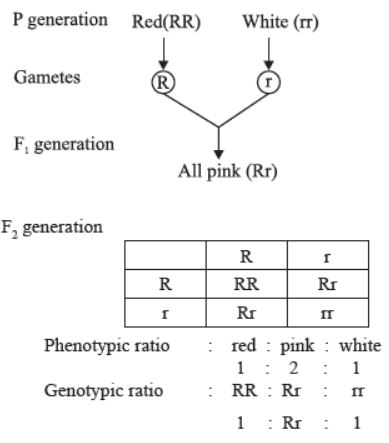
• The phenotypic ratio and genotypic ratio in F2 generation is 1:2:1.
Multiple Alleles / Co-dominance
• When a gene exists in more than two allelic forms, it shows the phenomenon of multiple alleles. A well known example is the inheritance of A, B and O blood groups in human being.
• The gene for blood group occurs in three allelic forms IA, IB and i. A person carries two of these alleles.
• The alleles IA and IB produce a slightly different form of the sugar while allele i does not produce any sugar.
• When IA and IB are present together, both are equally dominant and produce glycoproteins A and B and the blood group is AB. This is because of co-dominance.
Chromosome theory of Inheritance
• Chromosome theory of inheritance was proposed by Sutton and Boveri independently in 1902.
• The two workers found a close similarity between the transmission of hereditary characters and behaviour of chromosomes while passing from the one generation to the next through agency of gametes.
Salient features of chromosome theory:
• Both chromosomes as well as genes occur in pairs in the somatic or diploid cells.
• Homologous chromosomes separate during gamete formation.
• The paired condition of both chromosomes as well as Mendelian factor is restored during fertilization.
Experimental verification of chromosomal theory:
• Experimental verification of chromosomal theory of inheritance was done by Thomas Hunt Morgan and his colleagues.
• Morgan worked with tiny fruit flies, Drosophila melanogaster.
Reasons for selecting Drosophila (Fruit fly):
• Suitable for genetic studies.
• Grown on simple synthetic medium in the laboratory.
• They complete their life cycle in about two weeks.
• A single mating could produce a large number of progeny flies.
• Clear differentiation of male and female flies
• Have many types of hereditary variations that can be seen with low power microscopes.
Linkage and Recombination
• Linkage is the phenomenon where two or more linked genes are always inherited together and their recombination frequency in a test cross progeny is less than 50%.
• A pair of genes may be identified as linked, if their recombination frequency in a test cross progeny is lower than 50 percent.
• All the genes present on one chromosome form a linkage group and an organism possesses as many linkage groups as its haploid number of chromosomes.
• If the two genes are fully linked, their recombination frequency will be 0%.
Sex Determination
• Those chromosomes which are involved in the determination of sex of an individual are called sex chromosomes while the other chromosomes are called autosomes.
• XX – XY type: In most insects including fruit fly (Drosophila) and mammals including human beings, the females possess two homomorphic sex chromosomes, XX. The males contain two heteromorphic sex chromosomes, i.e., XY. Hence the males produce two types of gametes /sperms, either with X-chromosome or with Y-chromosome, so they are called heterogametes.
• ZZ – ZW type: In birds and some reptiles, the males are represented as ZZ (homogametes) and females are ZW (heterogamete).
• XX – XO type: In round worms and some insects, the females have two sex chromosomes, XX, while the males have only one sex chromosomes X. There is no second sex chromosome. Therefore, the males are designated as XO. The females are homogametic because they produce only one type of eggs. The males are heterogametic with half the male gametes carrying X-chromosome while the other half being devoid of it.
Sex determination in Humans:
• Human beings have 22 pairs of autosomes and one pair of sex chromosomes.
• All the ova formed by female are similar in their chromosome type (22+X). Therefore, females are homogametic.
• The male gametes or sperms produced by human males are of two types, (22+X) and (22+Y). Human males are therefore, heterogametic.
Mutation
• It is a phenomenon which results in alteration of DNA sequences and consequently results in changes in the genotype and phenotype of an organism.
• Gene / Point mutation: Due to change in a single base pair of DNA. Example: Sickle cell anaemia (GAG → GUG).
• Chromosomal mutation: Due to change in structure or number of chromosomes. Example: Down’s syndrome.
• Mutagens: The chemical and physical factors that induce mutations are known as mutagens. Example: UV rays.
Genetic Disorders
• Pedigree analysis: It is a system to analyze the distribution and movement of characters in the family tree.
• Mendelian Disorders: These are mainly determined by alteration or mutation in the single gene. These disorders are transmitted to the offspring on the same line as the principle of inheritance.
• Examples: Haemophilia, Cystic fibrosis, Sickle cell anaemia, Colour blindness, Phenylketonuria, Thalessemia, etc.
Haemophilia:
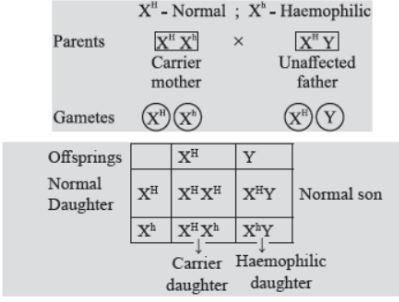
• It is a sex linked recessive disease, which shows its transmission from unaffected carrier mother to some of the male progeny.
• Haemophilia is a disorder in which a vital factor for clotting of blood is lacking. So, the clotting of blood is abnormally delayed and it can be fatal.
Punnet sqaure for haemophilia Sickle cell anaemia:
• It is an autosomal linked recessive trait. It is due to a mutant allele on chromosome 11 (autosome) that causes substitution of glutamine (GAG) to valine (GUG) at the sixth position of β-chain of haemoglobin.
• The disease is controlled by a single pair of allele HbA and HbS. HbAHbA (normal); HbAHbS (carrier) and HbSHbS (diseased).
• The patient has sickled shaped RBCs with defective haemoglobin. They are destroyed more rapidly than normal RBCs.
Phenylketonuria:
• It is an autosomal recessive trait.
• The affected individual lacks an enzyme (phenylalanine hydroxylase) that converts the amino acid phenylalanine into tyrosine.
• As a result, this phenylalanine and its derivatives accumulate in the cerebrospinal fluid leading to mental degeneration (retardation) and are excreted in the urine due to its poor absorption by kidney.
Chromosomal Disorders:
• Due to absence or excess or abnormal arrangement of one or more chromosomes.
• A change in the number of chromosomes in an organism arises due to non-disjunction of chromosomes, during gamete formation.
Aneuploidy:
• This arises due to loss or gain of one or more chromosomes during gamete formation.
• Example: Down’s syndrome (47) and Turner’s syndrome (45).
Polyploidy:
• In this, there is an increase in a whole set of chromosomes.
• Accordingly, these may be haploid, diploid and polyploid.
Down’s syndrome:
• Caused due to presence of an additional copy of the chromosome number 21 (trisomy of 21).
• Symptoms: Short statured with small round mouth, palm is broad with characteristic palm crease, physical, psychomotor and mental development is retarded.
Klinefelter’s syndrome:
• It arises due to non-disjunction of X-chromosomes during ova formation.
• Caused due to the presence of an additional copy of X-chromosome resulting into a karyotype of 47 (44 + XXY).
• Symptoms: A male with underdeveloped breasts (gynaecomastia), sparse body hair, mentally retarded and sterile.
Turner’s syndrome:
• Caused due to the absence of one of the X-chrosomes, i.e., 45 (44 + XO)
• Symptoms: A female with rudimentary ovaries, short stature, lack of secondary sexual characters, they are sterile.
- Genetics is a branch of biology that deals with the study of heredity and variations. Heredity is the study of transmission of characters from parents to offspring or from one generation to the next. The characters that are passed from one generation to the next are called hereditary characters. Variations may be defined as the differences in characteristics shown by the individuals of a species and also by the offspring or siblings of the same parents.
- The term genetics was first used by W. Bateson (1906).
- Gregor Johann Mendel (1822-84) is called the Father of Genetics because he was the first to workout the patterns of heredity by performing experiments on garden pea plant (Pisum sativum).
GENETIC TERMINOLOGIES AND SYMBOLS
- Character is a well defined morphological or physiological feature of an organism, for example plant height.
- Trait is the distinguishing feature of a character, for example tallness or dwarfness.
- Gene is the unit of genetic information that determines the biological character of an organism.
- Allelomorphs or alleles refer to the two Mendelian factors which occur on the same locus on the two homologous chromosomes of an individual and control the expression of a character e.g., T and t, Y and y, R and r are pairs of alleles.
- Term allele was given by W. Bateson.
- Dominant allele is one of the factor of an allelic pair which can express itself whether present in homozygous or heterozygous state, e.g., T (tallness in pea), R (round seed in pea).
- Recessive allele is the factor of an allelic pair which is unable to express its effect in the presence of its contrasting alternative form in a heterozygote, e.g., t in Tt.
- The diploid condition in which the alleles at a given locus are identical is called homozygous or pure, e.g., TT or tt.
- Organism containing two different alleles or individual containing both dominant and recessive genes of an allelic pair, e.g., Tt, is known as heterozygous or hybrid.
- When only one allelic pair is considered in cross breeding, it is called monohybrid cross.
- When two allelic pairs are considered for crossing, it is called dihybrid cross.
- When there is involvement of more than two allelic pairs in a cross it is called polyhybrid cross.
- F1 generation is the generation of hybrids produced from a cross between the genetically different individuals called parents. For example, Tt individuals are produced in F1 generation from a cross between TT and tt parents.
- F2 generation is the generation of individuals which arises as a result of inbreeding or interbreeding amonst individuals of F1 generation.
Hybrid vigour or heterosis is the superiority of hybrid over either of its parents in one or more traits.
- Genotype is the gene complement or genetic constitution of an individual with regard to one or more characters irrespective of whether the genes are expressed or not.
- Phenotype is the observable characteristic of an organism which is determined by its genes.
- The portion or region on chromosome representing a single gene is called gene locus.
- The aggregate of all genes and their alleles present in an interbreeding population is known as the gene pool.
- Pure line or pure breeding line is a strain of individuals homozygous for all genes considered. The term was coined by Johannsen.
- Punnett square is a checker board which was devised by R.C. Punnett and used to show the result of a cross between two organisms.
- Genome is a constitution of all the genes contained in a single set of chromosomes, i.e., in a haploid nucleus. Each parent, through its reproductive cells, contributes its genome to its offspring. A single genome is present in haploid cells, two in diploid cells and many in polyploid cells.
Free study material for Biology
Chapter 04 Principles of Inheritance and Variation Concepts and Summary for Class 12 Biology
About Chapter 04 Principles of Inheritance and Variation Revision Notes
Explore reliable chapter overviews for Chapter 04 Principles of Inheritance and Variation tailored for Class 12 learners. Use these structured points to grasp difficult themes and ensure solid preparation for upcoming assessments.
How to Use These Revision Notes
Cross-reference your comprehension with comprehensive NCERT solutions for Class 12 to ensure absolute clarity across all sub-topics in this chapter.
Enhance Practice with MCQs and Worksheets
Explore our broader library of printable assignments, chapter notes, and mock tests designed to support continuous revision and secure higher marks in CBSE assessments.
FAQs
You can download the teacher prepared revision notes for CBSE Class 12 Biology Principles Of Inheritance And Variation Notes Set 02 from StudiesToday.com. These notes are designed as per 2026-27 academic session to help Class 12 students get the best study material for Biology.
Yes, our CBSE Class 12 Biology Principles Of Inheritance And Variation Notes Set 02 include 50% competency-based questions with focus on core logic, keyword definitions, and the practical application of Biology principles which is important for getting more marks in 2026 CBSE exams.
Yes, our CBSE Class 12 Biology Principles Of Inheritance And Variation Notes Set 02 provide a detailed, topic wise breakdown of the chapter. Fundamental definitions, complex numerical formulas and all topics of CBSE syllabus in Class 12 is covered.
These notes for Biology are organized into bullet points and easy-to-read charts. By using CBSE Class 12 Biology Principles Of Inheritance And Variation Notes Set 02, Class 12 students fast revise formulas, key definitions before the exams.
No, all study resources on StudiesToday, including CBSE Class 12 Biology Principles Of Inheritance And Variation Notes Set 02, are available for immediate free download. Class 12 Biology study material is available in PDF and can be downloaded on mobile.