

Download CBSE Class 7 Science Useful Resources
Review targeted academic resources with the Class 7 Electric Current and Its effects Important Questions VBQs. Built according to official CBSE standards for the 2026-27 term, these downloadable Class 7 Science study materials support effective daily practice and deeper conceptual understanding for Chapter 14 Electric Current and Its Effects.
Access CBSE Study Guides and Summaries
View or download the dedicated Class 7 Electric Current and Its effects Important Questions VBQs resource below. Engaging with these advanced study guides under focused conditions ensures continuous academic progress and mastery of the 2026-27 curriculum for Chapter 14 Electric Current and Its Effects.
Class 7 Electric Current and Its effects Important Questions VBQs. There are many more useful educational material which the students can download in pdf format and use them for studies. Study material like concept maps, important and sure shot question banks, quick to learn flash cards, flow charts, mind maps, teacher notes, important formulas, past examinations question bank, important concepts taught by teachers. Students can download these useful educational material free and use them to get better marks in examinations. Also refer to other worksheets for the same chapter and other subjects too. Use them for better understanding of the subjects.
CLASS 7 SCIENCE CHAPTER 14 ELECTRIC CURRENT AND ITS EFFECTS IMPORTANT QUESTIONS
Activity 1
Aim: To observe the heating effect of current
Materials required: Battery eliminator, wires, heating element
Theory: When electric current flows through a wire, the wire becomes hot. This is called heating effect of current.
Diagram:
Procedure: 1. Connect the heating element with the battery eliminator using wires as shown in the circuit diagram. 2. Let the current flow through the wire and observe.
Observation:
Answer:
1. When the current is switched on, the heating element becomes hot within a short time.
2. When the circuit is switched off, the element cools down and stops getting hot.
Teacher's Note:
a) Touch the wire only after switching off, because the heated element can burn the skin.
b) Heat is produced in the element, while the connecting wires stay almost cool.
Conclusion:
Answer: Electric current produces heat when it flows through a wire of high resistance. This is the heating effect of current.
Teacher's Note:
a) Heat is produced because the wire opposes the flow of current.
b) The heating element is made of a material with high resistance and high melting point.
Activity 2
Aim: To observe the magnetic effect of current
Materials required: Battery eliminator, wires, a solenoid, magnetic compass, alpins
Theory: When electric current flows through a wire, the wire behaves like a magnet. This is called magnetic effect of current.
Procedure: 1. Connect the solenoid with the battery eliminator using wires as shown in the circuit diagram. 2. Let the current flow through the wire. 3. Bring a magnetic compass near it and observe. 4. Keep some alpins near the solenoid / wire and observe.
Observation:
Answer:
1. When the current flows, the magnetic needle of the compass placed near the wire deflects from its north-south direction.
2. When the current flows, the alpins (iron pins) are attracted towards the solenoid and the wire.
3. When the current is switched off, the compass needle returns to its original north-south position and the pins fall off.
Teacher's Note:
a) The compass needle is itself a small magnet, so it responds to the magnetic field of the current.
b) Keep the compass away from iron objects, otherwise the reading will be wrong.
c) Deflection is larger when the current is larger.
Conclusion:
Answer: A current carrying wire or solenoid behaves like a magnet. This is the magnetic effect of current.
Teacher's Note:
a) The magnetism lasts only while current flows.
b) The solenoid works like a bar magnet with two poles.
Activity 3
Aim: To observe the working of an electromagnet
Materials required: Battery eliminator, switch, wires, an iron nail, insulated copper wire, pins or small iron pieces
Theory: An electromagnet is a temporary magnet. A soft iron core becomes magnetic only while current flows through the coil wound around it.
Procedure: 1. Wind a few turns of insulated copper wire around the iron nail. 2. Connect the two ends of the coil to the battery eliminator through a switch. 3. Switch on the current and bring the iron nail near some pins. 4. Switch off the current and observe the pins again.
Observation:
Answer:
1. When the switch is on, the iron nail attracts the pins.
2. When the switch is off, the pins fall from the nail.
Teacher's Note:
a) Count the pins that stick, then compare the number with more turns of wire.
b) Do not leave the switch on for long, as the coil and wires heat up.
Conclusion:
Answer: The iron nail becomes a magnet only when current flows through the coil. Hence, an electromagnet is a temporary magnet.
Teacher's Note:
a) The coil must be insulated so that current does not leak to the nail.
b) Strength can be increased by adding more turns or increasing the current.
Activity 4
CONSTRUCTION AND WORKING OF ELECTRIC BELL
Construction: - An electric bell consists of a coil of wire wound on an iron piece. This coil acts as an electromagnet. An iron strip with a hammer at one end is kept close to the electromagnet. There is a contact screw near the iron strip. A gong is placed near the hammer. The circuit is made as shown in the diagram.
Working: - When the switch is closed and the circuit is completed, current flows through the coils of the electromagnet. It attracts the soft iron strip that is attached to the hammer. The hammer moves with it and hits the gong, but the circuit is now broken at the point X of the contact screw. The electromagnet loses its magnetism and no longer attracts the iron strip (soft iron armature). The spring moves back to its original position and makes contact at X, thus completing the circuit again. This cycle is then repeated as long as the switch is on.
Answer:
1. Blank 1: switch (the circuit is completed when the switch is closed).
2. Blank 2: electromagnet, because the coils are wound on the iron piece.
3. Blank 3: soft iron strip, which is attached to the hammer.
4. Blank 4: gong, which the hammer strikes.
5. Blank 5: broken, because the iron strip has moved away from the contact screw.
6. Blank 6: magnetism.
7. Blank 7: spring, which brings the hammer back to contact at X.
8. Blank 8: circuit.
Teacher's Note:
a) The make-and-break action of the hammer produces the ringing sound.
b) The contact screw and the spring must not touch the hammer permanently.
c) Iron is used for the core because it loses its magnetism quickly when current stops.
Assignment 14.1
Fill in the blanks:-
a) A filament of low melting point is used in __________________.
Answer: fuse wire.
Teacher's Note:
a) A fuse must melt easily when the current becomes too large.
b) The alloy of tin and lead is used because its melting point is low.
b) An electric fuse is based on ________________ effect of current.
Answer: heating.
Teacher's Note:
a) The fuse wire heats up as current passes through it.
b) It melts and breaks the circuit when the heat becomes too much.
c) The filament of an electric bulb is made of a metal of ________ melting point.
Answer: high.
Teacher's Note:
a) Tungsten is used because it can glow without melting.
b) A low melting point metal would melt as soon as the bulb glows.
d) Nichrome is used for making _______________.
Answer: heating elements.
Teacher's Note:
a) Nichrome has high resistance and high melting point.
b) It is used in electric iron, toasters and heaters.
e) The materials used as a filament of a bulb and that used in electric iron are __________________ and ___________________ respectively.
Answer: tungsten and nichrome respectively.
Teacher's Note:
a) Bulb filament is made of tungsten, which has a very high melting point.
b) Electric iron uses nichrome as its heating element.
f) ______ is the symbol of ___________ ______________.
[Figure: circuit symbol of a switch drawn as a line with a gap and a lifted lever, showing an open switch]
Answer: open switch.
Teacher's Note:
a) In the symbol the lever is lifted, so the circuit is broken.
b) The closed switch symbol has the lever touching the contact.
g) ______ is the symbol of ________________.
[Figure: circuit symbol of a cell, a long thin line and a short thick line placed side by side with leads at both ends]
Answer: cell.
Teacher's Note:
a) The longer line marks the positive terminal.
b) A battery of several cells is shown by joining such symbols in a row.
h) The wires used for connections in a simple circuit are represented by _________.
Answer: straight lines.
Teacher's Note:
a) Connecting wires are drawn as plain straight lines.
b) Crossing lines without a dot means the wires are not joined.
2. Match the following:-
| COLUMN A | COLUMN B |
|---|---|
| A. electric current | a. low melting point |
| B. electric cell | b. magnetic effect |
| C. electric fuse | c. current does not flow |
| D. electric iron | d. heating effect |
| E. electric bell | e. +ve to -ve terminal |
| F. open circuit | f. source of current |
Answer:
A - e (current flows from the positive to the negative terminal)
B - f (a cell is a source of current)
C - a (a fuse wire has low melting point)
D - d (an electric iron works by heating effect)
E - b (an electric bell works by magnetic effect)
F - c (no current flows in an open circuit)
Teacher's Note:
a) Current is conventionally taken to flow from positive to negative terminal.
b) Match the appliance first, then the effect it uses.
Assignment 14.2
Write the correct option with the option number for the following in the space provided.
1. When an electric current passes through a wire, the wire gets hot. This is called
(a) electricity
(b) conduction
(c) Joule heating
(d) none of these
Answer: (c) Joule heating
1. Heating of a wire by current is named after James Prescott Joule.
2. Hence, the correct option is (c).
Teacher's Note:
a) Joule heating is another name for the heating effect of current.
b) Electricity is the flow of charge, not the heat itself.
2. An electric fuse is
(a) a safety device
(b) used to produce current
(c) used to heat a room
(d) an electric appliance
Answer: (a) a safety device
1. A fuse melts when current is too high.
2. This breaks the circuit and protects the appliances, so it is a safety device.
3. Hence, the correct option is (a).
Teacher's Note:
a) A fuse protects wiring from overheating and fire.
b) A fuse is not a source of current, so option (b) is wrong.
3. In an electric bell, we can find
(a) electromagnet
(b) hammer
(c) interrupter
(d) all of these
Answer: (d) all of these
1. An electric bell has an electromagnet, a hammer and a make-and-break contact called the interrupter.
2. Hence, all of these are present, and the correct option is (d).
Teacher's Note:
a) The interrupter is the contact screw that opens and closes the circuit.
b) Each part has its own role in producing the ringing sound.
4. Which of these does not use the heating effect of current?
(a) electric toaster
(b) electric fan
(c) electric iron
(d) room heater
Answer: (b) electric fan
1. Toaster, iron and room heater produce heat from current.
2. A fan works by a motor that turns blades, so it does not use heating effect.
3. Hence, the correct option is (b).
Teacher's Note:
a) Appliances that give out heat use a heating element of nichrome.
b) A fan converts electrical energy into motion, not heat.
5. An electromagnet is a ________________ magnet.
(a) permanent
(b) temporary
(c) naturally occurring
(d) both (a) and (b)
Answer: (b) temporary
1. An electromagnet is magnetic only while current flows through its coil.
2. Hence, it is a temporary magnet, and the correct option is (b).
Teacher's Note:
a) A permanent magnet keeps its magnetism when no current flows.
b) Soft iron cores lose magnetism quickly, which makes them temporary.
6. In a simple circuit of cell, switch and a bulb, if the filament is broken the circuit is
(a) complete
(b) incomplete
(c) complete but bulb doesn't glow
(d) either (a) or (c)
Answer: (b) incomplete
1. A broken filament means the path for current is cut.
2. A circuit with a break in its path is an open circuit, which is incomplete.
3. Hence, the correct option is (b).
Teacher's Note:
a) Option (c) is wrong because a broken circuit cannot light the bulb.
b) An open circuit is incomplete, so no current flows at all.
7. The strength of electromagnet can be increased by
a) increasing the number of turns of coil
b) increasing the current
c) Both (a) and (b) together
d) Either (a) or (b)
Answer: c) Both (a) and (b) together
1. More turns of coil increase the magnetic field.
2. More current through the coil also increases the magnetic field.
3. Both changes act together, so the correct option is c).
Teacher's Note:
a) Using both methods gives the strongest electromagnet.
b) Do not increase the current beyond the safe limit of the wire.
8. An electric fuse wire melts when current flowing through it is
a) more than the maximum amount
b) less than the maximum amount
c) more than the minimum amount
d) less than the maximum amount
Answer: a) more than the maximum amount
1. A fuse is rated for a maximum safe current.
2. Current above this value heats the fuse wire until it melts.
3. Hence, the correct option is a).
Teacher's Note:
a) Option (d) is printed the same as option (b) in the paper, so it is not a separate choice.
b) Option (c) is wrong because minimum current does not melt a fuse.
9. In an electric bell, when circuit is complete the hammer hits the
(a) soft iron strip
(b) contact screw
(c) gong
(d) electromagnet
Answer: (c) gong
1. When the circuit is complete, the electromagnet pulls the hammer towards it.
2. The hammer strikes the gong and produces the sound.
3. Hence, the correct option is (c).
Teacher's Note:
a) The hammer is attached to the soft iron strip, so option (a) is only the part that moves.
b) The gong is the metal bowl that makes the ringing sound.
10. When a magnetic compass is brought near a current carrying wire, the needle of the compass
a) points towards south
b) points towards north
c) does not move at all
d) deflects
Answer: d) deflects
1. A current carrying wire produces a magnetic field around it.
2. The compass needle lines up with this field, so it deflects from north-south.
3. Hence, the correct option is d).
Teacher's Note:
a) The deflection stops when the current is switched off.
b) Options (a) and (b) are wrong because the needle does not simply point to a fixed direction.
Give one word for the following:-
a) A group of cells joined together - ___________________
Answer: Battery.
Teacher's Note:
a) Cells joined in a row give a larger voltage.
b) A single cell is not called a battery.
b) Magnet produced by current carrying coil - ___________________
Answer: Electromagnet.
Teacher's Note:
a) The coil is wound around a soft iron core.
b) It is temporary because it works only while current flows.
c) A safety device which protects our electric appliances - ___________________
Answer: Fuse.
Teacher's Note:
a) A fuse melts to cut off current when it is too high.
b) Replace a blown fuse only with one of the correct rating.
d) Representation of electric components using symbols in a circuit - ___________________
Answer: Circuit diagram.
Teacher's Note:
a) A circuit diagram uses standard symbols for each component.
b) It is drawn with straight lines for wires.
e) This is replacing fuse in our household circuits - ___________________
Answer: Circuit breaker (MCB).
Teacher's Note:
a) A circuit breaker switches off automatically when current is too high.
b) Unlike a fuse, it can be reset and used again.
THINK and ANSWER!!!
The bulb is new, filament is not broken and connections are tight. In the given circuit, the bulb does not glow. Identify the possible reasons.
Answer:
1. The cell may be discharged or weak, so it cannot push enough current.
2. The switch may be open, so the circuit is not complete.
3. The cell may be connected in the wrong direction, or the battery terminals may be dirty and not in contact.
4. A connecting wire may be broken inside its insulation even though the ends look tight.
Teacher's Note:
a) Check the switch first, since it is the easiest fault to fix.
b) A new bulb can still fail to glow if the supply is not reaching it.
c) Test each wire with a tester to find a hidden break.
Assignment 14.3
1. Draw the circuit diagram for the given figure.
[Figure: picture of a battery at the top and a bulb in the middle of a rectangular frame labelled Electric Circuits, with wires forming a closed loop]
Answer:
1. Draw a cell at the top of the loop with its positive terminal marked.
2. Connect one bulb in the same loop using straight lines for the connecting wires.
3. Close the loop so that current can flow from the cell through the bulb and back to the cell.
4. Show the bulb with a circle and a cross inside it.
Teacher's Note:
a) The circuit must form a closed loop for the bulb to glow.
b) Use the standard symbols for cell and bulb, not pictures.
2. Draw the circuit diagram for the given figure.
[Figure: picture of a cell and a bulb connected by wires in a closed loop on a blue background]
Answer:
1. Draw the cell with its longer line as positive.
2. Draw one bulb in the loop, joined to the cell by straight wires.
3. Complete the loop back to the other terminal of the cell.
Teacher's Note:
a) Every component in a simple circuit must lie in one loop.
b) Mark the positive and negative terminals to show the direction of current.
3. Which scientific concept is demonstrated by this figure?
[Figure: picture of a cell connected by a wire running over a magnetic compass placed below it]
Answer: Magnetic effect of electric current.
Teacher's Note:
a) The wire produces a magnetic field when current flows through it.
b) This experiment was first shown by Hans Christian Oersted.
4. What happens to the needle of the magnetic compass?
[Figure: picture of a cell, wires and a switch above a magnetic compass]
Answer:
1. When the switch is closed and current flows, the needle deflects from its north-south position.
2. When the switch is opened, the needle returns to point north-south.
Teacher's Note:
a) Deflection is caused by the magnetic field of the current-carrying wire.
b) The needle returns when the current stops.
5. Draw the symbols for the following electric components.
(a) a cell
Answer: A long thin line and a short thick line placed side by side, with a connecting lead at each end. The longer line is the positive terminal.
Teacher's Note:
a) The long line marks the positive terminal.
b) Use the same symbol for each cell in a battery.
(b) a battery of 3 cells
Answer: Three cell symbols joined in a row, with the positive end of one cell joined to the negative end of the next.
Teacher's Note:
a) Joining cells end to end adds their voltage.
b) Check the polarity of each cell before joining.
(c) connecting wire
Answer: A plain straight line.
Teacher's Note:
a) Wires are drawn as straight lines with no break in the symbol.
(d) bulb in 'on' position
Answer: A circle with a cross inside it, joined to the circuit by wires.
Teacher's Note:
a) The cross inside the circle shows the filament.
b) A bulb that is on is part of a closed circuit.
(e) bulb in 'off' position
Answer: A circle with a cross inside it, joined to the circuit, where the circuit is broken by an open switch or a missing link.
Teacher's Note:
a) The bulb symbol does not change, only the state of the circuit does.
b) An off bulb is part of an open circuit.
(f) open switch
Answer: A short line with a gap, and a lever lifted up from the contact.
Teacher's Note:
a) An open switch breaks the circuit.
b) Current cannot flow through an open switch.
(g) closed switch
Answer: A short line with its lever touching the contact, so the path is complete.
Teacher's Note:
a) A closed switch allows current to flow.
b) The open and closed symbols differ only by the lever position.
Assignment 14.4
1. Why do we use a soft iron core in an electromagnet?
Answer:
1. Soft iron becomes strongly magnetised when current flows through the coil.
2. It loses its magnetism as soon as the current is switched off.
3. Hence, a soft iron core makes a strong temporary magnet.
Teacher's Note:
a) Steel keeps its magnetism, so it is not suitable for an electromagnet.
b) The quick loss of magnetism is what makes the electromagnet switchable.
2. Write 3-4 practical applications of electromagnet.
Answer:
1. Electric bell, which rings when the hammer is attracted to the electromagnet.
2. Electric crane, which lifts heavy iron scrap and drops it when the current is switched off.
3. Telephone earpiece and loudspeaker, which change electrical signals into sound.
4. Electric relay, which is used to switch circuits on and off.
Teacher's Note:
a) Each use depends on the electromagnet being switched on and off at will.
b) A crane is a good example of a large electromagnet at work.
3. The strength of electromagnet depends on what factors?
Answer:
1. The number of turns of the coil.
2. The current flowing through the coil.
3. The nature of the core, such as soft iron.
Teacher's Note:
a) More turns give a stronger magnetic field for the same current.
b) A soft iron core is much stronger than an air core.
4. What is an electric fuse? On what principle does it work?
Answer:
1. An electric fuse is a short piece of wire of tin-lead alloy with low melting point, placed in series in a circuit.
2. It works on the heating effect of current.
3. When the current is too high, the fuse wire heats up, melts and breaks the circuit.
Teacher's Note:
a) A fuse is always connected in series with the appliance.
b) Replace a blown fuse with one of the same rating, never with a thicker wire.
5. What happens when an iron nail is kept inside a current carrying coil?
Answer:
1. The iron nail becomes magnetised while current flows.
2. It can then attract small iron objects such as pins.
3. When the current is switched off, the nail loses its magnetism.
Teacher's Note:
a) The coil with the nail inside forms an electromagnet.
b) The nail becomes a temporary magnet, not a permanent one.
6. In a simple circuit of a cell, switch and a bulb connected with wires, on passing current for some time, the bulb becomes hot but the wires do not. Why?
Answer:
1. The filament of the bulb has high resistance, so it heats up strongly.
2. The connecting wires have very low resistance, so they carry the current with little heating.
Teacher's Note:
a) Heat is produced in proportion to resistance.
b) Copper wire is used for connections because its resistance is low.
7. What are fuse wires generally made of?
Answer: Fuse wires are generally made of an alloy of tin and lead.
Teacher's Note:
a) The alloy has a low melting point.
b) Pure metals are not used because they melt at higher temperatures.
8. What is the material used for making heating elements?
Answer: Nichrome, an alloy of nickel, chromium and iron.
Teacher's Note:
a) Nichrome has high resistance and a high melting point.
b) It does not oxidise quickly when heated.
9. What is an electromagnet?
Answer: An electromagnet is a temporary magnet made by winding an insulated copper wire around a soft iron core and passing current through the coil.
Teacher's Note:
a) It is magnetic only while current flows.
b) Its strength can be changed by changing the current.
10. Why do we use fuse in our household circuits?
Answer:
1. A fuse protects the household wiring and appliances.
2. If the current becomes too high, the fuse melts and cuts off the supply.
3. This prevents overheating and possible fire.
Teacher's Note:
a) Too much current can happen because of a short circuit or too many appliances.
b) A fuse acts as the weakest link in the circuit.
11. Who was the first person to observe deflection of compass needle when current passes through a nearby wire?
Answer: Hans Christian Oersted.
Teacher's Note:
a) Oersted made this observation in 1820.
b) The discovery showed the link between electricity and magnetism.
12. How can you show that an electric current produces magnetic effect?
Answer:
1. Place a magnetic compass near a straight wire connected to a cell through a switch.
2. Switch on the current and observe the compass needle, which deflects.
3. Switch off the current and observe that the needle returns to its original position.
4. Hence, the current produces a magnetic effect.
Teacher's Note:
a) Keep the compass away from iron objects for a clear reading.
b) Reversing the current reverses the direction of deflection.
13. How will prove that an electromagnet is a temporary magnet?
Answer:
1. Wind insulated wire around an iron nail and connect it to a cell through a switch.
2. Switch on the current and bring the nail near some pins; the pins stick to it.
3. Switch off the current; the pins fall off the nail.
4. Hence, the nail loses its magnetism when the current stops, so it is a temporary magnet.
Teacher's Note:
a) A permanent magnet would keep holding the pins after the switch is off.
b) Use a soft iron nail, not a steel one, for a clear result.
Assignment 14.5
1. Study the figure below and fill in the blanks:-
[Figure: an iron nail placed inside a coil of insulated wire, connected to a battery and a switch; the nail is shown at the top of the coil]
The figure above shows the working of a/an __________________. In this a coil of _________________ wire is wound around an _______ _________. When electric current is allowed to _____________ through the wire, the iron nail becomes _________________. When the _____________ is turned off, the iron nail loses its ________________.
Answer:
1. The figure shows the working of an electromagnet.
2. A coil of insulated copper wire is wound around an iron nail.
3. When electric current is allowed to flow through the wire, the iron nail becomes magnetic.
4. When the switch is turned off, the iron nail loses its magnetism.
Teacher's Note:
a) The iron nail is the soft iron core of the electromagnet.
b) The insulated wire stops current from leaking into the nail.
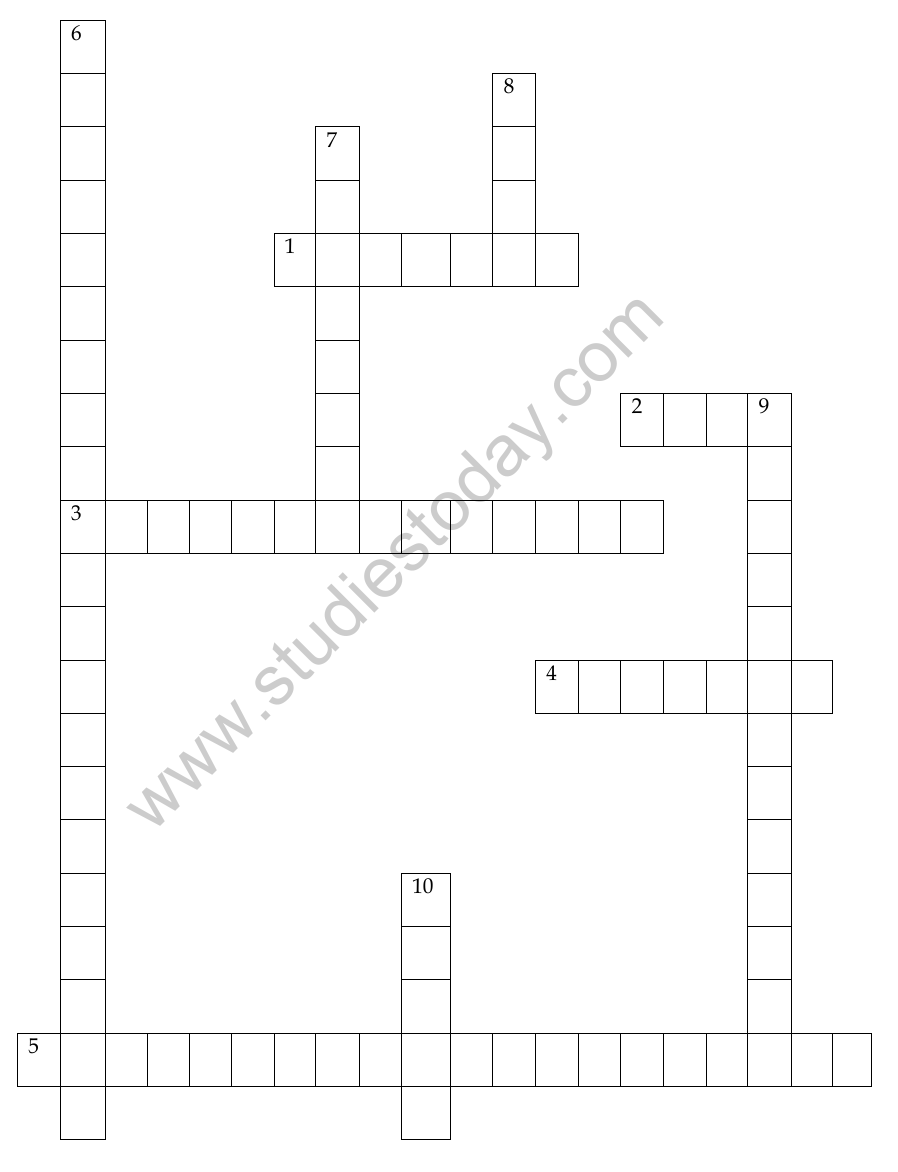
2. Solve the crossword below:-
ACROSS
1. Coil of wire present in a room heater is called ____________. (7)
Answer: ELEMENT (heating element).
Teacher's Note:
a) The heating element is a coil of nichrome wire.
b) When current flows, the coil glows and gives out heat.
2. Wires of low melting point are used for making _________.(4)
Answer: FUSE.
Teacher's Note:
a) A fuse wire melts at a low temperature.
b) This protects the circuit when current is too high.
3. Symbols of electric components are used in this. (7,7)
Answer: CIRCUIT DIAGRAM.
Teacher's Note:
a) A circuit diagram shows how components are joined.
b) Each component has a standard symbol.
4. Combination of two or more cells. (7)
Answer: BATTERY.
Teacher's Note:
a) Cells joined together form a battery.
b) A battery has a larger voltage than one cell.
5. Scientist who studied magnetic effect of current. (4,9,7)
Answer: HANS CHRISTIAN OERSTED.
Teacher's Note:
a) Oersted observed the deflection of a compass needle near a wire.
b) He is credited with the discovery of electromagnetism.
DOWN
6. Now-a-days these are used in place of fuse. (9,7,7)
Answer: MINIATURE CIRCUIT BREAKER.
Teacher's Note:
a) A miniature circuit breaker (MCB) trips when current is too high.
b) Unlike a fuse, it can be switched on again after it trips.
7. Wire of high melting point and high resistance is used to make ________ of bulb. (8)
Answer: FILAMENT.
Teacher's Note:
a) Tungsten is the usual filament material.
b) The filament glows white hot when current passes through it.
8. Current stops flowing when the switch is __________. (4)
Answer: OPEN.
Teacher's Note:
a) An open switch breaks the circuit.
b) The circuit is closed again when the switch is closed.
9. Soft iron core with insulated copper wire wound around it in an electric bell. (13)
Answer: ELECTROMAGNET.
Teacher's Note:
a) The electromagnet pulls the hammer when current flows.
b) It loses its magnetism when the circuit breaks.
10. Working of electric heaters, kettles, iron, etc are based on _______ effect of current. (7)
Answer: HEATING.
Teacher's Note:
a) These appliances convert electrical energy into heat.
b) The heating effect depends on the resistance of the element.
[Figure: blank crossword grid with numbered cells 1 to 10 as printed in the PDF; the answers are given in clues 1 to 10 above]
High Order Thinking Skills
1. In the two figures, the bulbs are identical and are connected as shown in the figure:-
[Figure: two circuit diagrams. Left, a Series circuit with one battery (+ marked) and three identical light bulbs placed one after another in a single loop. Right, a Parallel circuit with one battery (+ marked) and three identical light bulbs each connected across the battery terminals in separate branches.]
a) In which case will all the bulbs glow with same brightness? Explain your answer.
Answer: In the parallel circuit (Figure 2), every bulb gets the full voltage of the battery, so all three bulbs glow with the same brightness.
Teacher's Note:
a) Each parallel branch is connected directly across the battery.
b) Identical bulbs in series also glow equally, but they share the battery voltage, so each glows dimmer than in the parallel circuit.
b) In which case, the bulbs will not glow with same brightness?
Answer: With identical bulbs and no fault, neither circuit gives unequal brightness. Unequal brightness occurs only when one bulb is different or faulty, for example a loose contact in a parallel branch.
Teacher's Note:
a) The question assumes identical bulbs, so the difference must come from a fault, not from the circuit type.
b) A loose or broken bulb in a parallel branch changes only that branch, while the other bulbs stay bright.
c) Compare the connections of the three bulbs in both figures. How are they different?
Answer:
1. In the series circuit, the three bulbs are joined one after another in a single loop, so the same current flows through each bulb.
2. In the parallel circuit, each bulb has its own branch connected across the battery, so each bulb gets the full battery voltage.
3. If one bulb in the series circuit breaks, all bulbs go off, but in the parallel circuit the other bulbs stay on.
Teacher's Note:
a) Series connection uses one path for current.
b) Parallel connection gives several paths, so the current divides among the branches.
c) Household appliances are connected in parallel for this reason.
2. What are the color convention for live, neutral and earth wires?
Answer:
1. Live wire is red.
2. Neutral wire is black.
3. Earth wire is green.
Teacher's Note:
a) The live wire carries the supply voltage, so it must be handled with care.
b) The earth wire is a safety path and is not meant to carry normal current.
3. The different electrical appliances used in our houses - are they connected in series or parallel?
Answer: Electrical appliances in our houses are connected in parallel.
Teacher's Note:
a) Each appliance gets the full mains voltage.
b) Appliances can be switched on and off independently in a parallel connection.
c) Switching off a fan does not affect the bulbs.
4. Silver is a better conductor than a copper and aluminium. Then, why do we use copper and aluminium to make wires to carry electric current?
Answer:
1. Silver is far more expensive than copper and aluminium.
2. Copper and aluminium are good conductors and are available in large quantities.
3. Aluminium is light and cheap, so it is used for long overhead lines.
Teacher's Note:
a) Cost decides the choice of wire material for large lengths.
b) Copper is strong and flexible, which makes it good for house wiring.
Please click the link below to download Class 7 Electric Current and Its effects Important Questions VBQs.
Free study material for Science
Useful Resources and Notes for Class 7 Science Chapter 14 Electric Current and Its Effects
Essential Notes for Class 7 Science
Explore essential learning tools for Class 7 Science Chapter 14 Electric Current and Its Effects. This curated collection features in-depth notes and targeted practice questions built around the active 2026 curriculum to streamline your daily revision.
Verified Solutions for Class 7 Science
Built using official NCERT guidelines for Class 7 Science, these materials provide reliable academic support. Integrating past examination questions and step-by-step solutions helps students understand official CBSE grading criteria.
Enhance Accuracy with Online Tests
Wrap up your chapter revision by testing your knowledge against standard objective question formats. Explore our full library of free, up-to-date sample papers and online assessments to secure top grades in your CBSE examinations.
FAQs
Our advanced study package for Chapter 14 Electric Current and Its Effects includes detailed concepts, diagrams, Mind Maps, and explanation of complex topics to ensure Class 7 students learn as per syllabus for 2026 exams.
The Mind Maps provided for Chapter 14 Electric Current and Its Effects act as visual anchors which will help faster recall during high-pressure exams.
Yes, teachers use our Class 7 Science resources for lesson planning as they are in simple language and have lot of solved examples.
Yes, You can download the complete, mobile-friendly PDF of the Science Chapter 14 Electric Current and Its Effects advanced resources for free.
Yes, our subject matter experts have updated the Chapter 14 Electric Current and Its Effects material to align with the rationalized NCERT textbooks and have removed deleted topics and added new competency-based questions.