

Advanced Study Material for Class 7 Science: All Chapters
Review targeted academic resources with the Class 7 Language of Chemistry Important Questions for exams. Built according to official CBSE standards for the 2026-27 term, these downloadable Class 7 Science study materials support effective daily practice and deeper conceptual understanding for All Chapters.
Practice Class 7 Science Resources: All Chapters
View or download the dedicated Class 7 Language of Chemistry Important Questions for exams resource below. Engaging with these advanced study guides under focused conditions ensures continuous academic progress and mastery of the 2026-27 curriculum for All Chapters.
Class 7 Language of Chemistry Important Questions for exams. There are many more useful educational material which the students can download in pdf format and use them for studies. Study material like concept maps, important and sure shot question banks, quick to learn flash cards, flow charts, mind maps, teacher notes, important formulas, past examinations question bank, important concepts taught by teachers. Students can download these useful educational material free and use them to get better marks in examinations. Also refer to other worksheets for the same chapter and other subjects too. Use them for better understanding of the subjects.
LANGUAGE OF CHEMISTRY
Smart Notes
Just like 26 letters make up an entire English language, a few elements are a basis of all chemical reactions. This makes it necessary for us to understand this exciting new language, the language of chemistry.
J.J. Berzelius laid the foundation of language of chemistry in the early 19th century. In this, an atom is represented by a symbol, a molecule by a formula and a chemical reaction by a chemical equation. Let us learn more about what each of these terms mean and how are they allotted to a substance to make it meaningful and easy to understand.
Symbols
Early scientists used pictures to denote elements (pure substances made up of identical atoms). As more elements were discovered this was not possible. Every element is now denoted by a symbol/ English alphabet. A symbol is the short hand representation of an element. It represents-
- An element in particular
- An atom of an element
For ex- the symbol H represents one atom of the element hydrogen.
The symbols were allotted in a systematic manner-
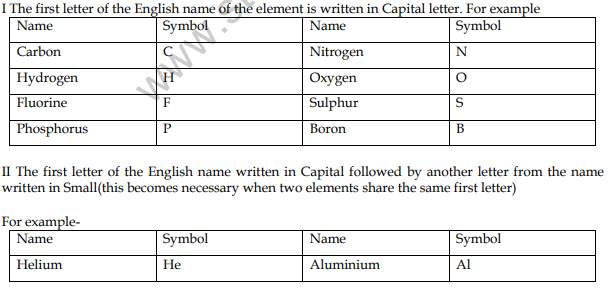
I The first letter of the English name of the element is written in Capital letter. For example
| Name | Symbol | Name | Symbol |
|---|---|---|---|
| Carbon | C | Nitrogen | N |
| Hydrogen | H | Oxygen | O |
| Fluorine | F | Sulphur | S |
| Phosphorus | P | Boron | B |
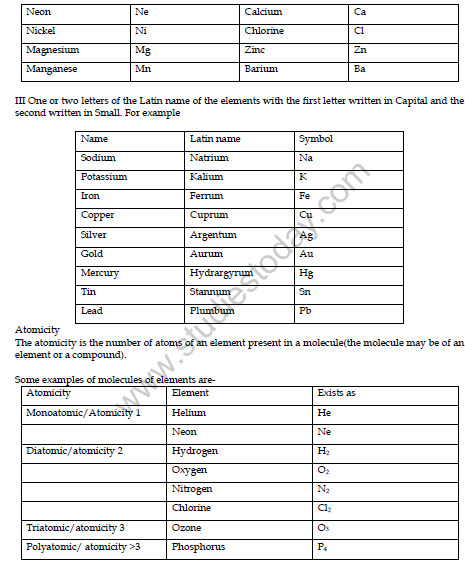
II The first letter of the English name written in Capital followed by another letter from the name written in Small (this becomes necessary when two elements share the same first letter)
For example-
| Name | Symbol | Name | Symbol |
|---|---|---|---|
| Helium | He | Aluminium | Al |
| Neon | Ne | Calcium | Ca |
| Nickel | Ni | Chlorine | Cl |
| Magnesium | Mg | Zinc | Zn |
| Manganese | Mn | Barium | Ba |
III One or two letters of the Latin name of the elements with the first letter written in Capital and the second written in Small. For example
| Name | Latin name | Symbol |
|---|---|---|
| Sodium | Natrium | Na |
| Potassium | Kalium | K |
| Iron | Ferrum | Fe |
| Copper | Cuprum | Cu |
| Silver | Argentum | Ag |
| Gold | Aurum | Au |
| Mercury | Hydrargyrum | Hg |
| Tin | Stannum | Sn |
| Lead | Plumbum | Pb |
Atomicity
The atomicity is the number of atoms of an element present in a molecule (the molecule may be of an element or a compound).
Some examples of molecules of elements are-
| Atomicity | Element | Exists as |
|---|---|---|
| Monoatomic/Atomicity 1 | Helium | He |
| Neon | Ne | |
| Diatomic/atomicity 2 | Hydrogen | H2 |
| Oxygen | O2 | |
| Nitrogen | N2 | |
| Chlorine | Cl2 | |
| Triatomic/atomicity 3 | Ozone | O3 |
| Polyatomic/ atomicity >3 | Phosphorus | P4 |
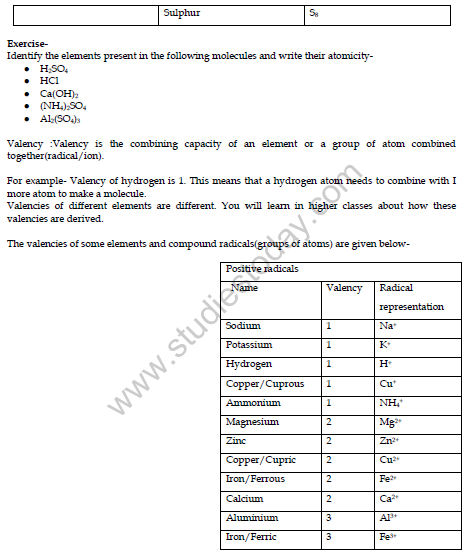
| Sulphur | S8 |
Exercise-
Identify the elements present in the following molecules and write their atomicity-
- H2SO4
- HCl
- Ca(OH)2
- (NH4)2SO4
- Al2(SO4)3
Valency: Valency is the combining capacity of an element or a group of atom combined together (radical/ion).
For example- Valency of hydrogen is 1. This means that a hydrogen atom needs to combine with 1 more atom to make a molecule.
Valencies of different elements are different. You will learn in higher classes about how these valencies are derived.
The valencies of some elements and compound radicals (groups of atoms) are given below-
Positive radicals
| Name | Valency | Radical representation |
|---|---|---|
| Sodium | 1 | Na+ |
| Potassium | 1 | K+ |
| Hydrogen | 1 | H+ |
| Copper/Cuprous | 1 | Cu+ |
| Ammonium | 1 | NH4+ |
| Magnesium | 2 | Mg2+ |
| Zinc | 2 | Zn2+ |
| Copper/Cupric | 2 | Cu2+ |
| Iron/Ferrous | 2 | Fe2+ |
| Calcium | 2 | Ca2+ |
| Aluminium | 3 | Al3+ |
| Iron/Ferric | 3 | Fe3+ |
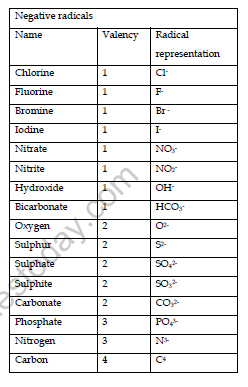
Negative radicals
| Name | Valency | Radical representation |
|---|---|---|
| Chlorine | 1 | Cl− |
| Fluorine | 1 | F− |
| Bromine | 1 | Br− |
| Iodine | 1 | I− |
| Nitrate | 1 | NO3− |
| Nitrite | 1 | NO2− |
| Hydroxide | 1 | OH− |
| Bicarbonate | 1 | HCO3− |
| Oxygen | 2 | O2− |
| Sulphur | 2 | S2− |
| Sulphate | 2 | SO42− |
| Sulphite | 2 | SO32− |
| Carbonate | 2 | CO32− |
| Phosphate | 3 | PO43− |
| Nitrogen | 3 | N3− |
| Carbon | 4 | C4− |
Chemical formula
A chemical formula is the short hand representation of a chemical compound which is written using symbols of the elements involved. Let us learn how to deduce the chemical formula of an ionic chemical compound comprising of a positive and a negative radical or a metal and a non metal.
Steps for writing a chemical formula-
I Write the symbols of the radicals side by side, keeping the positive radical on the left and the negative radical on the right.
For example- Na O
II Write the valencies of the radicals on their top right hand side.
For Example- Na1+ O2−
III Cross the valencies and write them as sub-scripts. (the valency of the negative radical becomes the atomicity of the positive radical and vice versa). The charges on the radicals are NOT written in the chemical formula.
For example- Na1+ O2−
Na2O
IV If possible, bring the valencies to the lowest terms.
For example- Ca2+ O2−
Ca2O2 or CaO
V If a radical has more than element, keep it in a bracket. The atomicity of the individual atoms in such a radical cannot be brought to lowest terms.
For example- Ca2+ SO42−
Ca2(SO4)2 or CaSO4 (The number 4 here cannot be cancelled). Also, the formula cannot be written as Ca2S2O8
Exercise
Now write the chemical formulae for the following compounds-
- Hydrogen chloride
- Aluminium hydroxide
- Sodium sulphate
- Calcium carbonate
- Carbon dioxide
- Ferric chloride
- Cuprous oxide
- Potassium nitrate
- Magnesium phosphate
- Hydrogen sulphide
LET US DO
WRITING CHEMICAL FORMULAE
Here is an activity which is both visual and kinaesthetic that can be used to help students at various levels learn to write, or practice writing chemical formulae.
A series of cards representing common anions and cations are used. Each card has both the symbol and name of the ion written on them.
For example, students are given the cards and asked to write the formula for sodium chloride
This requires one sodium ion (card) and one chloride ion (card), therefore the formula for sodium chloride is written NaCl.
Similarly for sodium sulphate
This requires two sodium ions (cards) and one sulphate ion (card), therefore the formula for sodium sulphate can be written Na2SO4.
The formula for aluminium sulphate is Al2(SO4)3 that is
These cards can also be used as an assessment task where students discover the 'rule' for writing chemical formulae for themselves.
So, here you go. Just cut out the cards given on the next few pages, pages them on a hard paper and you are ready to take the challenge of chemical formulae.
Cation cards (each card has the symbol and the name of the ion; three cards of each ion are given)
| Ion | Name on card | Ion | Name on card | Ion | Name on card |
|---|---|---|---|---|---|
| Na+ | sodium ion | Li+ | lithium ion | K+ | potassium ion |
| NH4+ | ammonium ion | H+ | hydrogen ion | Ag+ | silver ion |
| Cu2+ | copper ion | Ca2+ | calcium ion | Pb2+ | lead ion |
| Zn2+ | zinc ion | Fe3+ | Iron (III) ion | Al3+ | Aluminium ion |
| Mg2+ | magnesium ion | Fe2+ | iron (II) ion | Ba2+ | Barium ion |
Anion cards (three cards of each ion, except phosphate which has two; some blank cards are also given)
| Ion | Name on card | Ion | Name on card | Ion | Name on card |
|---|---|---|---|---|---|
| Cl− | Chloride ion | I− | Iodide ion | F− | Fluoride ion |
| OH− | Hydroxide ion | NO3− | Nitrate ion | NO2− | Nitrite ion |
| CO32− | Carbonate ion | SO42− | Sulphate ion | O2− | Oxide ion |
| Br− | Bromide ion | H− | Hydride ion | PO43− | Phosphate ion |
| S2− | Sulphide ion | SO32− | Sulphite ion | Blank cards | |
Steps for naming a chemical compound
I Write the name of the metal/ positive radical (the first alphabet written in capital) followed by the name of the negative radical/non-metal (written in small).
II Note- The names of the metal and radicals remain the same. The name of the non-metal is written ending in “ –ide”.
For example-
NaCl- Sodium chloride
NH4OH- Ammonium hydroxide
III The names of radicals consisting of more than one atom remains the same. For example- Carbonate (CO3), hydroxide (OH−)
IV In case of variable valency, the radical with a lower valency ends in –ous while the higher valency is written as –ic.
For example Ferrous sulphate (Fe2+), Ferric chloride (Fe3+)
Now write the chemical names of the following compounds-
- Na2O
- AlCl3
- Ca3(PO4)2
- KNO3
- FeSO4
- CuCl2
- NH4NO3
- Na2CO3
- Mg(HCO3)2
- Ag2S
Writing word Equations
A chemical equation is a short hand representation of a chemical change. It is written using the symbol and formulae of the substances involved.
A chemical equation has two parts-
Reactants- These are the substances which take part in a chemical reaction. They are written on the left hand side of the equation.
Products- These are the substances which are formed as a result of the chemical reaction. These are written on the right hand side of the chemical equation.
For example- A chemical reaction between magnesium and oxygen can be written as follows-
Magnesium + Oxygen → Magnesium oxide
This chemical equation can be read as follows-
Magnesium combines with oxygen to form magnesium oxide. Magnesium and oxygen are the reactants while magnesium oxide is the product.
Exercise-
Represent the following chemical reactions as word equations and identify the reactants and the products-
- Hydrogen gas combines with oxygen gas to form water.
- Hydrochloric acid reacts with sodium hydroxide to form sodium chloride and water.
- Sodium metal burns in air to form sodium oxide.
- Iron reacts with copper sulphate to form ferrous sulphate and copper
- Carbon dioxide dissolves in water to form carbonic acid
Answers
- ______________________________
Reactants: ______________________________
Products: ______________________________ - ______________________________
Reactants: ______________________________
Products: ______________________________ - ______________________________
Reactants: ______________________________
Products: ______________________________ - ______________________________
Reactants: ______________________________
Products: ______________________________ - ______________________________
Reactants: ______________________________
Products: ______________________________
Classify each of the following as an element [E], a compound [C], or a mixture [M].
| No. | Substance | No. | Substance |
|---|---|---|---|
| _____ 1. | Gold | _____ 6. | Air |
| _____ 2. | Water | _____ 7. | Carbon dioxide |
| _____ 3. | Seawater | _____ 8. | Silver |
| _____ 4. | Sugar | _____ 9. | Ice |
| _____ 5. | A chocolate sundae | _____ 10. | Freshly-brewed black coffee |
FUN TIME WITH MATHEMATICS AND SCIENCE
(a) Atmospheric Gases
Let's take a moment to look at what makes up the "air" in the Earth's atmosphere. The air is really a mixture of many different gases, and each gas has its own properties. The composition of air is not constant. It can vary from time to time and place to place.
Below is a pie chart with a graphical representation of dry air.
(b) The following pie chart is a self explanatory depiction of the causative agents of air pollution.
(c) Did You Know ?????????
There are elements in the human body………
99% of the mass of the human body is made up of only six elements: oxygen, carbon, hydrogen, nitrogen, calcium, and phosphorus. Every organic molecule contains carbon. Since 65-90% of each body cell consists of water (by weight), it isn't surprising that oxygen and hydrogen are major components of the body. The data below shows the percentage of different elements that make up the human body.
| Element | Percentage |
|---|---|
| Hydrogen | 10 |
| Oxygen | 65 |
| Carbon | 18 |
| Nitrogen | 3 |
| Calcium | 2 |
| Phosphorus | 1 |
| Other elements | 1 |
Now, based on your understanding of a pie chart, construct a pie chart representing the composition of elements present in human body (approximate interpretation)
Free study material for Science
Science Class 7 Exam Resources: All Chapters
Essential Notes for Class 7 Science
Explore essential learning tools for Class 7 Science All Chapters. This curated collection features in-depth notes and targeted practice questions built around the active 2026 curriculum to streamline your daily revision.
Verified Solutions for Class 7 Science
Designed around the official curriculum, these study guides guarantee standard compliance. Reviewing step-by-step solutions clarifies complex sub-topics within All Chapters and demystifies standard marking schemes for Science evaluations.
Enhance Accuracy with Online Tests
Maximize your grade potential by utilizing Class 7 Science practice papers in tandem with these structured notes. All printable assignments and interactive mock tests on our platform are updated for the 2026 session and available free of charge.
FAQs
Our advanced study package for All Chapters includes detailed concepts, diagrams, Mind Maps, and explanation of complex topics to ensure Class 7 students learn as per syllabus for 2026 exams.
The Mind Maps provided for All Chapters act as visual anchors which will help faster recall during high-pressure exams.
Yes, teachers use our Class 7 Science resources for lesson planning as they are in simple language and have lot of solved examples.
Yes, You can download the complete, mobile-friendly PDF of the Science All Chapters advanced resources for free.
Yes, our subject matter experts have updated the All Chapters material to align with the rationalized NCERT textbooks and have removed deleted topics and added new competency-based questions.