

Official CBSE Study Materials for Class 7 Science
Access comprehensive study materials and useful resources for Chapter 12 Reproduction in Plants using the Class 7 Reproduction in Plants Important Questions VBQs. Designed to align with the 2026-27 CBSE academic guidelines, these advanced resources help Class 7 Science students reinforce core concepts beyond standard textbooks.
Advanced Resources for Science
Navigate directly to the advanced Science study materials using the digital viewer below. Each resource pack includes detailed conceptual summaries and solved practice questions, allowing students to instantly reinforce their learning.
Class 7 Reproduction in Plants Important Questions VBQs. Please refer to the examination notes which you can use for preparing and revising for exams. These notes will help you to revise the concepts quickly and get good marks.
Chapter 12
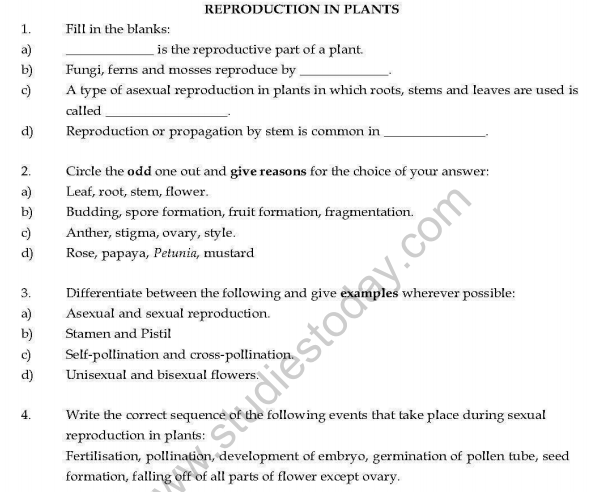
REPRODUCTION IN PLANTS
1. Fill in the blanks: [4 Marks]
a) ____________ is the reproductive part of a plant.
b) Fungi, ferns and mosses reproduce by ____________.
c) A type of asexual reproduction in plants in which roots, stems and leaves are used is called ____________.
d) Reproduction or propagation by stem is common in ____________.
Answer:
1. a) Flower
2. b) Spores
3. c) Vegetative propagation
4. d) Potato (or ginger / sugarcane / rose)
Teacher's Note:
a) Flowers contain reproductive organs such as stamen and pistil.
b) Spores are asexual reproductive bodies covered by a hard protective coat.
c) Vegetative propagation uses vegetative parts like roots, stems, and leaves.
d) Stems store food and possess nodes from which new plants sprout.
2. Circle the odd one out and give reasons for the choice of your answer: [4 Marks]
a) Leaf, root, stem, flower.
b) Budding, spore formation, fruit formation, fragmentation.
c) Anther, stigma, ovary, style.
d) Rose, papaya, Petunia, mustard
Answer:
1. a) Flower: It is a reproductive part, whereas leaf, root, and stem are vegetative parts.
2. b) Fruit formation: It is a sexual process/result of fertilization, whereas budding, spore formation, and fragmentation are asexual methods of reproduction.
3. c) Anther: It is a male reproductive part of a flower, whereas stigma, ovary, and style are parts of the female reproductive organ (pistil).
4. d) Papaya: It produces unisexual flowers, whereas rose, Petunia, and mustard bear bisexual flowers.
Teacher's Note:
a) Distinguishes between vegetative parts and reproductive structures in plants.
b) Separates asexual reproduction categories from sexual reproductive developments.
c) Tests knowledge of male versus female parts inside a flower.
d) Classifies plants based on the presence of unisexual and bisexual flowers.
3. Differentiate between the following and give examples wherever possible: [4 Marks]
a) Asexual and sexual reproduction.
b) Stamen and Pistil
c) Self-pollination and cross-pollination.
d) Unisexual and bisexual flowers.
Answer:
| Comparison | Column A | Column B |
|---|---|---|
| a) Asexual vs Sexual | New plants are obtained without production of seeds (e.g., rose, potato). | New plants are obtained from seeds through fusion of gametes (e.g., tomato, mango). |
| b) Stamen vs Pistil | Male reproductive part consisting of anther and filament. | Female reproductive part consisting of stigma, style, and ovary. |
| c) Pollination Types | Transfer of pollen from anther to stigma of the same flower or same plant. | Transfer of pollen from anther of one flower to stigma of another flower of same kind. |
| d) Flower Types | Contain either only male or only female reproductive organs (e.g., papaya, corn). | Contain both male and female reproductive organs (e.g., mustard, rose). |
Teacher's Note:
a) Asexual needs single parent; sexual requires male and female gametes.
b) Always label parts accurately when comparing floral organs.
c) Self-pollination happens within same flower/plant; cross-pollination involves agents like wind, water, or insects.
d) Provide clear biological examples for each category to score full marks.
4. Write the correct sequence of the following events that take place during sexual reproduction in plants:
Fertilisation, pollination, development of embryo, germination of pollen tube, seed formation, falling off of all parts of flower except ovary. [3 Marks]
Answer:
1. Pollination
2. Germination of pollen tube
3. Fertilisation
4. Falling off of all parts of flower except ovary
5. Development of embryo
6. Seed formation
Teacher's Note:
a) Pollination must precede pollen tube germination and fertilization.
b) Fertilization leads to zygote formation, after which floral parts wither.
c) The ovary transforms into a fruit while ovules develop into seeds.
5.
a) Name the type of asexual reproduction shown in the above diagram. [1 Mark]
Answer: Budding.
Teacher's Note:
a) Budding involves the formation of a small bulb-like projection called a bud that grows and detaches from the parent cell.
b) Give an example of organism showing the above method of reproduction. [1 Mark]
Answer: Yeast.
Teacher's Note:
a) Yeast is a single-celled microscopic fungus that commonly reproduces asexually through budding.
6. Describe the process of fragmentation with the hep of a diagram. [3 Marks]
Answer:
1. Fragmentation is a type of asexual reproduction observed in organisms like Spirogyra, where the body breaks up into two or more smaller fragments.
2. Each of these fragments grows into a new, independent individual mature organism.
3. Under favorable conditions such as availability of water and nutrients, algae multiply rapidly by this method.
[Figure: Diagram of Spirogyra filament breaking into two fragments and growing into new filaments]
Teacher's Note:
a) Fragmentation is common in simple multicellular organisms.
b) Ensure students label the parent filament and growing new fragments clearly in the diagram.
c) Avoid confusing fragmentation with binary fission, which occurs in unicellular organisms.
7. Define fertilisation. List the sequence of events that take place in a flower after fertilisation. [3 Marks]
Answer:
1. Fertilisation is defined as the fusion of a male gamete with a female gamete to form a zygote.
2. After fertilisation, the ovary grows into a fruit while other parts of the flower wither and fall off.
3. The ovules develop into seeds, which contain the embryo protected inside a seed coat.
Teacher's Note:
a) Fertilisation is a key step in sexual reproduction in plants leading to seed formation.
b) A common mistake is confusing ovary transformation with ovule transformation; remember ovary forms fruit, ovule forms seed.
c) Mentioning the zygote and embryo formation adds precision to the answer.
8. Give any two uses of seed dispersal. How are the seeds of following plants dispersed? [4 Marks]
a) Grass
b) Urena
c) Coconut
d) Xanthium
e) Drumstick
Answer:
1. Uses of seed dispersal: It prevents overcrowding of plants in one area and enables plants to invade new habitats for sunlight, water, and minerals.
2. Grass: Dispersed by wind or animals (lightweight seeds or clinging structures).
3. Urena: Dispersed by animals through hooks that stick to fur or clothes.
4. Coconut: Dispersed by water due to its fibrous outer coat enabling it to float.
5. Xanthium: Dispersed by animals using spiny hooks.
6. Drumstick: Dispersed by wind due to winged and lightweight seeds.
Teacher's Note:
a) Seed dispersal mechanisms depend on physical adaptations like hooks, wings, or fibrous coats.
b) Students often miss listing the general uses before answering individual plant parts.
c) Connect the adaptation of coconut (fibrous husk) and drumstick (winged seeds) directly to water and wind dispersal agents.
9. In the diagram of the flower given below: [3 Marks]
a) Where is female gamete or egg formed?
b) Which part of the flower contains pollen grains?
c) Name the parts of the flower that form the fruit and seeds respectively.
[Figure: Longitudinal section of a flower showing stamen, anther, filament, pollen tube, stigma, style, ovary, petal, sepal, ovule, and receptacle with clear labels]
Answer:
1. The female gamete or egg is formed inside the ovule, which is located within the ovary.
2. The anther, which is a part of the stamen, contains pollen grains.
3. The ovary forms the fruit and the ovules form the seeds respectively.
Teacher's Note:
a) Identifying flower parts from cross-section diagrams is an essential board exam skill.
b) Be precise with terms; do not write just flower, specify ovule inside ovary for the egg.
c) Note that stamen is the male reproductive whorl containing the anther.
10. Draw neat and well-labelled diagrams of the following: [4 Marks]
a) Maple seed
b) Stamen
c) Pistil
d) Leaf of Bryophyllum showing leaf buds.
Answer:
1. Maple seed: Draw a seed showing its elongated wing-like structure adapted for wind dispersal.
2. Stamen: Draw a stalk-like filament carrying a bilobed anther at the top.
3. Pistil: Draw the female reproductive organ clearly showing the stigma, style, and swollen basal ovary.
4. Leaf of Bryophyllum: Draw a notched leaf margin with small plantlets (leaf buds) growing along the edges.
[Figure: Diagrams of maple seed with wing, stamen with anther and filament, pistil with stigma, style and ovary, and Bryophyllum leaf with marginal buds]
Teacher's Note:
a) Clear, pencil-drawn diagrams with proper arrow labels fetch full marks in biology.
b) Students must ensure that all requested parts in stamen, pistil, and Bryophyllum are distinctly labelled.
c) Vegetative propagation in Bryophyllum occurs through the buds present on the leaf margin.
VALUE BASED QUESTION:
Aditya came back from school and he saw that the shoots were growing from the eyes of the potato in a vegetable basket in his kitchen. He took the potato and separated the eyes and planted in his kitchen garden. Why did he do so? If you were in his place what would you do? [3 Marks]
Answer:
1. Aditya observed that shoots were growing from the eyes of the potato, which are actually buds capable of vegetative propagation.
2. He separated the eyes and planted them because each eye can grow into a new potato plant independently.
3. If we were in his place, we would do the exact same thing to propagate new plants efficiently through vegetative reproduction.
Teacher's Note:
a) Potato tubers reproduce vegetatively through buds known as eyes.
b) Ensure each cut piece of the potato contains at least one healthy eye for successful growth.
c) Vegetative propagation helps produce plants faster and they are genetically identical to the parent plant.
LAB ACTIVITY
Objective: To study the parts of a flower. [3 Marks]
Materials required: China rose flower, forceps, hand lens, dissecting blade, microscope and needle.
Procedure:
1. Take a China rose flower and place it on a clean flat surface.
2. Observe the outer green leaf-like structures called sepals (calyx).
3. Observe the bright colored petals (corolla) that attract insects.
4. Carefully pluck off the petals and sepals using forceps to expose the reproductive organs.
5. Observe the stamens (male reproductive parts consisting of filament and anther) and the pistil (female reproductive part consisting of stigma, style, and ovary).
[Figure: Diagram of a China rose flower showing sepals, petals, stamens, and pistil clearly labelled]
Observation:
1. The outermost whorl consists of green sepals.
2. The second whorl consists of prominent colored petals.
3. Numerous stamens bearing anthers containing pollen grains are attached around the pistil.
4. The central female reproductive organ, the pistil, shows a sticky stigma, an elongated style, and a swollen ovary at the base.
Conclusion:
1. A typical flower consists of four main floral whorls: sepals, petals, stamens, and pistil.
2. Stamens are the male reproductive organs and pistils are the female reproductive organs.
Precautions:
1. Handle the dissecting blade and sharp needles carefully to avoid injury.
2. Pluck the floral parts gently without damaging the delicate inner whorls.
Teacher's Note:
a) China rose is an ideal specimen because its floral parts are large and easily distinguishable.
b) Always handle sharp lab instruments with utmost care.
c) Recognizing floral organs is fundamental to understanding plant sexual reproduction.
Free study material for Science
CBSE Class 7 Science Study Material: Chapter 12 Reproduction in Plants
Core Study Kit: Class 7 Science Chapter 12 Reproduction in Plants
Explore essential learning tools for Class 7 Science Chapter 12 Reproduction in Plants. This curated collection features in-depth notes and targeted practice questions built around the active 2026 curriculum to streamline your daily revision.
NCERT-Aligned Solutions for Chapter 12 Reproduction in Plants
Built using official NCERT guidelines for Class 7 Science, these materials provide reliable academic support. Integrating past examination questions and step-by-step solutions helps students understand official CBSE grading criteria.
Next Steps in Your Exam Preparation
For peak performance in upcoming evaluations, integrate official Science sample papers directly into your study schedule. Follow up your revision by attempting online MCQ tests for Chapter 12 Reproduction in Plants to refine calculation speed and precision.
FAQs
Our advanced study package for Chapter 12 Reproduction in Plants includes detailed concepts, diagrams, Mind Maps, and explanation of complex topics to ensure Class 7 students learn as per syllabus for 2026 exams.
The Mind Maps provided for Chapter 12 Reproduction in Plants act as visual anchors which will help faster recall during high-pressure exams.
Yes, teachers use our Class 7 Science resources for lesson planning as they are in simple language and have lot of solved examples.
Yes, You can download the complete, mobile-friendly PDF of the Science Chapter 12 Reproduction in Plants advanced resources for free.
Yes, our subject matter experts have updated the Chapter 12 Reproduction in Plants material to align with the rationalized NCERT textbooks and have removed deleted topics and added new competency-based questions.