

Advanced Study Material for Class 7 Science: Chapter 12 Reproduction in Plants
Explore structured advanced study materials through the Class 7 Reproduction in Plants Notes for exams. Tailored for Class 7 learners, utilizing these Science resources ensures thorough preparation and strengthens foundational knowledge before final CBSE evaluations.
Practice Class 7 Science Resources: Chapter 12 Reproduction in Plants
Navigate directly to the advanced Science study materials using the digital viewer below. Each resource pack includes detailed conceptual summaries and solved practice questions, allowing students to instantly reinforce their learning.
Class 7 Reproduction in Plants Notes for exams. There are many more useful educational material which the students can download in pdf format and use them for studies. Study material like concept maps, important and sure shot question banks, quick to learn flash cards, flow charts, mind maps, teacher notes, important formulas, past examinations question bank, important concepts taught by teachers. Students can download these useful educational material free and use them to get better marks in examinations. Also refer to other worksheets for the same chapter and other subjects too. Use them for better understanding of the subjects.
REPRODUCTION IN PLANTS
Reproduction
Reproduction is the process by which living organisms produce more of their kind. Plants reproduce either sexually or asexually.
I. Asexual mode of reproduction
It is the process which involves single parent in giving rise to offspring. It is the growth of a new plant from a part of the plant other than the seed.
Modes of asexual reproduction in plants
Plants reproducing by asexual mode do not produce gametes. A single parent multiplies to give rise to new individuals. Different modes of asexual reproduction in plants are elucidated.
1. Vegetative propagation
a) Leaf propagation: Bryophyllum propagates vegetatively by the formation of leaf buds on the margins of a leaf. When the buds come in contact with moist soil, each bud is capable of growing into a new plant. is the production of new plants from the vegetative parts of the plant. Roots, stems and leaves are called the vegetative parts of a plant. Vegetative propagationtakes place by different methods like Leaf propagation, Root propagation, Underground stem propagation etc.
b) Root propagation: Sweet potato and Dahlia are cut into many pieces and are covered with mud. Each piece of the root tuber is capable of growing into young plant.
c) Stem propagation: In money plant, stem is cut and one side of it is buried in the soil. This stem from the parent plant grows into a new plant.
d) Underground stem tuber propagation: Potato is a stem tuber growing underground. It bears special structures called as eyes on it. When a potato is cut and buried under the soil. Each eye having a bud developed into a new plant.
e) Underground stem propagation: Ginger is an underground stem called as rhizome. It has lot of scaly leaves atnodes. These when buried under the soil gave rise to new plants.
2. Budding
a. Yeast reproduces by budding. involves the growth of a small bulb-like projection called as bud. This bud grows and detaches itself from the parent cell to grow independently into a new organism.
b. Yeast is a unicellular organism belonging to the category of Fungi.
c. It reproduces the new individual by the process of budding.
d. Little amount of cytoplasm forms a protuberance.
e. Nucleus divides into two. One nucleus migrates into the bud.
f. Bud gets detached from the parent to develop into new individual.
g. During budding, yeast respires and releases carbon dioxide.
h. The carbon dioxide released helps the dough to puff up and become spongy. Hence,
it is used to bake a cake and to make dough.
3. Fragmentation
involves breaking down of filaments into fragments that grow into young ones.
a. Algae are green, thread-like plants that grow in stagnant water, ponds and lakes.
b. They float on the surface of the water causing algal bloom.
c. Algae reproduce by the method of fragmentation.
d. As it is a multicellular organism, each cell strips of as a fragment and falls on the substratum
e. It gets its strength to develop into new individual
4. Spore formation is the method of developing new individuals by forming reproductive structures called spores.
• A spore is a small spherical or oval structure which protects the future individual in a thick protective covering.
• Spore germinates on a substratum under favourable conditions.
• Some organisms like ferns, some groups of fungi reproduce by spore formation.
a. Ferns reproduce by releasing spores that germinate into young ones.
b. Fungus reproduces by means of spores. Fungus like bread mould produces spores which germinate on moist organic surfaces. The cottony white mass on bread formed by fungus
after spore germination is called a mould. Spores can survive in extreme conditions because of the protective hard coat.
c. Moss also reproduces by spores.
II. Sexual mode of reproduction
This type of reproduction involves two organisms of opposite sex, the male and the female. Reproductive organs in plants produce gametes – ovules (eggs) and pollen grains.
• Egg is the female gamete produced by ovary.
• Pollen grains are male gametes produced by stamens.
• A zygote is the future individual formed by the fusion of an egg and a pollen grain. Zygote develops into a seed.
• Seeds enclose embryo, the future individual until favourable conditions prevail for the development of embryo into a plantlet.
Reproductive structures of a plant
Flowers are the reproductive structures which help the plant to undergo the process of sexual reproduction. These are the most attractive parts of the plant. A flower may have a stalk-like structure called the pedicel which helps in its attachment to the plant.
Structure of a flower
A complete flower is made up of four whorls on it. These are sepals, petals, stamens and the pistil. These four whorls are attached to flattened tip of the flower called as receptacle.
• Sepals collectively form calyx. These protect the inner parts of the flower in its bud condition.
• Petals collectively form corolla. These are the coloured structures which attract insects and birds for pollination.
• Stamens are the male reproductive parts. Stamen is made up of two structures namely, a filament and an anther. Filament is a tubular structure. Anther is a knoblike structure containing pollen grains. Pollen grains act as the male gametes or the male reproductive cells.
• Pistil is the centrally located female reproductive part of a flower. It is made up of stigma, style and the ovary. The stigma is a flattened structure which receives the pollen. It is sticky in nature. The style is long tubular structure which conveys pollen to the ovary. The ovary contains numerous ovules. Each ovule contains a female gamete or egg cell.
Types of flowers
Flowers based on the reproductive whorls they carry, can be classified into unisexual flowers and bisexual flowers.
• A unisexual flower is the flower which consists of either stamens or pistil. A flower with a whorl of stamens is called as male flower. A flower with just a pistil is called as a female flower.
• A bisexual flower is the flower which consists both the whorls of stamens and pistil. i.e. male and female reproductive structures.
Pollination
Pollination is the transfer of pollen from the stamen to the stigma.
• Different factors which help in the transfer of pollen are called as agents of pollination. Agents of pollination include air, water, birds, insects, animals etc.
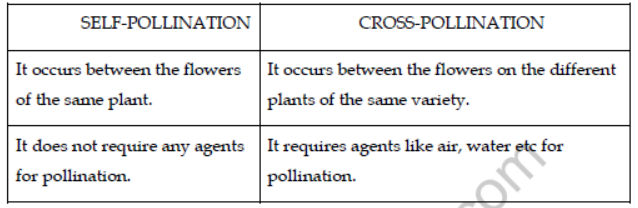
• Pollination can be of two types namely, self-pollination and cross-pollination.
• Self pollination is the transfer of pollen from the stamen to the stigma of the same flower. Cross-pollination is the transfer of pollen from the stamen of one flower to the stigma of another flower on the same plant or a different plant of the same kind.
Fertilizaion
• Stigma of the flower secretes sugary substances.
• As the pollen grains from the stamen fall on the stigma, they recognise the sugary substance and germinate to produce a structure called as pollen tube.
• Pollen tube grows in size through style to reach the egg in the ovary.
• As it reaches the ovule, the tip of the tube opens and releases male gametes to fertilise the egg cell.
• The fusion of a male gamete and a female gamete to produce a zygote - single cell.
• Zygote which develops into an embryo.
• Fertilized ovary becomes a fruit.
• The ovule develops into a seed.
Formation of seed
There occur some changes in the flower after the process of fertilization.
• Sepals, petals, stigma and the style fall off leaving the fertilized ovary.
• Zygote utilises the reserved food in the ovule to divide and transform into an embryo.
• Walls of the ovule develop hard layers of the seed.
• A seed contains a young plant and stored food in the form of cotyledons.
Formation of fruit
Ovary grows in size due to formation of seeds. This well-grown fertilized ovary becomes the fruit. A fruit can have any number of seeds in it. Fruits can be fleshy or dry in nature.
Please click the link below to download Class 7 Reproduction in Plants Notes for exams.
Free study material for Science
Science Class 7 Exam Resources: Chapter 12 Reproduction in Plants
Core Study Kit: Class 7 Science Chapter 12 Reproduction in Plants
Review targeted study resources for Chapter 12 Reproduction in Plants tailored for Class 7 learners. Utilizing these structured notes and quick-revision tools ensures complete alignment with current CBSE evaluation standards.
NCERT-Aligned Solutions for Chapter 12 Reproduction in Plants
Designed around the official curriculum, these study guides guarantee standard compliance. Reviewing step-by-step solutions clarifies complex sub-topics within Chapter 12 Reproduction in Plants and demystifies standard marking schemes for Science evaluations.
Next Steps in Your Exam Preparation
For peak performance in upcoming evaluations, integrate official Science sample papers directly into your study schedule. Follow up your revision by attempting online MCQ tests for Chapter 12 Reproduction in Plants to refine calculation speed and precision.
FAQs
Our advanced study package for Chapter 12 Reproduction in Plants includes detailed concepts, diagrams, Mind Maps, and explanation of complex topics to ensure Class 7 students learn as per syllabus for 2026 exams.
The Mind Maps provided for Chapter 12 Reproduction in Plants act as visual anchors which will help faster recall during high-pressure exams.
Yes, teachers use our Class 7 Science resources for lesson planning as they are in simple language and have lot of solved examples.
Yes, You can download the complete, mobile-friendly PDF of the Science Chapter 12 Reproduction in Plants advanced resources for free.
Yes, our subject matter experts have updated the Chapter 12 Reproduction in Plants material to align with the rationalized NCERT textbooks and have removed deleted topics and added new competency-based questions.