

Official CBSE Study Materials for Class 7 Science
Access comprehensive study materials and useful resources for Chapter 06 Physical and Chemical Changes using the Class 7 Science Physical and Chemical Changes Chapter Notes. Designed to align with the 2026-27 CBSE academic guidelines, these advanced resources help Class 7 Science students reinforce core concepts beyond standard textbooks.
Advanced Resources for Science
Access the complete useful resource PDF for Class 7 Science below. Regular practice with these targeted academic notes builds familiarity with complex topics and helps secure higher marks in final school evaluations.
Question. Identify the chemical change among the following:
a) Mixing sand in water.
b) Magnetizing a piece of iron.
c) A copper container getting tarnished
d) Evaporation of water
Answer : C
Question. When heated candle wax changes from a solid into a liquid. The molecules______________.
a) Absorb heat and move apart.
b) Absorb heat and come together.
c) Release heat and move apart.
d) Release heat and come together.
Answer : A
Question. In an experiment to investigate corrosion, a piece of iron metal is placed under different conditions. Each of the test tubes shown here is sealed completely and left for a few weeks. Arrange them in the order of most to least corroded pieces of iron metal at the end of the experiment.
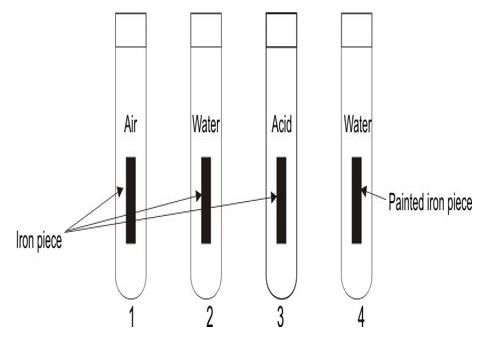
a) 3, 2, 1, 4
b) 1, 2, 3, 4
c) 3, 1, 4, 2
d) 2, 4, 1, 3
Answer : A
Question. By mistake about 500 g of rajma seeds and 300 g of moong dal have got mixed up. Which of these methods is likely to be most effective for separating them?
a) Add water to the mixture and remove the moong dal which will float on top.
b) Hand pick the moong dal which looks quite different from the rajma seeds.
c) Use an appropriate sieve and remove the rajma seeds which remain on it.
d) Shake the mixture-the moong dal will settle at the bottom and rajma seeds on top.
Answer : C
Question. In the diagram below Circle P represents compounds/mixtures that contain oxygen and are edible and Circle Q represents compounds/mixtures that contain both hydrogen and oxygen. In the region R, the region of intersection of circles P and Q, which of the following can be placed?
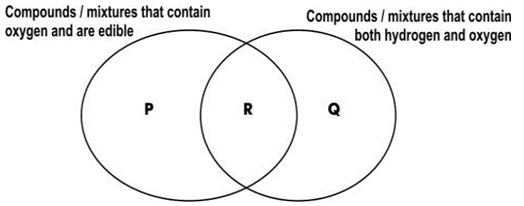
a) Washing powder
b) Sugar
c) Common Salt
d) Wax
Answer : B
Question. The figure below shows a diagrammatic representation of molecules of two different gases kept in either side of a tap. The tap is open, which of the following diagrams would represent BEST the diagram after sometime?
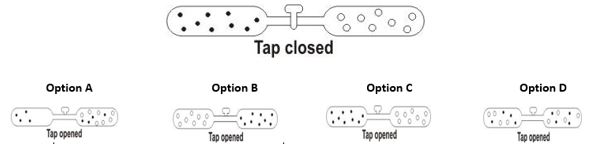
Answer : D
Question. In which of the following actions is a CHEMICAL reaction produced?
a) Bubbling air through lime water
b) Bubbling air through water
c) Adding common salt to water
d) Adding sugar to coffee powder
Answer : A
Question. Rakhi adds 5 tablespoons of sugar to about 1 litre (5 glasses) of water in a vessel and stirs the water till the sugar dissolves. She then starts boiling the water. After every 2 minutes, she takes out 2 spoons of this water and keeps it in different vessels to cool. On tasting the different samples of cooled water, she will find that
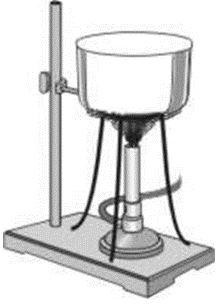
a) all the samples taste like plain water
b) each sample tastes sweeter than the previous one.
c) each sample tastes less sweet than the previous one.
d) all the samples taste sweet like the original solution.
Answer : B
Question. A representation of a biogas plant is shown in the figure. A biogas plant uses micro-organisms to convert domestic and agricultural sewage into methane gas which is used as fuel. Which option below contains materials that can ALL be put into the biogas plant?
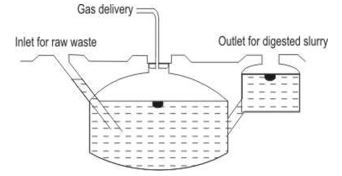
a) crop residues, plastic and aquatic weeds.
b) paper, human excreta and leather pieces.
c) cow dung, glass pieces and sticks.
d) water hyacinth, poultry wastes and husk.
Answer : D
Question. The valve in the above figure is initially closed. If it is opened for sometime for the gas to pass in the box and then closed, which of the following will represent the gas molecules in the box? (the dots represent the gas molecules)
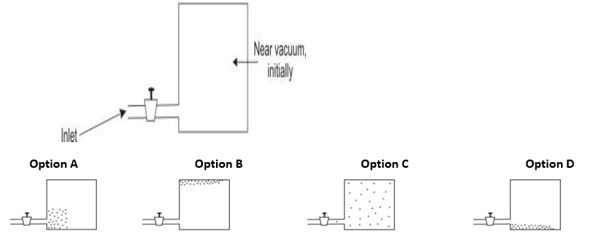
Answer : C
Question. Why Sea anemones are called animals even though they do not move from place to place?
a) They eat other animals.
b) They breathe.
c) They do not make their own food.
d) They reproduce.
Answer : C
Question. Some animals have been placed in groups A and B as shown below.What could be the basis for their division into the two groups?
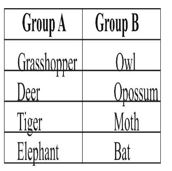
a) One group is active during the day; the other group is active at night.
b) One group lives near prairies; the other group lives near forests.
c) One group benefits people; the other group harms people.
d) One group eats only plants; the other group eats only meat.
Answer : A
Question. Plants (and animals) adapt themselves to their surroundings in many ways. For example, the trees shown in the picture are about 150 feet tall because they need to reach out to the sunlight. They are not very wide and hence they have developed aerial roots that support the great height. The habitat of the trees is likely to be:
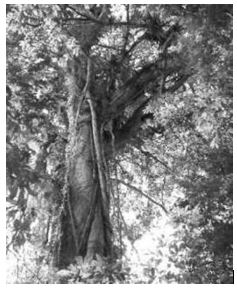
a) Coastal areas
b) Deserts
c) Forests
d) Mountain slopes
Answer : C
Question. Which would distinguish BIRDS and MAMMALS?
Use the data given in the table below and answer the question.
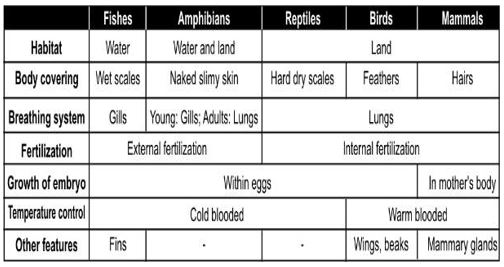
a) Habitat
b) Body covering
c) Breathing system
d) Temperature control
Answer : B
Question. Which of these would have both these characteristics?
1. skin covered with scales
2. lays eggs in water
Use the data given in the table below and answer the question.

a) Fish
b) Amphibian
c) Reptiles
d) Birds
Answer : A
Physical and Chemical Changes
There are several differences between a physical and chemical change in matter or substances. A physical change in substance doesn’t change what the substance is. In a chemical change where there is a chemical reaction, a new substance is formed and energy is either given off or absorbed.
For example, if a piece of paper is cut up into small pieces it still is paper. This would be a physical change in the shape and size of the paper. If the same piece of paper is burned, it is broken up into different substances that are not paper.
Physical change can be reversed, chemical changes cannot be reversed with the substance changed back without extraordinary means, if at all. For example, a cup of water can be frozen when cooled and then can be returned to a liquid form when heated.
If one decided to mix sugar into water to make sugar water, this would be a physical change as the water could be left out to evaporate and the sugar crystals would remain. However, if one made a recipe for a cake with flour, water, sugar and other ingredients and baked them together, it would take extraordinary means to separate the various ingredients out to their original form.
When heat is given off in a chemical change or reaction, it is called an exothermic reaction. When heat is absorbed in a chemical change or reaction, it is called an endothermic reaction. The speed at which chemical reactions take place depend on the temperature pressure and chemical reactions take place depend on the temperature pressure and how concentrated the substances involved in the chemical reaction are. Sometimes substances called catalysts are used to speed up or help along a chemical reaction. Light is helpful in the processing of film.
*Film is processed with the assistance of light.
* Heat is another factor that facilitates chemical reactions.
EXERCISE
I. Write true/false for the following statement.
1. With a physical change, no new substance is formed
2. With chemical change, no change in composition of substance occurs.
3. With a physical change, energy is either given of or absorbed.
4. A chemical change can be easily reversed
5. A catalyst speeds up a chemical reaction
II. Write the changes for the following
a) Glass Breaking
b) Rusting bicycle
c) Melting butter
d) Separating sand from grand
e) Spoiling food
f) Moving lawn
g) Corroding metal
h) Bleaching hair
i) Fireworks
j) Frying an egg
k) Burning leavings
l) Making salt water
m) Melting wax
n) Burning wax
o) Squeezing lemon
Free study material for Science
Science Class 7 Exam Resources: Chapter 06 Physical and Chemical Changes
Quick Revision Material for Chapter 06 Physical and Chemical Changes
Explore essential learning tools for Class 7 Science Chapter 06 Physical and Chemical Changes. This curated collection features in-depth notes and targeted practice questions built around the active 2026 curriculum to streamline your daily revision.
Expert Notes and Solved Exam Questions
Designed around the official curriculum, these study guides guarantee standard compliance. Reviewing step-by-step solutions clarifies complex sub-topics within Chapter 06 Physical and Chemical Changes and demystifies standard marking schemes for Science evaluations.
Additional Study Resources for Class 7
For peak performance in upcoming evaluations, integrate official Science sample papers directly into your study schedule. Follow up your revision by attempting online MCQ tests for Chapter 06 Physical and Chemical Changes to refine calculation speed and precision.
FAQs
Our advanced study package for Chapter 06 Physical and Chemical Changes includes detailed concepts, diagrams, Mind Maps, and explanation of complex topics to ensure Class 7 students learn as per syllabus for 2026 exams.
The Mind Maps provided for Chapter 06 Physical and Chemical Changes act as visual anchors which will help faster recall during high-pressure exams.
Yes, teachers use our Class 7 Science resources for lesson planning as they are in simple language and have lot of solved examples.
Yes, You can download the complete, mobile-friendly PDF of the Science Chapter 06 Physical and Chemical Changes advanced resources for free.
Yes, our subject matter experts have updated the Chapter 06 Physical and Chemical Changes material to align with the rationalized NCERT textbooks and have removed deleted topics and added new competency-based questions.