

Class 7 Science Study Guide: Class 7 Time and Motion Important Questions VBQs
Explore structured advanced study materials through the Class 7 Time and Motion Important Questions VBQs. Tailored for Class 7 learners, utilizing these Science resources ensures thorough preparation and strengthens foundational knowledge before final CBSE evaluations.
Download Chapter 13 Motion and Time Study Material PDF
Access the complete useful resource PDF for Class 7 Science below. Regular practice with these targeted academic notes builds familiarity with complex topics and helps secure higher marks in final school evaluations.
Class 7 Time and Motion Important Questions VBQs. Please refer to the examination notes which you can use for preparing and revising for exams. These notes will help you to revise the concepts quickly and get good marks.
TIME AND MOTION
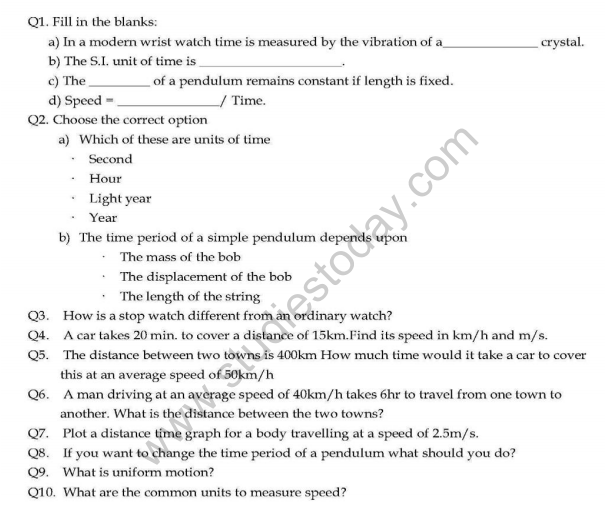
Motion and time are the basic ideas used to describe how objects move and how we measure the duration of events. This Class 7 Science worksheet on Chapter 13, Motion and Time, covers the simple pendulum and its time period, devices used to measure time from sundials to quartz clocks, speed and average speed, the speedometer and the odometer, distance-time graphs, uniform and non-uniform motion, and numerical problems on speed, distance and time.
Topics Covered
1. Simple pendulum and its time period
2. Devices used to measure time
3. Speed, average speed and units of speed
4. Speedometer and odometer
5. Uniform and non-uniform motion
6. Distance-time graphs
7. Numerical problems on speed, distance and time
CHAPTER 13 - MOTION AND TIME
Assignment-13.1
Q1. Fill in the blanks:
a) In a modern wrist watch time is measured by the vibration of a ______________ crystal.
b) The S.I. unit of time is ______________________.
c) The ______________ of a pendulum remains constant if length is fixed.
d) Speed = ______________ / Time.
Answer:
a) quartz crystal.
b) second (s).
c) time period.
d) distance.
Teacher's Note:
a) A quartz crystal vibrates at a very steady frequency when a current is passed through it.
b) Other units of time, such as minute and hour, are converted to seconds for measurement.
c) Time period is the time taken for one complete oscillation.
d) Speed is the distance travelled per unit time, so Speed = Distance / Time.
Q2. Choose the correct option
a) Which of these are units of time
- Second
- Hour
- Light year
- Year
b) The time period of a simple pendulum depends upon
- The mass of the bob
- The displacement of the bob
- The length of the string
Answer:
a) Second, hour and year.
b) The length of the string.
Teacher's Note:
a) A light year is a unit of distance, not of time.
b) A longer string gives a longer time period; the mass and the displacement do not change it.
c) The length of the string is the only factor that changes the time period.
Q3. How is a stop watch different from an ordinary watch?
Answer: A stop watch can be started, stopped and reset at any moment, so it measures the duration of an event, whereas an ordinary watch only shows the time of day.
Teacher's Note:
a) Stop watches are used to time races and experiments.
b) An ordinary watch keeps running continuously and cannot measure a chosen interval.
Q4. A car takes 20 min. to cover a distance of 15km. Find its speed in km/h and m/s.
Answer:
1. Distance = 15 km, time = 20 min = \( \frac{20}{60} \) h = \( \frac{1}{3} \) h.
2. Speed = \( \frac{\text{Distance}}{\text{Time}} \) = \( \frac{15}{\frac{1}{3}} \) = 45 km/h.
3. Converting to m/s: 45 x \( \frac{1000}{3600} \) = 12.5 m/s.
Teacher's Note:
a) Always convert the time to hours before dividing for km/h.
b) To convert km/h to m/s, multiply by 5/18.
Q5. The distance between two towns is 400km How much time would it take a car to cover this distance at an average speed of 50km/h?
Answer:
1. Distance = 400 km, average speed = 50 km/h.
2. Time = \( \frac{\text{Distance}}{\text{Speed}} \) = \( \frac{400}{50} \) = 8 h.
Teacher's Note:
a) Check the units: km divided by km/h gives hours.
b) The answer is 8 hours, or a full working day for a car.
Q6. A man driving at an average speed of 40km/h takes 6h to travel from one town to another. What is the distance between the two towns?
Answer: Distance = Speed x Time = 40 x 6 = 240 km.
Teacher's Note:
a) Multiply speed by time to find distance.
b) The result is in km because km/h multiplied by h gives km.
Q7. Plot a distance time graph for a body travelling at a speed of 2.5m/s.
Answer:
1. Distance = speed x time = 2.5 x time.
2. Points on the graph: (0 s, 0 m), (4 s, 10 m), (8 s, 20 m), (12 s, 30 m), (16 s, 40 m).
3. Joining these points gives a straight line that passes through the origin.
Teacher's Note:
a) A straight distance-time line means the body moves with uniform speed.
b) The slope of the line is equal to the speed, here 2.5 m/s.
Q8. If you want to change the time period of a pendulum what should you do?
Answer: Change the length of the string of the pendulum. A longer string gives a longer time period, and a shorter string gives a shorter time period.
Teacher's Note:
a) Changing the mass of the bob does not change the time period.
b) Changing the amplitude of the swing also does not change the time period for small swings.
Q9. What is uniform motion?
Answer: An object is in uniform motion when it covers equal distances in equal intervals of time along a straight line.
Teacher's Note:
a) A train running at a steady speed on a straight track is an example.
b) Uniform motion means the speed does not change.
Q10. What are the common units to measure speed?
Answer: Metre per second (m/s) and kilometre per hour (km/h).
Teacher's Note:
a) m/s is the SI unit of speed.
b) km/h is used for vehicles on roads.
Open Ended Questions
a) If we wanted to change the time period of a pendulum, what do you think we should do?
Answer: We should change the length of the string.
Teacher's Note:
a) The time period increases when the length increases.
b) The mass of the bob has no effect on the time period.
b) What is the unit of time period?
Answer: Second (s).
Teacher's Note:
a) The time period is a time, so its unit is the unit of time.
b) It is the time taken for one complete oscillation.
Activity 1
Aim: To find the time period of a simple pendulum by changing the length of the string.
Materials required: A stand with a clamp, a string, a metal bob, a stop watch and a metre scale.
Theory: A simple pendulum is a bob hung from a fixed point by a light string. It swings to and fro. One complete to-and-fro motion is one oscillation. The time taken to complete one oscillation is the time period.
Diagram: A stand with a clamp holds the string, and the bob hangs at the lower end of the string.
Procedure:
1. Fix the string to the clamp and hang the bob at a chosen length.
2. Pull the bob aside slightly and release it so that it swings to and fro.
3. Measure the time taken for 20 oscillations with the stop watch.
4. Divide this time by 20 to get the time period.
5. Change the length of the string and repeat steps 2 to 4.
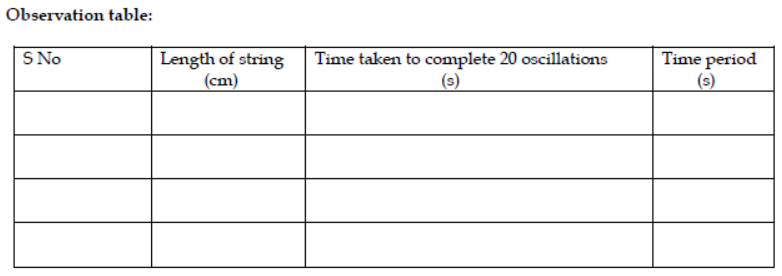
Observation table:
| S No | Length of string (cm) | Time taken to complete 20 oscillations (s) | Time period (s) |
|---|---|---|---|
| 1 | |||
| 2 | |||
| 3 | |||
| 4 |
Conclusion: The time period of a simple pendulum increases as the length of its string increases.
Teacher's Note:
a) Time period = time for 20 oscillations / 20.
b) Repeat each reading two or three times to reduce timing errors.
Assignment-13.1 (Multiple Choice Questions)
Tick the correct option(s):-
1) Which of these are units of time?
a) second
b) hour
c) light year
d) year
Answer: (a), (b) and (d)
1. Second, hour and year are units of time.
2. Light year is a unit of distance.
3. Hence, the correct options are (a), (b) and (d).
Teacher's Note:
a) A light year is the distance light travels in one year.
b) A year is a long unit of time, equal to about 365 days.
2) The time period of a simple pendulum depends upon
a) length of pendulum
b) mass of bob
c) amplitude of oscillating pendulum
d) length of string
Answer: (a) length of pendulum and (d) length of string (both mean the same)
1. The time period depends on the length of the pendulum.
2. Length of the pendulum and length of the string are the same quantity.
3. Hence, the correct options are (a) and (d).
Teacher's Note:
a) Mass of the bob and amplitude do not change the time period.
b) The time period grows with the square root of the length.
3) The distance covered by an object can be calculated by the formula
a) speed / time
b) time / speed
c) speed x time
d) speed + time
Answer: (c) speed x time
1. Speed = distance / time.
2. Multiplying both sides by time gives distance = speed x time.
3. Hence, the correct option is (c).
Teacher's Note:
a) Check the units: m/s multiplied by s gives m.
b) The formula holds for uniform motion.
4) The instantaneous speed of a vehicle is measured by
a) odometer
b) ammeter
c) anemometer
d) speedometer
Answer: (d) speedometer
1. A speedometer shows the speed of the vehicle at every instant.
2. An odometer shows the distance travelled, not the speed.
3. Hence, the correct option is (d).
Teacher's Note:
a) An ammeter measures electric current, and an anemometer measures wind speed.
b) The speedometer reading is usually given in km/h.
5) The graph of an object moving with uniform motion is a
a) curved line
b) straight line parallel to time axis
c) straight line parallel to distance axis
d) straight line inclined towards time axis
Answer: (d) straight line inclined towards time axis
1. In a distance-time graph, uniform motion gives a straight line.
2. The line is inclined to the time axis because distance increases with time.
3. Hence, the correct option is (d).
Teacher's Note:
a) On a speed-time graph, uniform motion gives a straight line parallel to the time axis.
b) The steeper the line, the greater the speed.
6) Which of the following is not a time measuring device?
a) sun dial
b) water clock
c) odometer
d) sand clock
Answer: (c) odometer
1. A sundial, a water clock and a sand clock are all devices that measure time.
2. An odometer measures distance travelled by a vehicle.
3. Hence, the correct option is (c).
Teacher's Note:
a) A sundial uses the shadow of the sun to show time.
b) Water clocks and sand clocks were used long before mechanical clocks.
7) The SI unit of speed is
a) m x s
b) m/s
c) km/h
d) km/min
Answer: (b) m/s
1. Speed = distance / time.
2. The SI units of distance and time are metre and second, so the SI unit of speed is m/s.
3. Hence, the correct option is (b).
Teacher's Note:
a) km/h is a common unit but not an SI unit.
b) m x s is the unit of a product, not of speed.
8) The motion of a simple pendulum is
a) oscillatory
b) rectilinear
c) periodic
d) circular
Answer: (a) oscillatory and (c) periodic
1. The pendulum swings to and fro about its mean position, so its motion is oscillatory.
2. The motion repeats after equal intervals of time, so it is also periodic.
3. Hence, the correct options are (a) and (c).
Teacher's Note:
a) Rectilinear means motion along a straight line, which a pendulum does not follow.
b) Every oscillatory motion of this kind is periodic.
9) The clocks and watches which have an electric circuit with one or more cells are
a) quartz clocks
b) pendulum clocks
c) water clocks
d) digital clocks
Answer: (a) quartz clocks
1. Quartz clocks use a battery-powered electric circuit and a quartz crystal that vibrates steadily.
2. Pendulum clocks and water clocks do not use an electric circuit.
3. Hence, the correct option is (a).
Teacher's Note:
a) Digital clocks also use batteries, but the classic answer for this type of clock is the quartz clock.
b) A quartz crystal vibrates at a fixed frequency when an electric current is applied.
10) The SI unit of distance is
a) metre
b) kilometre
c) centimeter
d) odometer
Answer: (a) metre
1. The SI unit of distance is the metre (m).
2. Kilometre and centimetre are other units of length, not SI base units.
3. Hence, the correct option is (a).
Teacher's Note:
a) Kilometre is 1000 metres, and centimetre is one-hundredth of a metre.
b) An odometer is a device, not a unit.
11) Which of these is not a unit of speed?
a) m/s
b) km/h
c) s/m
d) km/min
Answer: (c) s/m
1. m/s and km/h are units of speed.
2. km/min is also a unit of speed, as it is distance per time.
3. s/m is time divided by distance, which is the reciprocal of speed, so it is not a unit of speed.
Teacher's Note:
a) Speed is distance divided by time, so its unit must have a length in the top and a time in the bottom.
b) s/m is the unit of slowness, not of speed.
12) The unit of time period is
a) second
b) metre
c) metre per second
d) (second)2
Answer: (a) second
1. Time period is the time taken for one complete oscillation.
2. Time is measured in seconds.
3. Hence, the correct option is (a).
Teacher's Note:
a) (second)² is a square of time, not a unit of time period.
b) Metre and metre per second are units of distance and speed.
13) Which clock is most accurate?
a) sundial
b) waterclock
c) hourglass
d) pendulum clock
Answer: (d) pendulum clock
1. A pendulum swings at a nearly constant time period when its length is fixed.
2. A sundial, a water clock and an hourglass are less steady.
3. Hence, among the options, the correct option is (d).
Teacher's Note:
a) Pendulum clocks were the most accurate clocks until quartz clocks were invented.
b) Temperature changes can alter the length of the pendulum and affect accuracy.
Assignment-13.2
Label the diagram of simple pendulum given below:-
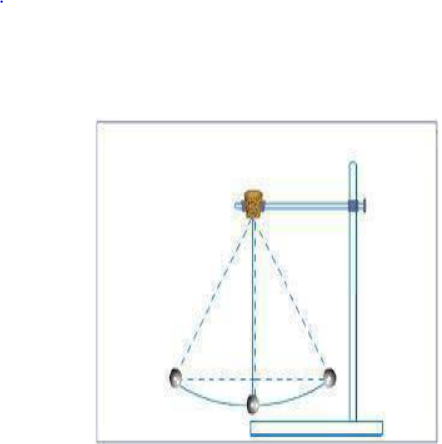
[Figure: Simple pendulum on a clamp stand. A clamp at the top holds the string. The string hangs vertically from the clamp to the bob. The bob swings to the left and to the right, from one extreme position to the other, and passes through the mean position at the lowest point.]
Label the following parts:-
Clamp stand: the vertical support holding the pendulum.
Length of pendulum: the distance from the clamp to the centre of the bob.
Bob: the heavy metal ball at the lower end.
Extreme positions: the two farthest points on either side reached by the bob.
Mean position: the central rest point directly below the clamp.
Amplitude: the distance from the mean position to an extreme position.
Teacher's Note:
a) Draw the amplitude as a line from the mean position to one extreme position.
b) The length of the pendulum is measured from the clamp to the centre of the bob, not to its edge.
Explain the following:-
Bob - The heavy metal ball attached to the lower end of the string of a pendulum, which swings to and fro.
One oscillation of pendulum - One complete to-and-fro motion of the pendulum, that is, from one extreme position to the other extreme position and back again to the first.
Time period - The time taken by the pendulum to complete one oscillation. Its unit is second (s).
Frequency - The number of oscillations completed by the pendulum in one second. Its unit is hertz (Hz).
Teacher's Note:
a) Frequency and time period are reciprocals of each other: frequency = 1 / time period.
b) A pendulum that makes 2 oscillations in one second has a frequency of 2 Hz.
Answer the following questions:-
1. Name some devices to measure time which were used before pendulum clocks became popular?
Answer: Sundial, water clock (clepsydra), sand clock (hourglass) and candle clock.
Teacher's Note:
a) A sundial works by the shadow of the sun.
b) A water clock measures time by the flow of water from one vessel to another.
2. Write the SI units of
(a) distance
(b) time
(c) speed
Answer:
(a) Distance: metre (m).
(b) Time: second (s).
(c) Speed: metre per second (m/s).
Teacher's Note:
a) These are the SI base units used for measuring length and time.
b) Speed has no separate base unit, so it is written as m/s.
3. Which device measures the speed of a vehicle at an instant?
Answer: Speedometer.
Teacher's Note:
a) The speedometer shows the speed at every instant while the vehicle moves.
b) It is usually calibrated in km/h.
4. Which device measures the distance travelled by a vehicle?
Answer: Odometer.
Teacher's Note:
a) The odometer records the total distance covered by the vehicle.
b) It does not show the speed of the vehicle.
5. What type of motion is exhibited by a simple pendulum?
Answer: Oscillatory (periodic) motion.
Teacher's Note:
a) The pendulum moves to and fro about its mean position.
b) The motion repeats after the same time interval, which is the time period.
6. Plot distance-time graph for the following data and interpret its motion:-
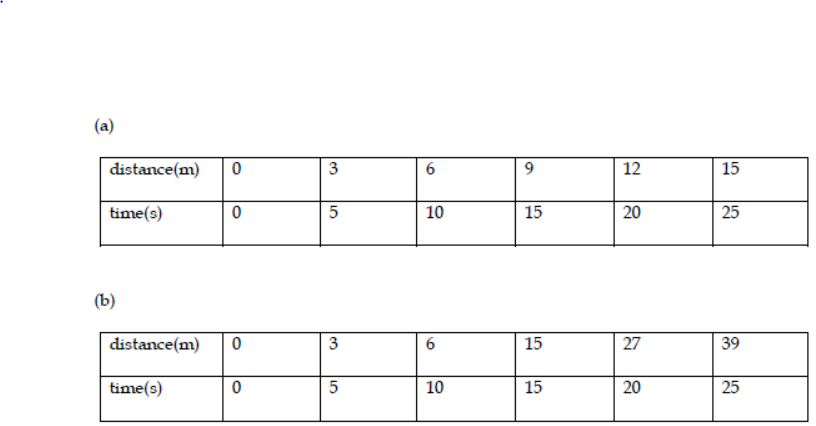
(a)
distance (m): 0, 3, 6, 9, 12, 15
time (s): 0, 5, 10, 15, 20, 25
Answer: The points (0, 0), (5, 3), (10, 6), (15, 9), (20, 12) and (25, 15) lie on a straight line. The speed is 3 m / 5 s = 0.6 m/s, the same in every interval, so the motion is uniform.
(b)
distance (m): 0, 3, 6, 15, 27, 39
time (s): 0, 5, 10, 15, 20, 25
Answer:
1. From 0 s to 10 s, the distance increases by 3 m every 5 s, so the speed is 0.6 m/s.
2. From 10 s to 15 s, the distance increases by 9 m, so the speed is 1.8 m/s.
3. From 15 s to 25 s, the distance increases by 12 m every 5 s, so the speed is 2.4 m/s.
4. The body first moves slowly, then speeds up, and finally moves with a steady speed of 2.4 m/s. The motion is non-uniform.
Teacher's Note:
a) A straight distance-time line means uniform speed, and a curved or bent line means changing speed.
b) In data set (b), the steeper part of the graph means a higher speed.
Assignment-13.3
Identify the following devices and write them in the space provided:-
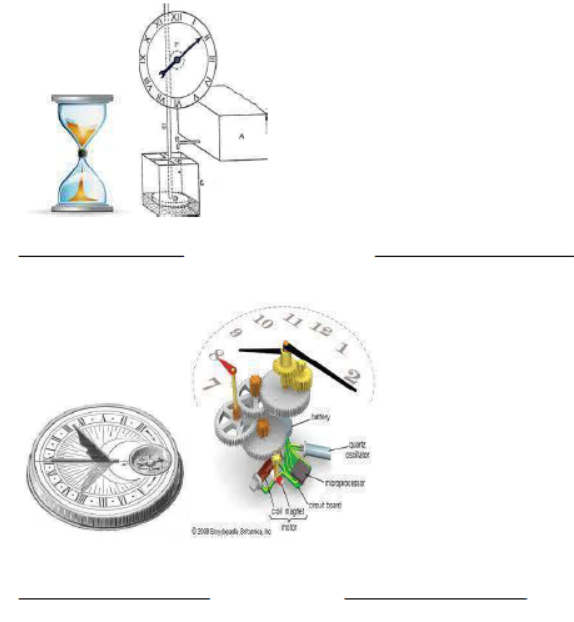
[Figure: Six devices are shown. Row 1: an hourglass and a water clock (a clock dial above a water container with a tap and float). Row 2: a sundial and an electronic quartz clock with its quartz oscillator, battery, microprocessor, circuit board, coil magnet and motor labelled. Row 3: a speedometer with MPH and km/h scales and an odometer window, and a speedometer with a km/h scale from 0 to 200.]
Answer:
Row 1: Hourglass (sand clock) and water clock.
Row 2: Sundial and quartz clock.
Row 3: Speedometer (with odometer window, in MPH and km/h) and speedometer (in km/h).
Teacher's Note:
a) The first two devices measure time, the next two are time devices too, and the last two measure speed.
b) The odometer window in the first speedometer shows the total distance travelled.
Assignment-13.4
Answer the questions for each of the figure:-
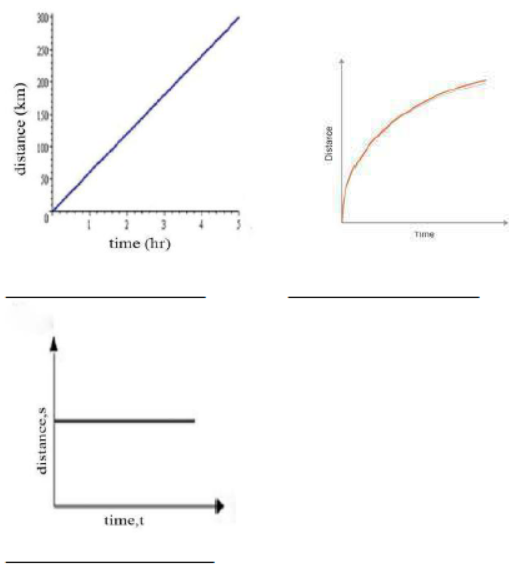
1. What can you say about the motion of the body in each of the graphs?

Answer:
(a) Distance (km) against time (hr): the graph is a straight line that rises steadily, so the body moves with uniform speed.
(b) Distance against time: the graph is a curve that rises steeply at first and then flattens, so the speed decreases with time and the motion is non-uniform.
(c) Distance (s) against time (t): the graph is a horizontal line, so the distance does not change with time and the body is at rest.
Teacher's Note:
a) A steeper straight line means a higher speed.
b) A horizontal line on a distance-time graph always means that the body is at rest.
2. Calculate the speed for the given graphs :-
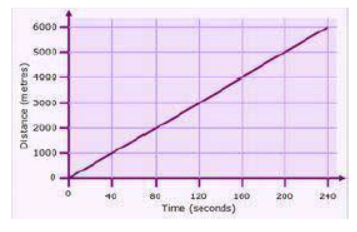
a) Calculate speed of the body between 0 - 200 s graphically.
Answer:
1. From the graph, the distance covered in 200 s is about 5000 m.
2. Speed = \( \frac{\text{Distance}}{\text{Time}} \) = \( \frac{5000}{200} \) = 25 m/s.
Teacher's Note:
a) Read the distance from the graph at 200 s, and not at the end of the line.
b) The slope of a straight distance-time line gives the speed directly.
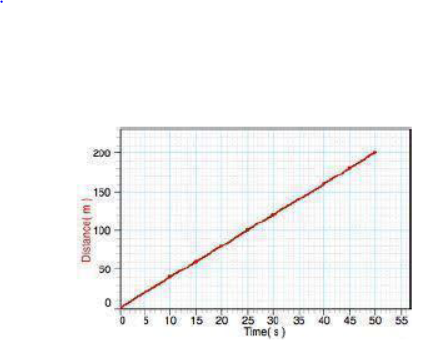
(b) Calculate the speed of the body between 0 - 50 s.
Answer:
1. From the graph, the body covers about 200 m in about 48 s.
2. Speed = \( \frac{200}{48} \) ≈ 4.2 m/s, which is about 4 m/s.
Teacher's Note:
a) The graph line reaches 200 m just before 50 s, so the speed is taken from that reading.
b) Speed is found from the slope, which here is the same throughout the line.
Assignment-13.5
Fill in the blanks:
Motion - An object is said to be in motion if its position changes with time with respect to a stationary object.
Fast / Slow - An object is said to be fast if it covers a certain distance in less time. An object is said to be slow if it covers the same distance in more time.
Uniform motion - An object moving along a straight line with uniform (constant) speed (covers equal distances in equal intervals of time) is said to be in uniform motion.
Non-uniform motion - An object moving along a straight line with variable (changing) speed (covers unequal distances in equal intervals of time) is said to be in non-uniform motion.
Speed - It is the distance travelled per unit time by a moving object.
speed = distance / time; average speed = total distance travelled / total time taken
The SI unit of distance is metre (m). The SI unit of time is second (s). The SI unit of speed and average speed is metre per second (m/s). Another unit often used is kilometre per hour (km/h).
Speedometer - It records the speed of a vehicle in km/h at every instant of time when the vehicle is moving.
Odometer - It measures the distance travelled by a vehicle.
Answer: The blanks are filled in above.
Teacher's Note:
a) Motion is always relative to a stationary object, such as a road or a tree.
b) Average speed is not the simple average of two speeds; it is total distance divided by total time.
Assignment-13.6
Relation between speed, distance and time
Speed = Distance / Time; Time = Distance / Speed; Distance = Speed x Time
1. What is the speed of a car which travels 60km in 2h?
Answer: Speed = 60 / 2 = 30 km/h.
Teacher's Note:
a) Speed is distance divided by time.
b) 30 km/h equals about 8.3 m/s.
2. Our school bus travels 15 km at a speed of 45 km/h. How much time will it take to reach school?
Answer: Time = 15 / 45 = \( \frac{1}{3} \) h = 20 min.
Teacher's Note:
a) Convert the fraction of an hour into minutes by multiplying by 60.
b) The time is less than half an hour, as expected.
3. The distance travelled by our car in 20 min is 9km. Calculate its speed in km/h. Convert it into m/s.
Answer:
1. Time = 20 min = \( \frac{1}{3} \) h.
2. Speed = 9 / \( \frac{1}{3} \) = 27 km/h.
3. In m/s: 27 x \( \frac{5}{18} \) = 7.5 m/s.
Teacher's Note:
a) Multiply km/h by 5/18 to get m/s.
b) A speed of 27 km/h is a comfortable city speed for a car.
4. A box of chocolates is kept at a place 50 m away. How long will a boy take to reach the box if he runs at a speed of 10 m/s.
Answer: Time = 50 / 10 = 5 s.
Teacher's Note:
a) Distance is in metres and speed is in m/s, so time comes out in seconds.
b) A speed of 10 m/s is a very fast running speed for a boy.
5. A train covers first 100 m in 2h and the next 100 m in 1h. Calculate its average speed.
Answer:
1. Total distance = 100 m + 100 m = 200 m.
2. Total time = 2 h + 1 h = 3 h.
3. Average speed = 200 / 3 = 66.7 m/h.
Teacher's Note:
a) Average speed is total distance divided by total time, not the average of the two speeds.
b) The time values in this question are unusually long for a train covering 100 m; the answer follows the data as printed.
6. The bus covers 40km in 1h and the next 50 km in 1h. What is the average speed of the bus?
Answer:
1. Total distance = 40 + 50 = 90 km.
2. Total time = 1 h + 1 h = 2 h.
3. Average speed = 90 / 2 = 45 km/h.
Teacher's Note:
a) The average of 40 and 50 is also 45, but here the speeds happen to be spread equally over equal times.
b) The speed in the second hour is higher than in the first.
7. A car takes 20 min to cover a distance of 15 km. Find its speed in km/h and m/s.
Answer: Speed = 15 / \( \frac{1}{3} \) = 45 km/h = 45 x \( \frac{5}{18} \) = 12.5 m/s.
Teacher's Note:
a) This is the same as Q4 in Assignment 13.1.
b) 12.5 m/s is the speed in SI units.
8. A man driving at an average speed of 40 km/h takes 6 h to travel from one town to another. What is the distance between the two towns?
Answer: Distance = 40 x 6 = 240 km.
Teacher's Note:
a) Same as the question in Assignment 13.1.
b) Check: 240 / 40 = 6 h.
9. The distance between two towns is 400 km. How much time would it take a car to cover this distance at an average speed of 50 km/h?
Answer: Time = 400 / 50 = 8 h.
Teacher's Note:
a) This is the same as Q5 in Assignment 13.1.
b) Divide distance by speed to get time.
10. What is the time period of a simple pendulum which completes 20 oscillations in 40 seconds?
Answer: Time period = \( \frac{\text{Time for 20 oscillations}}{20} \) = \( \frac{40}{20} \) = 2 s.
Teacher's Note:
a) Time period is the time for one oscillation.
b) Frequency here would be 0.5 oscillations per second.
Assignment-13.7
(A) Give one word for the following:-
Distance travelled per unit time by an object - Speed
Time taken by a simple pendulum to complete one oscillation - Time period
Motion of an object moving in a straight line with constant speed - Uniform motion
Motion of a pendulum and hands of a clock - Periodic (oscillatory) motion
SI unit of speed - Metre per second (m/s)
Shape of graph for an object moving with non-uniform motion - Curved line
Device to measure the distance moved by a vehicle - Odometer
Device which records instantaneous speed of a moving vehicle - Speedometer
SI unit of time - Second (s)
Clocks which have electric circuits with one or more cells - Quartz clocks
Answer: The one-word answers are given above.
Teacher's Note:
a) Time period and frequency are reciprocals of each other.
b) A speedometer shows speed, while an odometer shows the total distance.
(B) Answer the following questions:-
a) If you want to change the time period of a simple pendulum, what should you do?
Answer: Change the length of the string. The time period increases when the length is increased.
Teacher's Note:
a) The mass of the bob does not change the time period.
b) A shorter string gives a shorter time period.
b) What is meant by uniform motion and non-uniform motion? Give one example of each.
Answer:
Uniform motion: the object covers equal distances in equal intervals of time along a straight line. Example: a train moving at a steady speed on a straight track.
Non-uniform motion: the object covers unequal distances in equal intervals of time. Example: a bus moving in city traffic.
Teacher's Note:
a) Uniform motion has a constant speed, while non-uniform motion has a changing speed.
b) Motion in a straight line is the basic case for both definitions.
c) What are the usual units to measure distance and speed?
Answer: Distance is measured in metre (m) or kilometre (km). Speed is measured in metre per second (m/s) or kilometre per hour (km/h).
Teacher's Note:
a) Metre is the SI unit of distance.
b) m/s is the SI unit of speed, and km/h is used for vehicles.
d) When is a body said to be in motion?
Answer: A body is said to be in motion when its position changes with time, with respect to a stationary object.
Teacher's Note:
a) A passenger in a moving bus is in motion with respect to the road.
b) The same passenger is at rest with respect to the bus.
e) What is the SI unit of time period?
Answer: Second (s).
Teacher's Note:
a) Time period is a time, so it has the unit of time.
b) Frequency has the unit hertz (Hz), which is one oscillation per second.
High Order Thinking Skills
1. How is a stop watch different from an ordinary watch?
Answer: A stop watch can be started, stopped and reset at will, so it measures the interval between two events. An ordinary watch shows the time of day continuously and cannot measure a chosen interval.
Teacher's Note:
a) Stop watches are accurate for short intervals, such as the time taken by a runner.
b) A stop watch does not replace a clock for telling the time of day.
2. Pendulum clocks generally run fast in winter and slow in summer. Why?
Answer:
1. In summer, the metal rod of the pendulum expands, so its length increases.
2. A longer pendulum has a longer time period, so the clock loses time and runs slow.
3. In winter, the rod contracts, the time period becomes shorter, and the clock runs fast.
Teacher's Note:
a) Expansion and contraction of metal with temperature changes the length of the pendulum.
b) This effect is why invar is used in precise pendulum clocks.
3. Why is 'invar' used in making a pendulum clock?
Answer: Invar is an alloy of iron and nickel whose length hardly changes with temperature. So the length of the pendulum stays nearly the same and the time period stays constant.
Teacher's Note:
a) Invar has a very low coefficient of linear expansion.
b) A constant pendulum length keeps the clock accurate in all seasons.
4. The bob of a simple pendulum is made of wood. If it is replaced by a similar bob made of iron, how will it change the time period of the pendulum?
Answer: It will not change the time period. The time period depends on the length of the pendulum, not on the mass of the bob.
Teacher's Note:
a) The iron bob is heavier, but the length of the string is the same.
b) Air resistance may affect a light wooden bob slightly, but this is a small effect for school work.
5. Find out why and how the concept of TIME evolved?
Answer:
1. Early humans noticed the regular cycles of day and night, and the phases of the moon and the changing seasons.
2. People needed to measure time for farming, trade, religious events and daily work, so they used the sun, shadows, water, sand and candles.
3. Over time, these needs led to sundials, water clocks, hourglasses, pendulum clocks and finally quartz clocks.
Teacher's Note:
a) Each device was designed to measure time more accurately than the one before it.
b) Sundials depend on sunlight and do not work at night or on cloudy days.
Theory:
Diagram :
Procedure :
Observation table:
Free study material for Science
Free CBSE Study Guides: Class 7 Science Chapter 13 Motion and Time
Quick Revision Material for Chapter 13 Motion and Time
Explore essential learning tools for Class 7 Science Chapter 13 Motion and Time. This curated collection features in-depth notes and targeted practice questions built around the active 2026 curriculum to streamline your daily revision.
Expert Notes and Solved Exam Questions
Designed around the official curriculum, these study guides guarantee standard compliance. Reviewing step-by-step solutions clarifies complex sub-topics within Chapter 13 Motion and Time and demystifies standard marking schemes for Science evaluations.
Additional Study Resources for Class 7
For peak performance in upcoming evaluations, integrate official Science sample papers directly into your study schedule. Follow up your revision by attempting online MCQ tests for Chapter 13 Motion and Time to refine calculation speed and precision.
FAQs
Our advanced study package for Chapter 13 Motion and Time includes detailed concepts, diagrams, Mind Maps, and explanation of complex topics to ensure Class 7 students learn as per syllabus for 2026 exams.
The Mind Maps provided for Chapter 13 Motion and Time act as visual anchors which will help faster recall during high-pressure exams.
Yes, teachers use our Class 7 Science resources for lesson planning as they are in simple language and have lot of solved examples.
Yes, You can download the complete, mobile-friendly PDF of the Science Chapter 13 Motion and Time advanced resources for free.
Yes, our subject matter experts have updated the Chapter 13 Motion and Time material to align with the rationalized NCERT textbooks and have removed deleted topics and added new competency-based questions.