

Class 7 Science Study Guide: Class 7 Nutrition in Animals Important Questions VBQs
Explore structured advanced study materials through the Class 7 Nutrition in Animals Important Questions VBQs. Tailored for Class 7 learners, utilizing these Science resources ensures thorough preparation and strengthens foundational knowledge before final CBSE evaluations.
Download Chapter 02 Nutrition in Animals Study Material PDF
View or download the dedicated Class 7 Nutrition in Animals Important Questions VBQs resource below. Engaging with these advanced study guides under focused conditions ensures continuous academic progress and mastery of the 2026-27 curriculum for Chapter 02 Nutrition in Animals.
Class 7 Nutrition in Animals Important Questions VBQs. There are many more useful educational material which the students can download in pdf format and use them for studies. Study material like concept maps, important and sure shot question banks, quick to learn flash cards, flow charts, mind maps, teacher notes, important formulas, past examinations question bank, important concepts taught by teachers. Students can download these useful educational material free and use them to get better marks in examinations. Also refer to other worksheets for the same chapter and other subjects too. Use them for better understanding of the subjects.
Chapter 2
NUTRITION IN ANIMALS
Assignment 2.1
1. Fill in the blanks: [5 Marks]
a. _______________ is the process of elimination of undigested material from the body.
b. _______________, Liver and _______________ are the glands associated with the digestive system.
c. Digestion begins in the _______________ and ends in the _______________ intestine.
d. Food pipe or _______________ connects mouth to stomach.
e. _______________ help in movement and _______________ in Amoeba.
Answer:
1. a. Egestion
2. b. Salivary glands, pancreas
3. c. Buccal cavity (or mouth), small
4. d. Oesophagus
5. e. Pseudopodia, food capture (or engulfing food)
Teacher's Note:
a) Egestion refers to the removal of faecal matter through the anus.
b) Salivary glands, liver, and pancreas are the main digestive glands.
c) Carbohydrate digestion starts in the mouth, while completion occurs in the small intestine.
d) The oesophagus is a muscular tube transporting food via peristalsis.
2. Complete the table given below: [4 Marks]


| ACTION OF JUICE | GLAND | LOCATION | JUICE |
|---|---|---|---|
| Digestion of starch into sugars | Salivary glands | Mouth / Buccal cavity | Saliva |
| Emulsification of fats | Liver | Biliary system / Duodenum | Bile |
| Digestion of carbohydrates, fats and proteins | Pancreas | Small intestine (Duodenum) | Pancreatic juice |
Answer:
1. Saliva is secreted by salivary glands located in the mouth.
2. Bile is secreted by the liver and stored in the gall bladder.
3. Pancreatic juice is secreted by the pancreas into the small intestine.
4. Each digestive juice acts on specific components of food to break them down into simpler substances.
Teacher's Note:
a) Digestive glands secrete specific enzymes and juices to aid chemical digestion.
b) Bile does not contain digestive enzymes, but aids fat digestion by emulsification.
c) The pancreas acts as a mixed gland releasing pancreatic juice into the small intestine.
d) Thorough knowledge of gland locations helps students understand human physiology.
3. Match the correct pairs: [5 Marks]
COLUMN A COLUMN B
a) Premolars i) Cutting and Biting Teeth
b) Incisors ii) U- shaped organ
c) Small intestine iii) Pseudopodia
d) Canines iv) Reabsorbs water from undigested food
e) False feet v) Piercing and tearing teeth
f) Stomach vi) Chewing and Grinding teeth
g) Large intestine vii) 7.5m long
Answer:
a) Premolars - vi) Chewing and Grinding teeth
b) Incisors - i) Cutting and Biting Teeth
c) Small intestine - vii) 7.5m long
d) Canines - v) Piercing and tearing teeth
e) False feet - iii) Pseudopodia
f) Stomach - ii) U-shaped organ
g) Large intestine - iv) Reabsorbs water from undigested food
Teacher's Note:
a) Incisors are chisel-shaped teeth used for cutting and biting.
b) Canines are pointed teeth used for piercing and tearing flesh.
c) Amoeba uses finger-like projections called pseudopodia for locomotion and capturing food.
d) Careful attention is needed as some printed match columns contain swapped option numbers.
4. Name the largest gland of the human body. [1 Mark]
Answer:
1. The liver is the largest gland of the human body.
2. It secretes bile juice that helps in the digestion of fats.
Teacher's Note:
a) The liver is located in the upper right side of the abdomen.
b) Students often confuse the liver with the pancreas or stomach.
5. Give the function(s) of the following: [5 Marks]
a) Rectum
b) Caecum in ruminants
c) Pseudopodia
d) Large intestine
e) Gall Bladder
Answer:
1. Rectum - Stores unabsorbed food as faeces temporarily before it is eliminated through the anus.
2. Caecum in ruminants - Provides a large space for the digestion of cellulose by certain bacteria.
3. Pseudopodia - Helps amoeba in movement and capture of food.
4. Large intestine - Absorbs water and some salts from the undigested food material.
5. Gall Bladder - Stores and concentrates bile secreted by the liver.
Teacher's Note:
a) Each organ plays a specific role in the digestive system or cellular processes.
b) Caecum is present between the oesophagus and small intestine in ruminants but is absent in humans.
c) Pseudopodia are false feet projected by single-celled organisms like amoeba.
d) The gall bladder releases bile into the small intestine when fats enter.
6. Give any two functions of our tongue besides talking. [2 Marks]
Answer:
1. It helps in mixing saliva with food during chewing.
2. It helps in swallowing food and has taste buds to detect different tastes.
Teacher's Note:
a) The tongue is a fleshy muscular organ attached at the back to the floor of the buccal cavity.
b) Different regions of the tongue detect different types of tastes.
7. What would happen if there are no villi in the walls of small intestine? [2 Marks]
Answer:
1. The surface area for the absorption of digested food would decrease significantly.
2. Consequently, nutrients from food would not be properly absorbed into the blood stream.
Teacher's Note:
a) Villi are finger-like projections present in the inner walls of the small intestine.
b) They possess a network of thin and small blood vessels close to their surface for efficient absorption.
8. Differentiate between ingestion and egestion. [2 Marks]
Answer:
| Ingestion | Egestion |
|---|---|
| 1. The process of taking food into the body is called ingestion. | 1. The process of removal of faecal matter from the body through the anus is called egestion. |
| 2. It occurs at the beginning of the digestive process. | 2. It occurs at the end of the digestive process. |
Teacher's Note:
a) Ingestion involves the mouth or feeding apparatus of animals.
b) Egestion eliminates waste that cannot be digested or absorbed by the body.
9. If a piece of chapatti is chewed for sometime without swallowing it tastes sweet. Why? [2 Marks]
Answer:
1. Chapatti contains starch as a carbohydrate.
2. Saliva contains an enzyme called amylase that breaks down starch into simple sugars, which taste sweet.
Teacher's Note:
a) Saliva is secreted by the salivary glands in the mouth cavity.
b) Prolonged chewing allows more saliva to act on the starch for conversion into sugar.
10. Give reasons, why cows are able to digest cellulose and not humans? [2 Marks]
Answer:
1. Cows are ruminants that possess a large sac-like structure called rumen containing cellulose-digesting bacteria.
2. Humans lack these specific cellulose-digesting bacteria and the required stomach structure to digest cellulose.
Teacher's Note:
a) Cellulose is a type of plant carbohydrate rich in dietary fibre.
b) Ruminants can chew their food twice through rumination to aid this process.
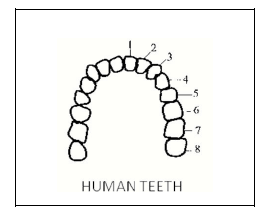
11. In the figure of human teeth given below, what do the given numbers indicate? [4 Marks]
Answer:
1. Number 1 indicates the first incisor (cutting and biting tooth).
2. Number 2 indicates the second incisor (cutting and biting tooth).
3. Number 3 indicates the canine (piercing and tearing tooth).
4. Numbers 4 and 5 indicate premolars (crushing and grinding teeth), and numbers 6, 7, and 8 indicate molars (grinding teeth).
Teacher's Note:
a) Humans have four types of teeth with different functions in the mouth.
b) The numbering typically starts from the center line of the jaw moving backwards.
VALUE BASED QUESTIONS:
Tina brought home a stray puppy. She fed it before contacting the blue cross society to hand it over to them. Why do you think she did so? If you were in her place what would you do? [3 Marks]
Answer:
1. Tina fed the puppy because she felt empathy and compassion towards animals in distress.
2. She contacted the blue cross society to ensure the puppy receives proper shelter, medical care, and rehabilitation.
3. If I were in her place, I would have done the exact same thing to ensure the animal's safety and well-being.
Teacher's Note:
a) This question assesses social values, empathy, and responsible citizenship towards stray animals.
b) Animal welfare organizations like the Blue Cross help rescue and protect abandoned pets.
c) Showing kindness to animals reflects good moral character and humane values.
Lab activity: To test the activity of salivary amylase on starch. [5 Marks]
Objective: To test the activity of salivary amylase on starch.
Materials required: enzyme salivary amylase, starch solution, test tubes, iodine solution, dropper.
Procedure:
Answer:
1. Take two clean test tubes and label them as Test Tube A and Test Tube B.
2. Add 1 ml of starch solution to each of the two test tubes.
3. Add 1 ml of saliva (containing salivary amylase) to Test Tube A and 1 ml of distilled water to Test Tube B as a control.
4. Leave both test tubes undisturbed for about 20 to 30 minutes at room temperature.
5. Add 2 to 3 drops of iodine solution to both test tubes and observe the color change.
[Figure: Diagram showing two test tubes labeled A and B. Test tube A contains starch and saliva showing no blue-black color with iodine, while test tube B contains starch and water showing a blue-black color with iodine.]
Observation:
1. Test Tube A containing saliva does not show any blue-black color upon adding iodine.
2. Test Tube B containing water turns blue-black upon adding iodine.
Conclusion:
1. Salivary amylase breaks down starch into simpler sugars (maltose).
2. Starch is absent in Test Tube A because it was digested by the enzyme, whereas starch remains present in Test Tube B.
Precautions:
1. All glassware must be thoroughly clean and dry before use.
2. Handle iodine solution with care to avoid skin contact or stains.
3. Maintain the appropriate room temperature for enzyme action.
Teacher's Note:
a) Salivary amylase is an enzyme that initiates carbohydrate digestion in the oral cavity by converting complex starch into simple sugars.
b) Iodine solution acts as a specific indicator that turns blue-black in the presence of starch and remains yellow-brown when starch is absent.
c) The control test tube ensures that the breakdown of starch is exclusively due to the enzyme salivary amylase rather than external factors.
d) Always ensure adequate time is given for the enzymatic reaction to reach completion before performing the iodine test.
Free study material for Science
Useful Resources and Notes for Class 7 Science Chapter 02 Nutrition in Animals
Essential Notes for Class 7 Science
Review targeted study resources for Chapter 02 Nutrition in Animals tailored for Class 7 learners. Utilizing these structured notes and quick-revision tools ensures complete alignment with current CBSE evaluation standards.
Verified Solutions for Class 7 Science
Each resource draws directly from authorized textbooks to maintain academic accuracy. Evaluating solved examples allows Class 7 students to master the formal presentation and answer-writing standards expected in upcoming school exams.
Enhance Accuracy with Online Tests
Wrap up your chapter revision by testing your knowledge against standard objective question formats. Explore our full library of free, up-to-date sample papers and online assessments to secure top grades in your CBSE examinations.
FAQs
Our advanced study package for Chapter 02 Nutrition in Animals includes detailed concepts, diagrams, Mind Maps, and explanation of complex topics to ensure Class 7 students learn as per syllabus for 2026 exams.
The Mind Maps provided for Chapter 02 Nutrition in Animals act as visual anchors which will help faster recall during high-pressure exams.
Yes, teachers use our Class 7 Science resources for lesson planning as they are in simple language and have lot of solved examples.
Yes, You can download the complete, mobile-friendly PDF of the Science Chapter 02 Nutrition in Animals advanced resources for free.
Yes, our subject matter experts have updated the Chapter 02 Nutrition in Animals material to align with the rationalized NCERT textbooks and have removed deleted topics and added new competency-based questions.