

Official CBSE Study Materials for Class 7 Science
Review targeted academic resources with the Class 7 Soil Important Questions VBQs. Built according to official CBSE standards for the 2026-27 term, these downloadable Class 7 Science study materials support effective daily practice and deeper conceptual understanding for Chapter 09 Soil.
Advanced Resources for Science
View or download the dedicated Class 7 Soil Important Questions VBQs resource below. Engaging with these advanced study guides under focused conditions ensures continuous academic progress and mastery of the 2026-27 curriculum for Chapter 09 Soil.
Class 7 Soil Important Questions VBQs. Please refer to the examination notes which you can use for preparing and revising for exams. These notes will help you to revise the concepts quickly and get good marks.
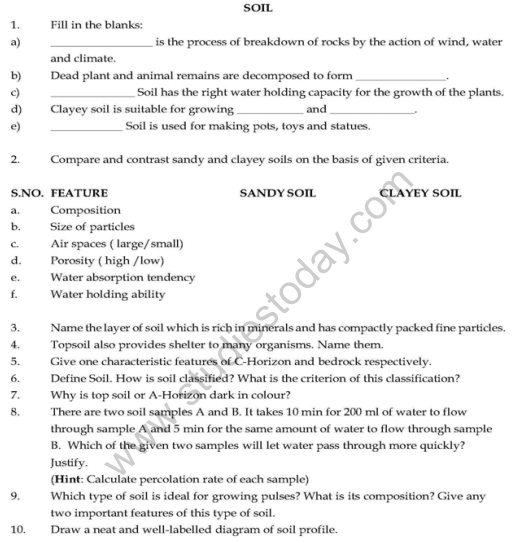
Chapter 9
SOIL
1. Fill in the blanks: [5 Marks]
a) _______________ is the process of breakdown of rocks by the action of wind, water and climate.
b) Dead plant and animal remains are decomposed to form _______________.
c) _______________ soil has the right water holding capacity for the growth of the plants.
d) Clayey soil is suitable for growing _______________ and _______________.
e) _______________ soil is used for making pots, toys and statues.
Answer:
1. a) Weathering
2. b) Humus
3. c) Loamy
4. d) Paddy, wheat (or gram)
5. e) Clayey
Teacher's Note:
a) Weathering is a continuous geological process.
b) Humus adds vital nutrients to the soil.
c) Loamy soil provides optimal aeration and moisture retention.
d) Specific crops require specific soil textures for root penetration.
2. Compare and contrast sandy and clayey soils on the basis of given criteria. [6 Marks]
| S.NO. | FEATURE | SANDY SOIL | CLAYEY SOIL |
|---|---|---|---|
| a. | Composition | ||
| b. | Size of particles | ||
| c. | Air spaces (large/small) | ||
| d. | Porosity (high/low) | ||
| e. | Water absorption tendency | ||
| f. | Water holding ability |
Answer:
| S.NO. | FEATURE | SANDY SOIL | CLAYEY SOIL |
|---|---|---|---|
| a. | Composition | Large proportion of sand particles | Large proportion of fine clay particles |
| b. | Size of particles | Large | Very small |
| c. | Air spaces (large/small) | Large | Small |
| d. | Porosity (high/low) | High | Low |
| e. | Water absorption tendency | Low | High |
| f. | Water holding ability | Poor / Very low | High |
Teacher's Note:
a) Particle size dictates pore space and aeration properties.
b) Water retention is inversely proportional to particle size.
c) Tabular comparisons help differentiate physical properties clearly.
d) Sandy soil drains quickly while clayey soil retains excess water.
3. Name the layer of soil which is rich in minerals and has compactly packed fine particles. [1 Mark]
Answer:
1. B-horizon or middle layer (subsoil).
Teacher's Note:
a) Subsoil accumulates minerals leached from the topsoil layer.
4. Topsoil also provides shelter to many organisms. Name them. [2 Marks]
Answer:
1. Organisms such as earthworms, rodents, moles, beetles and various insects live in the topsoil.
2. Plant roots and microorganisms like bacteria and fungi also find shelter and nutrients here.
Teacher's Note:
a) Earthworms help aerate and loosen the soil structure.
b) Microorganisms break down organic matter into humus.
5. Give one characteristic feature of C-Horizon and bedrock respectively. [2 Marks]
Answer:
1. C-horizon consists of small lumps of rocks with cracks and crevices.
2. Bedrock is hard, non-porous and difficult to dig with a spade.
Teacher's Note:
a) C-horizon lies just below the B-horizon.
b) Bedrock forms the deepest layer of the soil profile.
6. Define Soil. How is soil classified? What is the criterion of this classification? [3 Marks]
Answer:
1. Soil is the uppermost layer of the earth's crust consisting of weathered rock particles and organic matter.
2. Soil is classified into sandy, clayey and loamy types.
3. The criterion of this classification is the relative proportion of particles of various sizes contained in the soil.
Teacher's Note:
a) Soil formation is a very slow natural weathering process.
b) Particle proportion dictates water percolation rates.
c) Classification helps determine agricultural suitability for crops.
7. Why is topsoil or A-Horizon dark in colour? [1 Mark]
Answer:
1. Topsoil is dark in colour because it is rich in humus and mineral nutrients.
Teacher's Note:
a) Humus is formed by decayed organic matter.
8. There are two soil samples A and B. It takes 10 min for 200 ml of water to flow through sample A and 5 min for the same amount of water to flow through sample B. Which of the given two samples will let water pass through more quickly? Justify.
(Hint: Calculate percolation rate of each sample) [3 Marks]
Answer:
1. Formula: Percolation rate (ml/min) = \(\frac{\text{Amount of water (ml)}}{\text{Percolation time (min)}}\)
2. Sample A percolation rate = \(\frac{200}{10}\) = 20 ml/min
3. Sample B percolation rate = \(\frac{200}{5}\) = 40 ml/min
4. Sample B will let water pass through more quickly because it has a higher percolation rate.
Teacher's Note:
a) Percolation rate measures how fast water drains through soil.
b) Shorter time for the same water volume implies higher percolation.
c) Sandy soils exhibit higher percolation rates than clayey soils.
9. Which type of soil is ideal for growing pulses? What is its composition? Give any two important features of this type of soil. [3 Marks]
Answer:
1. Loamy soil is ideal for growing pulses.
2. Composition: It is a mixture of sand, silt and clay along with humus.
3. Two important features: It has the right water holding capacity and good aeration for plant roots.
Teacher's Note:
a) Loam contains silt particles in addition to sand and clay.
b) It prevents waterlogging while maintaining adequate moisture.
c) It is considered the best agricultural soil.
10. Draw a neat and well-labelled diagram of soil profile. [3 Marks]
Answer:
1. The soil profile consists of distinct layers or horizons stacked vertically.
2. Top layer: A-horizon (Topsoil) - dark, rich in humus and minerals.
3. Middle layer: B-horizon (Subsoil) - lighter in colour, harder, rich in minerals.
4. Lower layer: C-horizon - made of small rock lumps with cracks.
5. Bottom layer: Bedrock - hard and solid rock.
[Figure: Diagram showing vertical layers of soil profile with A-horizon, B-horizon, C-horizon and Bedrock clearly labeled]
Teacher's Note:
a) A soil profile is a vertical section through different layers of the soil.
b) Each layer differs in texture, colour, depth and chemical composition.
c) Proper labelling of all four horizons is essential for full credit.
VALUE BASED QUESTION:
Arun prefers to drink water cooled by the refrigerator, but he fills the earthen pot in his house with fresh water as his grandparents love to drink water from an earthen pot. [2 Marks]
Answer:
1. Earthen pots (matkas) have microscopic pores through which water seeps to the outer surface and evaporates, causing cooling.
2. This value-based action shows Arun's care, respect and consideration for his grandparents' traditional preferences and health.
Teacher's Note:
a) Evaporative cooling makes earthen pot water naturally cool and refreshing.
b) Accommodating elderly family members reflects strong moral values and empathy.
LAB ACTIVITY 1 [3 Marks]
Objective: To study the profile of the soil.
Materials required: Glass jar, soil and water.
Procedure:
[Figure: Diagram of a glass jar containing layers of soil settled in water from bottom to top: gravel, sand, clay, silt, and humus floating on top]
Observation:
1. The soil settles down in distinct layers based on particle size.
2. Heaviest particles like gravel settle at the bottom, followed by coarse sand, fine sand, silt, and clay.
3. A layer of dark organic matter called humus floats on top of the water.
Conclusion:
Soil is composed of different types of particles of varying sizes along with organic matter, which settle in layers when mixed with water.
Precautions:
1. The soil sample should be added gently into the glass jar filled with water.
2. The mixture should be stirred well and allowed to rest undisturbed for proper sedimentation of layers.
Answer:
1. The activity demonstrates the different components and layers of soil through sedimentation.
2. Heavier particles settle first while lighter organic matter remains at the top.
3. This simple laboratory method helps in visually identifying soil texture fractions.
Teacher's Note:
a) The activity relies on the principle of sedimentation based on particle density and size.
b) Ensure students do not shake the jar too violently to avoid breaking the glass.
c) Humus floats because it is lighter than water and mineral particles.
LAB ACTIVITY 2 [5 Marks]
Objective: To investigate the absorption of water in different types of soil.
Materials required: 3 glass jars, 3 funnels, water, 3 different kinds of soil (loam, sand, clay), filter paper, weighing machine.
Procedure:
[Figure: Three setup arrangements side by side, each showing a glass jar with a funnel placed on top, a folded filter paper inside the funnel containing soil sample, and water being poured into the funnel]
Answer:
1. Procedure: Take 50 g of dry soil samples of sand, clay, and loam separately. Place filter paper inside three funnels and put 50 g of each soil sample in the respective funnels. Pour a measured volume of water (e.g., 100 mL) drop by drop over the soil in each funnel using a measuring cylinder until water starts dripping into the glass jars below.
2. Observation: Measure the amount of water collected in the jar. Calculate the absorbed water by subtracting the collected water from the total water poured. Sandy soil allows maximum water to pass through, clay retains more water with minimum percolation, and loamy soil shows balanced absorption.
3. Conclusion: Loamy soil has moderate water retention and percolation suitable for plant growth, sandy soil has high percolation and low absorption, while clayey soil has high water retention and very low percolation.
4. Precautions: Ensure equal initial weight of all soil samples, pour water at the same rate across all three setups, and ensure no water spills outside the funnel.
Teacher's Note:
a) This experiment demonstrates the percolation rate and absorption capacity of different soil textures.
b) Students often confuse percolation rate with total water retention capacity.
c) Loam is considered the best soil for growing plants because it contains a balanced proportion of sand, silt, and clay.
d) Always verify that the filter papers used are of the same size and grade to ensure uniform experimental conditions.
Free study material for Science
Useful Resources and Notes for Class 7 Science Chapter 09 Soil
Quick Revision Material for Chapter 09 Soil
Access comprehensive study material for Chapter 09 Soil, including revision notes, concept maps, and high-probability questions. These resources are designed in alignment with the latest 2026 CBSE syllabus for Class 7 Science to support effective exam preparation.
Expert Notes and Solved Exam Questions
Built using official NCERT guidelines for Class 7 Science, these materials provide reliable academic support. Integrating past examination questions and step-by-step solutions helps students understand official CBSE grading criteria.
Additional Study Resources for Class 7
Wrap up your chapter revision by testing your knowledge against standard objective question formats. Explore our full library of free, up-to-date sample papers and online assessments to secure top grades in your CBSE examinations.
FAQs
Our advanced study package for Chapter 09 Soil includes detailed concepts, diagrams, Mind Maps, and explanation of complex topics to ensure Class 7 students learn as per syllabus for 2026 exams.
The Mind Maps provided for Chapter 09 Soil act as visual anchors which will help faster recall during high-pressure exams.
Yes, teachers use our Class 7 Science resources for lesson planning as they are in simple language and have lot of solved examples.
Yes, You can download the complete, mobile-friendly PDF of the Science Chapter 09 Soil advanced resources for free.
Yes, our subject matter experts have updated the Chapter 09 Soil material to align with the rationalized NCERT textbooks and have removed deleted topics and added new competency-based questions.