

Class 7 Science Study Guide: Class 7 Science Waste Water Management Exam Notes
Review targeted academic resources with the Class 7 Science Waste Water Management Exam Notes. Built according to official CBSE standards for the 2026-27 term, these downloadable Class 7 Science study materials support effective daily practice and deeper conceptual understanding for Chapter 18 Wastewater Story.
Download Chapter 18 Wastewater Story Study Material PDF
Access the complete useful resource PDF for Class 7 Science below. Regular practice with these targeted academic notes builds familiarity with complex topics and helps secure higher marks in final school evaluations.
Class 7 Science Waste Water Management Exam Notes. Please refer to the examination notes which you can use for preparing and revising for exams. These notes will help you to revise the concepts quickly and get good marks.
Covers following topics:
- Waste
- Source of Waste Water
- Sewage treatement plant
- Uses of treated water
- How we can reduce sewage generation
- Waste water & disease
Ø WASTE
Any material which cannot be used in the form in which it is produced is called a waste. According to their physical state, waste can be classified into 3 categories – Solid waste, liquid waste & gaseous waste.
The impurities present in waste water are called contaminant. This waste water is called sewage.
→ SOURCE OF WASTE WATER
◊ Domestic Waste Water :
It includes all kinds of wastes like human excreta, food waste, soaps, detergents, oil, animal excreta, urine, etc.
◊ Agricultural Waste Water :
The waste water generated from farms and agricultural fields contains harmful pesticides, weedicides and animal wastes.
◊ Industrial Waste Water :
The waste water generated from various industries contains harmful chemicals. The discharge of industrial waste water is called Industrial effluent.
◊ Petroleum Oil :
The leakage of petroleum oil into the sea during drilling and shipping pollutes sea water. Oil spill is caused due to release of oil into rivers and oceans knowingly or unknowingly.
◊ Mining :
Waste water is also generated as a result of mining activities.
◊ Construction Activity :
Lot of waste water is generated during various stages of building houses, homes, malls, multiplexes, etc.
→ SEWAGE TREATMENT PLANT
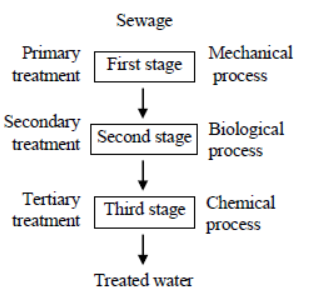
There are three processes which are involved in treating waste water before it is discharged into the water reservoirs. These processes are :
- Primary treatment 2.Secondary treatment
- Tertiary treatment
◊ Primary Treatment :
- It is the first stage and is called primary treatment. The waste water is passed through rotating screens to remove large objects.
- The water is then passed through a grit and sand tank to remove small stones and pebbles.
- The soild wastes such as faeces settle down at the bottom of the tank and are removed with the help of a scraper. This is a sludge
- The sludge can be used for production of biogas to be used as fuel or for producing electricity. Light materials float on top and are known as scum. The scum is removed with the help of a skimmer.
◊ Secondary Treatment :
- It is the second stage and is called secondary treatment. The treatment at this stage involves pumping of air into the clarified water to help aerobic bacteria to grow. The bacteria decompose the suspended waste.
- The activity of the bacteria produces decomposed organic material which settle down at the bottom of the tank as activated sludge. It is passed through sand drying beds to separate the solid material out of it. This solid waste can be used as manure.
◊ Tertiary Treatment :
- It is the third stage and is called tertiary treatment . The treated water now undergoes chemical treatment.
- The water is disinfected with chemicals like chlorine or may be exposed to ultraviolet rays to kill disease-causing organisms.
- It can also be treated with ozone gas. The water is then discharged into the distribution system. A schematic diagram of a waste water treatment plant is shown in
→ USES OF TREATED WATER
The treated water which is obtained from sewage treatment plant is used for irrigating fields, lawns and for aquaculture. In Kolkata the treated water is used for fisheries and growing crops and vegetables. The treated water is finally released in streams and rivers.
→ HOW WE CAN REDUCE SEWAGE GENERATION
- Leakage in sewer lines should be cheked and repaired regularly.
- Use flushes with low capacity to reduce flushed water.
- Waste water from basins, sinks and washing machines can be used again for watering plants or wiping floors
- Never pour household products such as cooking oil, fat, butter, plastic, etc. down the drain. These materials can block the pipes and sewage may start overflowing in your home or at public places.
- Newer throw paints, solvents, insecticides, automobile oils, and medicines down the drain as they may kill microbes that help to purify water.
- Used tea leaves, solid food remains, sanitary towels, toys, etc. should not be thrown in the waste water pipe because these materials may choke the drains
- Ask civic authorities to cover the open drains of your area.
- Plant eucalyptus trees all along sewage ponds as these plants absorb surplus water rapidly.
→ WASTE WATER AND DISEASES
Drinking of waste & contaminated water cause many human disease in India. People consuming contaminated water may suffer from diseases like gastroenteritis, dysentry, typhoid, cholera, meningitis and hepatitis.
Please click on below link to download pdf file for Class 7 Science Waste Water Management Exam Notes.
Free study material for Science
Free CBSE Study Guides: Class 7 Science Chapter 18 Wastewater Story
Essential Notes for Class 7 Science
Access comprehensive study material for Chapter 18 Wastewater Story, including revision notes, concept maps, and high-probability questions. These resources are designed in alignment with the latest 2026 CBSE syllabus for Class 7 Science to support effective exam preparation.
Verified Solutions for Class 7 Science
Each resource draws directly from authorized textbooks to maintain academic accuracy. Evaluating solved examples allows Class 7 students to master the formal presentation and answer-writing standards expected in upcoming school exams.
Enhance Accuracy with Online Tests
For peak performance in upcoming evaluations, integrate official Science sample papers directly into your study schedule. Follow up your revision by attempting online MCQ tests for Chapter 18 Wastewater Story to refine calculation speed and precision.
FAQs
Our advanced study package for Chapter 18 Wastewater Story includes detailed concepts, diagrams, Mind Maps, and explanation of complex topics to ensure Class 7 students learn as per syllabus for 2026 exams.
The Mind Maps provided for Chapter 18 Wastewater Story act as visual anchors which will help faster recall during high-pressure exams.
Yes, teachers use our Class 7 Science resources for lesson planning as they are in simple language and have lot of solved examples.
Yes, You can download the complete, mobile-friendly PDF of the Science Chapter 18 Wastewater Story advanced resources for free.
Yes, our subject matter experts have updated the Chapter 18 Wastewater Story material to align with the rationalized NCERT textbooks and have removed deleted topics and added new competency-based questions.