

Official CBSE Study Materials for Class 7 Science
Explore structured advanced study materials through the Class 7 Science Waste Water Story Chapter Notes. Tailored for Class 7 learners, utilizing these Science resources ensures thorough preparation and strengthens foundational knowledge before final CBSE evaluations.
Advanced Resources for Science
Navigate directly to the advanced Science study materials using the digital viewer below. Each resource pack includes detailed conceptual summaries and solved practice questions, allowing students to instantly reinforce their learning.
Class 7 Science Waste Water Story Chapter Notes. There are many more useful educational material which the students can download in pdf format and use them for studies. Study material like concept maps, important and sure shot question banks, quick to learn flash cards, flow charts, mind maps, teacher notes, important formulas, past examinations question bank, important concepts taught by teachers. Students can download these useful educational material free and use them to get better marks in examinations. Also refer to other worksheets for the same chapter and other subjects too. Use them for better understanding of the subjects.
This Class 7 Science Waste Water Story chapter notes page explains potable water, the sources of tap water, sewage and its contaminants, the steps of waste water treatment in a sewage treatment plant, household habits that reduce water pollution, alternative methods of waste disposal such as recycling, landfill, incineration and composting, and the links between sanitation and diseases.
WASTE WATER STORY
Water is the most common liquid on earth. It is needed by all living things to survive. We use water for drinking, cleaning, bathing, washing clothes, etc. Even plants cannot survive without water.
Clean water that is fit for drinking is called potable water. Even though three-fourths of the earth's surface is covered with water, it is not equally distributed in all the areas. In many places, people have to walk for several kilometres to fetch clean water.
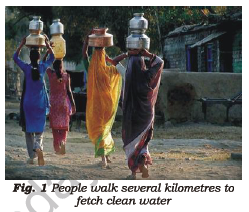
[Figure: Fig. 1 People walk several kilometres to fetch clean water. Several women carry pots of water on their heads along a path.]
Tap water mainly comes from a river, a lake or underground wells. Is the water from these sources pure? No! It may contain dissolved substances like gases from the air, nitrates and sulphates from the soil, bacteria, harmful germs, sand, grit, soil particles, etc. Before the water reaches our taps, it is made fit for drinking by killing the harmful germs and by removing solid matter. This is done by water works.
Everyday we use a lot of tap water in our homes for various activities. Most of the water we use in our homes is used for cleaning, washing, cooking and carrying away waste materials. Only a little water is used for drinking.
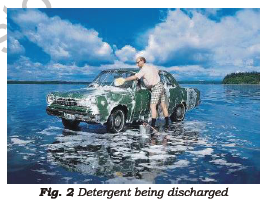
Do you know how tap water gets dirty? We all are responsible for it. We mix all sorts of things with tap water: shampoo, soap, toothpaste, detergents, wastes from food, human waste, etc. This water containing wastes is called sewage. Sewage includes garbage, human wastes and water that has been used for cleaning, washing and bathing.
[Figure: Fig. 2 Detergent being discharged. A person washes a car in a river.]
CONTAMINANTS IN SEWAGE
Sewage contains many dissolved and suspended impurities, which are called contaminants. The contaminants can be summed up as follows:
• Organic impurities: These include human waste, animal waste, food waste, soaps, detergents, pesticides, etc.
• Inorganic impurities: These include nitrates, sulphates, phosphates, metals, etc.
• Nutrients: Like nitrogen and phosphorus.
• Bacterial and other microorganisms: These may cause diseases like typhoid, cholera, dysentery, etc.
Sewage is also generated from factories, offices, hospitals, institutions, etc. Since sewage contains lots of germs and impurities, it is unfit for use and is drained into the rivers or lakes. But, before reaching the river or the lake, the sewage has to be treated. This is done in Sewage Treatment Plants (STP) or Waste Water Treatment Plants (WWTP).
WASTE WATER TREATMENT
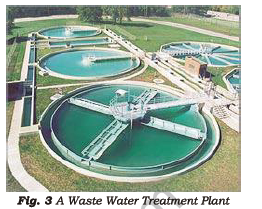
Waste water treatment refers to the process of removing contaminants from waste water. It includes physical, chemical and biological processes to remove physical, chemical and biological contaminants. The waste water generated from our homes or factories is taken into the ground by a set of pipes. It then flows to a waste water treatment plant.
[Figure: Fig. 3 A Waste Water Treatment Plant, showing large circular sedimentation tanks with rotating scraper arms.]
Screening
The first step is to pass the waste water through bar screens to remove large objects like rags, wood pieces, sticks, stones, cans, polythene bags, etc. It is necessary to remove these objects, as they may damage the equipment used in waste water treatment plants.
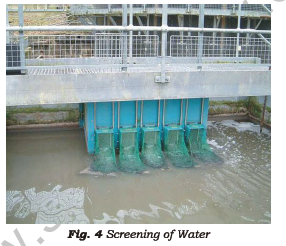
[Figure: Fig. 4 Screening of water, showing a bar screen across a channel of flowing water.]
Grit tanks
Water is then allowed to go into a grit and sand removal tank. Here, the speed of incoming waste water is controlled carefully. This allows the grit, sand, stones and other heavy objects to settle at the bottom.
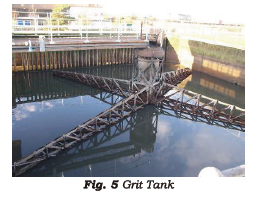
[Figure: Fig. 5 Grit tank.]
Sedimentation tanks
Water is now allowed to pass into large tanks called sedimentation tanks (also called clarifiers). These tanks are large enough so that solids like faeces (sludge) sink slowly to the bottom, and materials like grease and oil float at the surface and are skimmed off. The sludge collected at the bottom of the sedimentation tank is continuously removed by scrapers.

The sludge is sent to separate tanks called digesters, where it is broken down (decomposed) by anaerobic bacteria (bacteria which do not require oxygen for their survival). Biogas is released during this process.
The water now obtained is called clarified water and looks cleaner.
[Figure: Fig. 6 Sedimentation tank.]
Sewage Treatment
Treatment of sewage includes removal of solid wastes from the sewage and making the liquid part, i.e., water, less harmful and fit for human consumption. The solid part of the sewage can later be used as a fertilizer for crops.
On entering the treatment plant, large solid materials in the sewage are first removed by passing the water through vertical bars or grids. From here, the water then passes through the grinder. Here, plant wastes and other organic materials are reduced in size to enable efficient treatment and removal.
Next, the water is made to pass through grit chambers or settling tanks where impurities like silt, sand and gravel are removed. After this, the waste water is sent to sedimentation tanks, where organic wastes settle down and are separated for disposal.
The organic matter is digested and converted into methane, carbon dioxide and humus-like material. This is called sludge. The digested sludge is air dried on sand beds. It can be used as a fertilizer.
Compressed air is passed through the water and it is chlorinated to kill micro-organisms. Sometimes, before chlorination, water is treated biologically to further reduce the organic matter left in it. This treated water is finally released into water bodies.

[Figure: Fig. 7 Sewage treatment. Sewage pipes and flood water pipes carry water from houses and buildings to a sewage treatment plant. The treated sewage is released into a river, which flows to a water body.]
BETTER HOUSEKEEPING PRACTICES TO MINIMISE OR ELIMINATE RELEASE OF POLLUTANTS INTO WATER
Our everyday household activities are the major cause of contamination of water. We must be very careful while disposing of water. Here are some methods that you can adopt to reduce water contamination. Substances that pollute water are called pollutants.
At Home
• Hazardous household products should be disposed of properly. Many household chemicals like paints, motor oil, cleaning liquids, insecticides, etc., should not be allowed to go down the drain as these are very toxic. These are harmful to both humans and microbes that help in the purification of water.
• Used oil and fats should not be thrown in the drain. If allowed to go down the drain, they may choke the pipes.
• Dispose of non-biodegradable products safely. We should never flush non-biodegradable products like plastic bags or diapers down the toilet. This can damage the sewage treatment process.
In Your Lawns and Gardens
• Use manure or compost. Use of manure and compost should be encouraged. This reduces the need for chemical fertilizers. Fertilizers may reach the water bodies, thereby causing harm to aquatic life. Manure also helps in retaining soil fertility.
• Do not overwater your lawns. If you overwater lawns and gardens, the fertilizers get dissolved in the water and reach the ground, thus causing water contamination.
• Maintain the water storage tanks. Tanks should be cleaned regularly to prevent water contamination.
Public Places
• Do not throw plastic bags or any other material in rivers, lakes or any other water body. You should make an effort to dispose of any rubbish or litter without harming the water bodies.
• Dispose of waste properly after fairs, weddings and processions. A large amount of waste is generated during these activities. If not disposed of properly, these wastes may accumulate and lead to water contamination and the spread of waterborne diseases like cholera, dysentery, typhoid, etc.
For Your Community
• If you live very near to seas, rivers or lakes, you have a special responsibility in the fight against water contamination. People who live near water bodies can contaminate them directly, as compared to those who live farther away.
• You can educate your family, neighbours and friends about the ways to reduce water contamination.
• You can help a local NGO (Non Government Organisation) or conservation group to clean up rivers and streets.
• You can also actively take part in clean-up drives in your school and locality.
ALTERNATIVE ARRANGEMENT FOR SEWAGE DISPOSAL
Treating waste material as a resource to be exploited, instead of simply disposing of it, is not very new. Film-based photo labs used to recover silver from used chemicals after they were exhausted. There are many different methods for extracting valuable products; materials may be recycled, or even used to generate electricity.
The practice of treating waste materials as a resource is becoming common in metropolitan areas, where space for new landfills is running out. Besides, there is a growing concern that simply disposing of waste materials is unjustifiable in the long term, as most raw materials are finite in supply. In many areas, material for recycling is collected separately from general waste, with dedicated bins and collection vehicles.
Recycling
Recycling means recovering for further use a material that would otherwise be wasted. Organised municipal collection efforts support the reuse of everyday waste materials, so that the raw materials from these items can be used again.
The most common consumer items recycled include aluminium beverage cans, steel and aerosol cans, plastic and glass bottles, cardboard cartons, newspapers and magazines.
Of late, electronic waste sent to Asia is discouraged, since such materials contain high levels of toxic elements such as cadmium, lithium and selenium. Even the recovery of gold and copper can cause environmental problems.
Landfill
Disposing of waste in a landfill is the most traditional method of waste disposal, and it remains a common practice in most countries. Historically, landfills were often established in disused quarries, mining voids or borrow pits. However, it was discovered that landfills can pollute groundwater and surface water, which made them unpopular.
Landfills also generate methane and carbon dioxide, which cause odour problems, kill surface vegetation and are greenhouse gases. Hence, few people want a landfill in their vicinity, which makes solid waste disposal costlier.
Incineration
Incineration is a waste disposal method that involves burning waste at high temperatures. Such waste treatment plants convert waste into heat, gases and/or residual solid ash. A waste-to-energy plant (WtE) is the new term for an incinerator that burns wastes to produce steam and/or electricity. Incineration is popular in countries such as Japan, Sweden and Denmark.
Composting and Anaerobic Digestion
Organic waste materials such as plant material and food leftovers are increasingly being recycled. These materials are fed into a composting and/or digestion system to control the biological process that breaks down the organic matter. The resulting organic material (called mulch) is then used as a fertilizer for agricultural or gardening purposes.
There are a large variety of composting and digestion methods, varying in complexity from simple window composting of shredded plant material to automated enclosed-vessel digestion of mixed domestic waste.
Pyrolysis and gasification are two related forms of thermal treatment in which solid waste is converted into solid, liquid and gas products. These can be burnt to produce energy or refined into other products. Gas is burnt to produce electricity and steam. Gasification is another way of producing renewable energy and heat.
Over-utilisation of resources produces a lot of waste, besides creating a major environmental hazard. Depending upon their nature, wastes are classified as solids, liquids and gases.
Role of Eucalyptus tree in cleaning of sewage pond
Eucalyptus trees are planted along sewage ponds, into which water is released after the water treatment processes. Eucalyptus trees absorb waste water from the pond and release pure water vapour into the atmosphere.
SANITATION OF PUBLIC PLACES
Growing community involvement in health, sanitation and proper waste disposal can improve our sanitation. Adopting sanitation practices should become a way of our life. The quality of living that is expressed in clean homes and clean neighbourhoods is called good sanitation.
In fact, sanitation of the whole community depends on the personal habits of individuals like you and me. This helps to maintain an environment that is healthy and protected. Much of our ill health can be traced to factors of environment such as water pollution and improper waste disposal. So, as individuals and proactive citizens of the country, our contribution to enhancing the quality of life should be to follow the dos and don'ts listed below.
Don'ts
i) Never defecate on open grounds.
ii) Don't run down government policies on sanitation and health programmes.
iii) Never throw household products like cooking oil, paint and grease into the drain.
iv) Do not dispose of wastes at public places like parks, hospitals, bus depots and railway stations.
v) Drinking water from taps at public places should be avoided.
vi) Don't overlook any open manholes in your locality or ignore choked drains.
Dos
i) Maintain proper disposal of human excreta and other domestic wastes.
ii) Impart basic knowledge to people to make them aware of the aspects of keeping good health.
iii) Maintain a healthy environment by keeping your house and neighbourhood clean.
iv) Use dustbins to throw litter or waste. If you cannot find dustbins, carry the waste home and throw it in the dustbin of your house.
v) Use mineral water or water from filters installed at public places for drinking purpose only.
vi) Complain to the municipality or the Gram Panchayat if you find open drains in your neighbourhood.
SANITATION AND DISEASES
Sanitation and diseases are related to each other, as lack of sanitation can cause diseases. In our country, a large number of people even today do not have sewage facilities and thus defecate in open fields, railway tracks, etc. The untreated human excreta pollute soil and water sources, including underground water.
When this contaminated water is used for drinking, it can cause diseases such as cholera, typhoid, hepatitis and dysentery, which may even lead to death. Therefore, lack of sanitation, resulting in drinking of contaminated water, can cause serious health problems.
Let us now understand the process of waste water treatment.

Free study material for Science
CBSE Class 7 Science Study Material: Chapter 18 Wastewater Story
Quick Revision Material for Chapter 18 Wastewater Story
Explore essential learning tools for Class 7 Science Chapter 18 Wastewater Story. This curated collection features in-depth notes and targeted practice questions built around the active 2026 curriculum to streamline your daily revision.
Expert Notes and Solved Exam Questions
Designed around the official curriculum, these study guides guarantee standard compliance. Reviewing step-by-step solutions clarifies complex sub-topics within Chapter 18 Wastewater Story and demystifies standard marking schemes for Science evaluations.
Additional Study Resources for Class 7
For peak performance in upcoming evaluations, integrate official Science sample papers directly into your study schedule. Follow up your revision by attempting online MCQ tests for Chapter 18 Wastewater Story to refine calculation speed and precision.
FAQs
Our advanced study package for Chapter 18 Wastewater Story includes detailed concepts, diagrams, Mind Maps, and explanation of complex topics to ensure Class 7 students learn as per syllabus for 2026 exams.
The Mind Maps provided for Chapter 18 Wastewater Story act as visual anchors which will help faster recall during high-pressure exams.
Yes, teachers use our Class 7 Science resources for lesson planning as they are in simple language and have lot of solved examples.
Yes, You can download the complete, mobile-friendly PDF of the Science Chapter 18 Wastewater Story advanced resources for free.
Yes, our subject matter experts have updated the Chapter 18 Wastewater Story material to align with the rationalized NCERT textbooks and have removed deleted topics and added new competency-based questions.