

Download CBSE Class 7 Science Useful Resources
Review targeted academic resources with the Class 7 Respiration in Organisms Important Questions VBQs. Built according to official CBSE standards for the 2026-27 term, these downloadable Class 7 Science study materials support effective daily practice and deeper conceptual understanding for Chapter 10 Respiration in Organisms.
Access CBSE Study Guides and Summaries
Navigate directly to the advanced Science study materials using the digital viewer below. Each resource pack includes detailed conceptual summaries and solved practice questions, allowing students to instantly reinforce their learning.
Class 7 Respiration in Organisms Important Questions VBQs. Please refer to the examination notes which you can use for preparing and revising for exams. These notes will help you to revise the concepts quickly and get good marks.
Chapter- 10
RESPIRATION IN ORGANISMS
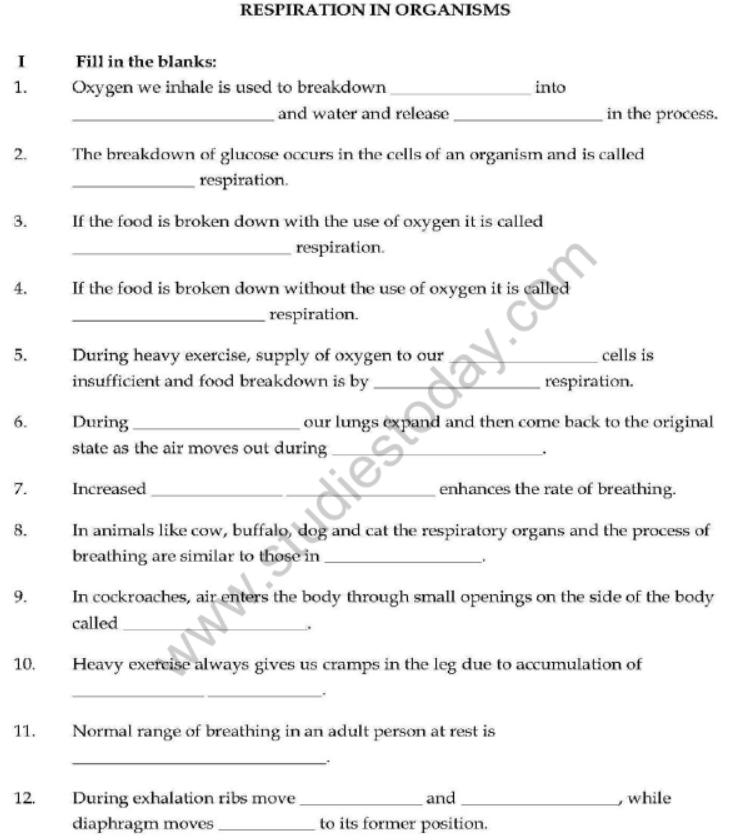
I Fill in the blanks:
1. Oxygen we inhale is used to breakdown ____________ into ____________ and water and release ____________ in the process. [1 Mark]
Answer:
1. glucose
2. carbon dioxide
3. energy
Teacher's Note:
a) Cellular respiration involves the breakdown of food to release energy.
b) Oxygen is utilized to break down glucose completely.
2. The breakdown of glucose occurs in the cells of an organism and is called ____________ respiration. [1 Mark]
Answer:
1. cellular
Teacher's Note:
a) Cellular respiration takes place inside the cells of all living organisms.
b) It is essential for generating energy for various life processes.
3. If the food is broken down with the use of oxygen it is called ____________ respiration. [1 Mark]
Answer:
1. aerobic
Teacher's Note:
a) Aerobic respiration uses oxygen to release a large amount of energy.
b) The end products are carbon dioxide, water, and energy.
4. If the food is broken down without the use of oxygen it is called ____________ respiration. [1 Mark]
Answer:
1. anaerobic
Teacher's Note:
a) Anaerobic respiration occurs in the absence of oxygen.
b) It produces less energy and yields by-products like alcohol or lactic acid.
5. During heavy exercise, supply of oxygen to our ____________ cells is insufficient and food breakdown is by ____________ respiration. [1 Mark]
Answer:
1. muscle
2. anaerobic
Teacher's Note:
a) Muscle cells respire anaerobically when oxygen demand exceeds supply.
b) This temporary anaerobic breakdown produces lactic acid, causing cramps.
6. During ____________ our lungs expand and then come back to the original state as the air moves out during ____________. [1 Mark]
Answer:
1. inhalation
2. exhalation
Teacher's Note:
a) Breathing involves alternating steps of taking in air and giving out air.
b) Rib movements and diaphragm contraction drive these volume changes in the chest cavity.
7. Increased ____________ enhances the rate of breathing. [1 Mark]
Answer:
1. physical activity
Teacher's Note:
a) Active muscles require more oxygen, speeding up the breathing rate.
b) Increased breathing rate supplies additional oxygen to body cells.
8. In animals like cow, buffalo, dog and cat the respiratory organs and the process of breathing are similar to those in ____________. [1 Mark]
Answer:
1. humans
Teacher's Note:
a) Mammals share a similar chest cavity and lung-based breathing system.
b) They possess lungs as their primary respiratory organs.
9. In cockroaches, air enters the body through small openings on the side of the body called ____________. [1 Mark]
Answer:
1. spiracles
Teacher's Note:
a) Insects possess a network of air tubes called tracheae for gas exchange.
b) Spiracles act as external valves controlling air entry.
10. Heavy exercise always gives us cramps in the leg due to accumulation of ____________. [1 Mark]
Answer:
1. lactic acid
Teacher's Note:
a) Partial breakdown of glucose during anaerobic respiration forms lactic acid.
b) Hot water baths or massage help relieve these muscle cramps.
11. Normal range of breathing in an adult person at rest is ____________. [1 Mark]
Answer:
1. 15-18 times per minute
Teacher's Note:
a) A single breath includes one inhalation and one exhalation.
b) Breathing rate varies depending on the physical exertion level.
12. During exhalation ribs move ____________ and ____________, while diaphragm moves ____________ to its former position. [1 Mark]
Answer:
1. downwards
2. inwards
3. upwards
Teacher's Note:
a) Exhalation decreases the chest cavity volume, forcing air out.
b) Diaphragm relaxes and arches back upward during this process.
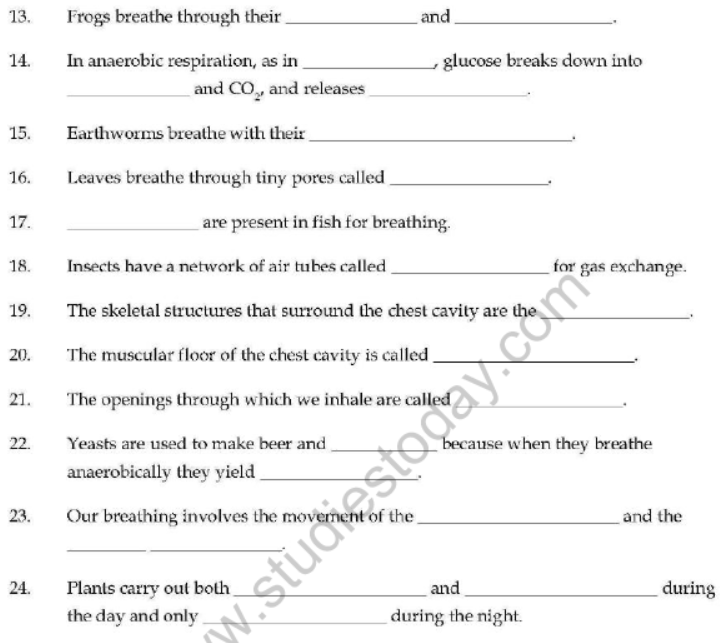
13. Frogs breathe through their ____________ and ____________. [1 Mark]
Answer:
skin, lungs
Teacher's Note:
a) Frogs have a dual mode of respiration.
b) They use moist skin in water and lungs on land.
14. In anaerobic respiration, as in ____________, glucose breaks down into ____________ and \(CO_{2}\), and releases ____________. [1 Mark]
Answer:
yeast, alcohol, energy
Teacher's Note:
a) Yeast respires anaerobically to produce alcohol.
b) This process is widely used in making beer and wine.
15. Earthworms breathe with their ____________. [1 Mark]
Answer:
skin
Teacher's Note:
a) Earthworm skin is moist and slimy to touch.
b) Gases can easily pass through the skin of earthworms.
16. Leaves breathe through tiny pores called ____________. [1 Mark]
Answer:
stomata
Teacher's Note:
a) Stomata are tiny pores present on the surface of leaves.
b) They facilitate the exchange of oxygen and carbon dioxide.
17. ____________ are present in fish for breathing. [1 Mark]
Answer:
Gills
Teacher's Note:
a) Gills are projections of the skin.
b) They help fish use oxygen dissolved in water.
18. Insects have a network of air tubes called ____________ for gas exchange. [1 Mark]
Answer:
tracheae
Teacher's Note:
a) Insects possess a system of air tubes called tracheae.
b) Oxygen-rich air rushes through spiracles into the tracheal tubes.
19. The skeletal structures that surround the chest cavity are the ____________. [1 Mark]
Answer:
ribs
Teacher's Note:
a) Ribs form a cage-like structure around the chest.
b) They protect vital organs like the heart and lungs.
20. The muscular floor of the chest cavity is called ____________. [1 Mark]
Answer:
diaphragm
Teacher's Note:
a) The diaphragm is a large, dome-shaped muscle.
b) Movement of the diaphragm helps in breathing.
21. The openings through which we inhale are called ____________. [1 Mark]
Answer:
nostrils
Teacher's Note:
a) Air enters our nasal cavity through nostrils.
b) Nasal passages contain hair and mucus to trap dust.
22. Yeasts are used to make beer and ____________ because when they breathe anaerobically they yield ____________. [1 Mark]
Answer:
wine, alcohol
Teacher's Note:
a) Single-celled organisms called yeasts respire anaerobically.
b) They are commercially used to make wine and beer.
23. Our breathing involves the movement of the ____________ and the ____________. [1 Mark]
Answer:
ribs, diaphragm
Teacher's Note:
a) Breathing involves both chest bones and muscles.
b) Diaphragm and rib cage movements change chest cavity volume.
24. Plants carry out both ____________ and ____________ during the day and only ____________ during the night. [1 Mark]
Answer:
photosynthesis, respiration, respiration
Teacher's Note:
a) Plants perform photosynthesis only in the presence of sunlight.
b) Respiration goes on continuously day and night in all living cells.
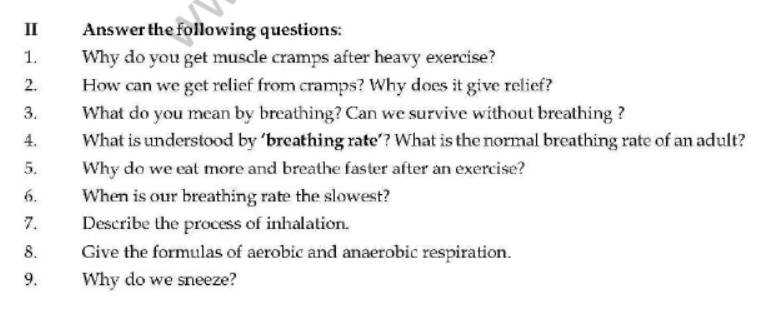
II Answer the following questions:
1. Why do you get muscle cramps after heavy exercise? [2 Marks]
Answer:
1. Heavy exercise increases energy demand, but the supply of oxygen to produce energy is limited.
2. Under this condition, anaerobic respiration takes place in muscle cells to fulfill the energy demand, leading to the partial breakdown of glucose into lactic acid, the accumulation of which causes muscle cramps.
Teacher's Note:
a) Lactic acid accumulation causes painful cramps.
b) Anaerobic respiration occurs during strenuous physical activity.
2. How can we get relief from cramps? Why does it give relief? [2 Marks]
Answer:
1. We can get relief from cramps through a hot water bath or a massage.
2. It improves blood circulation, which increases the supply of oxygen to the muscle cells, completely breaking down lactic acid into carbon dioxide and water.
Teacher's Note:
a) Heat and massage improve circulation.
b) Complete oxidation removes accumulated lactic acid.
3. What do you mean by breathing? Can we survive without breathing ? [2 Marks]
Answer:
1. Breathing means taking in air rich in oxygen and giving out air rich in carbon dioxide with the help of respiratory organs.
2. No, we cannot survive without breathing because all living cells require a continuous supply of oxygen to release energy from food for survival.
Teacher's Note:
a) Breathing is a physical process of gas exchange.
b) Continuous oxygen supply is essential for cellular activities.
4. What is understood by 'breathing rate'? What is the normal breathing rate of an adult? [2 Marks]
Answer:
1. The number of times a person breathes in a minute is termed as the breathing rate.
2. A normal adult human being breathes 15 to 18 times per minute at rest.
Teacher's Note:
a) One breath comprises one inhalation and one exhalation.
b) Breathing rate changes according to the body's physical activity level.
5. Why do we eat more and breathe faster after an exercise? [2 Marks]
Answer:
1. Exercise increases the rate of cellular respiration to meet the high energy demand of active muscles.
2. This requires more food intake and a faster breathing rate to supply extra oxygen quickly to the body cells.
Teacher's Note:
a) Higher energy demand speeds up metabolism.
b) Lungs work faster to take in more oxygen.
6. When is our breathing rate the slowest? [1 Mark]
Answer:
1. Our breathing rate is the slowest when we are sleeping or resting peacefully.
Teacher's Note:
a) Resting lowers the body's energy requirement.
b) Slow metabolism reduces the need for rapid oxygen intake.
7. Describe the process of inhalation. [3 Marks]
Answer:
1. Inhalation is the process of taking in oxygen-rich air into the body.
2. During inhalation, ribs move up and outward, and the diaphragm moves downward.
3. This increases the space in the chest cavity, causing air to rush into the lungs.
Teacher's Note:
a) Inhalation expands the chest cavity.
b) Air moves from a region of higher pressure outside to lower pressure inside.
8. Give the formulas of aerobic and anaerobic respiration. [2 Marks]
Answer:
1. Aerobic respiration: Glucose + Oxygen → Carbon dioxide + Water + Energy
2. Anaerobic respiration: Glucose → Alcohol + Carbon dioxide + Energy
Teacher's Note:
a) Aerobic respiration releases a large amount of energy.
b) Anaerobic respiration yields less energy and byproducts like alcohol or lactic acid.
9. Why do we sneeze? [2 Marks]
Answer:
1. When we inhale, unwanted dust, smoke, and pollen particles present in the air enter our nasal cavity.
2. These particles irritate the lining of the cavity, triggering sneezing which expels these foreign particles from the air.
Teacher's Note:
a) Sneezing is a protective reflex action.
b) It helps keep the respiratory passage clean.
III Differentiate between the following
1) Respiration and Photosynthesis [3 Marks]
Answer:
| Feature | Respiration | Photosynthesis |
|---|---|---|
| Process Type | Catabolic process involving breakdown of food to release energy. | Anabolic process involving synthesis of food using solar energy. |
| Gas Exchange | Takes in oxygen and releases carbon dioxide. | Takes in carbon dioxide and releases oxygen. |
| Occurrence | Occurs in all living cells at all times. | Occurs only in green plants in the presence of sunlight. |
Teacher's Note:
a) Respiration releases energy stored in glucose for cellular activities.
b) Photosynthesis traps solar energy to manufacture food.
c) These two processes complement each other in maintaining atmospheric oxygen and carbon dioxide balance.
2) Breathing and Cellular [3 Marks]
Answer:
| Feature | Breathing | Cellular Respiration |
|---|---|---|
| Level | Physical process occurring at the organ level. | Biochemical process occurring at the cellular level. |
| Energy Involvement | Energy is consumed during respiratory movements. | Energy is released in the form of ATP. |
| Enzymes | No enzymes are required for this physical exchange of gases. | Various specific enzymes are required to break down glucose. |
Teacher's Note:
a) Breathing is simply the intake of oxygen-rich air and expulsion of carbon dioxide-rich air.
b) Cellular respiration takes place inside the cells to break down food molecules.
c) Breathing acts as a transport mechanism to supply oxygen for cellular respiration.
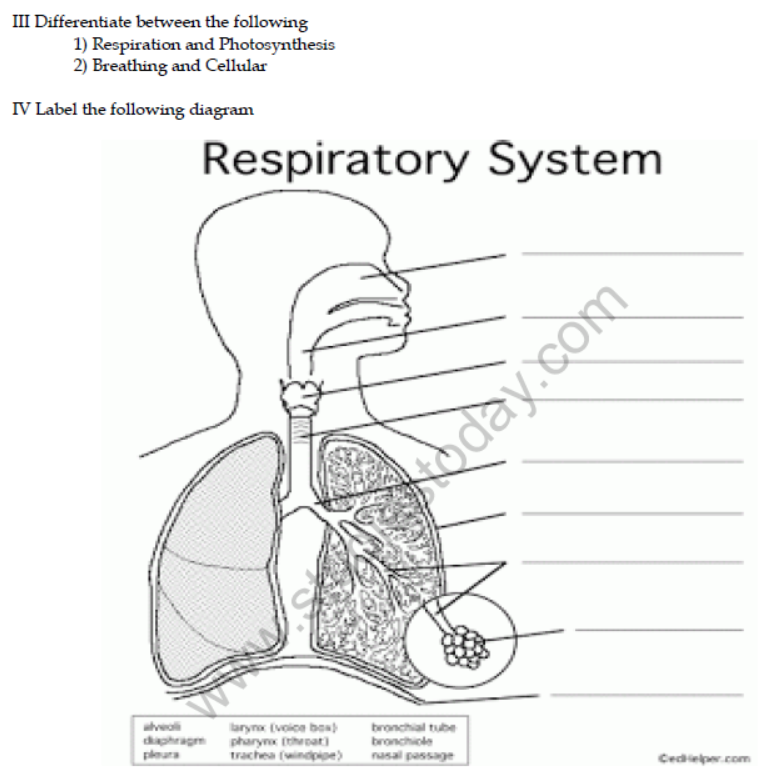
IV Label the following diagram [5 Marks]
[Figure: Outline diagram of the human respiratory system showing nasal passage, pharynx, larynx, trachea, bronchus, bronchioles, alveoli, lungs, pleura, and diaphragm, with pointing lines to each part.]
Answer:
1. Nasal passage
2. Pharynx (throat)
3. Larynx (voice box)
4. Trachea (windpipe)
5. Bronchial tube
6. Bronchiole
7. Alveoli
8. Lungs
9. Diaphragm
10. Pleura
Teacher's Note:
a) The respiratory tract starts at the nasal passage and leads air into the windpipe.
b) Alveoli provide the large surface area required for gaseous exchange in the lungs.
c) The diaphragm is a muscular sheet that forms the floor of the chest cavity.
d) Proper labeling requires identifying both upper respiratory structures and internal lung components accurately.
V. Give Reasons:
1. A child blows out air on the surface of a clean cold mirror and notices droplets of water after sometime. Why does this happen? [2 Marks]
Answer:
1. The exhaled air contains water vapour along with carbon dioxide.
2. When this warm exhaled air comes in contact with the cold surface of the mirror, the water vapour condenses into tiny droplets of water.
3. This demonstrates that water vapour is a byproduct of respiration.
Teacher's Note:
a) Exhaled air is warm and laden with moisture from the respiratory tract.
b) Condensation occurs when warm moisture hits a cold surface.
2. What will happen to a cockroach if it is made to drown in water? [2 Marks]
Answer:
1. The cockroach will die due to suffocation.
2. Insects like cockroaches have small openings called spiracles on the sides of their bodies and a network of tubes called tracheae for breathing; submerging them in water blocks these spiracles and cuts off oxygen supply.
Teacher's Note:
a) Insects lack lungs and rely entirely on tracheal systems connected to spiracles.
b) Water blocks the spiracles, preventing air entry.
3. Why should we breathe through the nose and not through the mouth? [2 Marks]
Answer:
1. The nasal cavity contains fine hairs and mucus that trap dust, pollen, and impurities present in inhaled air.
2. Breathing through the nose ensures that the air is filtered and warmed before it reaches the delicate lungs, whereas mouth breathing allows dust and germs to enter directly.
Teacher's Note:
a) Nasal hairs and mucus act as natural air filters.
b) Mouth breathing bypasses this filtration and humidification mechanism.
4. Sachin came back home after a cricket match. His legs were paining, so he took hot water bath and felt relaxed. Explain. [3 Marks]
Answer:
1. Heavy physical exercise like playing a cricket match causes temporary anaerobic respiration in the leg muscles due to a shortage of oxygen.
2. This partial breakdown of glucose produces lactic acid, the accumulation of which causes muscle cramps and pain.
3. A hot water bath improves blood circulation, which increases the supply of oxygen to the muscle cells and helps in the complete breakdown of accumulated lactic acid, providing relief.
Teacher's Note:
a) Anaerobic respiration occurs when energy demand is high and oxygen supply is inadequate.
b) Lactic acid buildup is responsible for fatigue and muscle pain after heavy exertion.
c) Improved blood circulation flushes out metabolic wastes and relieves cramps.
VI. MULTIPLE CHOICE QUESTIONS
1. What is the "pipe" between the mouth and stomach called? [1 Mark]
a. Epiglottis
b. Trachea
c. Esophagus
d. Appendix
Answer: c. Esophagus
1. The food pipe that connects the mouth to the stomach is known as the esophagus.
2. Trachea is the windpipe.
3. Hence, the correct option is (c).
Teacher's Note:
a) The esophagus pushes food down to the stomach via peristalsis.
b) Do not confuse the food pipe with the windpipe.
2. What are the increasingly smaller airways branching off into the lungs called? [1 Mark]
a. Air sacs
b. Bronchial tubes
c. Capillaries
d. Lungs
Answer: b. Bronchial tubes
1. Inside the lungs, the bronchi branch into smaller tubes called bronchial tubes or bronchioles.
2. These tubes distribute air throughout the lung tissue.
3. Hence, the correct option is (b).
Teacher's Note:
a) Bronchial tubes form the respiratory tree inside the lungs.
b) Capillaries are blood vessels, not airways.
3. What are the bubble-shaped sacs in the lungs where gas exchange takes place called? [1 Mark]
a. Capillaries
b. Bronchial tubes
c. Alveoli
d. Lungs
Answer: c. Alveoli
1. Alveoli are tiny, bubble-shaped air sacs at the end of the bronchioles.
2. They provide a large surface area for the exchange of oxygen and carbon dioxide.
3. Hence, the correct option is (c).
Teacher's Note:
a) Alveoli are surrounded by a network of thin blood capillaries.
b) Gas exchange occurs across the thin walls of the alveoli via diffusion.
4. When you inhale, the air pressure in the chest cavity... [1 Mark]
a. stays the same, allowing both pressures to be equal
b. increases, allowing lungs to expand
c. decreases, allowing outside air to flow into the lungs
d. there is no air pressure in your chest cavity
Answer: c. decreases, allowing outside air to flow into the lungs
1. During inhalation, the diaphragm moves down and ribs move up and out, increasing the chest cavity volume.
2. An increase in volume causes the air pressure inside the chest cavity to decrease below atmospheric pressure.
3. Air rushes in from the outside where pressure is higher.
4. Hence, the correct option is (c).
Teacher's Note:
a) Air always moves from a region of higher pressure to lower pressure.
b) Volume and pressure are inversely proportional according to Boyle's law.
5. Where does the transfer of oxygen into the bloodstream take place? [1 Mark]
a. In the heart
b. In the trachea
c. In the alveoli
d. In the nasal passages
Answer: c. In the alveoli
1. Oxygen diffuses across the thin walls of the alveoli into the surrounding blood capillaries.
2. Once in the blood, oxygen binds with hemoglobin in red blood cells.
3. Hence, the correct option is (c).
Teacher's Note:
a) The heart pumps the oxygenated blood to the rest of the body.
b) The actual transfer into the bloodstream occurs exclusively at the alveolar-capillary membrane.
6. Emphysema is a disease of the lungs that can best be prevented by: [1 Mark]
a. healthy diet
b. exercise
c. never smoking
d. taking vitamins
Answer: c. never smoking
1. Emphysema is a chronic lung condition that destroys the walls of the alveoli.
2. Cigarette smoking is the primary cause of this disease.
3. Avoiding tobacco smoke prevents the onset of emphysema.
4. Hence, the correct option is (c).
Teacher's Note:
a) Emphysema is a major component of chronic obstructive pulmonary disease (COPD).
b) Smoking damages lung elasticity and destroys alveolar air sacs permanently.
LAB ACTIVITY [5 Marks]
Objective: To show that exhaled air contains carbon dioxide.
Materials required: Freshly prepared Lime water, straw, test tube.
Procedure:
[Figure: Setup showing a test tube containing freshly prepared lime water and a straw dipped into it, with bubbles being blown into the liquid.]
Answer:
1. Procedure: Take about 5 mL of freshly prepared lime water in a clean test tube and dip one end of a plastic straw into the lime water. Gently blow air through the other end of the straw into the lime water for a minute.
2. Observation: The clear lime water turns milky after passing exhaled air through it for a short time.
3. Conclusion: Exhaled air contains carbon dioxide, which reacts with calcium hydroxide (lime water) to form insoluble calcium carbonate, causing the milkiness.
4. Precautions: Ensure the lime water is freshly prepared, blow air gently to prevent the liquid from spilling, and use a clean straw.
5. Equation of reaction: Ca(OH)2 (aq) + CO2 (g) → CaCO3 (s) + H2O (l)
Teacher's Note:
a) Carbon dioxide turns lime water milky due to the formation of a white precipitate of calcium carbonate.
b) Students must write balanced chemical equations with correct physical states.
c) Fresh lime water is essential because old lime water absorbs carbon dioxide from the atmosphere.
d) This experiment directly demonstrates the gaseous exchange product of cellular respiration in humans.
Free study material for Science
Useful Resources and Notes for Class 7 Science Chapter 10 Respiration in Organisms
Core Study Kit: Class 7 Science Chapter 10 Respiration in Organisms
Explore essential learning tools for Class 7 Science Chapter 10 Respiration in Organisms. This curated collection features in-depth notes and targeted practice questions built around the active 2026 curriculum to streamline your daily revision.
NCERT-Aligned Solutions for Chapter 10 Respiration in Organisms
Designed around the official curriculum, these study guides guarantee standard compliance. Reviewing step-by-step solutions clarifies complex sub-topics within Chapter 10 Respiration in Organisms and demystifies standard marking schemes for Science evaluations.
Next Steps in Your Exam Preparation
Wrap up your chapter revision by testing your knowledge against standard objective question formats. Explore our full library of free, up-to-date sample papers and online assessments to secure top grades in your CBSE examinations.
FAQs
Our advanced study package for Chapter 10 Respiration in Organisms includes detailed concepts, diagrams, Mind Maps, and explanation of complex topics to ensure Class 7 students learn as per syllabus for 2026 exams.
The Mind Maps provided for Chapter 10 Respiration in Organisms act as visual anchors which will help faster recall during high-pressure exams.
Yes, teachers use our Class 7 Science resources for lesson planning as they are in simple language and have lot of solved examples.
Yes, You can download the complete, mobile-friendly PDF of the Science Chapter 10 Respiration in Organisms advanced resources for free.
Yes, our subject matter experts have updated the Chapter 10 Respiration in Organisms material to align with the rationalized NCERT textbooks and have removed deleted topics and added new competency-based questions.