

Class 7 Science Study Guide: Class 7 Heat Important Questions VBQs
Review targeted academic resources with the Class 7 Heat Important Questions VBQs. Built according to official CBSE standards for the 2026-27 term, these downloadable Class 7 Science study materials support effective daily practice and deeper conceptual understanding for Chapter 04 Heat.
Download Chapter 04 Heat Study Material PDF
View or download the dedicated Class 7 Heat Important Questions VBQs resource below. Engaging with these advanced study guides under focused conditions ensures continuous academic progress and mastery of the 2026-27 curriculum for Chapter 04 Heat.
Class 7 Heat Important Questions VBQs. There are many more useful educational material which the students can download in pdf format and use them for studies. Study material like concept maps, important and sure shot question banks, quick to learn flash cards, flow charts, mind maps, teacher notes, important formulas, past examinations question bank, important concepts taught by teachers. Students can download these useful educational material free and use them to get better marks in examinations. Also refer to other worksheets for the same chapter and other subjects too. Use them for better understanding of the subjects.
HEAT
ACTIVITIES
Activity 1
Aim – To compare the conductivity of different substances.
Materials Required –
Theory –
Diagram
Procedure
Observation
- The _______________________________________________________________________
- The _______________________________________________________________________
- The _______________________________________________________________________
- The _______________________________________________________________________
- The _______________________________________________________________________
Conclusion
________________________________________________________________________________
________________________________________________________________________________
Activity 3
Aim – To show how conduction takes place in a metal.
Materials Required –
Theory -
Diagram
Procedure
Observation
Conclusion
Activity 4
Aim – To show convection
Materials Required –
Theory –
Diagram
Procedure
Observation
Conclusion
Activity 5
Aim – To show that both glass and water is a poor conductor of heat.
Materials Required –
Theory –
Diagram
Procedure
Observation
Conclusion
Precaution
ASSIGNMENT 4.1
1. Look at the following pictures and write the primary mode of transfer of heat in each case:-
- From the sun to earth
- From the flame to the vessel
- Movement of air
- From the flame to the metal rod
- From the flame to vessel
From the vessel to water
From the vessel to its handle
From the fire to the sides
2. In which direction does heat flow occurs when you hold an ice cube in your hand.
3. At what temperature are the readings on the Celsius and Fahrenheit scales the same? Prove with calculations?
ASSIGNMENT 4.2


Multiple Choice Questions
Tick the correct option(s):-
1. Heat is a form of
- electricity
- energy
- friction
- force
2. The primary mode of transfer of heat in solids is
- conduction
- convection
- radiation
- conduction and convection
3. Which of these is a good conductor of heat?
- wool
- straw
- water
- copper
4. The heat energy from the sun reaches us through
- conduction
- convection
- radiation
- radiation as well as convection
5. Air conditioners are placed high up on the walls so that
- they create less noise
- cooler air sinks down and cools the room as hot air rises up
- room looks better
- cooling takes place faster by conduction
6. It is easier to drink tea from a porcelain mug than from a steel glass as
- porcelain mug has a handle
- tea cools faster in steel glass
- porcelain is an insulator and so when lips come in contact with the mug it is not too hot
- porcelain mugs are attractive
4. The mode of transfer of heat in which molecules do not change their positions is
- conduction
- convection
- radiation
- both conduction and convection
5. Sea breeze is caused due to
- conduction
- convection
- radiation
- neither conduction nor radiation
6. Of the pair of substances given, which pair has only conductors?
- wood and iron
- iron and glass
- iron and copper
- copper and glass
7. In which case will the entire water in the test tube heat up? Why?
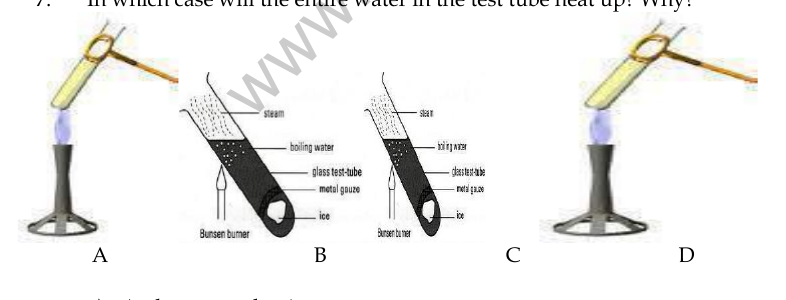
- A, due to conduction
- B, due to convection
- C, due to conduction
- D, due to convection
8. Which of the following can be used to measure our body temperature?
- any mercury thermometer
- alcohol thermometer
- clinical thermometer
- laboratory thermometer
OPEN BOOK TEST
Fill in the blanks with appropriate word(s):-
- A reliable measure of the hotness of an object is its _________________.
- Temperature is measured by a device called _________________.
- The thermometer that measures our body temperature is called ______________ thermometer.
- The normal temperature of a human body is _____ °C.
- The range of laboratory thermometer is ______ °C to ______ °C.
- The _________ of a clinical thermometer prevents mercury level from falling on its own.
- In __________, generally heat is transferred by conduction.
- ____________ and _____________ are two substances which are not solids and are poor conductors of heat.
- ___________ conductors are also called insulators.
- If two conducting objects at different temperatures are in contact, heat flows from ______________ object to ______________ object.
- Sea breeze occurs during ____________ and land breeze occurs during ________.
- Our body gives heat to and receives heat from the surroundings by ___________.
- Wool is a ____________ conductor of heat.
- The temperature of the object ______________ due to the absorbed part of the heat.
- Light coloured clothes ___________ most of the heat that falls on them.
NUMERICALS FOR SELF PRACTICE
Conversion formula between Joule (J) and calorie (cal)
1 cal = 4.18 J = 4.2 J
Conversion formula between °C, °F and K
K = C + 273
\[ \frac{C}{5} = \frac{F - 32}{9} \]
Practice questions – Convert:
| No. | Convert | No. | Convert |
|---|---|---|---|
| 1. | 27 °C into K | 1. | 3 cal into J |
| 2. | 100 °C into K | 2. | 8.4 J into cal |
| 3. | 323 K into °C | 3. | 5 cal into J |
| 4. | 290 K into °C | 4. | 21 J into cal |
| 5. | 23 K into °C | 5. | 7 cal into J |
| 6. | 20 °C into °F | 6. | 16.8 J into cal |
| 7. | 68 °F into °C | 7. | 2 cal into J |
| 8. | 100 °C into °F | 8. | 12.6 J into cal |
| 9. | 227 °C into °F | 9. | 10 cal into J |
| 10. | −40 °F into °C | 10. | 42 J into cal |
ASSIGNMENT 4.5
Think and answer (for revision)
Explain the following observations scientifically:-
- Huge ice blocks are covered with sawdust and packed in jute sacks during transfer.
- During winters, the metallic handles of wooden doors are colder than the doors.
- Deserts are cooler during nights.
- A bird fluffs its feather on a cold day.
- A black car gets hotter in the sun than a white car.
- A double layered blanket is warmer than a single thick blanket.
- The heating element of an electric kettle is at the bottom.
- Ventilators are provided near the roof of rooms in our houses.
QUESTION BANK (for self assessment during recapitulation)
- Name the device used to measure temperature.
- Which thermometer measures our body temperature?
- What is the range of clinical thermometer in degree Celsius and degree Fahrenheit?
- What is the use of kink in a clinical thermometer?
- Name two things other than solids which are poor conductors of heat.
- Name the mode of transfer of heat which does not require any medium.
- What is the difference between dark and light surfaces (in terms of heat)?
- Name the two units of heat. Which one is the SI unit of heat?
- Name the three units of temperature? Which one is the SI unit of temperature?
- What is the relation between joule and calorie?
Fill in the blanks with appropriate word:-
- The process by which heat is transferred from hotter end to colder end of an object is known as ___________________.
- Materials which allow heat to pass through them easily are called _______________ of heat.
- Materials which do not allow heat to pass through them easily are called _______________ of heat.
- When heat falls on an object, a part of it is _______________, a part is _______________ and a part may be ________________.
- The temperature of an object increases due to ______________ part of the heat.
- A dull black surface __________________ and ___________________ heat.
- _____________, ______________ and ______________ surfaces are good reflectors of heat.
- A good reflector of heat is a ______________ absorber and _________________ radiator of heat.
Answer the following questions:-
- What are the precautions which need to be taken while using a laboratory thermometer?
- Why is the range of clinical thermometer 35 °C to 42 °C?
- Write an activity to show that conduction takes place in a metal. [In activity format]
- Explain how convection takes place in water?
- Explain land and sea breeze with relevant diagrams.
Give reasons for the following:-
[Write the scientific concept and then explain]
- We feel warm if we wear woolen clothes in winter.
- Fire fighters wear special shiny suits when they enter a building on fire.
- A loosely knit sweater keeps us warmer than a tightly knit one.
- A hot air balloon rises up.
- The bottom of cooking utensils are blackened and the upper part is kept shining.
- Deserts are very hot during day and cold at night.
- Double walled containers are used to make ice boxes.
HIGH ORDER THINKING SKILLS
- What are the various measures used by a pizza delivery man to keep pizza hot?
- You have to keep ice cold water in a plastic bottle from morning to noon. What arrangements will you make to succeed in keeping the water cold?
- Houses in different regions vary according to the climatic conditions of the places. Suggest ways of constructing a house so that it caters to the requirement of a desert [clue – rooms should be cool] polar region [clue – rooms should be warm]
- Draw a labeled diagram of a thermos flask and explain how it keeps water hot for long time.
- Water at depth in lakes stays cold even on hot summer days. How?
- If pieces of black paper and white paper are laid on snow in sunshine, what is likely to happen?
- Why a clinical thermometer should not be sterilized by boiling?
- Give an example of a solid which contracts on heating.
1. The _______________________________________________________________________
5. The ________________________________________________________________________
Conclusion
________________________________________________________________________________
________________________________________________________________________________
a) electricity
b) energy
c) friction
d) force
a) conduction
b) convection
c) radiation
a) wool
b) straw
c) water
a) conduction
b) convection
c) radiation
Free study material for Science
Free CBSE Study Guides: Class 7 Science Chapter 04 Heat
Essential Notes for Class 7 Science
Explore essential learning tools for Class 7 Science Chapter 04 Heat. This curated collection features in-depth notes and targeted practice questions built around the active 2026 curriculum to streamline your daily revision.
Verified Solutions for Class 7 Science
Built using official NCERT guidelines for Class 7 Science, these materials provide reliable academic support. Integrating past examination questions and step-by-step solutions helps students understand official CBSE grading criteria.
Enhance Accuracy with Online Tests
Maximize your grade potential by utilizing Class 7 Science practice papers in tandem with these structured notes. All printable assignments and interactive mock tests on our platform are updated for the 2026 session and available free of charge.
FAQs
Our advanced study package for Chapter 04 Heat includes detailed concepts, diagrams, Mind Maps, and explanation of complex topics to ensure Class 7 students learn as per syllabus for 2026 exams.
The Mind Maps provided for Chapter 04 Heat act as visual anchors which will help faster recall during high-pressure exams.
Yes, teachers use our Class 7 Science resources for lesson planning as they are in simple language and have lot of solved examples.
Yes, You can download the complete, mobile-friendly PDF of the Science Chapter 04 Heat advanced resources for free.
Yes, our subject matter experts have updated the Chapter 04 Heat material to align with the rationalized NCERT textbooks and have removed deleted topics and added new competency-based questions.