

Download CBSE Class 7 Science Useful Resources
Review targeted academic resources with the Class 7 Transportation in Animals and Plants Important Questions. Built according to official CBSE standards for the 2026-27 term, these downloadable Class 7 Science study materials support effective daily practice and deeper conceptual understanding for Chapter 11 Transportation in Animals and Plants.
Access CBSE Study Guides and Summaries
Navigate directly to the advanced Science study materials using the digital viewer below. Each resource pack includes detailed conceptual summaries and solved practice questions, allowing students to instantly reinforce their learning.
Class 7 Transportation in Animals and Plants Important Questions. Please refer to the examination notes which you can use for preparing and revising for exams. These notes will help you to revise the concepts quickly and get good marks.
Chapter 11: Transportation in Animals and Plants - Important Questions
Chapter 11: TRANSPORTATION IN ANIMALS AND PLANTS
Fill in the blanks:
- _______________ carry blood from all parts of the body back to the heart.
- The process that causes ascent of water in plants is called _______________.
- A normal heart beats about _______ times per minute which can be measured with the help of an instrument called _______________.
- The _______________ present in _______________ blood cells transports oxygen to all parts of the body.
- The main organs of excretion in the human body are _______________ and an adult human being passes about _______ L of urine per day.
Answer: (a) Veins; (b) transpiration; (c) 72, stethoscope; (d) haemoglobin, red; (e) kidneys, 1.5 (about 1 to 1.8 L).
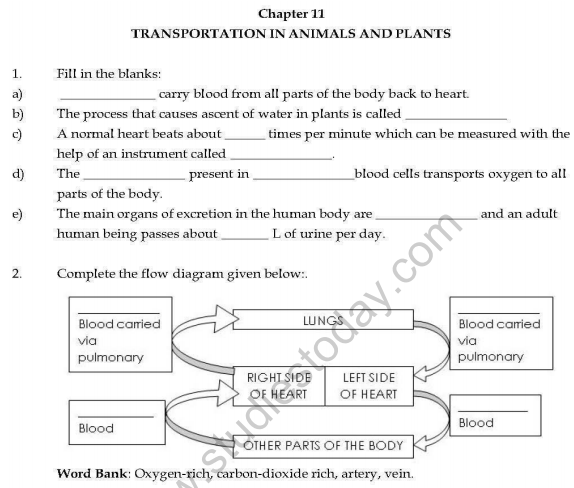
Complete the flow diagram given below:
Word Bank: Oxygen-rich, carbon-dioxide rich, artery, vein.
Answer: The blood flows in this order: right side of the heart → lungs → left side of the heart → other parts of the body → right side of the heart.
Give one function of each of the following:
- Urinary bladder
- Blood platelets
- Haemoglobin
- Capillaries
- Stomata
Answer: (a) Urinary bladder: stores urine until it is passed out of the body. (b) Blood platelets: help in the clotting of blood at a cut or wound, so that bleeding stops. (c) Haemoglobin: the red pigment in red blood cells that combines with oxygen and carries it to all parts of the body. (d) Capillaries: thin-walled vessels through which oxygen and food pass from the blood to the cells and wastes pass from the cells to the blood. (e) Stomata: tiny pores in leaves through which gases are exchanged and water vapour is lost (transpiration).
Name the artery that carries oxygen rich blood from left ventricle to all parts of the body.
Answer: The aorta.
Define Pulse.
Answer: The regular throb felt in an artery (for example at the wrist) due to the heart pumping blood into it is called the pulse. The pulse rate is the same as the heartbeat rate, about 72 per minute in a normal adult.
Give the composition of urine formed in humans.
Answer: Urine is about 95% water, about 2.5% urea and about 2.5% other substances such as salts (e.g. sodium chloride), uric acid and creatinine.
Differentiate between the following pairs:
- Xylem and Phloem
- Arteries and Veins
- Egestion and Excretion
Answer: (a) Xylem carries water and minerals from the roots to the leaves and other parts (upward only); it is made of dead cells. Phloem carries the food made in the leaves to all other parts of the plant (in both directions); it is made of living cells. (b) Arteries carry blood away from the heart, usually oxygen-rich blood; they have thick, elastic walls and no valves. Veins carry blood to the heart, usually carbon-dioxide rich blood; they have thin walls and valves. (c) Egestion is the removal of undigested food (faeces) through the anus. Excretion is the removal of waste products of the body’s chemical reactions, such as urea and carbon dioxide.
List any three functions of blood.
Answer: 1. It carries oxygen from the lungs and digested food from the intestine to all the cells. 2. It carries carbon dioxide and other wastes from the cells to the lungs and kidneys for removal. 3. White blood cells protect the body from germs, and platelets help the blood to clot at a wound. (It also carries hormones and helps to keep the body temperature even.)
What is the significance of sweat formation in humans?
Answer: Sweat removes extra water, salts and a little urea from the body. When sweat evaporates it takes away heat from the body and so cools it, which helps to keep body temperature steady.
Root hair help the plants to absorb water and minerals. How?
Answer: Root hairs are very fine, long outgrowths of root cells. They greatly increase the surface area of the root in contact with soil water. Water and dissolved minerals pass from the soil into the root hair cells and then on into the xylem vessels of the root.
What prevents mixing of oxygen rich blood and carbon dioxide rich blood in human heart?
Answer: The heart is divided into a right half and a left half by a wall called the septum, and valves keep the blood flowing one way. So oxygen-rich blood (left side) never mixes with carbon-dioxide rich blood (right side).
Sponges and Hydra neither require a circulatory system nor a circulatory fluid like blood. Why?
Answer: Their bodies are very thin, and nearly all their cells are in direct contact with the water around them. Oxygen and food can reach every cell, and wastes can leave, directly by diffusion, so they need no blood or heart.
In a state of bacterial infection like cholera, which cells are expected to attack the germs?
Answer: The white blood cells (leucocytes), which engulf and destroy germs.
Draw neat and well-labelled diagrams of the following:
- Circulation of blood in humans
- Human Excretory System
Answer: (a) The circulation of blood is shown in the flow diagram given for question 2 (right side of heart, lungs, left side of heart, other parts of the body, back to right side of heart). (b) The human excretory system is shown below.
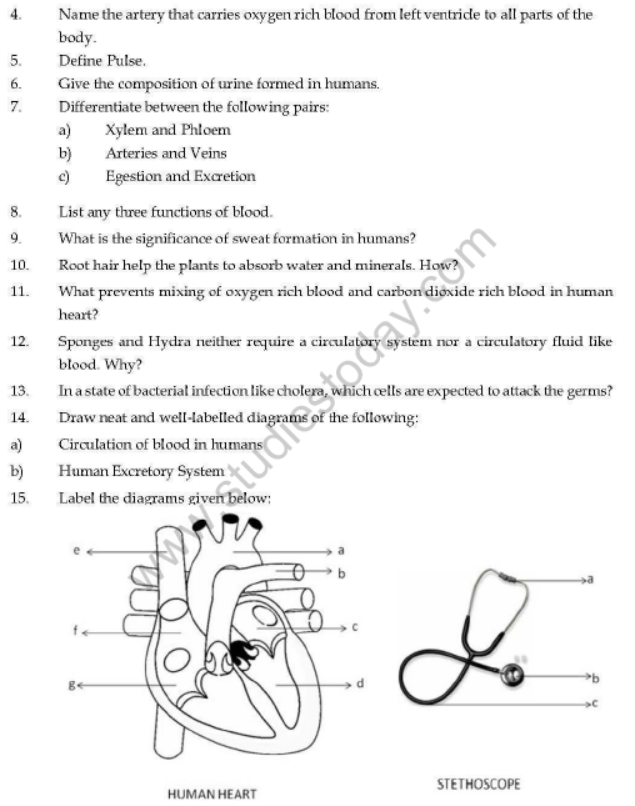
Label the diagrams given below:
(Two illustrations: the human heart, with arrows a to g, and a stethoscope, with arrows a to c. The illustrations are not reproduced here.)
Answer: Human heart: (a) aorta, (b) pulmonary vein, (c) left atrium, (d) left ventricle, (e) superior vena cava, (f) right atrium, (g) right ventricle. Stethoscope: (a) ear pieces, (b) chest piece (diaphragm), (c) rubber tube.
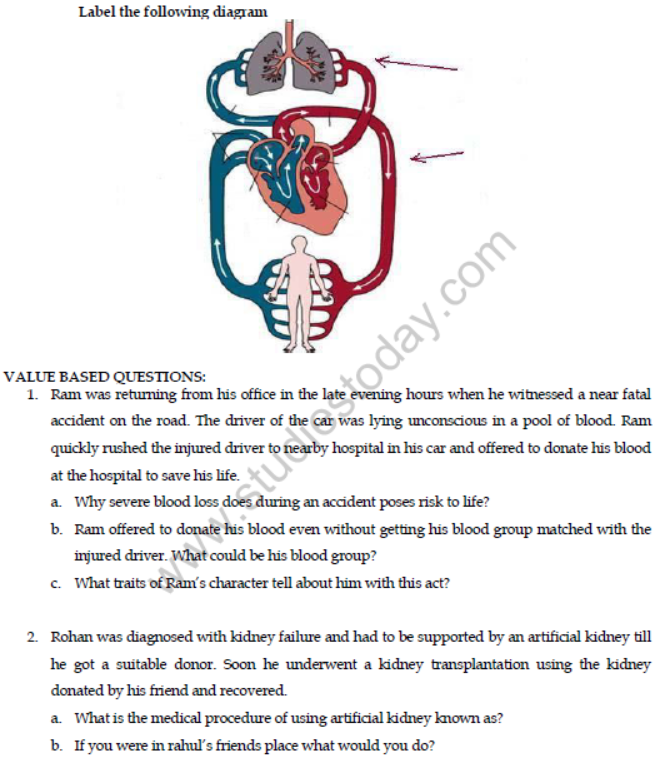
Label the following diagram
(Illustration of the double circulation of blood through the heart, lungs and body with two arrows; not reproduced here.)
Answer: The upper arrow points to the pulmonary vein, which brings oxygen-rich blood from the lungs to the heart. The lower arrow points to the aorta, which carries oxygen-rich blood from the heart to the body.
VALUE BASED QUESTIONS:
Ram was returning from his office in the late evening hours when he witnessed a near fatal accident on the road. The driver of the car was lying unconscious in a pool of blood. Ram quickly rushed the injured driver to the nearby hospital in his car and offered to donate his blood at the hospital to save his life.
- Why does severe blood loss during an accident pose a risk to life?
- Ram offered to donate his blood even without getting his blood group matched with the injured driver. What could be his blood group?
- What traits of Ram’s character does this act tell about him?
Answer: (a) Blood carries oxygen and food to all the organs. After heavy blood loss the brain, heart and other organs do not get enough oxygen and the blood pressure falls, which can cause death. (b) O negative (O), the universal donor, because it can be given to people of any blood group. (c) Ram is kind, helpful, brave, alert and unselfish; he showed presence of mind and a sense of social responsibility.
Rohan was diagnosed with kidney failure and had to be supported by an artificial kidney till he got a suitable donor. Soon he underwent a kidney transplantation using the kidney donated by his friend and recovered.
- What is the medical procedure of using artificial kidney known as?
- If you were in Rahul’s friend’s place what would you do?
Answer: (a) Dialysis (haemodialysis). (b) I would also be ready to donate a kidney after a medical check, because a healthy person can live well with one kidney, and I would support my friend in every other way too. This shows care and concern for others.
LAB ACTIVITY
Objective: To show transportation of water through the cells of potato.Material required: 2 potatoes, peeler, knife, salt solution, coloured water, pins, and petri dish.Procedure:- Peel both potatoes and cut off a thin slice from one end of each so that they stand firmly.
- With the knife carefully scoop out a cavity in the middle of each potato, leaving the walls thick.
- Fill the cavity of the first potato with salt solution and the cavity of the second with plain water.
- Push a pin into the side of each potato at the level of the liquid in the cavity.
- Stand both potatoes in a petri dish containing coloured water and leave them for a few hours.
- Do not make the potato walls too thin or break through the base of the cavity.
- Mark the starting level of the liquid exactly with the pin.
- Use the same amount of coloured water for both potatoes.
- Handle the knife and pins carefully.
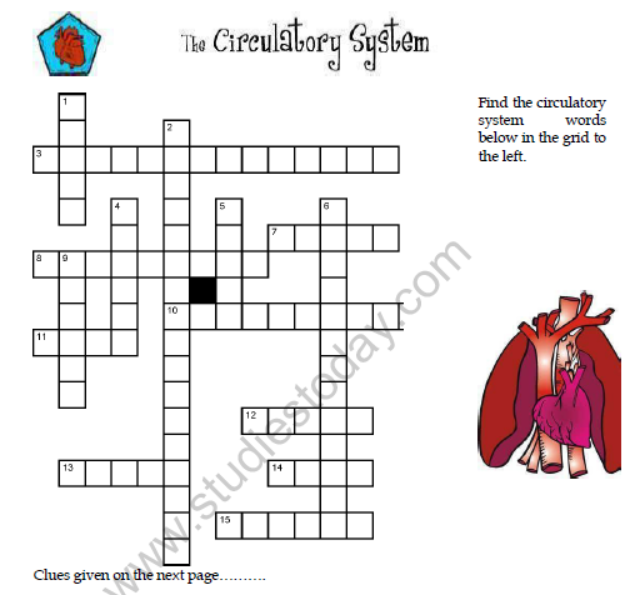
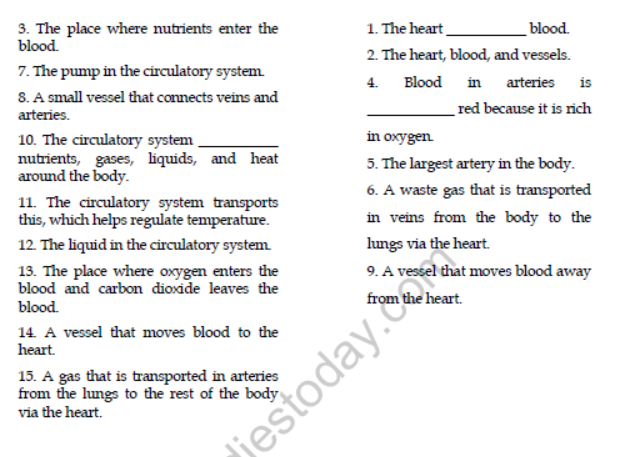
The Circulatory System (crossword)
Across
3. The place where nutrients enter the blood.
7. The pump in the circulatory system.
8. A small vessel that connects veins and arteries.
10. The circulatory system ___________ nutrients, gases, liquids, and heat around the body.
11. The circulatory system transports this, which helps regulate temperature.
12. The liquid in the circulatory system.
13. The place where oxygen enters the blood and carbon dioxide leaves the blood.
14. A vessel that moves blood to the heart.
15. A gas that is transported in arteries from the lungs to the rest of the body via the heart.
Down
1. The heart ___________ blood.
2. The heart, blood, and vessels.
4. Blood in arteries is ___________ red because it is rich in oxygen.
5. The largest artery in the body.
6. A waste gas that is transported in veins from the body to the lungs via the heart.
9. A vessel that moves blood away from the heart.
Answer: Across: 3 small intestine, 7 heart, 8 capillary, 10 transports, 11 heat, 12 blood, 13 lungs, 14 vein, 15 oxygen. Down: 1 pumps, 2 circulatory system, 4 bright, 5 aorta, 6 carbon dioxide, 9 artery.
Free study material for Science
Useful Resources and Notes for Class 7 Science Chapter 11 Transportation in Animals and Plants
Quick Revision Material for Chapter 11 Transportation in Animals and Plants
Explore essential learning tools for Class 7 Science Chapter 11 Transportation in Animals and Plants. This curated collection features in-depth notes and targeted practice questions built around the active 2026 curriculum to streamline your daily revision.
Expert Notes and Solved Exam Questions
Designed around the official curriculum, these study guides guarantee standard compliance. Reviewing step-by-step solutions clarifies complex sub-topics within Chapter 11 Transportation in Animals and Plants and demystifies standard marking schemes for Science evaluations.
Additional Study Resources for Class 7
Maximize your grade potential by utilizing Class 7 Science practice papers in tandem with these structured notes. All printable assignments and interactive mock tests on our platform are updated for the 2026 session and available free of charge.
FAQs
Our advanced study package for Chapter 11 Transportation in Animals and Plants includes detailed concepts, diagrams, Mind Maps, and explanation of complex topics to ensure Class 7 students learn as per syllabus for 2026 exams.
The Mind Maps provided for Chapter 11 Transportation in Animals and Plants act as visual anchors which will help faster recall during high-pressure exams.
Yes, teachers use our Class 7 Science resources for lesson planning as they are in simple language and have lot of solved examples.
Yes, You can download the complete, mobile-friendly PDF of the Science Chapter 11 Transportation in Animals and Plants advanced resources for free.
Yes, our subject matter experts have updated the Chapter 11 Transportation in Animals and Plants material to align with the rationalized NCERT textbooks and have removed deleted topics and added new competency-based questions.