

Official CBSE Study Materials for Class 7 Science
Explore structured advanced study materials through the Class 7 Science Light Exam Notes. Tailored for Class 7 learners, utilizing these Science resources ensures thorough preparation and strengthens foundational knowledge before final CBSE evaluations.
Advanced Resources for Science
Navigate directly to the advanced Science study materials using the digital viewer below. Each resource pack includes detailed conceptual summaries and solved practice questions, allowing students to instantly reinforce their learning.
Class 7 Science Light Exam Notes. Please refer to the examination notes which you can use for preparing and revising for exams. These notes will help you to revise the concepts quickly and get good marks.
Following topics are covered:
•Light
•Sources of light
•Medium of light
•Linear propagation of light
•Behaviour of light
•Reflection of light
•Laws of reflection of light
•Regular & diffused reflection
•Reflection from plane mirror
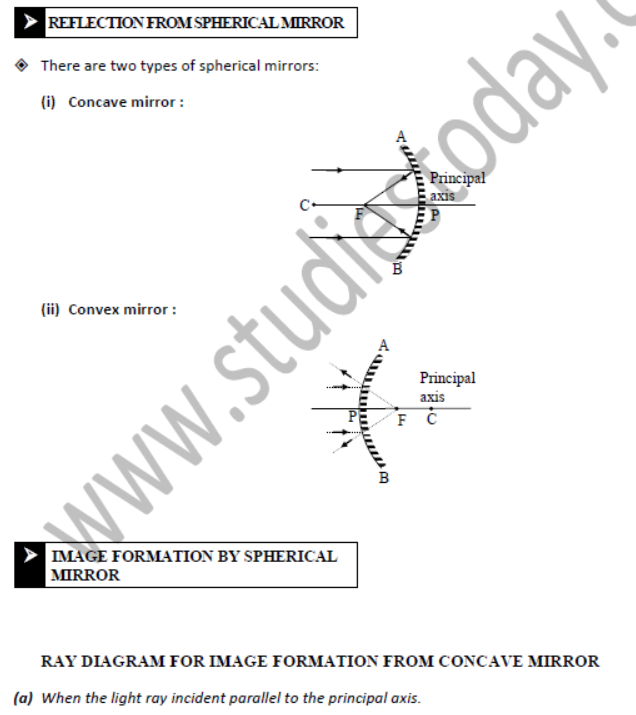
•Reflection from spherical mirror
•Image formation by spherical mirror
•Refraction of light
•Spherical lens
•Image formation by spherical lens
•Total internal reflection
•Dispersion of white light by a glass prism
•Human Eye
•Defects of vision
•Refraction in nature
•Scattering of light
Light
Light is a form of energy, (optical energy) which helps us in seeing objects by its presence.
Light travels in a straight line with 3 × 10⁸ m/s in vaccum..
The velocity of light changes when it travels from one medium to another.
Light gets reflected back from polished surfaces, such as mirrors, polished metal surfaces, etc.
Light undergoes refraction (bending) when it travels from one transparent medium to another.
Sources Of Light
The objects which emit (give) light are called luminous objects. It may be natural or man-made. Sun is a natural source of light and electric lamp, and oil lamp, etc. are man-made source of light.
In the following videos we have explained you about the concept of Light and its properties. Watch this video to understand the concepts and also post your questions and comments in the comments section
→ MEDIUM OF LIGHT
Substance through which light propagates or tends to propagate is called a medium of light.
According to the medium of light objects are divided into three parts.
(i) Transparent object :
Bodies that allow light to pass through then i.e. transmit light through them, are called transparent bodies. Ex. Glass, water, air etc
(ii) Translucent object :
Bodies that can transmit only a part of light through them are called translucent objects. Ex. Froasted or ground glass, greased paper , paraffin wax etc.
(iii) Opaque object :
Bodies that do not allow light to pass through them at all are said to be opaque objects Ex. Chair, desk etc.
→LINEAR PROPAGATION OF LIGHT
Light travels in a straight line. In vaccum or air, light travels with the velocity of 3 × 10⁸ m/s.
Activity : If we see at a lighted candle through a straight pipe as shown in figure(a), we are able to see the candle but if we see the candle through a bent pipe we are not able to see the candle flame as shown in figure (b).
This activity showed that light travels along straight lines.

→BEHAVIOUR OF LIGHT
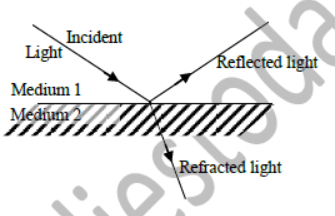
When light travelling in one medium falls on the surface of a second medium, the following three effects may occur.
(i) A part of the incident light is turned back into the first medium. This phenomenon is called reflection of light.
(ii) A part of the incident light is transmitted into the second medium along a changed direction. This phenomenon is called refraction of light.
(iii) The remaining third part of light energy is absorbed by the second medium. This phenomenon is called absorption of light.
→ REFLECTION OF LIGHT
When light rays are incident on an opaque polished surface (medium), these are returned back in the same medium.
This phenomenon of returning of ray of light in the same medium, is called reflection of light.
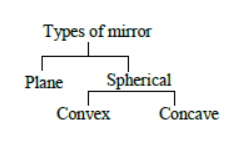
◊ Types of mirror
◊ SOME ASSOCIATED TERMS
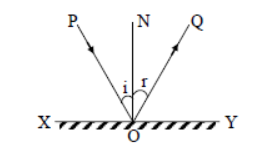
♦ Reflecting surface : The surface from which the light is reflected, is called the reflecting surface. In diagram, XY is the reflecting surface. (Actually XY is the section of a reflecting surface, made by the plane of the book page which is perpendicular to it.)
♦ Point of incidence : The point on the reflecting surface at which a ray of light strikes, is called the point of incidence. In diagram, O is the point of incidence.
♦ Normal : A perpendicular drawn on the reflecting surface at the point of incidence, is called the normal. In diagram, NO is the normal.
♦ Incident ray : The ray of light which strikes the reflecting surface at the point of incidence is called the incident ray. In diagram, PO is the incident ray.
♦ Reflected ray : The ray of light reflected from the reflecting surface from the point of incidence, is called the reflected ray. In diagram, OQ is the reflected ray.
♦ Angle of incidence : The angle that the incident ray makes with the normal, is called the angle of incidence. It is represented by the symbol i. In diagram, angle PON is the angle of incidence.
♦ Angle of reflection : The angle that the reflected ray makes with the normal, is called the angle of reflection. It is represented by the symbol r. In diagram, QON is the angle of reflection.
→ LAWS OF REFLECTION
◊ First law : The incident ray, the reflected ray and the normal at the point of incidence, all lie in the same plane.
Second law : The angle of reflection (∠r) is always equal to the angle of incidence (∠i). i.e.,
∠r = ∠i
(For normal incidence, i = 0, r = 0. The ray is reflected back along normal).
→ REGULAR & DIFFUSED REFLECTION
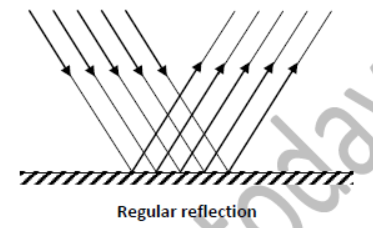
◊ Regular Reflection :
In this reflection, parallel beam of light goes parallel after reflection from plane surface. This reflection follows the laws reflection.
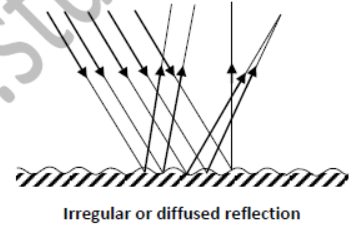
◊ IRREGULAR REFLECTION OR DIFFUSED REFLECTION :
In this reflection, parallel beam of light goes random after reflection from a rough surface. This reflection also follows the laws of reflection.
→ REFLECTION FROM PLANE MIRROR
♦ Size : size of the image is same as that of object.
♦ Upright or Erect : Image formed erect with respect to object.
♦ Image distance : It will be same as that of object distance.
♦ Lateral inversion : If you move your right hand, it will appear as if the left hand of your image is moving. If you keep a printed page in front of a plane mirror, the image of the letters appear erect but inverted laterally, or sideways. Such an inversion is called lateral inversion.

Please click on below link to download pdf file forClass 7 Science Light Exam Notes.
Free study material for Science
CBSE Class 7 Science Study Material: Chapter 15 Light
Comprehensive Study Resources for Chapter 15 Light
Access comprehensive study material for Chapter 15 Light, including revision notes, concept maps, and high-probability questions. These resources are designed in alignment with the latest 2026 CBSE syllabus for Class 7 Science to support effective exam preparation.
Understanding Marking Schemes
Built using official NCERT guidelines for Class 7 Science, these materials provide reliable academic support. Integrating past examination questions and step-by-step solutions helps students understand official CBSE grading criteria.
Complete Revision for Science
For peak performance in upcoming evaluations, integrate official Science sample papers directly into your study schedule. Follow up your revision by attempting online MCQ tests for Chapter 15 Light to refine calculation speed and precision.
FAQs
Our advanced study package for Chapter 15 Light includes detailed concepts, diagrams, Mind Maps, and explanation of complex topics to ensure Class 7 students learn as per syllabus for 2026 exams.
The Mind Maps provided for Chapter 15 Light act as visual anchors which will help faster recall during high-pressure exams.
Yes, teachers use our Class 7 Science resources for lesson planning as they are in simple language and have lot of solved examples.
Yes, You can download the complete, mobile-friendly PDF of the Science Chapter 15 Light advanced resources for free.
Yes, our subject matter experts have updated the Chapter 15 Light material to align with the rationalized NCERT textbooks and have removed deleted topics and added new competency-based questions.