

Advanced Study Material for Class 7 Science: Chapter 17 Forests Our Lifeline
Review targeted academic resources with the Class 7 Science Forests Our Lifeline Chapter Notes. Built according to official CBSE standards for the 2026-27 term, these downloadable Class 7 Science study materials support effective daily practice and deeper conceptual understanding for Chapter 17 Forests Our Lifeline.
Practice Class 7 Science Resources: Chapter 17 Forests Our Lifeline
Access the complete useful resource PDF for Class 7 Science below. Regular practice with these targeted academic notes builds familiarity with complex topics and helps secure higher marks in final school evaluations.
Class 7 Science Forests Our Lifeline Chapter Notes. There are many more useful educational material which the students can download in pdf format and use them for studies. Study material like concept maps, important and sure shot question banks, quick to learn flash cards, flow charts, mind maps, teacher notes, important formulas, past examinations question bank, important concepts taught by teachers. Students can download these useful educational material free and use them to get better marks in examinations. Also refer to other worksheets for the same chapter and other subjects too. Use them for better understanding of the subjects.
Forests: Our Lifeline
INTRODUCTION
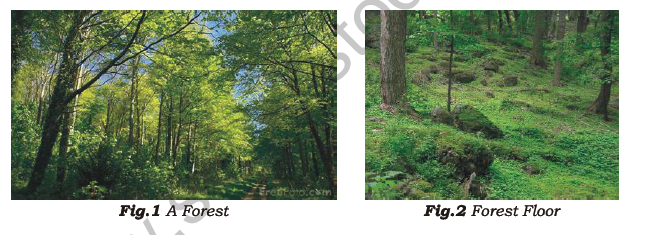
About one-third of the world’s land surface is covered by forests. It is an eco-system (plants and animals) which is dominated by trees. Forest provide the most useful renewable resources. They prevent soil erosion, replenish oxygen in the air and maintain the fertility of the soil. A forest is a biotic community spread over a large tract of uncultivated land and is predominantly composed of trees, shrubs, herbs and climbers. Forests occupy a special place in the life of people. They are invaluable wealth of a nation and a renewable natural resource. In the last hundred years, utilization of forest products has gone up mainfold to meet the growing demands for wood and timber. Excessive felling of forest trees because of setting up industries, building of roads cities and
for cultivation is very common. Deforestation poses serious threat to our economy, quality of life and environment. However, the State of Forest Report (SFR-2009) gives an encouraging picture. Our forest and tree cover stands at 23.84% which is an increase of 4.75% over ten years. Forests provides home for different animals, birds, reptiles, insects, worms and microbes., Some live on the floor, others on tree twigs. Some walk on the ground, some burrow and others fly.
FOREST TYPES IN INDIA
The distribution of natural forests in India is governed principally by rainfall. Rainfall varies from 12 cm to 125 cm annually in different parts of the country resulting in a wide variety of vegetation - from xerophytic scrub forest in the arid zones of Rajasthan to evergreen rainforests in the tropics as in the Western Ghats, Assam, North Bengal, Andamans and Conifers in the temperate regions. In between the extremes, there are many intermediate types of forests.
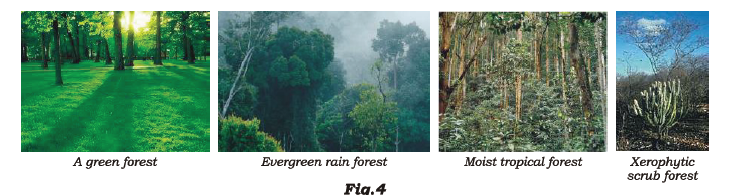
Due to different climatic conditions different forests show variation in the type of trees and animals inhabiting the forests.
In North-East India, Sal is most common tree, while in South West the common tree is Teak. In the arid zone, species such as Cacti and Acacias are dominant. The Himalayan mountains have Coniferous as well as trees with broad leaves. Between the foothills of the Himalayas and the plains of river Ganga lie the great terai forest in which Sal is a common species. The dense forest consists of distinct horizontal layers. These are:
Canopy
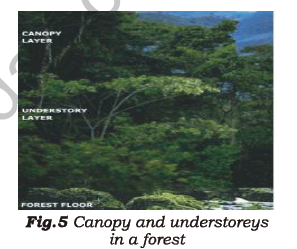
The canopy is the uppermost levels of a forest formed by the crowns of trees and shrubs. The crown of a tree is the branched part of the stem and leaves above the main trunk. Tree crowns are of different shapes and sizes. The canopy layer is formed by the largest trees. This layer is very crowded and blocks out most of the sunlight. It also acts as wind breaker. The canopy is the densest layer and home to unique flora and fauna.
Understorey
The understorey layer lies between the canopy and the forest floor. This layer is home to a number of birds, snakes and lizards, as well as predators such as jaguars and leopards.
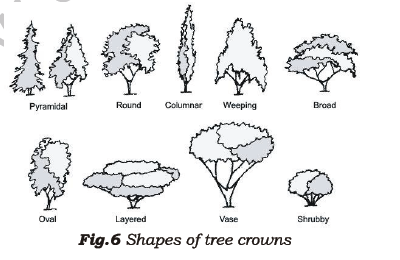
The leaves are much larger at this level. A wide range of insects are also found. Only about 5% of the sunlight shining on the forest reaches the understorey. Forest understorey also have higher humidity than the exposed areas.
Forest Floor
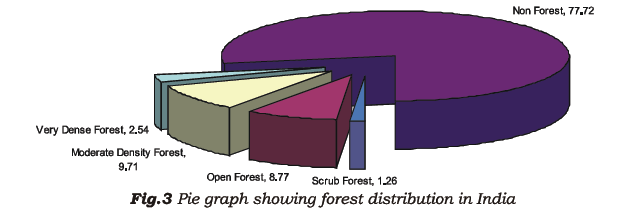
The forest floor layer receives only 2 per cent of sunlight. The forest floor has almost no vegetation because of the low sunlight penetration. Only plants adapted to low light can grow in this region. Many forms of fungi grow here which help in decaying of dead animals and plants thus converting them into dark coloured organic matter. This forms the humus.
Please click the link below to download Class 7 Science Forests Our Lifeline Chapter Notes.
Free study material for Science
Free CBSE Study Guides: Class 7 Science Chapter 17 Forests Our Lifeline
Quick Revision Material for Chapter 17 Forests Our Lifeline
Explore essential learning tools for Class 7 Science Chapter 17 Forests Our Lifeline. This curated collection features in-depth notes and targeted practice questions built around the active 2026 curriculum to streamline your daily revision.
Expert Notes and Solved Exam Questions
Designed around the official curriculum, these study guides guarantee standard compliance. Reviewing step-by-step solutions clarifies complex sub-topics within Chapter 17 Forests Our Lifeline and demystifies standard marking schemes for Science evaluations.
Additional Study Resources for Class 7
Wrap up your chapter revision by testing your knowledge against standard objective question formats. Explore our full library of free, up-to-date sample papers and online assessments to secure top grades in your CBSE examinations.
FAQs
Our advanced study package for Chapter 17 Forests Our Lifeline includes detailed concepts, diagrams, Mind Maps, and explanation of complex topics to ensure Class 7 students learn as per syllabus for 2026 exams.
The Mind Maps provided for Chapter 17 Forests Our Lifeline act as visual anchors which will help faster recall during high-pressure exams.
Yes, teachers use our Class 7 Science resources for lesson planning as they are in simple language and have lot of solved examples.
Yes, You can download the complete, mobile-friendly PDF of the Science Chapter 17 Forests Our Lifeline advanced resources for free.
Yes, our subject matter experts have updated the Chapter 17 Forests Our Lifeline material to align with the rationalized NCERT textbooks and have removed deleted topics and added new competency-based questions.